Wednesday, May 2, 2012

Old Sun's wife - Piegan warrior


Salve,
American Indians of the Plains are famous for their association with horses and horsemanship feats, but not seldom it is forgotten or omitted that often (the wholly nomadic tribes) and at times (in case of the earth or grass lodge dwellers)  the entire household was also transported on horseback (and dog back) or pulled loaded on travois, especially during the golden era when the Comanches ruled the southern plains while various nations and tribes skirmished over the northern and central plains...

The work of setting up or taking down of the conical tents/lodge known as tippi / teepee (from the Dakota Sioux language ), gathering and cooking food, working hides, making clothes, carrying for children, accompanying the men on hunts to dress the carcass and prepare meat for the most important food product of the plains pemmican, tending to small gardens etc was done by women and girls  while their men were hunting, stealing horses or on war-party, and boys were busy watching the horse herds and gentling horses or hunting for small game.

Notwithstanding these domestic and economic duties and obligations that the women carried in the very masculine and bellicose societies of the Great Plains nomads, some women undertook taking active role in the war parties (as we know from the records of the frontier wars between the US military and the nomads - eg Mo-chi, Buffalo Calf Road Woman, Moving Robe Woman, Minnie Hollow Wood, The Other magpie ), while others took active part in negotiations and other diplomatic relations leading to cessation of hostilities or simply truces.

In pre-horse era of the Great Plains Indians cultures during the historic period (after 1500AD) their women were obviously the desired target of kidnapping/slaving parties carried by the enemy warriors, thus those women would become captives and slaves, and some eventually would change their status to adopted tribal members  and wives to their captors.

Once the horses became companions of the Plains Indians during XVII century Apacheria (excellent dissertation on the subject, plus Frank R. Secoy's work)/Jumano/Ute/Caddo horse distribution period and later during the Comancheria of XVIII century domination, the entire warrior ethos of the Great Plains Indians turned to horse capturing and coup counting as the primary pursuits for the warrior. Researchers like professor John C. Ewers ( in this book ''Plains Indians Culture,'' p.196 ) suggest that the custom of stealing women during the pre-horse era and the honours associated with that activity  were actually appropriated/addopted as the model for the horse stealing raids during the post-horse era (that lasted until the 1880s AD).

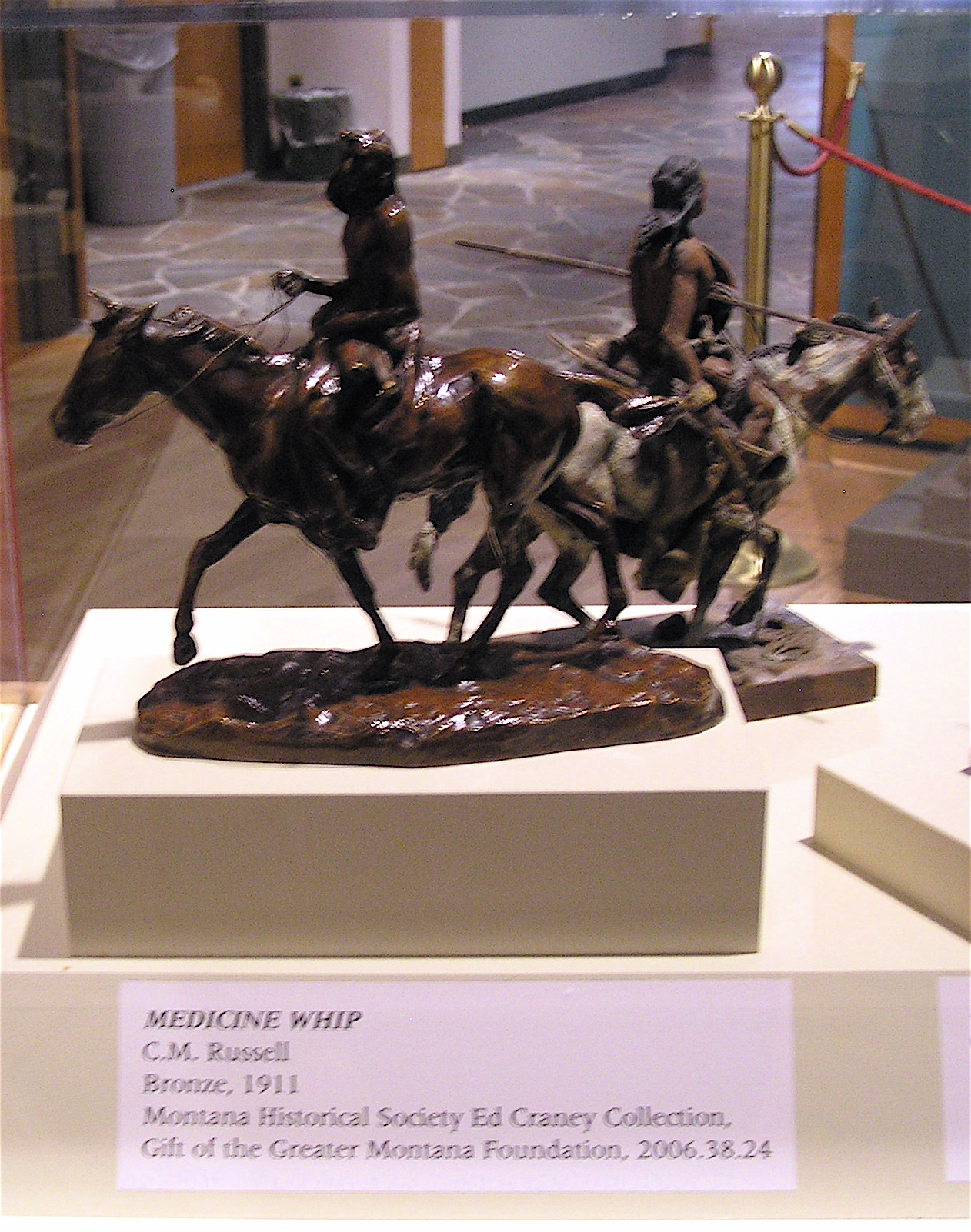
Well, there is a tale gathered from XIX century Blackfeet by an Anglo traveller named Julian Ralph. He was travelling in company of Frederic Remington (and Charles M. Russell's drawings and paintings) whose art (in public domain) is gracing this post.

Old Sun and his wife:
 "...to our joy, we found seated in that room the famous chief Old Sun. He is the husband of the most remarkable Indian squaw in America, and he would have been Crowfoot's successor were it not that he was eighty-seven years of age when the Blackfoot Cæsar died. As chief of the North Blackfeet, Old Sun boasts the largest personal following on the Canadian plains, having earned his popularity by his fighting record, his commanding manner, his eloquence, and by that generosity which leads him to give away his rations and his presents. No man north of Mexico can dress more gorgeously than he upon occasion, for he still owns a buckskin outfit beaded to the value of a Worth gown. Moreover, he owns a red coat, such as the Government used to give only to great chiefs.
    Mr. Remington was anxious to paint Old Sun and his squaw, particularly the latter, and he easily obtained permission
Old Sun's wife sits in the council of her nation—the only woman, white, red, or black, of whom I have ever heard who enjoys such a prerogative on this continent. She earned her peculiar privileges, if any one ever earned anything.[...] When Old Sun [24]brought his wife to sit for her portrait I put all etiquette to shame in staring at her, as you will all the more readily believe when you know something of her history.
    Forty or more years ago she was a Piegan maiden known only in her tribe, and there for nothing more than her good origin, her comeliness, and her consequent value in horses. She met with outrageous fortune, but she turned it to such good account that she was speedily ennobled. She was at home in a little camp on the plains one day, and had wandered away from the tents, when she was kidnapped. It was in this wise: other camps were scattered near there.
    On the night before the day of her adventure a band of Crows stole a number of horses from a camp of the GrosVentres, and very artfully trailed their plunder towards and close to the Piegan camp before they turned and made their way to their own lodges. 
    When the Gros Ventres discovered their loss, and followed the trail that seemed to lead to the Piegan camp, the girl and her father, an aged chief, were at a distance from their tepees, unarmed and unsuspecting. 
Down swooped the Gros Ventres. They killed and scalped the old man, and then their chief swung the young girl upon his horse behind him, and binding her to him with thongs of buckskin, clashed off triumphantly for his own village.
That has happened to many another Indian maiden, most of whom have behaved as would a plaster image, saving a few days of weeping.
Not such was Old Sun's wife.
When she and her captor were in sight of the Gros Ventre village, she reached forward and stole the chief's scalping-knife out of its sheath at his side. With it, still wet with her father's blood, she cut him in the back through to the heart. Then she freed his body from hers, and tossed him from the horse's back. Leaping to the ground beside his body, she not only scalped him, but cut off his right arm and picked up his gun, and rode madly back to her people, chased most of the way, but bringing safely with her the three greatest trophies a warrior can wrest from a vanquished enemy. Two of them would have distinguished any brave, but this mere village maiden came with all three. From that day she has boasted the right to wear three eagle feathers.
   Old Sun was a young man then, and when he heard of this feat he came and hitched the requisite number of horses to her mother's travois poles beside her tent. I do not recall how many steeds she was valued at, but I have heard of very high-priced Indian girls who had nothing except their feminine qualities to recommend them. In one case I knew that a young man, who had been casting what are called "sheep's eyes" at a maiden, went one day and tied four horses to her father's tent. Then he stood around and waited, but there was no sign from the tent. Next day he took four more, and so he went on until he had tied sixteen horses to the tepee. At the least they were worth $20*, perhaps $30*, apiece. At that the maiden and her people came out, and received the young man so graciously that he knew he was "the young woman's choice," as we say in civilized circles, sometimes under very similar circumstances.
     At all events, Old Sun was rich and powerful, and easily got the savage heroine for his wife. She was admitted to the Blackfoot council without a protest, and has since proven that her valor was not sporadic, for she has taken the war-path upon occasion, and other scalps have gone to her credit.""
Julian Ralph, On Canada's Frontier, NY 1892
[via The Project Gutenberg]
---
*dollar amounts in 1890s

ps
More on the Plains Indian tribes and their horses in the future, I hope :)
ps'
Italian comix dell arte master Paolo Eleteri Serpieri used Remington's image of Old Sun's wife killing the Gros Ventre warrior for creation of his own image in the series  L'Histoire du Far-West ("The Story of the West") - can be seen in this collection of Western images - caveat - some drawings explicit)

Sunday, April 29, 2012

Charles M. Russell and cow-puncher horse


Salve,
I admit I love looking at the paintings and ink drawings by
Charles Marion Russell (own two books on his paintings) but often I have to remind myself that he also was a great sculptor...and a writer, e.g. his fine book "Trails Plowed Under" - with many of his own illustrations - is accessible here. 

While perusing a book on his sculptures  I saw this sculpture:  "When the best riders quit, when the best riders fail." 
 In this photo there is Charlie with the very sculpture.

The very spirited piece depicts one of the most dangerous evolutions that some unhappy horses could engage in while being 'gentled' no-so-gently into a remuda (working horses' string) by the cow-puncher or cowboy. In this photo below one of the rare historic depictions of a horse throwing himself backward.


   Before I go to the depiction of that sculpture as told by maestro Charlie himself, let me quote his own lines describing what a cow-puncher was, the varieties of cow-punchers and their equipment etc:
"[cow-puncher] ranged from Mexico to the Big Bow River of the north, an' from where the trees get scarce in the east to the old Pacific. He don't need no iron hoss*, but covers his country on one that eats grass an' wears hair. All the tools he needed was saddle, bridle, quirt, hackamore, an' rawhide riatta or seagrass rope; that covered his hoss. 


"The puncher himself was rigged, startin' at the top, with a good hat not one of the floppy kind you see in pictures, with the rim turned up in front. The top-cover he wears holds its shape an' was made to protect his face from the weather; maybe to hold it on, he wore a buckskin string under the chin or back of the head. Round his neck a big silk handkerchief, tied loose, an' in the drag of a trail herd it was drawn over the face to the eyes, hold-up fashion, to protect the nose an' throat from dust. In old times, a leather blab or mask was used the same. Coat, vest, an' shirt suits his own taste. Maybe he'd wear California pants, light buckskin in color, with large brown plaid, sometimes foxed, or what you'd call reinforced with buck or antelope skin. Over these came his chaparejos or leggin's. His feet were covered with good high-heeled boots, finished off with steel spurs of Spanish pattern. His weapon's usually a forty-five Colt's six-gun, which is packed in a belt, swingin' a little below his right hip. Sometimes a Winchester in a scabbard, slung to his saddle under his stirrup-leather, either right or left side, but generally left, stock forward, lock down, as his rope hangs at his saddle-fork on the right.


"By all I can find out from old, gray-headed punchers, the cow business started in California, an' the Spaniards were the first to burn marks on their cattle an' hosses, an' use the rope. Then men from the States drifted west to Texas, pickin' up the brandin' iron an' lass-rope, an' the business spread north, east, an' west, till the spotted long-horns walked in every trail marked out by their brown cousins, the buffalo.

"Texas an' California, bein' the startin' places, made two species of cowpunchers;

those west of the Rockies rangin' north, usin' centerfire or single-cinch saddles, with high fork an' cantle; packed a sixty or sixty-five foot rawhide rope, an' swung a big loop. These cow people were generally strong on pretty, usin' plenty of hoss jewelry, silver-mounted spurs, bits, an' conchas; instead of a quirt, used a romal, or quirt braided to the end of the reins. Their saddles were full stamped, with from twenty-four to twenty-eight-inch eagle-bill tapaderos. Their chaparejos were made of fur or hair, either bear, angora goat, or hair sealskin. These fellows were sure fancy, an' called themselves buccaroos, coming from the Spanish word, vaquero."

"The cowpuncher east of the Rockies originated in Texas and ranged north to the Big Bow. He wasn't so much for pretty; his saddle was low horn, rimfire, or double-cinch; sometimes 'macheer.' Their rope was seldom over forty feet, for being a good deal in a brush country, they were forced to swing a small loop. These men generally tied, instead of taking their dallie-welts, or wrapping their rope around the saddle horn. Their chaparejos were made of heavy bullhide, to protect the leg from brush an' thorns, with hog-snout tapaderos.

"Cowpunchers were mighty particular about their rig, an' in all the camps you'd find a fashion leader. From a cowpuncher's idea, these fellers was sure good to look at, an' I tell you right now, there ain't no prettier sight for my eyes than one of those good-lookin', long-backed cowpunchers, sittin' up on a high-forked, full-stamped California saddle with a live hoss between his legs.

Now to the sculpture, in Charlie's own words (from  Charles M. Russell Sculptor):

"The old-time cow-puncher knew his horse and it was often a battle of wits when he was “breaking" him to ride. This horse is making a fight and is figuring on landing on his riders. This rider being of the best, is thinking too. As he steps off his fighting horse he will be standing besides him when he lands and having a hold on the cheek piece of the hackamore, will help the horse bump his head a little harder when he hits the ground. As the horse comes up the cow-puncher will grasp the horn and will be in the saddle when he gets on his feet again. [...] most horse think twice before they throw themselves a second time."


  +All drawings by Charles Russell - in public domain+
---
*hoss - horse
  ps. 
I have been reading Charlie's biography - quite an interesting read. By the way his illustrated letters have been published too - fascinating material in there :)

Sunday, April 22, 2012

Breaking bronchos* in Texas

Salve,
let me take you to XIX century southern Great Plains, where Spanish horses (later crossed with other American breeds ) had been used extensively and thoroughly since the colonization of Texas first by the Comanches and Kiowa  from the north-west and then by the Spanish from the south-west and eventually Anglo-Americans (including lost of German immigrants and some Polish folks) from the north-east.

Today the attached pictures, containing the text, will tell the story of gentling semi-wild horses known then as bronchos* (broncos) in Texas, at Lechuza Ranch near San Antonio, as seen and and described by British traveller Mary J.Jaques in her book "Texan Ranch Life" (London:1894). Illustrations (mostly Frederic Remington, Charles M. Russell and some period photos) come from several XIX century and early XX century books in public domain.
Enjoy Ms Jaques storytelling:


...
* bronco - ''Sin domar''- Mexican Spanish for a semi-wild, unbroken (ungentled) horse, a horse without schooling.

Tuesday, April 17, 2012

Klushino 1610 hussar skech I reworked

Salve,
   more than a year ago I drew a Polish hussar breaking a fence by using his horse's weight, hooves and body, during the attack on the foe hiding behind the wooden fences on the Klushino battlefield.

Couple days ago, as I have been doing some work on another set of drawing on the Vienna 1683 hussaria, I decided to play a bit with this old sketch and here are the results:

This is not a finished image, I think I will still add more elements -  details like fallen horse or a soldier, broken lance, pikes etc - that make these sketches more interesting.

post scriptum

welcome all new 'followers' of my blog and hope to provide all of us with some more interesting horse tales in the future...
Until then

Monday, April 16, 2012

Hungarian saddle continued - Jean Roemer

Salve,
with archive.org and google books I found more information on the Hungarian saddle, topic already started here. This time is comes from a book by a former Duch cavalryman Jean Roemer (here some recollections on the professor Roemer from the faculty of the City University - New York), who wrote his interesting work (almost mid XIX century) titled:
Cavalry: its History, Management, and Uses in War
 Let us start with a depiction of the cavalryman and his mount versus the saddle:
''....the cavalry soldier places everything needed for himself and horse upon the saddle ; not because the weight thus becomes lighter for the horse, but because distributed on a larger surface, and snugly stowed away, it is easier for him to bear, and leaves his rider a freer use of his arms in combat. The requisites of a good saddle are the greatest lightness combined with the greatest solidity, a perfect fit to the horse's back, a firm and easy seat for the rider, and proper accommodation for the equipments, so as to allow their equal distribution in respect both of bulk and weight. The great fault in military saddles is their excessive weight and bulkiness, which imperfections are not always redeemed by a corresponding solidity. The number of horses rendered useless by sore backs tells fearfully against their construction, while bad riding also is too often owing to the clumsy seat, which in many cases allows the man to stick to his horse, not by means of his saddle, but in spite of it. Now, if the rider cannot keep a steady seat, he will certainly wound his horse, however well the saddle may fit. A bad seat is, therefore, a second cause of that bane of cavalry, sore backs, which, again, are not seldom occasioned by an injudicious method, or, what is worse, a want of method, in packing the effects upon the saddle.''
The light cavalry Hungarian saddle, with a drawing:
 
"The saddle most in use among the light cavalry of Europe, is the Hungarian tree, whose general introduction may be accounted for by the numerous hussar regiments which at one time were gotten up everywhere in Hungarian fashion; and we regret to say that most of its original merit has been lost, owing to the gradual changes successively introduced with a view to improvement. The Austrians and Russians, however, have departed less than any other nation from its earliest form, and the saddle now in use among them, and represented in [drawing above], is thus described by General McClellan: "It is of hard wood, entirely uncovered, and consists of the bars c, the front fork a, the rear fork b, and the saddle seat or strainingstrap d. The ends of the forks e, e, are let into mortises in the bars, and secured by raw-hide thongs passing through mortises p, p. The saddle seat, or straining leather, is a stout strap of leather from 11" to 13" inches long, 4" inches broad at the hind fork, 3" to 4 in the middle, and 2" to 3 at the front fork. It is secured to the front fork by four flat-headed nails, a strip of leather being first laid over the end of the strap, as seen at f." 
 
"As the greatest strain comes upon its junction with the hind fork, it is secured to it differently. At each angle of the strap a stout thong is left when cutting it out; this thong is passed around the neck of the fork, and secured by a nail in rear; five flat-headed nails are then driven through the strap into the fork; under the head of each nail a round piece of leather is placed to prevent the strap from being cut or worn; f shows this arrangement. The strap is attached to the bars by rawhide thongs, as shown in the figure. The forks are strengthened by light iron plates nailed to front of the front fork and rear of the hind fork. The girth is attached to the bars by thongs passing through the holes g. The stirrup leathers pass through the mortises h, and in the notch m, a groove being cut in the under surface of the bar to receive the leather. The holes i, are for the purpose of attaching the straps which secure the holsters; those at k, for attaching the crupper. Near the upper end of each fork is a mortise; that in the front fork to receive the cloak strap that in the rear fork to receive the valise strap. The girth is of leather, 3" inches broad, and fastened by a large buckle on the left side."
 
Allegedly saddles were used without any saddle pad in Hungary by the peasants (as stated by Roemer in the following fragment), and curiously he makes no mention about the Hungarian 'cowboy' or  the 'csikos'* (Roemer was on the Marshall Radetzky staff in the late 1830s/early 1840s, before the Hungarian revolution of 1848, yet perhaps shared his commander's dislike towards the Hungarian patriots, being himself really without a country) - and here we have an image from 1846 that clearly shows that there is a saddle pad under the clearly Hungarian saddle of this puszta csikos:

''In Hungary the peasants use this wooden saddle on the bare backs of their horses, and in the French service they have made experiments to the same effect. As long as the horses kept up their condition, it was found to answer very well, but on long marches and in difficult country, when the horses fell off in flesh, they were invariably wounded by the contact of the wooden edges with the bare ribs.''
I should add that the csikos rode horses often bareback and were famous for the Hungarian post - 5 or more harnessed horses driven with the 'driver/rider' standing on the last pair of horses and driving them all- (Hungarian version of Roman riding) (here is Hungarian or here Roman riding- examples). 
 Then he goes to add that,  outside the French army, all use some padding under the saddle tree

''For all these reasons, the Hungarian saddle is still everywhere used with some medium between it and the horse's back, generally a blanket, folded in twelve or sixteen thicknesses, or better, as the Russians have it, placed on a tablecloth of stout felt, four layers thick, which number is increased or diminished according to the condition of the horse. On the march, the seat is usually covered with some article of clothing, and the whole with a shabrack of heavy cloth and a lamb's skin with the wool outside. This saddle recommends itself by its cheapness and lightness, and is also solid enough, provided it be made on correct principles and of good materials; otherwise, as may be easily conceived, the working of the wood and the stretching of the leather parts, especially the thongs, greatly disturb the seat of the rider.''

Here, more info for the Hungarian readers and those who want to see some images from Hungary showing horse tack, including the saddle and bridle, and clothes/costumes.
 ...
 * I plan to do a little entry on the 'csikos' based on the XIX century literary depictions - some quite Romantic - :). and one day on the XVII-XVIII centuries Hungarian hussars ...

Friday, April 6, 2012

Anatomy of a spade bit

Salve,
 Wednesday I quoted Richard F. Burton's opinion on the western bit as he saw it in 1860, and then mentioned various authors 'talking' about the spade bit, so today let me show you the drawing depicting various part of spade bit - sort of an anatomy of this horse bit, in a drawing:


And here some more of Sir Richard's opinions on Western tack of the cavaliers he encountered on his trek, some comparisons with other cultures:

   "The equipment of the cavalier excited my curiosity, especially the saddle, which has been recommended by good authorities for military use. The coming days of fast warfare, when “heavies,” if not wholly banished to the limbo of things that were, will be used as mounted “beef-eaters,” only for show, demand a saddle with as little weight as is consistent with strength, and one equally easy to the horse and the rider. In no branch of improvement, except in hat-making for the army, has so little been done as in saddles.
The English military or hunting implement still endures without other merit than facility to the beast, and, in the man’s case, faculty of falling uninjured with his horse. Unless the rider be copper-lined and iron-limbed, it is little better in long marches than a rail for riding. As far as convenience is concerned, an Arab pad is preferable to Peat’s best.
But the Californian saddle can not supply the deficiency, as will, I think, appear in the course of description.
The native Indian saddle is probably the degenerate offspring of the European pack-saddle: two short forks, composing the pommel and cantle, are nailed or lashed to a pair of narrow sideboards, and the rude tree is kept in shape by a green skin or hide allowed to shrink on. It remarkably resembles the Abyssinian, the Somal[Somali], and the Circassian saddle, which, like the “ dug-out” canoe, is probably the primitive form instinctively invented by mankind.
It is the sire of the civilized saddle, which in these lands varies with every region.
The Texan is known by its circular seat; a string passed round the tree forms a ring: provided with flaps after the European style, it is considered easy and comfortable."
Nota bene, Burton, when in British service in Indian during the 1840s, bought and rode a native bred Indian horse Kattywar (or Kathiawari), when his fellow officers were buying much more expensive Gulg Arab 9Persian bred) horses.
Here is the description in his own writings: ''it was a bright dun, with black stripes and stockings, a very vicious brute, addicted to all the sins of horseflesh, but full of spirits as a thoroughbred. Master and horse got along thoroughly well.'' (after Edward Price, Captian Sit Richard Burton, the Secret Agent who Made the Pilgrimage to Mecca, Discovered the Kama Sutra, and Brought the Arabian Nights to the West")
More on Kattywar/Khathiawar from Captain M.H Hayes (image from his book):

Photo above, some 50 years after Sir Richard,''...shows us a typical Kathiawar mare. She is a "three-cornered" animal; but having been brought up among rough surroundings, is capable of enduring much privation and hard work; though necessarily slow on account of her body being much longer than she is high at withers or croup. Her body is also very long compared to its depth. She is "calf-kneed," "sickle-hocked," and slightly tied-in below the hocks. As compensations, her shoulders are fairly well shaped; her fore arms and gaskins are strong; and her "bone" below the knees is good.''
General depiction of the East Indian horse by cpt Hayes:  The native horses of India are of the smart, wiry sort. As a rule, they are best when they do not exceed 14.1 or 14.2 [hands]; for the more they overtop this height, the "weedier" do they become. Having light fore hands and well-sloped shoulders, they are clever and jump well. They have excellent feet. Their legs, though capable of standing a great deal of work on hard ground, are often, from errors of breeding and bringing up, misshapen; so that turned-out toes, calf-knees, cow-hocks, and sickle-hocks are of frequent occurrence among them. Generally, they are flat-sided and light in the loin. Consequently, they are poor weight carriers, and bad stayers at fast paces; but are marvellously good at enduring fatigue and privation. The best of them make capital light cavalry horses up to, say, 13 stone 7 lbs. Although they are not as strong or as goodlooking as Arabs, they are probably hardier and better suited to endure hunger and thirst. Many of them, especially if they have a dash of English or Arab blood, have a fair turn of speed, and consequently make good pig-stickers and polo ponies. Indian racing ponies, which have a strong infusion of English blood, are, speaking generally, about 14 lbs. worse than Arabs of the same height, and particularly so over long distances. At fourteen hands it would be difficult to "bring them together" with English ponies in a race for, say, a mile. Without the constant importation of fresh blood from England, it is impossible in India to breed horses fit for racing, or for the requirements of English cavalry and artillery: even then, the results are very poor.

Wednesday, April 4, 2012

Richar F. Burton on the Western bridle


Salve,
yesterday I quoted the interesting observations  the famous British traveller Richard F. Burton made about the California saddle (1860).
Well, today I will finish his depiction with his critique of the bridle used along with the saddle:

    "The bridle is undoubtedly the worst part of the horse’s furniture. The bit is long, clumsy, and not less cruel than a Chifney*. I have seen the Arab ring, which, with sufficient leverage, will break a horse’s jaw, and another, not unlike an East Indian invention, with a sharp triangle to press upon the animal’s palate, apparently for the purpose of causing it to rear and fall backward. It is the offspring of the Mexican ''manége,'' which was derived, through Spain, from the Moors."
 as we know Sir Richard was not a cavalry officer (he served with infantry regiments), but as an English gentry, he most likely trained in fox hunting, riding horses with snaffle bits and using a typical flat saddle (aka English hunt saddle). He did not like or most likely did not understand the California spade bit - a 'form of curb bit with an exaggerated extension of the port that ends in a curved enlargement in the shape of a spoon' (Gehrad A. Malm, DVM, 1996:4). Also he did not understand that California horse tack was just simply a Mexican horse tack, that in turn was Spanish horse tack. He did not mention 'mecate' (horse hair reins) nor arduous training (involving hackamore, snaffle and finally curb bit0that horse underwent in order to be ridden in spade bit or ring- or Chileno bit (what he calls Arab ring, used to be called also a Morisco bit - in this link you can find one of the most knowledgeable horsewomen, Dr Deb Bennett giving her view on the historical use of curb bits/horse training equipment/method in the context of Spanish/Mexican/California versus Anglo-Texan horse traditions)

American William S. Tevis jr stated in his 1922 book "The Horse" :
   ''A horse is generally used in a hackamore for about a year, and then he is doublereined for another year. Double-reining consists in putting a Spanish bit bridle over the hackamore and allowing the animal to carry the spade bit in his mouth for this length of time. During this period, however, he is controlled almost entirely by the hackamore, and merely allowed to carry the bit in his mouth in order to become used to it and play with the wheel at the fore part of the spade, which has the tendency to keep his mouth wet.
The horse by this time should be completely bridlewise to the hackamore and by degrees this knowledge can be transferred to the spade bit, so that he will stop and turn by a pull on this bit and the feel of the reins on his neck.''
 The best description, from a position of a working cowman and practitioner, of the hackamore to spade bit training can be found in Ed Connell's books, eg Hackamore Reinsman
The best description of working California vaqueros can be found in the works of Arnold R. Rojas, collected in These were the Vaqueros.
 Professor Robert W. Miller wrote, in "Western Horse Behavior and Training" (1975:139-41) that spade bit is  'one of the most misunderstood curb bits.' He says that "a good spade bit, properly fitted to the horse and properly handled, is just the opposite of being cruel. It is really designed to keep  horse very light and soft mouthed." But "it takes considerably more time  and patience to train a spade bit horse."
Sir Richard was not a spade bit rider nor Morisco bit rider, he was a snaffle rider, and thus his biased opinion above, shared then by many who had no clue about its proper use. The bad legend of these types of curb bits continue today.
*Chifney bit:

  as described by 'my' trusted XIX century expert in hippology Captain Matthew Horace Hayes (Riding on the Flat and Across Country, 1891):
The celebrated Sam Chifney, who fell into disgrace with the racing public, on account of having been suspected of intentionally losing a race at Newmarket on the 2oth October, 1791, when riding the then Prince of Wales's horse, Escape, invented this form of curb, in which the objectionable downward pull on the headstall is entirely dispensed with; for its headstall is attached to short arms, that revolve on the mouthpiece, independently of the cheeks of the bit, to which the curbchain is hooked.
The Chifney bit is very severe, and is inapplicable to most horses that are ridden by men with indifferent hands; for its curbchain alone resists the forward action of the upper arms of the cheeks of the bit. Thus, the whole of the pressure falls on the gums, tongue and under part of the lower jaw, and none of it is taken, as with the ordinary curb, by the animal's poll, which, I need hardly say, is not as sensitive as the parts just named.
 (drawing above come from Cpt. hayes book)
 
as described by John Henry Walsh (1866)
The Chifney bit is provided with a joint at the junction of the lever and mouthpiece, so that the action of the former is not confined by the head of the bridle. But though in theory this is all very pretty, in practice it is found to be of no service whatever.


as described by  Elizabeth Platt Karr (1884)
The Chifney bit is another very severe one, and is very useful in managing a horse that pulls hard. But if the animal have a tender mouth, this bit should be used with great caution, and not at all by an inexperienced rider.
(image comes from Ms Platt Karr book)

ps
my son has been working on his own blog - being almost 11 years old he is very interested in mythical creatures, dinosaurs and zoology while inventing his own creatures. 

Tuesday, April 3, 2012

Richard F. Burton on California saddle


Salve,
today I will point my 'virtual horse' towards XIX century and writings of one of the pre-eminent travellers of the United Kingdom of the Victorian era.
Well, I dare say that any person with some interest in the past should have heard of Richard Francis Burton, extraordinary traveller and adventurer, linguist and writer ( translator of ''1000 and 1 night,'' & ''Kama sutra'' etc) of the  Victorian United Kingdom.I should add that I am a great fan of Sir Richard's writings.
In 1860 Burton came to the US and stayed here for a while travelling, eg he visited the South, went to visit the Mormons in Utah etc. He published a book about this visit and edited another, that edied work, in due time, should become the subject of my blog.
In his own book, published after the visit to the US, titled ''The city of the Saints : and across the Rocky mountains to California (1862)'' Sir Richard describes the California saddle as he saw it, with all his biases of an English-bred and educated gentleman, in his travels across the Great Plains, Rocky Mountains and California:
-->
   ''The Californian [saddle] is rather oval than circular; borrowed and improved from the Mexican, it has spread from the Pacific to the Atlantic slope of the Rocky Mountains, and the hardy and experienced mountaineer prefers it to all others: it much resembles the Hungarian [you can compare Burton's impression of the Hungarian saddle with contemporary depiction by Dwyer from my earlier blog post ], and in some points recalls to mind the old French cavalry 'demipique.'
It is composed of a single tree of light strong wood, admitting a freer circulation of air to the horse’s spine — an immense advantage  — and, being without iron, it can readily be taken to pieces, cleaned or mended, and refitted. The tree is strengthened by a covering of raw-hide carefully sewed on; it rests upon a “ sweat-leather,” a padded sheet covering the back, and it is finished off behind with an “ anchero”* of the same material protecting the loins.[see my depiction of the vaquero saddle and its elements in my earlier blog]
The pommel [fuste delantero] is high, like the crutch of a woman’s saddle, rendering impossible, under pain of barking the knuckles, that rule of good riding which directs the cavalier to keep his hands low. It prevents the inexperienced horseman being thrown forward, and enables him to “hold on” when likely to be dismounted; in the case of a good rider, its only use is to attach the lariat, riata*, or lasso.
The great merit of this “ unicorn” saddle is its girthing: with the English system, the strain of a wild bull or of a mustang “bucker” would soon dislodge the riding gear. The “sincho”*[cinch] is an elastic horsehair cingle*, five to six inches wide, connected with “lariat straps,” strong thongs passing round the pommel and cantle; it is girthed well back from the horse’s shoulder, and can be drawn till the animal suffers pain: instead of buckle, the long terminating strap is hitched two or three times through an iron ring.
The whole saddle is covered with a machila* [mochilla], here usually pronounced macheer, two pieces of thick leather handsomely and fancifully worked or stamped, joined by a running thong in the centre, and open to admit the pommel and cantle [fuste trasero]. If too long, it draws in the stirrup-leathers, and cramps the ankles of any but a bowlegged* man. The machila is sometimes garnished with pockets, always with straps behind to secure a valise, and a cloak can be fastened over the pommel, giving purchase and protection to the knees.
    The rider sits erect, with the legs in a continuation of the body line, and the security of the balance-seat enables him to use his arms freely: the pose is that of the French schools in the last century, heels up and toes down.[ well, see these posts of mine showing French riding school images from XVIII century]
   The advantages of this equipment are obvious; it is easier to horse and man probably than any yet invented.
On the other hand, the quantity of leather renders it expensive: without silver or other ornaments, the price would vary from $25 at San Francisco to $50 at Great Salt Lake City, and the high got-up rise to $250:£5O for a saddle!
If the saddle-cloth slips out, and this is an ‘accident which frequently occurs, the animal’s back will be galled. The stirrup-leathers can not be shortened or lengthened without dismounting, and without leggins* the board-like leather macheer soon makes the mollets* innocent of skin.
   The pommel is absolutely dangerous: during my short stay in the country I heard of two accidents [sic!], one fatal, caused by the rider being thrown forward on his fork. Finally, the long seat, which is obligatory, answers admirably with the Californian pacer or canterer*, but with the high-trotting military horse it would inevitably lead—as has been proved before the European stirrup-leather was shortened-—to hernias and other accidents.
    To the stirrups I have but one serious objection—they can not be made to open in case of the horse falling; when inside the stiff leather macheer, they cramp the legs by bowing them inward, but habit soon cures this. Instead of the light iron contrivances which before recovered play against the horse’s side, which freeze the feet in cold, and which toast them in hot weather, this stirrup is sensibly made of wood. 
In the Eastern States it is a lath bent somewhat in the shape of the dragoon form, and has too little weight; the Californian article is cut out of a solid block of wood, mountain mahogany being the best, then maple, and lastly the softer pine and cotton-wood. In some parts of the country it is made so narrow that only the toe fits in, and then the instep is liable to be bruised. For riding through bush and thorns, it is provided in front with 'zapateros'* or leathern curtains, secured to the straps above, and to the wood on both sides: they are curiously made, and the size, like that of the Turk’s lantern, denotes the owner’s fashionableness; dandies may be seen with the pointed angles of their stirrup-guards dangling almost to the ground.
The article was borrowed from Mexico-—the land of character dresses. When riding through prickly chapparal, the leathers begin higher up, and protect the leg from the knee downward. I would not recommend this stirrup for Hyde Park, or even Brighton; but in India and other barbarous parts of the British empire, where, on a cold morning’s march, men and officers may be seen with wisps of straw defending their feet from the iron, and on African journeys, where the bush is more than a match for any texture yet woven, it might, methinks, be advantageously used.
The same may be said of the spurs [old book - The History of the Spur] which, though cruel in appearance, are really more merciful than ours. The rowels have spikes about two inches long; in fact, are the shape and size of a small starfish; but they are never sharpened, and the tinkle near the animal’s sides serves to urge it on without a real application. The two little bell-like pendants of metal on each side of the rowel-hinge serve to increase the rattling, and when a poor rider is mounted upon a tricky horse, they lock the rowels, which are driven into the sincho, and thus afford another point d’appuii. If the rider’s legs be long enough, the spurs can be clinched under the p0ny’s belly. Like the Mexican, they can be made expensive: $25 a pair would be a common price.
 -----
well, I hope you find this depiction of this particular piece from the large arsenal of the American Western Horse Heritage written by a British writer, for all intensive purposes a foreigner.  This is my intro in the subject of California horsetack and horse, more will come in the future.
* original spelling

Tuesday, March 27, 2012

Interview with Dave Nicholson, DVM, famed endurance rider

Salve,
a quick post on something very interesting and enjoyable, while educational with plenty of history to all who like horses, Arabians, endurance riding and horse stories etc:
The Arabian Horse World magazine has made available an interview with famous endurance rider, horseman and author, Dave Nicholson,DVM (doctor of veterinary medicine) done 20 years ago. Amongst others he participated in the Great American Horse Race of 1976 (interesting article here) and the Pony Express Ride of 1979, and many Tevis Cup rides.
enjoy
Bellow a postcard of the Antoniny Stud Farm in Polish Borderlands showing Arabian mares at Pasture. This famous stud farm and its horses were destroyed by the Bolshevik Revolutionaries - here Polish poem titled the  ''Śmierc Ibrahima'' ('Death of Ibrahim') commemorating this disaster, from the webpage of Bask stud at Albigowa.

Monday, March 26, 2012

Cavaliere d'Arpino's horses

Salve,
 as I imagine most of the people educated in the Western Civilisation history are somewhat interested in the Greek and Roman mythology and legendary history, I am also passionate about them, and my passion has been sustained and  'fuelled'  by more than 2,500 years of Western-influenced art.

I had been perusing flicker and I found some great photos of a Mannerist murals depicting Roman legendary history, amongst them the battle between the Horatii and Curiatii.
The below version of the battle is by Helen A. Guerber ( The Story of Romans, 1870)
''Romans and Albans had all assembled to view the battle between their champions, and were eagerly awaiting the struggle which was to decide their fate. They had agreed that the nation which won should rule over the one which was worsted in the fight that was about to begin.
Encouraged to do their best by the feeling that so much depended upon their valor, the Horatii and Curiatii met. The Romans and Albans, stationed on either side, watched the encounter with breathless interest and in anxious silence.
The six young men were equally brave and well trained, but before long two of the Horatii fell, never to rise again. Only one of the Roman champions was left to uphold their cause; but he was quite unhurt, while all three of his enemies had received severe wounds.
The Curiatii were still able to fight, however, and all three turned their attention to the last Horatius. They hoped to dispatch him quickly, so as to secure the victory for Alba before the loss of blood made them too weak to fight.
The Roman champion knew that he would not be able to keep these three foes at bay, and he noticed how eager they were to bring the battle to a speedy close. To prevent that, he made up his mind to separate them, if possible, in order to fight them one by one.
He therefore made believe to run away, and was followed, as quickly as their strength allowed, by the Curiatii, who taunted him for his cowardice, and bade him stand and fight. The three wounded men ran on, as fast as they could, and were soon some distance apart; for the one whose wounds were slightest had soon left the others behind.
Horatius turned his head, saw that his enemies were now too far apart to help one another, and suddenly rushed back to attack them. A short, sharp encounter took place, and the first of the Curiatii fell, just as one of his brothers came to help him.
To kill this second foe, weakened as he was by the loss of blood and by the efforts he had made to hurry, was but the work of a moment. The second Qiriatius sank beneath his enemy's sword just as the last of the Alban brothers appeared beside him. With the courage of despair, this Curiatius tried to strike a blow for his country; but he too fell, leaving the victory to Horatius, the sole survivor among the six brave warriors who had begun the fight.
The Romans had seen two of their champions fall, and the third take refuge in what seemed to be cowardly flight; and they fancied that their honor and liberty were both lost. Imagine their joy, therefore, when they saw Horatius turn, kill one enemy after another, and remain victor on the field! Shout after shout rent the air, and the Romans were almost beside themselves with pride and gladness when the Alban king came over and publicly said that he and his people would obey Rome.
Leaving the Albans to bury their dead and bewail the loss of their liberty, the Romans led their young champion back to the city, with every sign of approval and joy. Compliments and praise were showered upon the young man, who, in token of victory, had put on the embroidered mantle of one of his foes.
Every one received him joyfully as he entered the city, —every one except his sister Camilla. When she saw the mantle which she had woven and embroidered for her betrothed, she burst into tears. In her sorrow she could not hold her tongue, and bitterly reproached her brother for killing her lover.
Horatius, angry at being thus reproved, roughly bade Camilla dry her tears, and told her she was not worthy of being a Roman, since she welcomed her country's triumph with tears. As she kept on crying, after this harsh reproof, Horatius suddenly raised his hand and struck her a deadly blow with the same sword which had taken her lover's life.
The sight of this heartless murder made the Romans so angry that they wanted to put the young man to death, in spite of the service he had just rendered his country. But his aged father implored them to spare his life. He said that two of his sons were lying on the battlefield, where they had given their lives for Rome; that his lovely daughter Camilla was no more; and that the people ought to leave his only remaining child as a prop for his old age.
When Tullus Hostilius heard this pitiful request, he promised to forgive Horatius upon condition that he would lead the Roman army to Alba, and raze the walls of that ancient city, as had been agreed. The Albans were then brought to Rome, and settled at the foot of the Caelian hill, one of the seven heights of the city.''
 
The painting of Horatii and other frescoes from which the horses are shown are located at the Capitoline Museum in Roma (Rome), Italy. They were painted by then famous Italian painter Giuseppe Cesari known as Cavalier d'Arpino.
And here are the horses or rather war horses created/imagined by the brushes of Cavaliere d'Arpino and, presumably, his atelier.
...

...

...

...

...

...
The photos above are by mharrsch under the creative commons licence
...

...

...

Thursday, March 15, 2012

Sassanian Sketches...

Salve,
 some time ago I did many sketches of the Sassanid horse warriors based on my friend Patryk Skupniewicz research into their arms and armour, and, I should add, my own observations of various Sassanian monuments and  of other researchers' work. Here one of them, of a royal warrior


Lately I did some drawings related to the horse bridles, esepcially the early curb-bits,psalion snaffle bits, cavessons and muzzle-cavesson 'mixes' from the Sassanian Period - III through VII century A.D.
First a sketch of a horse armour with a 'horned saddle' that came to Europe from Central Asia some time during late II century B.C. and stayed in use until the later Antiquity.

...

Various cavessons and muzzles of bronze


...
a curb-bit and horse mask or chamfron


...

Wednesday, March 7, 2012

Researching XVII century military wagons


Salve amici mei,
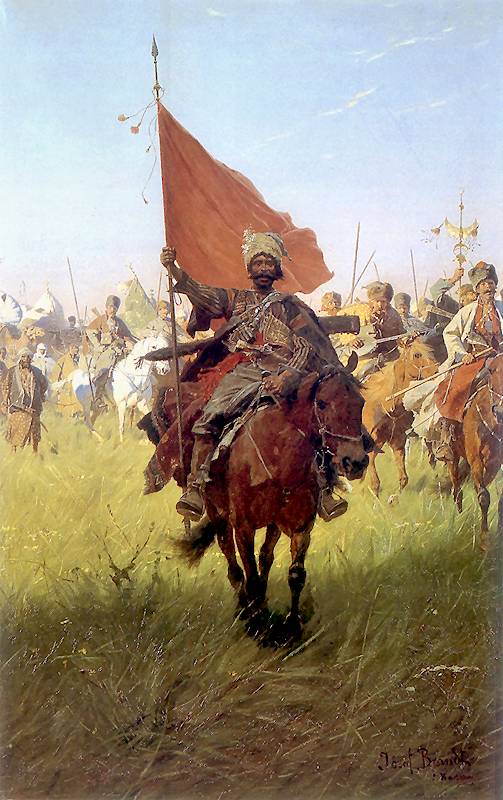
.. as I have been working on a project involving horse wagons and carriages for yet another book on XVII century hussaria,  I did a quick  sketch in Art Pen and watercolour of a Kozak standard bearer via an Orientalist painting by Józef Brandt's Powrót Zwycięzców (Victors' Return), it appears to be a Sich Kozak - interestingly at this time our Kozaks (Zaporozhian Cossacks) were not noted horsemen, fighting as fine infantry and marines (on their swift boats raiding Ottoman Turks all the way in their capital, Istanbul), with some weak light cavalry. Their strength laid in skilful use of early muskets, especially early versions of flintlock as 'doglock' or 'snaphance,' and in use of the "tabor" (wagon train (Wagenburg)) for defence - following the offensive tactics of Old Polish armies 'tabor' that in turn followed Czech Hussites that had re-invented the tabor and used it successfully during their battles with German knightly lancers during the 1420-30s. After the Bohemian mercenaries exported their tactics all over Europe, it was the Central and Eastern European armies and Ottoman Turkish armies became more or less skilful in its use.

At this moment I am after the construction of XVII century wagons and carriages, and I have been using both few iconographic sources eg


...and our Polish painters of the realist school led by aforementioned maestro Józef Brandt and  his contemporary maestro Juliusz Kossak.
Especially in the paintings of 'pan' (sir or master)Brandt these wagons can be see quite clearly. And at the same time we can enjoy these wonderful paintings by pan Brandt, also showing the colourful world of Old Commonwealth.

...

...

...

...

...

...

Tuesday, March 6, 2012

Giants of long distance horse travel 1889-2004

Salve,
I have been dormant most of this winter and it looks as the spring may come to this corner of the Great Plains soon. I did very little riding past 2 months, and have been dreaming about some long distance riding in the Rocky Mountains - the most I have don is 30 miles in saddle...
So reading about riders of the past I decided to start my retunr to this blog with some recollections on men,woman and horses that made some of the longest rides in last 120 years.

First could come travellers of Asia, the largest land mass on this Earth.
Allow me to start with a fine rider, gentleman and military man


Kozak officer Dmitri  Peshkov (Дмитрий Пешков), member of Amur Cossack Voisko/Host, who crossed Imperial Russia  astride a grey horse (photo above) named Serko (Серко) - a Manchurian horse -  notabene about this famous ride Russians made a movie in 2006. 
Dmitri and Serko rode "five thousand five hundred miles in one hundred and ninety-three days" (or 9000km in 193 days) from Blagoveshchensk on the Amur River in Siberia to Saint Petersburg on the Baltic Sea during the late 1889 to May 1890. Gospodin Dmitiri was decorated by the Tsar with an order of St.Anna and a leave from his military duty, and he then travelled to Palestine to visit the Holy Land. He fought in Boxer Rebellion, being a member of invading Russian army and later in Russo-Japanese war. Retired in 1908 with a rank of colonel of the Russian army, for his military service he was awarded not only plenty of Russian Imperial orders, but also Italian and French. Manchurian grey Serko died in Saint Petersburg and was buried there and his burial still exists.
There is a Russian book published in 2001 describing his adventures based on documents etc - Путешествие амурского казака Дмитрия Пешкова от Благовещенска до Петербурга. Here an article in Russian...


Next a Japanese officer and scion of a samurai family,
Fukushima Yasumasa, who from Berlin, German Empire,  started on horse ''Gaisen,'' left him in Moscow due to sickness, bought Russian horse ''Ural''(that bit him repeatedly) and in the Altai Mountains(Kazakhstan) bought two Kazakh horses that took him to Russian port city Vladivostok, and eventually these horses went to Japan - from February 1892 to June 1893, some 488 days.

 ''MAJOR YASUMASA FUKUSHIMA, military attaché of the Japanese Legation in Berlin, has started on one of the longest rides on record. He proposes to travel on horseback to Tokyo, a distance estimated at ten thousand miles, exclusive of waterways, on which he will have to take to a boat. He expects to ride six days in the week, and to make from thirty to thirty-five miles a day. His journey will last about fifteen months, and will subject him to extremes of heat and cold and to the most varying conditions. He weighs one hundred and fifty-four pounds, and will carry with him fifty-eight pounds of luggage.'' (the Illustrated American, vol.10, 1892)

 Fukushima continued his service in the Japanese Army (became a general) and wrote a book about his travel, in Japanese, titled ''A travel in Central and Southern Asia''

Next three American Continents travellers who used famous Argentinian horse breed - the criollo - to accomplish their tasks:
 most famous Aimé Tschiffely , in 1926-29 he rode from Buenos Aires, Argentina to NYC on two criollo horses Mancha and Gato, later wrote a book (and many others) about his ride, published in English under the title "Tschiffely's ride; ten thousand miles in the saddle from Southern Cross to pole star." by Simon in 1933.

[...]*
...and finally completely unknown and unfortunately passed away, the giant of horse long distance travel, Polish teacher and breeder Tadeusz Kotwicki who between 1995-97/98  rode from the end of Patagonia  in Argentina, along the Pacific side of South America to Kansas, US. Pan Tadeusz had ridden in Asia prior to his Americas' adventure, in 1992 he rode a Akhla-Teke mare from Jambyl Province, Kazakhstan to Moscow, Russia, some some 4000km in 120 days. He was also a breeder of Akhal-Teke horses in Poland.
The article below, from Polish daily, "Głos Pomorza" (Voice of Pomerania) from January 1997, tells us about the moment in his voyage when he reached Bogota, Colombia,  that Pan Tadeusz was going to ride all the way to the Bering Straits, yet from the article given in the link (http://boskawola.blogspot.com/2012/03/wspomnienie-tadeusza-kotwickiego-28.html ), we learn that he finished his epic journey in Kansas. I hope to learn more about his voyage from article the author of the blog will publish in Polish magazine "Koński Targ" (Horse Market).

Returning to Pan Tadeusz ride, from the newspaper article we learn that he rode a 142cm-at-withers tall grey criollo mare, bought in Argentinian Province of Santa Cruz, in 'Stag River' horse stud. 6 years old grey mare named ''Kropka'' (''Dot'') was gentled and trained by pan Tadeusz, who had brought his own saddle from Poland for this trip; during his trip rode her for 2-3 hours and walked the same distance, making daily 40-50km a day. During his passage through Peru, he was attacked by the Indian villagers, who believing a fold tale about a white man on a white(grey) horse eating children, beat him and he was only saved by a public official travelling with journalists.

well, until  the next time
ps
 by the way the so called Extreme Mustang Makeover finished in September last year and look at the winner of the Supreme Class
*
16th of June 2012, I am removing this fragment from the main body of the post - 
South African Marianne du Toit, who allegedly followed the footsteps/hoofsteps of Tschiffely on two criollo horses, from  2002-04, claimed she had ridden from Buenos Aires to NYC  and actually later wrote a book,  Crying with Cockroaches, about her claims.

- due to the substantive and  material claims against this story.