Wednesday, July 14, 2010

some old sketches of Napoleonic subjects

 salve,
My last trip to Poland was very fruitful in so many ways.  In regards to my old drawings and watercolors I was able to salvage some and photograph some, although the paper I had used on them 'went south' and I afraid will continue deterioration.
Anyway, long time ago, 20 years or so,  I drew these images of French Napoleonic cavalry based on different drawings by JOB, Benigni etc. At that time I was very interested in anything Napoleonic, no so anymore I am afraid.
Now I just added the cartoon function when resizing them on GIMP Paint Studio.
Enjoy


Friday, July 9, 2010

Klushino 1610-2010 in Warsaw/ Kluszyn w Warszawie


Salve,
400 anniversary of the Klushino battle took place this past weekend in Warsaw, Republic of Poland. For me this was the very first historical reenactment that I participated as a reenactor.
Many things could be said about the event and people participating in it, but definitely for me this was one very interesting meeting with the 'living history from a saddle etc. From cavalry to infantries of various nations - Czechs, Russians, Poles, Ukrainian etc - one could see how much work and passion had been dedicated to the reconstruction of the period costumes, arms and armor, camps, cooking utensils, food etc, in order to present to the modern, technology-driven world palpable and historical reconstruction of the XVII century life. There were also female camp followers and noble ladies, some dressed in  splendidly reconstructed courtly dresses etc.
Finally, the horsemen of husaria were there, in greatest numbers ever, with lances, wild pelts of animals, splendid horse tack on mostly well trained mounts, fancy weapons and armor - lovely and yet menacing sight to behold.


Polish actor Krzysztof Wakulinski Krzysztof_Wakulinski commanded the field as hetman Stanisław Żółkiewski, and narration was provided by another famous Polish actor  Olgierd Lukaszewicz Olgierd_ Lukaszewicz

Many good people were there, eg  in the above photo Polish writer Jacek Komuda  www.samozwaniec.info/archiwum.php , wearing a delia with a fur collar over  hussar armor and nice shishak, ridding his dapple grey mare.
 The principal organizer Bartek Siedlar  http://www.hussar.com.pl/13063/kluszyn-1610-2010-wasze-zdjecia-i-filmy ) was the spiritus movens of the event  and actual director of the event - that was also filmed - while I would like to especially thank Agnieszka for providing me with a nice Anglo-Arabian steed  Emir so I could ride on the battlefield and participate in some action on Sunday July 4, 2010.
I was especially impressed with  'Jareks' of Gniew Husar Banner  http://www.zamek-gniew.pl/index.php?mod=more&idsel=77 - their hussar spirit and splendid reconstruction of  husaria.


My friend Karol, Napoleonic reenactor and passionate propagator of historic riding, came to observe and we had a very interesting discussion on riding long, Xenophon, gaited horses of the past and Old Polish horsemanship with Tara and Rick Suligowski, US premier hussar, from California [sic!]
Polish, Ukrainian, Muscovite (Russian) and Czech infantry provided necessary firepower, and powder smoke at times was covering the field while cannon shots were thundering across the Vistula River meadow, where lots of debris from the Nazi Germany ruined and destroyed the Warsaw's medieval Old Town had been deposited during the post war reconstruction. Thus this past Sunday we accidentally walked and rode over some Old Warsaw stones and fragmented bricks that husaria might have walked many hundreds years ago.

Pictures posted here were taken by my niece Pati... with some help from my little son Jasio - :)
Please find linked galleries of photos taken there by various people and participants. Pictures will speak by themselves
do enjoy :)
 http://picasaweb.google.com/spottheweb/2010070304BitwaPodKUszynem#
http://picasaweb.google.com/108881231175947834151/Obchody400RocznicyBitwyPodKUszynem03072010#

http://picasaweb.google.com/Janusz.Pietrasik/BitwaPodKUszynem1610#

http://picasaweb.google.com/tweete79/BitwaPodKUszynem400Lat04072010#

http://picasaweb.google.com/tytus1239/KUszyn2010#

http://picasaweb.google.com/awesela/KUszynInscenizacja20100703#
http://picasaweb.google.com/Dawid.Piech/20100703KUszyn#
http://picasaweb.google.pl/albumyAbrata/KUszyn1610Warszawa2010#
http://picasaweb.google.com/114451786360711332970/20100704BitwaPodKUszynem#
http://picasaweb.google.com/patrycja.lon/400RocznicaBitwyPodKUszynem02#
http://picasaweb.google.com/elanar82/ObchodyRocznicyBitwyPodKUszynem04072010#
http://picasaweb.google.com/mikeskil/Kluszyn2010#

Saturday, July 3, 2010

American Indians - old drawings II


Salve,
 watercolor, pen and ink drawings of Native American horsemen - after all it is 4th of July, US Finest Day -  na zdrowie (to your health) America!

American Indians -old drawings I


Salve,
 more old Native American watercolor, pen and ink drawings, Kiowa above and Crow (Absaroke) below..

Friday, July 2, 2010

Horses-old drawings I


Salve,
 some more old horses in my ink and watercolor drawings -:) Old West, Indian war pony, and some race horse of English blood.

Horses - old drawings

Salve,
some horse drawings from my old sketchbooks,  done with pen and ink and watercolor

American Indians - my old drawings


Salve,
I am in Poland and I have found some of my old sketch books with some old drawings.
I am going to show some of these here, as I am going to talk more about the American Indians/Native Americans and their horses, and their horse tack.
 So allow me to start with some two decades old pen and ink and watercolor drawings.

Sunday, June 27, 2010

early XVIII century hussar


salve,
finally finishing my today's outpouring  the early XVIII century 'winged'  hussar  wearing a 'karacena'  armor (perhaps inspired by Trajan's column images of Sarmatian warriors fighting Romans) and a turbaned karacena (  karacena from Polish Army Museum ) helmet (in Polish history the period of  Sarmatism  and continuing 'romance' with the culture of  Ottoman Empire and Safavid  Persian) TrajanColumn_-_Cichorius_Plates

Late XV century Serbian hussar


salve,
the forefather of the Polish winged hussars - a Serbian hussar, who has a Turkish sabre, Balkan shield, Turkish helmet, and Turkish mace.
I intend to add a horse, wings on the shield,  and a lance later -
in GIMP  dario fecit :)

two more sketches of hussars


salve,
two sketches of hussars mounted and dismounted :)
I used GIMP to enhance the watercolor and pen&ink drawings.

sketches of some hussar commanding officers


Salve,
finally  last two sketches of hussar commanding officers - without a helmet, with right arm uncovered holding a mace -bulawa   /Bulawa of Turkish origin.

Hussar sketches in GIMP, pen and ink


Salve,
some sketches in color, and black and white ink drawing  enhanced with GIMP manipulations... Hussar is holding my most favorite weapon - war-ax, already seen in the Saka and Scythian arsenals more than 2700 years ago, eg Indo-Saka king Spalirises  SpalirisesStandingInArmour , here some XVII century examples war axes

Caltrop


Salve,
a little drawing of a hussar stopping his charge due to caltrops, that had been spread by the enemy infantry. In Polish this device was called a 'czośnik' (plural - czośniki). 
Normal battlefield occurrence in Europe and in Asia Minor from the Alexander the Great era through early modern warfare, obviously used by the infantry against  cavalry but also could be used against the infantry.

 Caltrops from Chania - X-XII centyrt AD

Caltrops from Muscovy (present Russia)
...

Thursday, June 24, 2010

Klushino - a new English language text by dr. Radek Sikora


Salve,
Let it be my pleasure to attach here a link to my friend Radek Sikora, already a 'doctor'  :)  or Ph.D.,  newest English language and the best researched  'take' on the Klushino battle - please do enjoy Klushino

And above and bellow  my own sketches based on the XVII century work of pan Józef Naronowicz-Naroński drawing of a Russian/Muscovy streletz version of the infantry field anti-cavalry defense. The second sketch intends to show   a post-hussar charge view of   horse casualties  inflicted  by these 'kobylice' (cheval de frise) - name used by our  Polish military scholar, Naronowicz-Naroński in his "Architektura militaris, to jest budownictwo wojenne" ,  published in the XVII century.

Wednesday, June 23, 2010

Vienna Codex - another splendid image


Salve,
more images of Ottoman Turkish military form the late XVI century, including the  Vienna Codex 6000. Fearsome delilers - perhaps the best warriors of the Ottoman Army -
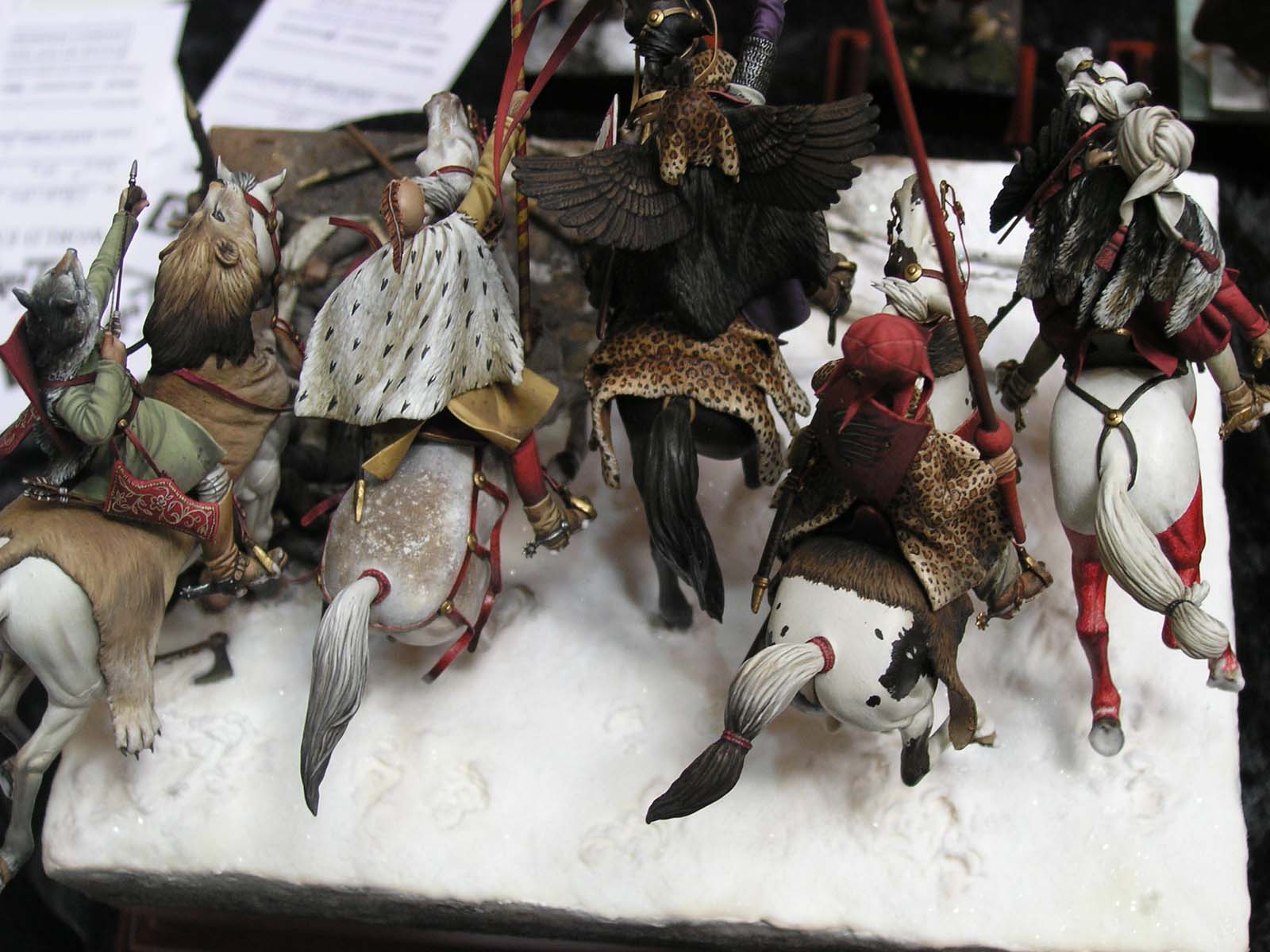
 Note that  the turbaned (most likely the helmet underneath the turban) commander is wearing an 'anima' laminated  cuirass, coat-of-mail under the cuirass protecting his arms and maybe his hips, while at his side there is a sabre, underneath his left thigh a broadsword (pallasch), while leading his splendid chestnut steed with one hand (horse is curb-bitted and holds his head high, parading :) )  and the right hand with a risen menacingly 'nadziak' or a steppe and eventually Turkish, Polish, Hungarian version of horseman  bec-du-faucon (pico de grajo).
Rider behind the turbaned ghazi is carrying  a heavy lance, painted, not dissimilar to the Polish Winged Hussar lances or even earlier Renaissance and medieval ones. His left side is covered by a leopard pelt - is he a Turkish hussar?
The foreground rider - and the most striking out of them, is a very muscular man with a shaved head but for a 'scalp lock' of the Slavic tradition. He has a red hat on his back, a type called by prof Zygulski jr. a Bosnian hat, so perhaps these riders were Bosnian converts. This man is caring a tuck/estock (panzerstrecher) underneath his left thigh, while his curved Hungarian style sabre is out of its sheath, being brandished in a typical manner -high above one's head.  Curb-bitted stallion has some interesting horse tack, especially the crouper  with what appears to be copper or brass bells, not dissimilar form the Spanish conquistadors bells used in the Americas.
The last man is wearing a bear coat, perhaps harking back to the ancient warrior rites  of the Indoeuropeans, where bear-men were the most fearsome warriors. Addition of a bird of prey wing on top of his head seems to go back to the steppe tradition of the Saka, Sarmatians and ancient Turks. He also has a nice Hungarian sabre, so popular with the Eastern European nobility and warriors during the XVI century.
Finally, the boots and spurs on these warriors are similar  to Polish and Hungarian ones.  
More Delilers from the Ottoman Turkish  miniatures, done in the second half of the  XVI century.


 6 years ago these soldiers were subject of a nice historical miniature, but not error free,  soldiers diorama at the Boston World Expo, work done by two Italian miniaturists Cartacci and Mariano Numitone , and I took some photos of them  Boston_Expo/Cartacci-TooLate.jpg
 I will speak more about the image of a deliler on the right some other time..

Tuesday, June 22, 2010

Image of glory and memento to passing time


Salve,
Don Gustavo, one of my Facebook friends and fellow admirer of fine Polish, Belorussian, Ukrainian, Lithuanian, Hungarian, Livonian, German nobility,  their gallantry and bravery, and who is a follower of my blog as well, pointed to me something that I have not seen before.
It is the attached below an image of the Polish knight (appears to be a winged hussar), deceased AD 1596, who was immortalized by his family with an epitaph, adorned with  a truly Renaissance portrait.
The  buried hussar's name was Andrzej Kochanowski of Korwin coat of arms  Korwin .
He was the founder of  the church  where he was buried, this late  Renaissance Roman Catholic Church in Grodek, near Kozienice in Poland. Mosci pan Andrzej Kochanowski, son of Dobieslaw, was himself  a cousin of our most preeminent Renaissance  poet- Jan Kochanowski, who himself was described wearing a hussar outfit during the fabulous 1574 royal entry to King's city of Cracow ( the entry of our shortest ruling and only French monarch, Henri Valois). Perhaps one day I return to Jan and his poem 'Jezda do Mokswy'  Jezda_do_Moskwy  , that describes the famous raid by Filon Kmita of coat of arms Radwan_Sowity , Haraburda  and Krzysztof 'Thunder' Radziwill against the
Muscovy's interior during king Bathory's war with Muscovy 1577-82.

Ad rem, our pan Andrzej here has a fine Renaissance armor (note a visible gilded spur  at this armored heel) and coat of mail, while his knightly weapons,  sword and sabre, along with his shishak with red plume are at his side. He is eternally resting on the human scull, a somber remainder : memento mori, while  a finely painted hourglass has for ever reminded the viewer about the passing time -Πάντα ῥεῖ pantha rei.
This is a somber and very pious piece of art,  and this style of painting portraits of deceased to decorate their burials and soon coffins/caskets became so called Sarmatian fashion across the Polish-Lithuanian Commonwealth, resulting in many fabulous paintings of our ancestors  Portret_trumienny_B._D._Lubomirskiej.jpg .  


ps
another drawing of mine above the text, it seems that those fabulous wild cats skins were often carried underneath the saddle, in ancient  Macedonian (vide Alexander the Great equestrian portraits) and Great Steppe warrior fashions.

a little of Renaisance and Triumph of Emperor Maximillian

Salve,
Hans Burkmair  Hans Burgkmair , designed one of the most impressive German Renaissance woodcut projects - more than 150 woodcuts of various  aspects of Emperor  Maximillian I (not a friend of Polish-Lithianian Jagiellonian Kingdom) display of power.  Also there can be found a little book on the archive.org  triumph of emperor where many details regarding these plates are given in somewhat antiquated English of the late XIX century.
Anyway,  this greatest link to the 'Maximillian Procession' woodcuts ( Graz collection of some of the hand painted woodcuts surviving form the Triumphal Procession of Maximillian) was  found by Michal 'Kadrinazi'  triumphzug 
Although Michal graciously posted the link on his blog, I decided to post it here since his blog is in Polish   http://kadrinazi.blogspot.com/ ... and few readers of English tongue might go  dircetly over to his fine, almost daily updated, blog on XVII century military, but if you choose to do so here is his post about it  http://kadrinazi.blogspot.com/2010/06/triumphzug-kaiser-maximilians.html .
thank you, Michal :)
ps
and my little drawing with GIMP paint studio and Mypaint, of our King Sigismund Augustus royal hussar circa 1553

Monday, June 21, 2010

in the spirit of Kluszyn 2010 (Klushino)

salve,
 today's little drawing of a charging winged hussar (true,  I'll have to add the wings later on)  - I hope I am showing here  the process of lowering his lance  the  while his rumak (war steed) is in full gallop... seconds before hitting the target.

Saturday, June 19, 2010

English Sportsman on Polish horse circa 1730s

Salve,
While perusing Sportsman Dictionary vol. 11, published 1737,  I found the following depiction of our Polish horses:
"These are much like the Danish horse, and are generally about the size of the Spanish Jennet, are of a middle stature, but their limbs are much better knit together, and are of a much stronger make, than the Spanish ones.

This horse is in many respects, like our natural English horse, except that their head are somewhat slenderer, like the Irish hobby; but  their necks and crests are raised upright, and very strong; their ears are very short and small, and their backs capable of bearing any weight; their chines [shins] are broad, their hoofs are judged to be as good as those of any horse in the world.
They are very good for a journey, and will endure long ones, with more ease than any other horse"


The attached  prints,  done during the late 1645 to  1651AD  in France,  by the Italian  draughtsman and master printmaker Stefano della Bella you can see such horses [nota bene this etching above  was used by Richard Brzezinski to reconstruct a winged hussar for this Osprey book - Polish Winged Hussars ]


Almost 60 years later, in their 1790s edition, famous  Encyclopedia Britannica editors wrote:
'Polish horses are like Danish, only the have not so fine a fore-hand, their colour is generally a bright bay, and that of the outward peel of the onion, They are fiery and vicious, '
while the depiction of the Danish horse is as follows:
'Danish horses are low, short, and square, but they have a fine head and short hair.'

ps

nice page with medieval and early modern horse tack, including a blurred image of a winged Polish horse from 'Certamen Equestre' series ( these Eimmart prints   commemorate the 1672 horse parade at the Swedish court of Karl XI ) horse tack
this one above is one of the G.C.  Eimmart's prints showing Polish musicians on Polish horses. Please note that many of the Eimmart's prints were used by the Poland's preeminent military costume historian and fabulous artist, pan Bronislaw Gembarzewski. Unfortunately his works were burnt during the savage destruction of Warsaw by the Hitler's Germans in 1944, and they mostly survive in microfilms and old publications, especially valuable are his books:  Żołnierz polski. Ubiór, uzbrojenie i oporządzenie wojska polskiego od XI wieku do 1831 roku (from microfilms published in 1960-1966, 4 volumes) [this one is a compilation of then available sources on Polish military men and their horses] , Wojsko polskie. Królestwo Polskie.  1815-1830  [Polish Kingdom] (1903), Wojsko polskie. Księstwo Warszawskie. 1807-1814  [Duchy of Warsaw] (1905), Husarze [Winged Hussars]  (1500-1775) (1939)

Turkish horse II

Merhaba :)
I found some more interesting depictions  of Turkish horses - from the AD 1737 English publication titled 'Sportsman Dictionary, ' vol 11.
"These horses are originally natives of Greece [ Byzantium ], and bear an extraordinary price with us [English], partly because of their extraordinary beauty, and partly because of the great expense of bringing them over [from Ottoman Empire to England].
These Turkish horses have fine heads, somewhat like Barbary ones, beautiful fore-hands, and straight limbs, rather small than large, are of a most delicate shape, their pace is genteel and graceful, and besides they are horses of good spirit.
Their coats are smooth and short, their hoofs long and narrow, which is a sign of swiftness; in a word, there are horses of great beauty courage and speed.
Their colour is, for the most part, grey of flea-bitten, tho' there are some of a bright bay colour; but most of these we have now in England, are grey."
Almost hundred years earlier, during his voyage across the seas 1647-52 English merchant Robert Bargrave visited Constantinople [Istanbul], the capital of the empire. He wrote in his travel diary:
'..but are to be seen such horses, and that in great number, as all Christendom cannot vie with; many of whose accouterments  alone are worth thousands, and those are but common which cost less than hundreds'
page 86, 'The Travel Diary of Robert Bargrave Levant Merchant 1647-1656,' ed M. G. Brennan.

Above, Sultan Suleiman the Magnificent  Suleiman_the_Magnificent on campaign riding  one of his fine horses, surrounded by his guards.