Thursday, March 19, 2020

the tilt at Quintain in the early modern England

Salvete Omnes,
a short post or perhaps not so short - :)
one of the great and rather fundamental exercise to learn and to hone one's  skills with a lance while on horseback was the tilt at the 'quitain.'
Samuel Johnson (1805) in his A Dictionary of the English Language has this definition -
Quintain - a post with a turning top, and the he tells us to look up a Quintin -
An upright post, on the top of which a cross post turned upon a pin; at one end of the cross post was a broad board, and at the other a heavy sand bag: the play was to ride against the broad end with a lance, and pass by before the sand bag, coming round, should strike the tilter on the back.
 
I have been perusing the Wiki Commons collections and came across this image of a quintain:

Apparently this Kentish village's quintain is quite old, as the ancient   lance exercise - tilting at the quintain - had been alive into the early modern or even post-Puritan revolution (aka English Civil War) period. 
well, I say that because it appears that during the later part of  XVII century there was still some practice with lances (ok, strong poles or staves) in the countryside.

For evidence we have this interesting description taken from 'The Natural History of Oxfordshire' (Robert Plot, 1677):
''They first set a post perpendicularly into the ground, and then place a slender piece of timber on the top of it on a spindle, with a board nailed to it on one end, and a bag of sand hanging at the other; against this board they antiently rode with spears. Now, as I saw it at Deddington on this county, only with strong staves, which violently bring about the bag of sand, if they make not good speed away, it strikes them in the neck or shoulders, and sometimes knocks them off their horses; the great design of this sport being to try the agility both of horse and man, and to break the board, which whoever does is for that time accounted princeps juventutis. It is now only in request at marriages, and set up in the way for young men to ride at as they carry home the bride, he that breaks the board being counted the best man.''

In 1813 J.N. Brewer (Topography of Oxfordshire) remarked that ''the sport is now  entirely disused, and the oldest man in the town does not remember to have heard his father mention the custom in any other than a traditional way.''

Curiously, during the Peninsular War the British and Spanish forces were truncated more than a dozen times by the Polish lancers in the French service.
In 1816 some of the British cavalry regiments (eg 12th  Royal Lancers, 16th Queen's Lancers  ) became lancer regiments, and tilting must have resumed as part of the training.

a photo of modern reenactment from the famous Malbork castle in Poland (naturally famous for the Teutonic Kinghts, but also the seat of the Malbork voivodeship in the Polish Kingdom AD1466-1772)

Valete

Friday, March 13, 2020

Wespazjan Kochowski - Nagrobek Koniowi

Salvete omne,
[in Polish]
Wespazjan Kochowski herbu Nieczuja gościł już na moim blogu -

a dzisiaj krótki wiersz mistrza barokowego pióra, który przecież był walecznym rycerzem sarmackim i obrońcą Ojczyzny epoki rebelii Chmielnickiego i Potopu a także stronnikiem marszałka Lubomirskiego stając min w bitwie pod Mątwami, który w tym wierszu nieco naśladuje mistrza Jana Kochanowskiego.


Nagrobek koniowi
J.m. panu Mikołaja Raszkowskiego*

Tu pod tym słupem leży koń  łysocisawy
Jeżeli który zgodny do Marsowej sprawy.
Za fraszkę Bellerofont i Pegazus lotny,
Przeszedł  ich dzielny rumak, rączy i obrotny.
Namniej mu bieg, i praca, trudy nie szkodziły,
W potrzebach szczęścia pełen, na podjazdach siły.
Nakoniec tu dla pana swej miłości
Ochwatem zamorzony, martwe złożył kości.

Nota bene 'łysina' to albo łysina podługowata (ang. Blaze) - odmiana na głowie końskiej, która jest podłużną białą plamą idącą od czoła aż pomiędzy nozdrza, albo idąc definicją Wincentego Pola  zwana łysina szeroką(ang. Bald face)- plama mogła sięgać i przechodzić za oczy czy brwi etc (  ta ostatnia nie była pochwalana przez autora Hippiki Dorohostajskiego ani przez piszącego ponad dwa wieki później Pola).

ze zbioru - Epigramata Polskie, czyli po naszemu fraszki.
przy okazji piękna ilustracja do wydania poezji mości Wespazjana (z FBC Polona) u stop poety grającego na lutni kirys i kopia husarska z proporcem, koncerz, sajdak i łubie oraz tarcza.


 *zdaje sie, ze herbu Sas

Valete
ps
zdrowia życzę wszystkim podróżnikom netowym i czytelnikom mojego bloga

Wednesday, March 4, 2020

Viking and Slavic Ornamental Design vol. 3 from WHP & Triglav

Salvete Omnes,
 
Winged Hussar Publishing LLC in cooperation with Triglav from Szczecin, Poland, publish the 3rd volume of the Viking and Slavic Ornamental Design - fantastic reference material and study of the designs obtained from archaeological artefacts and iconographic materials, collected during research trips to museums and sites ranging from Ireland to the eastern Slavic lands of Belarus, Ukraine and Russia.
 
 
Written by Igor Gorewicz,
 here at the 2018 Wolin Slav and Viking Festival

and illustrated by Marek Piłaszewicz, it is a treasure of imagery from the Viking and Pagan Slav period - be it for a reenactor costumes and equipment, tattoo idea or drawing exercise etc.
there are some sample pages kindly provided by the publishers


 Slavic horseman reconstructed - Wolin Festival 2019


photos from the various Wolin S&V Festival taken from Wiki Commons - here-
nota bene Slavic music bands at the festival- eg Javaryna & Dziwoludy.


Valete

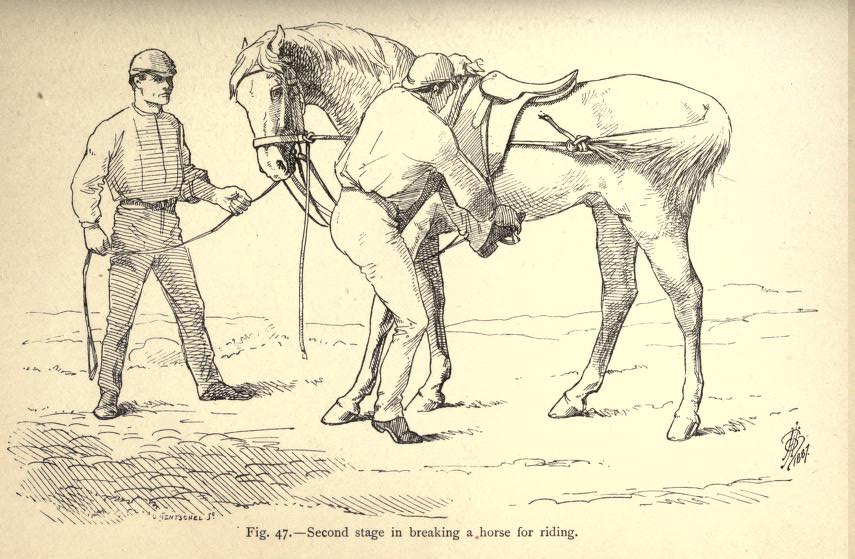
Hayes on Horse Breaking

Salvete Omnes,
so it is March - a brand new month -  and we are back to Cpt. M. Horace Hayes' books and late XIX  century British approach to riding horses and their training and management.
I like to read and learn or even ponder about the ideas collected within his writings, with the hindsight that Hayes was a true example of XIX century horseman, with their vast experiences, practices and not  a few limitations - so today I will invite you to take a closer look at this book -  Illustrated Horse Breaking.
 
I selected these fragments from the text - the full text can be found on the Archive world library.


Necessity for obtaining control over the Horse.
In order to fulfil the necessary conditions of safety for himself, the breaker should be able, by the system under which he works to quote the words of that admirable horse-master, Professor Sample to make the animal rideable and driveable before he is either ridden or driven. The breaker who employs the ordinary methods, is not alone exposed to danger when mounting, or even driving his pupils' for the first few times; but also in the preliminary handling, unless, indeed, in the case of young foals. The advice to go boldly up to the horse and show him that you are not afraid of him, so freely tendered on such occasions, should be treated by its recipient as a piece of "cheap swagger," or the outcome of pretentious ignorance; for, even granted that such a demeanour would efficiently soothe a terrified animal, or cow a treacherously-disposed one suppositions that are altogether absurd such counsel would in no way supply the necessary foolhardiness for such an undertaking. My advice to either amateur or professional is, never to give a horse a chance of doing wrong; so, in order to be consistent after having said this, I shall endeavour to describe a method by which any horse, unsecured, say, in a yard or loose box, can be brought under complete control with, practically speaking, no risk to the operator. 
On the nature of the coercion to be applied to unruly Horses. 
The only risk run in enforcing the obedience which it is absolutely necessary to exact from unruly horses, is that of spoiling the animal's pluck and spirit a contingency that can be incurred only when the fractiousness arises from "nervousness," or from want of comprehension; for what we term pluck and spirit in the horse should have no taint of stubbornness. The coercion employed should, naturally, be limited to what would be sufficient to overcome the wilfulness; for we should never employ a general effect, when a particular one will answer our purpose. Thus, suppose we had a high-couraged, generous animal, that had been made difficult to mount by a bad. rider, on various occasions, prodding the horse in the side with his toe, when attempting to get into the saddle, we might get control over the animal by Pratt's twitch (see page 113), or by tying him head and tail, and then prove to him that we would not touch him with our toe, when mounting. The Rareyfying of such an animal for this or any similar fault, would be injudicious in the extreme ; as it would, almost to a certainty, injuriously affect one of his most valuable qualities, namely, his pluck. As a sulky animal has little or no pluck to lose ; we may well content ourselves in gaining his obedience without troubling ourselves much about any possible deterioration of his courage.


Breaking by kindness alone. 
While fully admiring the kindness of heart of those enthusiasts who regard a horse as a friend to be won by affection, I must say that the better plan for making him a useful member of society, is to treat him as a servant who has to be taught his work, and from whom implicit obedience has to be demanded. Until he does his work honestly and well, the less petting he gets the better; for he is an animal that is very apt to become headstrong and fractious, by a small amount of indulgence in his own way. I entirely deprecate any fighting with the horse, or punishment with whip and spur, which he can resist; but I insist on the necessity after proving to the horse that he has nothing to fear, and after teaching him to understand one's wishes of shewing that he must obey. I shall endeavour, in due course, to explain to the reader how such obedience can be peremptorily enforced. 


The rough and ready style of breaking.
The method of reducing a horse to discipline, by forcibly securing him, getting on his back, and sticking on until he bucks himself to a standstill, is applicable only to unbroken animals of a more or less mature age, whose owners demand nothing further, than to have them made "quiet to ride." The objections to this method, as far as I can see, are : that it is not always possible to obtain the services of a rider of sufficient pluck and adhesiveness; that some horses, by " throwing themselves over," can get rid of any man off their back; that if the horse wins the fight, the victory will have the effect of making him much worse than he was before ; that the mastery, even if the process be repeated, is, often, not permanent, especially with a new rider ; that it is apt to spoil the horse's mouth ; and that, in the case of nervous or sulky animals, it is liable to increase their particular faults. The buckjumping style of breaking is, of course, only good as far as it goes, and has no just claim to teach the manners that make the horse, as assuredly as they do the man. 


Summary of the principles of the art of rendering Horses docile may be summed up as follows :
1. To obtain control over the animal.
2. To prove to him that he has nothing to fear from us, or from the surroundings in which we place him: in other words, to give him " confidence " and cure him of " nervousness."
3. To teach him to understand the meaning of the indications by which we desire to convey our orders to him.
4. To make him obey our orders in the most implicit manner, in the event of his offering deliberate resistance to them.
5. T o instruct him how to use his powers to the best advantage.
6. To make, by repetition, these acts of obedience and " cleverness " thus taught, into confirmed habits; so that the horse, who is, essentially, an animal of habit, may become a permanently useful servant. As an illustration, I may say that we should conduct the education of a colt or filly, according to the principles we should adopt with a recently- caught young savage whom we desired to make a useful servant. While shewing him that we had complete control over him, we should prove to him that he had nothing to fear from us, and, in doing so, would gain his confidence and affection. We should teach him our language, and, according as he understood our words, so should we demand implicit obedience to our orders, and would, thus, quickly establish the desired habit.

 
Valete

Wednesday, February 26, 2020

Jensky Codex - glory of Bohemian Late Medieval Art

Salvete Omnes,
a quick entry - medieval illuminations, late gothic armor and Jan Hus and Jan Žižka.

so without much ado , from the late medieval Kingdom of Bohemia ( since 1471AD ruled by Jagiellon king Wladyslaw II aka Vladislav Jagellonský) comes the so called Jensky (Jena) Codex painted by a master Janíček Zmilelý z Písku, who worked in Prague from the late 1400s until 1520s AD, and the codex is dated between 1490-1510AD.


 and the battle scene showing the Hussites fighting the German crusaders - see the Hussite wars page on Academia , eg Religion and Violence during the Hussite Wars. Although the painter showed the scenes from the first quarter of the XV century yet he painted the combatants using the last quarter of the XV century arms and armor, including the horse tack too.
We are rewarded here with the perfect lance technique - nota bene the main lancer with the couched lance is using the arret or lance rest.
 

On Jan Hus and his relationship with Polish Crown and Polish nobles see this article.

On another medieval Bohemian codex - you could read this article.

the whole manuscript can be viewed here
Valete

Tuesday, February 25, 2020

Jakuba Michałowskiego straty pod Zborowem AD 1649

Salvete Omnes,
[in Polish]
ostatnio na grupie końskiej na Facebook'u prowadziliśmy rozmowę na temat  ruszania na wojnę i występowania do bitwy z oporządzeniem bogatym i 'piórno' (ze pożyczę określenie od kronikarza a towarzysza husarskiego Marcina Bielskiego). Padło również nawiązanie do epoki staropolskiej czyli XVI-XVII wiecznej wojskowości polskiej - i mamy sporo źródeł w temacie tego, co  nasi przodkowie-rycerze zabierali ze sobą na wyprawy wojenne a kampanie.
Dodam, ze zachowały się spisy strat koni (bojowych i pociągowych) i wyposażenia pocztów jazdy z kampanii i walk (np są straty w koniach i sprzęcie u towarzyszy i ich pocztów   rożnych chorągwi jazy armii hetmana koronnego Stanisława Żółkiewskiego herbu Lubicz biorących udział w zwycięskiej bitwie pod Kłuszynem AD 1610 - listę te skompilował R. Sikora w swej książce o bitwie z 2010r.

Poniżej zamieszczam listę strat - nazywaną przez autora rękopisu 'komputem rzeczy porabowanych i potraconych' -  które znajdują się w rękopisie Jakuba Michałowskiego herbu Jasieńczyk, wojskiego lubelskiego i chorążego nadwornej chorągwii JKM Jana Kazimierza pod Zborowem, 15-16 sierpnia AD 1649roku.

Wypis tychże strat zamieścił po raz pierwszy polski historyk XIX-wieczny Ludwik Kubala w swej pracy o Zbarażu i Zborowie, zawartej w Szkicach historycznych, seria pierwsza (dostępne tutaj lub tutaj). Nota bene w czasie wyprawy beresteckiej mości pan Michałowski również poniósł był znaczne straty (o tych kiedy indziej).

Rpis Bibl. Ossol. Inv. Nr. 189, str, 264. Punkta z listu Andrzeja Szołdrskiego, biskupa poznanskiego. 

Kopia: PAN Kr. Rkps 2253/I, k. 208v.Jakuba Michałowskiego rękopis p. t. 
Komput rzeczy porabowanych i potraconych pod Zborowem 
Jakóba Michałowskiego, wojskiego lubelskiego, chorążego nadwornej chorągwi: 
Kontusz aksamitny niestrzyżony czerwony, takimże 
atłasem podszyty, ze złotemi pętlicami. 
Delia karmazynowa strzyżona ze złotem! porzebami, 
takimże atłasem podszyta, ze złotymi guzami wielkimi. 
Delia tabinowa zielona ze złotymi guzikami, takimże atłasem podszyta. 
Kontusz tabinowy lazurowy ze złotemi pętlczkami atłasem podszyty. 
Kontusz amarantowy ze złotemi pętlicami. 
Żupan: - karmazynowy afasowy, -ceglasty atasowy, -brzoskwiniowy atłasowy. 
Ubranie karmazynowe podszyte. 
Falandysz lazurowy na ubranie. 
Czapek sobolich aksamitnych dwie. 
Płaszcz karmazynowy jedwabny wielki sakiewski. 
Nóż turecki. 
Szabeltas haftowany złotem. 
Welensów trzy. 
Siedm kap z herbami na konie 
Platów aksamitnych do kulbak dwie. 
Mituk półszkarłatny ze złotymi kwiatami i kapa na kulbakę. 
Mituk póigrawatny zielony z frandzią długą u dołu. 
Kulbaka aksamitna karmazynowa srebrem oprawna, za którą 360 zł dałem 
Kulbaka safianowa. 
Kulbaka podróżna z pistoletami. 
Misiurka. 
Kobierzec z obwinięciem, w którem chusty biate, koszulek kilka pod żupany atłasowe 
i dołomany, chustki, prześcieradła, obrusy, serwety, podszewki i i. 
Puzdro cyny i talerzów. 
Kuchenne naczynia; kotły, garce miedziane wszystkie. 
Karwaszów par dwie. 
Karwasze złociste. 
Czeladne suknie wszystkie. 
W szkatułach łańcuch z trzema portugalami, dwa pierścienie, kubek srebrny, 
solniczka srebrna. 
Szkatuła korzenna wielka zapełniona.
Apteka wielka, pełna ingredjencji. 
Kobeł trzy. 
Muszkietów dwa. 
Muszkiet węgierski. 
Proporców dziewięć. 
Czaprak aksamitny wiśniowy ze złotymi, wielkimi kwiatami. 
Szopa wielka.
Namiot. 
Łóżko. 
Prochu 2 kamienie. 
Koszulka dziana. 
Dwa Szyszaki. 
Pasy dwa do zbroi do przedniej blachy. 
Wina 60 garcy. 
Petercymonu baryła. 
Małmazji białej i czerwonej puzdro.
 Cytrynowego soku flasza garcowa, fiołkowego druga. 
Wódki puzdro. 
Gorzałki przedniej dwie baryły. 
Pierników, biszkoptów, konfektów nie mało. 
Dwa wozy skarbowe czerwonem suknem nakryte po 6 koni. 
Jeden wóz skórą obity skarbowy z 4 końmi 
Wózek prosty z parą koni. 
Teleszka z jednym koniem. 
Klacz naręczna (zdechła w drodze) i podjezdek, 
Pleśniwego konia.
 Źrebca gniadego. 
Należnego kałuskiego konia wolskiego, struszowskiego i cisawego, 
także od karetki para koni ze wszystkiem i szorami wzięto ! 
od wszystkich wozów cugi pobrano. 
Legominy wszystkie. 
Szynek sześć.
Wóz wołowy z legominami i pięć wołów. 
Talszesanów kilkanaście. 
Pieniędzy dwa worki, pościel i ksiąg siedm,


Valete

Friday, February 21, 2020

Dogs, Cats, and Horses in the Scottish Medieval town - article

Salvete Omnes,

February 2020 AD is flying by - lots of great reading out there and plenty of studying too.

For those of you who are curious about the horse during the Middle Ages, and in the Medieval Scotland in particular, I propose to take ah hour or two and read the article, available on academia, titled 'Dogs, Cats and Horses in the Scottish medieval town' by Catherine Smith (1998).
so in this artoicle we have an introduction to the horse or garron of Medieval Scotland.

 finally, in this context comes this study by Emily Abrehart of horse bones excavated in London from the period of 1220 to 1900AD that includes quite interesting  discussion on the horses' sizes during the 700 years period -
valete
ps
illuminations from Wiki Commons are attached just for illustration purposes and their beauty.

Thursday, February 13, 2020

More Little Big Horn videos

Salvete Omnes,


since I have been watching and listening to presentations, documentaries etc on the Little Big Horn battle,and I have more link  to share with you.
 
- The History and The Guns Used at The Little Big Horn Battle - Wendell Grangaard (author of  Documenting the Weapons used at the Little Bighorn) fascinating presentation.


 -2010/11 The Little Big Horn Reconsidered Custer's Footprint on the Great Plains - from the Bismarck State College -  by Clay Jenkinson & Larry Skogen.

- Battlefields detectives (dailymotion or youtube) - very interesting forensic study of the guns on both side and their influence on the battle's outcome. They found Mitch Boyer among the other discoveries, and did a forensic reconstruction (based on a skull) of trooper Vincent Charlie.

- a VHS Produced in 1990 - a docudrama titled Custer's Last Trooper.

- a 1988 video titled A Good Day to Die (1988): Documentary on the Battle of the Little Bighorn.

and finally , the entire set of video presentations by a Little Big Horn battle aficionado and independent researcher.

Valete

Wednesday, February 12, 2020

The Horsemen of Hadrian's Wall - turma in action

Salvate Omnes,
 
a quick and joyful sharing  - this time to a BBC documentary titled The Horsemen of Hadrian's Wall  - part of the Digging for Britain (Series 6 Episode 4). On the Roman cavalry training and tournaments known as hippika gymnasia, like the famous Cantabrian circle, cuneus etc .

Narrated by professor Alice Roberts, who has been co-presenter within the series,  this episode is especially interesting since many reenactors took part in it from across UK and continental Europe - eg Yves Ruttiman (Yves is a fantastic Roman cavalry reenactor) or Timothy Dawson (among others Tim owns  the great side  devoted to the Roman Eastern Empire or Byzantine history of culture - do peruse it).
 
This presentation is quite spectacular and very informative, so do watch if you can - link .


 The film spends some time to study the Hexam Abbey Roman funerary monument of one Flavinus, Roman cavalry standard bearer.


 the revolutions of the 'turma' or the troop  of Roman cavalry reenactors are explained and put in historical perspective in a text and film by dr. Mike Bishop & Dr. Nigel Mills. The video, bits and pieces from the longer BBC video above, nicely complements the main documentary. More information and films here.

Valete
in case we forget, Britain is still home to Comitatus, the home of Roman cavalry reenactors - peruse their site.

BBC docudrama on the Little Big Horn battle

Salvete Omnes,
 
just discovered and watched - BBC on their channel on Youtube show interesting docudrama on the battle of the Little Big Horn.
 
Here is the film - from The Wild West series


Enjoy