Friday, May 20, 2011

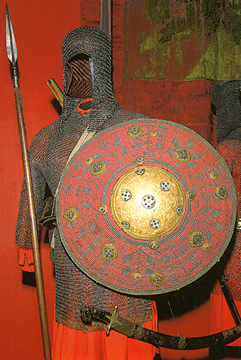
Dutch cavalry circa 1596-1600


Salve,
I found this interesting description of the Dutch cavalry around the time when last units of lancers were fazed out from the Western European armies. Dutch were fighting the Spanish Empire and its armies, and one must say that they did fight with valour, bravery and skill, using every possible innovation they could find. The odds were overwhelming and yet they finally won, and in process there was plenty of military art was produced on both sides, from paintings and drawings to prints, showing horses and riders...
source
The Dutch Army and the Military Revolutions, 1588-1688‬ By Olaf Van Nimwegen

p.97 -99
''Dutch cavalry was initially composed of lancers, cuirassiers and mounted arquebusiers.

Lancers were armed with a lance approximately four meters long, and lancer himself had to a an outstanding horseman, seeing as he made his attack at full gallop.

This limited the employability if lancers, who could only develop their strength – an attack at speed – on flat, hard ground. Cuirassiers, on the other hand, could be deployed both offensively and defensively on terrain that was more difficult to negotiate, and their style of combat required less practice and horses of lesser quality. Cuirassiers attacked only at trot. In January 1597 the Dutch lancers were transformed into cuirassiers. This change was effected almost simultatneously in the Spanish army (comment, who about the battle of the Dunes 1600). The Ordre of 1596 (repeated in 1599 Ordre) prescribed that these cuirassiers had to ride 'strong, stallion-like' horses (that is stallions and geldings perhaps) and be furnished with 'bullet-proof' cuirasses, a visored helmet, arms guards, a bridle gauntlet, a short sword fit for cutting and thrusting, and a pair of wheel-lock pistols [... ] Match (of Matchlock gun) scared the animals and it was difficult to reload the pistol while holding a smouldering match in one's fingers on a nervous horse.
In each company of one hundred cuirassiers, twenty fire of the best horsemen were armoured with heavy cuirasses and with knee plates (he means thighs and  leg armour?). 

To compensate for the extra weight they were not required to carry their baggage on the back of their own steeds. This was the task of the 'bidets', servants mounted on small packhorses (bidet being the French for a 'nag') who were also responsible for gathering the forage. These bidets were expected to take part in battle, but in practice were 'usually a hindrance and detrimental when one has to fight because of running and fleeing of the boys' . Simon Stevin therefore advocated replacing the bidets with dragoons, 'these being foot-soldiers on horseback.' These lightly could transport the baggage of the cuirassiers and fetch forage for the horses just as well.

Stevin's recommendation to establish the regiments of dragoons remained 

unheeded until the 2nd half of the XVII century, but their task was in part performed by the arquebusiers. These were mounted infantry equipped with a visorless helmet (morion), a cuirass, a sword and a wheel-lock carbine. A carbine was a firearm with a length of 'three big men's feet' (c.90cm) and a calibre of 17mm. The relatively short barrel made it possible to load and fire a carbine while in the saddle.''


The attached images are from the late XVI century, or the early to mid period of the 80 years war, as the Dutch-Spanish conflict was known.

Wednesday, May 18, 2011

Gaucho del norte

Salve,
long time ago I painted this watercolor . I only have a poor scan since I had given the original to a friend and consequently we lost touch.
I copied a painting that was from an English language book on the South American horsemen, especially the gauchos I think, and it was black and white. I think it was  titled el gaucho del norte, and this implies Argentina, and judging from the horse's head it was depicting a criollo horse.
I wonder if anyone, looking at my copy, may know  the name of its original painter and when it was painted?

Saturday, May 14, 2011

Interesting take on breed and pure-breds from a 1915 article

Salve,
 I have been spending more time around horses ever since I left New York, and I see so many different types and breeds of the good old equus caballus, many a fine and lovely animal, that I decided to dedicate a little post to the word 'breed,' as written almost a hundred years ago by Orren Lloyd-jones, Iowa state associate professor.

Let me give the voice to the esteemed professor -
BREED
''The word breed has no biological meaning; it is bandied about by different classes of men in different places in the world without uniform regard to either type or kinship of the animals referred to. Its whole meaning is entirely dependent on the action of the rules committee of the breed association. A breed is whatever the breeders want to call it, there are no natural boundaries, and no arbitrary ones that are universally accepted.
A breed is a group of domestic animals, termed such by common consent of the breeders, and in formulating a universal definition no person can go very much further without usurping a right which is not justly his.
WHAT PURE-BRED MEANS
The significance of the derivative, pure-bred, may well be considered at this time. When a group of animals becomes sufficiently set off to be called by common consent a breed, a number of breeders unite themselves into an association. A charter is secured from the Government, a breed record or register is established, and rules of eligibility for entry into the same are set down in the by-laws. Thus the breed is definitely delimited and from this time, but not before this time, the term pure-bred can be correctly and safely applied to individual specimens. There is no natural boundary and breeders must await the arbitrary and official one. A pure-bred is an animal entered or eligible to entry in the association books, or descended from such animals.
The history of the Percheron breed of horses is interesting in this connection. Draft horses from France were early imported into this country and in 1876 an association was formed for their registry. But it soon developed that more than one kind of draft horse existed in France and that a motley array of horses was being offered for entry into the American book. A bitter dispute arose concerning eligibility of horses for record. All admitted that a breed existed, but no one could give a satisfactory definition of a pure-bred. Finally in 1883, acting on the insistent requests of American importers, the French breeders established a Record Association. They accepted as foundation animals only those draft horses found in the six provinces which comprised the old district of La Perche. At once American breeders stipulated that imported horses, to qualify for entrance in the American Association books, must first be accepted by the French Society. This ended the embarrassing uncertainty; a breeder could now lay claim to the title "pure-bred" for a horse and could successfully establish his* right to do so. Pure-breds were created by definition as a result of this action by the Society. But though the sale value of these horses was greatly increased, their biological nature was not changed. This word again depends for its meaning on the verdict of a body of men; it is in fact a civil, rather than a biological word. Biologically a horse may carry enough heritable traits to make him a high caste pure-bred Percheron, but if his ancestors lived across the line in Boulogne rather than in one of the six provinces originally specified by the French rules committee, he cannot claim that title, but must remain a Boulonnais.''


*Dear reader, 100 years ago most people involved directly in breeding horses and horse husbandry were men, hence esteemed professor uses that masculine pronoun.

Wednesday, May 4, 2011

Chariots horses of Bronze Age I


--> Salve os,

    I have been slowly collecting information of the Bronze Age and Iron Age Eurasian (and Egyptian to some extend) 'chariotry' and chariot stallions, the most instrumental source in this topic must be  Ms Littauer and Mr Crouwel 2001 opus magnum Selected Writings on Chariots and Other Early Vehicles, Riding and Harness.  But there are other books too Osprey's Bronze Age War Chariots, Mycenaeanians, Egypt New Age Kingdom, Hittite Warrior, Assyrian Army, Drews' End of Bronze Age and Early Riders, and here the most important An early History of Horsemanship by Azzaroli, Ann Nyland training manual for her Arabians based on Kikkuli text , and Peter Raulwing article on Kikkuli text, finally D.W. Anthony The Horse the Wheel and Language .
***
 Early in the period  - during the late 3rd millennium BC Central Asian horse breeders and warriors of Indoeuropean (Indo-Aryan) extraction brought horses and chariots from the Eurasian steppe into the lands of western Asia, along with chariot archery and rapid horse warfare.

For a equestrian history student this period - roughly 2300 BC to 330BC - 'starts with a big bang': the very first 'book' (part of the Hittite Horse tablets) on horse conditioning and training by a Mitanni (Hurrian) horsemaster (term 'assussanni' that contains Indo-Aryan word for horse - *asva) named Kikkuli who was most likely working for a Hittite king at Hattusa during XV century BC .
The text describes 184 day training of a stallion* or gelding* period (at least 7 months), that started during the autumn with feed and water management, stable treatments and bitting and harnessing until advanced endurance training when harnessed with another stallion or gelding to a chariot's yoke. While we use a generic name 'Kikkuli text' actually the training manual was a combination of Hurrian and Hittite trainers knowledge. The text contains some very interesting Indo-Aryan technical language (not used by the Hittites themselves, who used their own Indoeuropean language) and these terms talk about technical aspects of chariot horse training – eg, plaiting of horses' tails before yoking them to the chariot. There are also names for horse colors – reddish brown, grey, reddish yellow, greenish yellow etc. This color information later shows up in the Mittani records and Egyptian too – reddish, black etc usually sires (stallions) are depicted and often their coat is described in their names (eg curly hair, felt hair etc). Interestingly enough it does not give any information on actual war horse chariot training for battle, and the first known text on war horse training for battle is Xenophon's Peri hippica (IV century BC).


While Kikkuli text is old (from around 1500 BC, then copied in XIV century BC), it is not the oldest as it is apparent from the Hittite surviving library on horse text (archiving of such text was begun prior to Kikkuli text), that that had already some manuals in XVIII century BC, the so called Anitta Text indicates such (according to Kammenhuder 1961 and Raulwing).
Well, is getting late , so until the next time when I will tak more about the horse harness and chariot warrior elite aka 'mariyannu' (maryannu)...

Interesting discussion on Hittite chariotry here http://theminiaturespage.com/boards/msg.mv?id=199411


* it is my rather informed belief that ancient horse warriors used stallions and geldings for war, and mare for the most valuable breeding, milk and meat.

Sunday, April 24, 2011

A couple of newer sketches

Salve,
I have been playing with MyPaint a lot - and lately my favorite brushes have been Devaad4's watercolor set and Tanda's one, so please allow me to show you some of my sketches related to these brushes, all still in progress but for the dragoon officer.
A new sketch started yesterday - I think it will be a second half XVI century knight or hussar, yet to be determined :)

A dragoon officer based on sources from mid XVII century - thanks to Michal Kadrinazi and his fine blog, where the color version of  the sketch happily landed as illustration for his article on Polish-Lithuanian dragoon uniforms (more sketches will follow as this subject is ripe for plucking )


And another 'pan hussar' in making, his final appearance yet to be determined, including additional figure or figures.
...

The Modern Art of Taming Wild Horses by Rarey


Salve,
short and sweet :)
for all enthusiasts of the history of horse training: of the most interesting books on horse 'taming' has been  The Modern Art of Taming Wild Horses by John Solomon Rarey http://en.wikipedia.org/wiki/John_Solomon_Rarey print version from wikipedia - http://en.wikisource.org/wiki/The_Modern_Art_of_Taming_Wild_Horses , from gutenberg.org in various formats for download http://www.gutenberg.org/ebooks/14776 , with illustrations http://www.akirarabelais.com/v/witchbefooled/taming/horses.html and even an  audio version can be had to here http://www.archive.org/details/taming_wild_horses_mv_0810_librivox (although authorship 'taken' on by  Mr. Kincaid, yet it is the same book from 1858 AD)
This book is a rare treasure - do enjoy :)

Friday, April 22, 2011

Wesolego Smigusa Dyngusa, Happy Easter, Feliz Pasquas


Salve,
 finally Spring has come to our Northern Hemisphere and with it Easter -Па́сха,  and also Smigus Dyngus (Easter Monday/Dyngus Day обливаний понеділок ) - old Slavic pagan ritual http://en.wikipedia.org/wiki/Easter_Monday

Happy Easter, happy Passover, Joyful Smigus Dyngus -  health, good fortune and prosperity to all; do bless and exchange your pisanki with family and friends :) http://en.wikipedia.org/wiki/Pisanka

Monday, April 18, 2011

Horsemanship pro is back


Salve,
just wanted to share with you the news that my most favorite horsemanship site (acidic language, irony and satire at times with huge amount of first-hand knowledge)  is back on line - Ludvik K. Stanek and his writings on ridding, on history of horsemanship, aids, historic and modern dressage and  saddles and many more http://horsemanpro.com/article.htm


Interesting art news http://www.cais-soas.com/news/index.php?option=com_content&view=article&id=349:16th-century-persian-folio-from-shahnameh-sets-auction-record&catid=59 - the epic Shahnameh depicted in a  portfolio from XVI century Iran  was sold at Sotheby for a record sum, and here you can see one of the pages - shah Tahmasp's Safavid period costumes, weapons , horse-tack and fabulous argamaks - http://antiquesandartireland.com/wp-content/uploads/2011/04/SHAHNAMEH-OF-SHAH.jpg
ps
be back with usual historical blog later on this month, after Easter or so - please stay put, thanks
ps'
I finally bought a horse bow - Korean Samick SKB 55 pounds and we have been shopping for a horse or two - amongst other worthy mounts and potential future equine companions we saw a 14 hands pregnant Kiger mustang mare (with a Paint stalion offspring) http://en.wikipedia.org/wiki/Kiger_Mustang - what a conformation on that horse, Dios mio.. Anyway, I guess I  am on my way to do some horsearchery this summer, first time since I left Poland :)
ps"
very interesting site for breeders - http://www.allbreedpedigree.com/

Monday, April 4, 2011

Tolstaya Mogila Kurgan - article and films


Salve,
a quick entry today -
I want to share with you several finds from the Internet related to the famous pectoral from on of the Pontic steppe kurgans (barrows) - Tolstaya Mogila Kurgan (or the Tovsta Mohyla Barrow)


Great article on the subject with good images - http://www.wumag.kiev.ua/wumag_old/archiv/1_98/pectoral.htm
 Another take on the Pectoral http://www.wumag.kiev.ua/index2.php?param=pgs20052/32
 An English language book to read related to this amazing piece of art, and the Scythian art in general,  is the work by a scholar named Esther Jacobson - The Art of the Scythians  http://books.google.com/books?id=ciZquFt9IFIC&printsec=frontcover&source=gbs_atb#v=onepage&q&f=false
 
MET article on the 'Scythian' excavations in Soviet Union, including the 1971 Tolstaya Mogila kurgan excavation.


Ukrainian language article on the Pectoral as the symbol of the  Scythian Mythology/religion http://www.nbuv.gov.ua/portal/Soc_Gum/Nvmdu/Ist/2009_27/02_27.pdf
Films on youtube -
1. Пектораль - in Russian - history of discovery
. http://www.youtube.com/watch?v=wAxZb0W2FrE&feature=player_embedded
2 in Ukrainian. http://www.youtube.com/watch?v=eACe3EHCICY&feature=player_embedded
3. and short film on the Scythian imagery in gold relief - http://www.youtube.com/watch?v=oCVNuzBB1lU&feature=related

Tuesday, March 29, 2011

Ancient Eurasian Nomad Horse -saddle and bit

Salve,
my sketches of the month of March seem to continue in the theme of the Eurasian nomads of old, I hope to your contentment as well. I have been reading various books on the early horse ridding and steppe horse-human interactions, and naturally I am drawn to the subject. When I'll have finished these books, then I will discuss some of the articles here - one has an an interesting ( two archaeologists and veterinarian co-authored it) critique of Saka/Scythian early saddles, and I must share my thoughts here, for I strongly disagree on what the conclusions they made. Please note that I am a strong partisan of Dr Anthony argument for early horse domestication on the Eurasian steppe, and I would like to critique some of the ideas of the opposing school - note my entry on this subject  here horse domestication dilema  But this will come some time this Spring, I hope.
Let us go back to the subject of ancient saddle and bit - well, our ancestors the Eurasian nomads used mostly snaffle bit - we do not know whether they also used a jakima/hackamore,  but they might have done that. But instead of snaffle rings they used 'psalia'- bronze, iron or wooden cheekpieces (solid round  or solid elongated pieces) that usually had three holes in it, one in the middle for the snaffle ends to pass, so reins will be attached to these ends, and two on both sides of the middle hole, where cheekstraps were attached, thus connecting the bit with the bridle.

The briddles  found in Pazyryk Kurgans in the Altai Mountains(Russia), in other kurgans of the Altai's Ukok Plateau in Russia, in the Tarim Basin (Uiguristan -China), on th Persian Apadana frieze, have not throatlatch, but a strap that runs from the middle of the cheekstrap under the lower part of mandible/jaw to the other side of the horse head.

The saddle was made of tho cushions (wool or horsehair stuffed leather 'rolls') held with wooden spacers along the horse's spine, with decorative leather or wooden frontelets/archers, thus creating a pommel and cantle-like part of the saddle( it may be worth noting that the current Argentine gaucho saddles have a type that is so very similar to this ancient nomad saddle).

Over the front, middle, and rear part of the cushions run leather straps, the middle one usually attached to the girth/cinch, but it could have been the front one two, as shown in some steppe art. The leather breastplate was attached to the girth, and secured with another leather strap coming across the withers, and usually the point of attachment of the breastplate and 'withers' strap was  covered with an adornment, later a metal disc, known by its Roman name 'Phalera.' The leather crouper was attached to the saddle's rear, the cantle, and at first had  adornments, but later also acquired its share of splendid artwork.

Tails were usually wrapped with leather and felt (felt was the textile of choice with these peoples) and forelock tied with some colorful ribbon, similar mystically or spiritually charged traits can be found in the horsemanship of the American Indians of the Great Plains. Ears were often notched (Pazyryk and other finds attest to this), perhaps a sign of ownership, and the  Sarmatians branded their horses with marks of ownership or tamgas. Saddles were then covered with a 'shabraque,' usually made out of felt, and the most famous and best preserved were found in the Altai - like in this drawing of mine  http://dariocaballeros.blogspot.com/2011/03/scythian-horse-sketch.html
 or could have a saddle pad underneath  the saddle like in this  drawing of mine http://dariocaballeros.blogspot.com/2009/09/nomad-sketch-update.html
 Well, it is getting late so  I shall finish for now, but rest assured that subject of ancient Eurasian saddlery will be continued in more installments...
*
My sketch is a ball pen drawing, with an acrylic wash over it, then GIMP and MyPaint.
-------------------------
Great German equine sculptor http://www.koblischek-art.net/englisch/index.htm

Thursday, March 24, 2011

Another Indo-Saka 'fantasia'


Salve,
 continuing with the spirit of Nowruz, I sketched a couple more Indo-Saka  archers, and here you can find a sketch that has been manipulated, colors changed etc.
My intention was to show an Indo-Saka horse archer  dressed in silk or cotton garments, that are rather see-through.
The sketch is not finished as I must work on it more, eg. add a bridle with reins, and plenty of jewelry to this man's costume.
The idea for the bow comes from  two famous and knowledgeable bowyers,
Adam Karpowicz and Stephen Selby, work on the Scythian bows from Western China corresponding to the Saka/Scythian (and Tocharian) tribes of the eastern Eurasian steppe, Bactria and Gandhara - the article to be had :) Scythian bow atarn 2010

Saturday, March 19, 2011

Nowruz e Shoma Pirooz & 'Fantasia ' on the Indo-Scythian theme


Salve,
I have been testing new brushes and 'upped' GIMP thanks to splendid work of monsieur David Revoy, one excellent French artist and open-source software developer, - his great website  http://www.davidrevoy.com/portfolio.html

Nowruz  or New Year - of the almost three thousand year old Iranian tradition - is approaching fast March 20-24 (even in Uiguristan or Tarim Basin, China) and my 'compadre' Dr Kaveh Farrokh, whose new book on the Qajar (Kadjar) and later Iranian military history  from Osprey will come out this summer,  has a very nice article on his website about the Nowruz tradition
http://www.kavehfarrokh.com/news/professor-shapur-shahbazi-nowruz-in-the-islamic-era/

Happy Nowruz to all my Iranian, Kurdish and Turkish (from Europe to Tarim Basin) readers, and to all who would like to celebrate this ancient holiday!
As I am scratching my shaved head with my Wacom 'brush-pen'  I think I may still 'paint' something for the Nowruz - perhaps shahanshah Dārayavahuš and his neighing Nissean stallion :)
...
ps
 the sketch above is a pure fantasy - but does have some elements of the Iranian (Median) horse tack from around VII century BC, Indo-Scythian attire from around I century AD, and Sarmatian and Parthian  short sword III-I century BC.

Thursday, March 17, 2011

Sketches novae II

Salve,
some sketches and work in progress: from Scythia to early modern Polish-Lithuanian Commonwealth.... and as usual some horses.

Monday, March 14, 2011

Sarmatian Warrior of Kosika Vessel


Salve,
we, Polish people, used to call ourselves 'Sarmaci' (the Sarmatians) after the dragon-standard wielding equestrians who formed  tribal confederacies on the Eurasian steppe en.wikipedia.org/wiki/Sarmatians  (fine book on the Sarmatian warriors is messer Mielczarek's  The Sarmatians from Osprey), and in Roman-influenced Europe fought the Imperial Rome and her allies. They might have  given to the  Western Europe many of later equestrian culture elements, amongst others,  the basis for the Arthurian legends (famous book From Scythia to Camelot) eg  magtudin.org/Arthur%20part%201.htm and the mounted, lance wielding knight (Sasanid Persian learned from them too) sarmatian-gold
In the late Medieval Poland, then emerging powerful state in personal union with Duchy of Lithuania,  the idea of the Polish nation (i.e. nobles and gentry) descending from the Sarmatians was adopted wholeheartedly  and consequently elaborated and woven into our cultural and socio-political fabric, including our own model of democracy and election of kings (sadly they did not follow with the arts similar to Sarmatians, whose work was full of mythical creatures, eagles, horses etc  )
Anyone who has had the opportunity to peruse the book Land of the Winged Horsemen -can be had from Amazon.com  amazon.com/Land-Winged-Horsemen-Poland-1572-1764/dp/0300079184   - can see how serious our Polish nobles were in their pursuit of that mythological, cultural and to large extend a political theme theme.
Generally speaking we Slavic peoples had plenty of contacts with the Sarmatians, reflected in our pagan religious traditions and folk customs, vocabulary, love of horses and color red, and our Polish heraldry reflects the tamgas (property marks) used by the Sarmatians on their mounts and weapons etc, while the very Serbian and Croats (divided now by religion, alphabet, and by the  tragic 1990s wars) are thought to have originated as a direct mixture of Sarmatian warriors (both male and female) and Slavic tribal people.

The object shown above is one of the famous Kosika vessels, also shown here- www.blogger.com/post-create.g?blogID=7466337662455429678  the fragments of several silver vessels from the south Russian steppe in the Astrakhan region have been found and ever since  have given us plenty of fine images of mounted Sarmatian warriors. The second image comes from another Kosika vessel and  my 9 years old son Jasio's drawing comes from that other Kosika vessel showing a armored lancer.
Reading - some sugestions
A good book to read on the Sarmatians is the work of Tadeusz Sulimirski titled 'The Sarmatians' , on the Roman era Bosporan Kingdom  that Sarmatians ruled 'The Army of the Bosporan Kingdom' by already mentioned Polish scholar Mariusz Mielczarek  and much older chapter in the Cambridge Ancient History by Rostovtzeff ,  article about migrations by Vinogradov  http://www.pontos.dk/publications/books/bss-1-files/BSS1_18_Vinogradov.pdf , on Sarmatian art - the Golden Deer of Eurasia, and also  a part of a book on European Nomads, a joint work by various scholars, already linked several posts ago in this entry dariocaballeros.blogspot.com/2011/03/scythian-horse-sketch.html

Today's musings  shall not be the end of Sarmatian thread, I hope to write and illustrate  many more entries  devoted to the Sarmatian warriors (both female and male) and their equestrianism. 

Saturday, March 12, 2011

Daylight saving time - if only a horse could laugh

Salve,
 in US of A. almost all the states will change to so called Daylight Saving Time tonight (well,  this night - from Saturday to Sunday). Two exceptions - Arizona and distant Hawaii, wise people I should say, for
Good time will return in November. This simplemindedness will also be followed in Europe, a week later or so I think - my horse commentary on it:
Scientists say this time change is harmful to us, humans http://www.falw.vu.nl/en/Images/merrow%20d_tcm24-30739.pdf
 while so much drummed up energy savings are at best... nominal...

ps
God have mercy on the people of Japan, especially of the Northern Japanese Islands.

Sunday, March 6, 2011

Scythian Horse sketch

Salve,
Since I have not done any writing on the Scythians for a while, I am going to correct this a bit as it reflects my current reading and drawing.

As it may be rather evident from this blog  the European or more precise Eurasian horsepeople of the late Bronze Age and Iron Age are one my fascinations and a reason for  this neverending  desire to read  and find out more about them.
In order to study them one needs to read Russian language publications  and German ones (I do not read German at the level that reading more than a picture caption is Herculean task) , and last 15 years the English language ones have been slowly becoming available, mostly because Russian language scholars have started to write in English. I have to say that in the  early XX the subject was studied in Europe and American but the Soviet Union and Communist China  nightmare across most of the Europe and Asia stopped contacts between the scholars and impeded research on the ancient Eurasian peoples.  War in Afghanistan - from Soviet invasion through civil war and Taliban rule to present Euro-American occupation - prevented research in that very important centre of ancient civilization of the Eurasian people, where perhaps one of the centers of the most ancient civilization originated - Bactria-Margiana Complex (BMC), and from BMC civilization area -Central Asia- the bronze tools, horses etc might have been spread by the Eurasian peoples to China, giving raise to Shang Chinese empire. In context of the XX century Western scholars working on the ancient Eurasian peoples we  should never forget the names of Mikhail Ivanovich Rostovtzeff, Tadeusz Sulimirski, Otto Meanchen-Helfen, or Rene Grousset - books they wrote are still great  journeys into the Eurasian horsepeoples past.

I have been reading several books on the Scythian-Saka horse tack and  riders - most of them in Russian (but there are some very interesting English ones too, written by Russian, European and American researchers  eg  this website dedicated tot he study of Eurasian nomads  under the aegis of Jeannine Davis-Kimball is a great research net library www.csen.org/Articles_Reivews/Bibliography.html  - you can download there this very important book  csen.org/Pubs_Sales_Reviews/Nomads/Nomad-188579-00-2.pdf   )  or in English  where they are evaluating Russian (and combined/joint Russian, Ukrainian and Euro-American research in the Eurasian plains and Caucasus foothills of Russia.
Generally fascinating topic, especially the big 'fight' between scholars regarding the time of horse's domestication in Eurasian plains (Anthony/Brown et al - their wonderful site is here   http://users.hartwick.edu/anthonyd/harnessing%20horsepower.html -  versus Marsha Levine et al, a very prolific researcher eg her article on Botai  http://faculty.ksu.edu.sa/archaeology/Publications/Neolithic/Botai%20and%20the%20Origins%20of%20Horse%20Domestication.pdf - here one of the projects this scholar  is involved the chariot horse in Shang Bronze Age Chine  http://www.arch.cam.ac.uk/~ml12/ChinPalaeoWebsite/introduction.htm )

Tuesday, March 1, 2011

XVI century pilgrims going to Jerusalem - German woodcut I


Salve,
yesterday I presented this whole woodcut and today, as promissed, some more thoughts on the lance-armed riders of this German woodcut.

From what we can see they are armed with long lances – perhaps 2,5-3,5 meters long, in tradition of Syria, Palestine and Egypt made out of bamboo, adorned with some horse hair or cotton at the lance point.
We do not see if they carry swords (mode of sword arrangement and kind of sword -straight or curved, could have told us more about these riders) , and they do not carry bows and quivers set, in a Bedouin fashion.
The carry round shields, either slung from the shoulder or in hand, similar shields appear in drawings by Carpaccio. They were most likely wicker-silk construction, a metal Iranian Safavid make or perhaps a metal heirlooms of the not-so-distant Mamluk era.

They seem to have two styles of ridding, the closer rider rides with long stirrups and the second with a short stirrups . The both use very long shanked curb-bits (perhaps after the German fashionable imports) on their steeds and single set of reins, but I drew my sketch with a martingale or perhaps a third rein known as a jaquima (hackamore) after a Mamluk horseman in Reception of Venetian ambassadors in Damascus (school of Bellini, 1489-96). Sipahi horses have no tug or horse tail hanging from the bridle, similar to the Mamluk horsemen drawn by Carpaccio.
Both horses are caparisoned and their shabraque is fringed on one side. We see no saddles, but they were most likely the high pommel and cantle saddles of the Mamluk-Turkish make.
Their horses appear to be some sort of Arabian or South-eastern Asian horse (eg in XIV-XVI centuries the Mamluks imported their best horses from India), rather small but spirited demonstrated by the second horse prancing. They are well 'dressed' (via French Dresseur) and proud mounts, ridden with light hand, probably neck-reined. We do not know whether these are stallions/ geldings or mares, but contemporary Turks rode stallions and geldings , while Arab Bedouins rode also mares.

The riders are dressed in more fluid Arab style of clothing – long robe with wide sleeves or galabiyeh/djelaba, loose kameez? shirt underneath, pants, sleepers for footwear, and turbans, perhaps covering their helmets.
Until the next time, my friends..
ps
I used several publications by dr David Nicolle to write this little entry, my 'best friend' when comes to Medieval and Early Modern Islamic warrior dress and appearance

Monday, February 28, 2011

XVI century pilgrims going to Jerusalem - German woodcut


salve,
this time a German woodcut from the second half of XVI century shows a caravan - consisting of a group of Christian pilgrims, riding mules, with an escort made out of 2 Arab Ottoman sipahis and infantry Arab archers along with a mule, camel and donkey train etc.
In my humble opinion this is another very interesting iconographic material related to Ottoman empire, its ethnically diverse warriors and their equestrian traditions, as well as peaceful interactions between the Muslims and Christians, when the latter traveled on a pilgrimage to the Holy Land.
In my next post I will expand a bit on the cavalrymen and their mounts (appearing to be an Arabian horse type) in this woodcut.

Wednesday, February 23, 2011

Interesting woodcut re Ottoman Turks at war


Salve,
again scouting the Net I came across this interesting later XVI century German woodcut showing 4 Ottoman horsemen escorting a very strange but triumphal procession. We have captured Hapsburg soldiers, identified by two headed black eagle on a first flag, showing to the observing, presumably, Turks their colors, weapons (one weapon looks like a long sword of the landsknechts) and finally comrades' severed  heads stuck on pikes and swords.
Head cutting is nothing new within the warrior cultures of the Eurasia, Africa, Oceania and Americas.
This particular processions resembles reported parades of cut heads and scalps on sticks and spears  within the American Indian warfare ceremonial and ritual during XVI-IX centuries.

Tuesday, February 22, 2011

Turkish horse of Cavendish

Salve,
A Turkish horse - engraving by Lucas Vostermans Jr. after Abraham Van Diepenbeeck for William Cavendish, Duke of Newcastle author of  A New Method and Invention to Dress Horses published 1657 (see here the color image of the  1659 version Mackomilia   ), English edition 1667.
I changed (by drawing over) the African groom's costume - from fancy to more Eastern looking, but not quite Turkish yet.
Author Dona Landry (  her book Noble brutes: how Eastern horses transformed English culture ) says about Mackomilia's image in this print that this 'horse displays natural impulsion and proud self-carriage' and that black groom depicted here is a 'symbol of social status' in England (page 46) and I would add whole Christian Europe of  XVII century.

Cavendish stated about a Turkish horse of his times (1650s)  that it was a tall horse, "but of unequal shape," and that though "remarkably beautiful, very active, with plenty of bone and excellent wind," ''fine animals' with ''beautiful eyes'',  it rarely had a good mouth. He advocated Eastern and Iberian horses to improve English stock.

It may be interesting to note that he was not alone for other early modern English writers, when advocating stallions,  proposed use of Arab, Barb and Turkish stallions to improve English horses (Markham,  Michael Barret etc) Nota bene prolific writer Markham, who wrote a book on training war horses, named those 'charging' or 'trotting' horses.
Finally in an letter dated January 22, 1690 from  one English gentleman to another we find a description of a Turkish horse:
Sir Christopher Musgrave to Rouert Harley.
''The Turkish horse is valued at 130 luidores. Ten years old, unstrained, his limbs very clean and in a fine condition. His height is fifteen hands wanting one inch.''

Some thoughts on horse and horse breeds by William Cavendish:

“.if a horse is fit to go a travelling pace, let him do it; if he is naturally inclined to make curvets, he must be put to it; and so of the demi-airs, passadoes, terre-a-terre, croupades, balotades, and caprioles. If he be not fit for any of these, put him to run the ring; if he be not cut out for that, use him as a drudge, or to go of errands. If none of these suit him, he will perhaps be good for running, hunting, or travelling, or for the portmanteau, or for the burdens, or for coach or cart; for really there is no horse but what is fit for some use or other.”


What nation produces the most beautiful horse?' To which I answered that I could not decide till I knew for what the horse was intended.... have heard Neapolitan horses commended, but these were ill-shaped, though strong and vigorous. I have seen Spanish horses, and have had them in my own possession, which were proper to be painted, or fit for a king to mount on a public occasion; for they are not so tender as the Barbs, nor so ill-shaped as the Neapolitans, but between both. Genets have a lofty, fine air, -trot and gallop well, but are seldom strong, though when well chosen they bear a good character. The best breed of horses is in Andalusia, especially that of the King of Spain's, at Cordova.
With regard to the Barbary horses, I freely confess they are my favourites, and I allow them the preference as to shape, strength, natural genteel air, and docility. I confess they have not so genteel a trot or gallop as the genets, but no horses in the world have a better movement in general, when they are well chosen and well instructed; though I have been informed in France, by an old officer of the army in Henry IV.'s time, that he had often seen a Barb beat down by the superior strength of a Flemish horse. I have experienced this difference between the bone of the leg of a Barbary horse and one from Flanders, viz., that the cavity of the bone of the former shall scarcely admit a straw, whilst you may thrust your finger in that of the latter. The generality of Barbs are sinewy, strong, swift, and good-winded. Mountain Barbs are horses of the best courage; many of them bear the marks of wounds they have received from lions.
With respect to the Northern horses, I have seen some beautiful in their kind, genteel in all sorts of paces, and which have excelled all others in leaping. Moreover, they have a peculiar excellency' in the motion of their fore-legs, which is the principal grace in the action of a horse; but they sooner come to decay than a Barb, and you will always find among them more horses fit for the cart than the manage.
The best stallion is a well-chosen Barb or a beautiful Spanish horse. Some people pretend that a Barb or genet produces too small a breed. There is no fear of having too small horses in England, since the moisture of the climate and the fatness of the land rather produce horses too large. In the choice of breeding mares, I would advise you to take either a well-shaped Spanish one, or a Neapolitan. When these are not easily obtained, then a beautiful English mare, of a good colour and well marked."

Monday, February 21, 2011

Ottoman Turkish Spahis - German woodcut of XVI century


Salve,
Scouting the net and libraries I found this little woodcut done sometimes during the second half of XVI century, showing the Ottoman Spahis aka Sipahi mounted on a caparisoned steed and a priest (imam) on a mule. There are quite a few images of religious men riding mules as they were much more seemly mounts for the clergy, I suppose.

   Our knight is rather dressed for outing on the caravan trail and not expressly for war - notwithstanding his bow and arrows, his noble and ancestral steppe prerogative - and he might be mounted on his parade gelding or stallion (being an owner of an estate he owned a few good gelding and stallions, fillies, colts, mules, donkeys and broodmares), bitted with a long-shanked curb-bit and a tide-down or martingale (but curiously on bridle without a noseband - an error of the printmaker?).

   I daresay this splendid little beauty is a pacing horse and might be  actually doing a Turkish version of a Spanish walk.
...

Sunday, February 20, 2011

1520s German woodcuts on two different 'seats'

Salve,
Blog has been slow this month and a bit dried, but nevertheless galloping forward I would like, and I fully intend to take you along :) 

By the way, I would like to extend  my Old Poland's sincere welcome to new followers and all the visitors of my blog.

Ad rem, ever since Dr Deb Bennett (scholar and horse trainer I admire and respect a lot) published her fine book 'The Conquerors. The Roots of the New World Horsemanship' ( http://www.equibooks.com/conquerors.html ) there has been this  popular notion that short riding style know in a Spanish form 'la jineta' was an exclusive Spanish and then Colonial New Spain domain.
Well, we know that Eastern Eurasian horsemen who were archers used short stirrup leathers and high saddle from  the Late Antiquity onwards,  causing many headaches to Chinese Emperors of Tang Dynasty (Uighurs and Turkuts)  and to the Germanic heirs of the Western Roman Europe a bit later (Awars).
Moors or more proper the African Berbers who brought the 'short stirrup' and high saddle  or 'la jineta' to Iberian Peninsula did not invent the practice for they had learned that style from some Turkish mercenaries (ghulams and mamluks - I intend an article on furusiyya here one day ) from Central Asia and Egypt.
Incidentally at the time of the spread of Spanish riding style into Americas there were other people that had been riding  short and high in South-Eastern Europe for long time already - the Ottoman Turks and their vassals in the Balkans -Hungarians, Wallachians etc, Ruthenians, Golden Horde warriors and Crimean Tatars, and Adyge, Georgian, and Alan peoples of the Caucasus these people would not call their riding style 'la jineta.'

Now we have an ample evidence that nobles of Central Europe (Holy Roman Empire) trained in both riding style - the short and long stirrup leather technique (la brida in Spanish), from woodcuts of 1520s done for Holy Roman Emperor Maximilian I who wanted to have been seen as the perfect knight (and used printed and lavishly illustrated books to buttress his image). Both woodcuts show a knight hunting, one of the best martial exercises for a mounted warrior - eg, great horseman, archer and warrior Chinghis or Genghis Khan used it to train his warriors.
Enjoy these woodcuts and study them a bit ( as per more evidence - long stirrups of knightly style is present in many woodcuts by master Albrecht Durer and other  XV and XVI century artists, while short Turkish riding style in paintings and drawing of  XV century master from Venice Bellini, and some woodcuts of Durer and others)


Friday, February 11, 2011

Iron Age war-hammer from Hungary

Salve,
effigies of horses in nomadic and ancient art are always wonderful to behold. My favorites are the remains of the  Eurasian steppes art from I millennium  BCE (from the steppe kurgans), artifacts belonging to the so called Animal Style, especially from the first part of that millennium when it was relatively free from Greek art  influence in the West, and influencing Chinese art in the East.
But as I am preparing some Hallstatt culture warriors on horseback  I came across this image of  iron war hammer head,  a horse head with its neck worked into a war-hammer head, and I think this artifact is simply beautiful (I have several other drawings of similar artifacts - axes and war-hammers). I decided to do a quick sketch.
ps
Could someone point me to a good book on the Iberian and  Celtiberian warriors and their horses, and the ancient horse tack in the Iberian Peninsula - Spanish or English? I have several drawings of Iberian warriors but I want to learn more, and I downloaded some articles from la revista  Gladius  http://gladius.revistas.csic.es/index.php/gladius

Thursday, February 10, 2011

Some Sketches

Salve,
we had some cold days and nights in Colorado - and lovely views of Pike's Peak snowed-in.
I am attaching here some sketches that I have been working on, in different stages of 'undress' :) - common theme - Polish-Lithuanian Commonwealth
hasta la vista