Thursday, December 19, 2019

James Fillis - ecuyer on Archive.org

Salvete Omnes,
our 2019 is rapidly closing, with the beautiful holiday of Christmas still several days away.
so on the gift giving and receiving note perhaps you may be interested in this 'libre' collection of two translations of the European ecuyer James Fillis' famous French work on equitation -

Principes de dressage et d'équitation - the 2nd, 1891 edition - the photos of exercises come from that edition, eye friendly  -
below ecuyer Fillis in the Russian cavalry school uniform?


Breaking and riding, with military commentaries  (American edition here) was translated by captain Horace Hayes, one of my favorite XIX century writers on horse.

Grundsätze der Dressur und Reitkunst was translated by Gustav Goebel( the published 1918 version).

 In pre-war Poland it was published under the title Zasady ujeżdżania i jazdy konnej in 1930.


Valete
ps
I think I will post the entire chapter on the army horse.

Tuesday, December 17, 2019

de la Gueriniere by Frazer & Irurzun

Salvete Omnes,
searching the archive library - where they are doing annual donations drive - I noticed the old English translation of the XVIII century horsemanship treatise by  François Robichon de La Guérinière .
It was translated by captain William Frazer, but it has additions from other horsemanship writers and practitioners.(Calcutta 1801).
Perhaps it could come useful to many of you, unless you want to get the newer translation from the Amazon books collection.

There is also the more complete XVIII century  Spanish translation titled Escuela de a caballo  by D. Baltasar de Irurzun, ecuyer of conde de Aranda, from 1787. Archive library has the volume II, while on google books there are both volumes available for downlad


Enjoy

Valete

Monday, December 16, 2019

The Lubomski's Lancer of the Guard - review

Salvete Omnes,
short entry - my good new horse of a computer suffered a serious bout of colic of the 'electrical short variety,' ergo I cannot do much with the blog at the moment.

ad rem,  last Spring the Winged Hussar Publishing LLC released Polish Guard Lancers: Uniforms and Equipment 1807 - 1815 by George Lubomski.
I came accross this review on  A Question of Scale wargaming blog and read some more on the TMP boards regarding the book.
Links -
 the review on A Question of Scale.
TMP Napoleonic Media boards forum
 
I hope those in doubt regarding the portemanteau will peruse pan Lubomski's book to find their answer.  
the UK Amazon reviewers are very generous with their praise for the book, while the US Amazon reviewers' complaints about paper b seem to take over the substantive aspect of the book.(but do not  mention  the rather low price for this type of work).

enjoy
Valete

Wednesday, December 11, 2019

Käthy, Neptun etc & C.G.E. Mannerheim

Salvete Omnes,

this year on November 30th the world history celebrated  the 80th anniversary of the beginning of the Soviet-Finnish War of 1939-40 or the Winter War, which was the naked and most brutal (bombing of the civilian buildings etc) aggression on Finland, and it was the most heroic war of defense and audacity, and marshal Mannerheim and his army and his people had the honor of stopping the Stalin's Red Army. (US military study of the Red Army doctrine and execution of this war).
In spite of the French, British and American outcry, the western powers of the late 1939 did nothringFinland's defense led by Mannerheim was left to their own designs and steadfastness, with some Swedish armament shipments, and due to their bravery and careful planning (like the use of fixed defenses of the Mannerheim Line, built between 1920 through 1930s) there were able to bring the war to a standstill, saving the most of the country but losing valuable Karelia to Stalin.


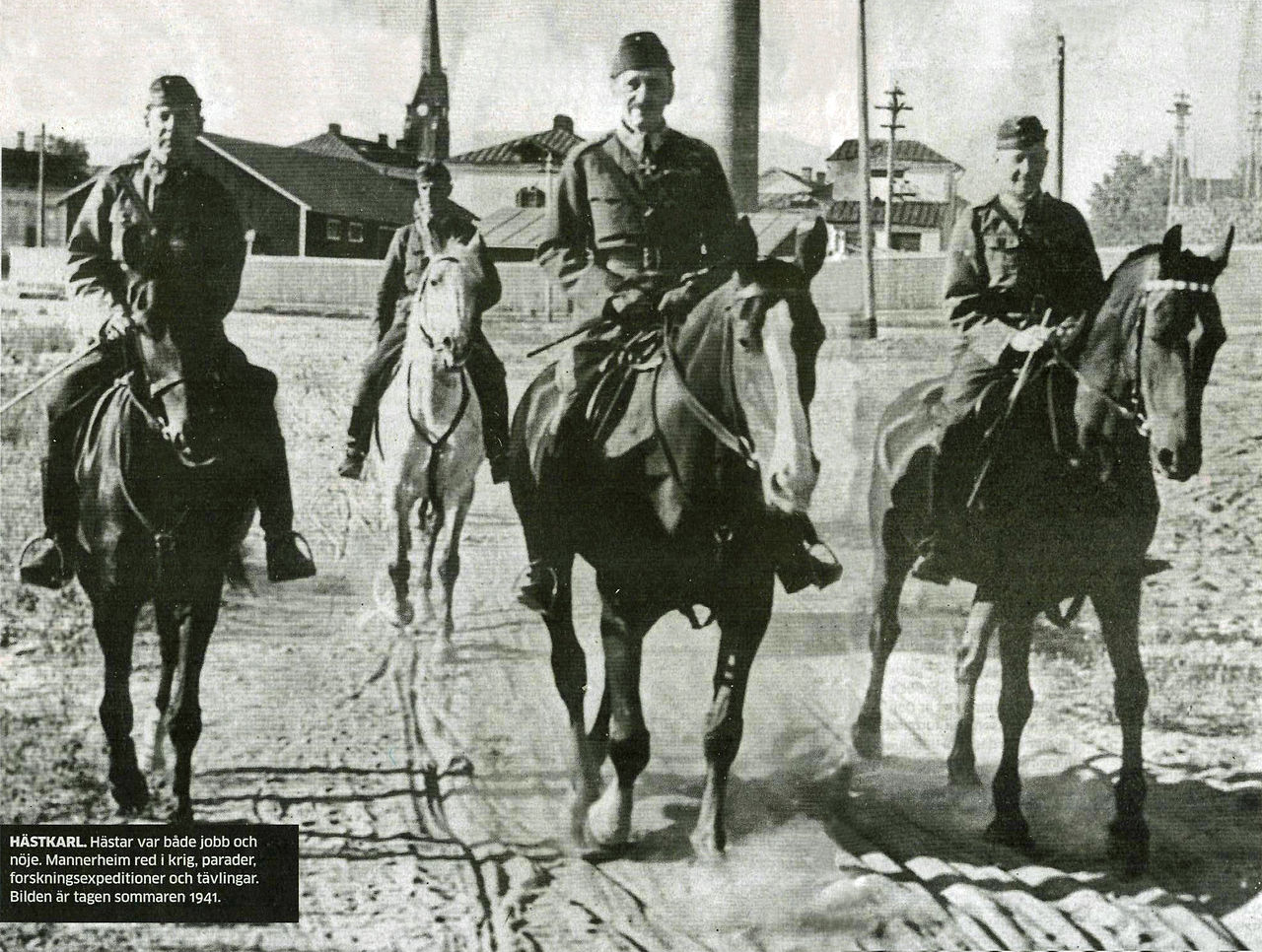
the author of this defensive war was the scion of the Swedish aristocratic family settled in Finland since the XVIIIc  baron Carl G.E.Mannerheim, who was the consummate cavalryman, schooled in riding at the Imperial Russian military riding schools, uhlan and chevalier guard officer, and commander of  13th Vladimir Uhlan Regiment (until 1911) and Life Guard Uhlan Regiment of His Imperial Majesty (until 1913) - both in Warsaw, Russian Poland. During the World War I's first year he commanded(?)  the Independent Life Guard Cavalry Brigade, fighting on the front against the forces of the Germany and Austro-Hungarian Empires -eg action on Krasnik. Then he commanded the 12 Cavalry Division until 1917.


 In Finland he became the cavalry commander and the military leader and fought on the side of Whites during the War of Liberty (on Wiki this conflict is called the Finnish Civil War). Next year he again served as the leader, thus secured the Finnish independence and transition to from the Grand Duchy of Finland to Finnish Republic in 1919.
His leadership was instrumental in the survival of Finland during the War World Two, allying the Finns with the Nazi Germany against the mortal danger posed by the Soviet Union until 1944 and going over the Allied side, this securing the Finnish territorial integrity and survival.


 It is known that he rode Filip across Asia to Pekin (today Beijing), Neptune was his horse in Finland in 1918, and later he rode Andermann that died in 1939. After that he rode Kathy.
More about Neptune and Kathy below -
      Neptune - was a  medal winning Olympic dressage horse, that is Swedish officer major Gustaf Adolf Boltenstern won silver medal in dressage in 1912 Olympic Games in Stockholm, Kingdom of Sweden, and in 1918 Neptune was sold to Mannerheim.

  Kathy - was his horse in the 1930s until the end that is the Mannerheim funeral - .


below photos of Neptune and Kathy under marshal Mannerheim:


perhaps Andermann being ridden by Mannerheim 


across the Central Asia to Tibet and China trek -two volume book  available here.


 Kathy's stone

Valete

ps
all photos from wiki commons

Saturday, December 7, 2019

Wiedzmin - fan film - The Witcher

Salvete Omnes,


o pewnym niezwyklym filmie, ktorego premiera stanowi temat dzisiejszego króciutkiego wpisu :

 ...niezwykła rzecz się zdarzyła, otóż fani cyklu opowiadań i powieści o wiedźminie Geralcie z Rivii autorstwa Sapka ( Andrzeja Sapkowskiego) zrealizowali własną pełnometrażową produkcję filmową pt: ''PÓŁ WIEKU POEZJI PÓŹNIEJ''.
Cały film - 1h 42 minuty - jest dostępny na stronie Alzur's Legacy - The Witcher Fan Film. (Youtube)
Wielkie brawa dla twórców i aktorów filmu,  czapka z głowy - vivat!

Film jest w wersji polskojęzycznej z angielskimi napisami.

inny plakat filmu - ze strony na Facebook.

z opisu:


Po 4 latach ciężkiej pracy nareszcie jest! Nasz pełnometrażowy, fanowski film o 
Wiedźminie stworzony zupełnie non-profit, od fanów dla
fanów twórczości Andrzeja Sapkowskiego! Opis: 
Ćwierć wieku po pogromie rivijskim (ostatnich wydarzeniach z Sagi) 
zostaje zaatakowane Kaer Morhen, stare siedliszcze wiedźminów z cechu Wilka. 
Napaści przewodzi potężny wojownik - Agaius. Parę lat później z Aretuzy, 
świeżo odbudowanej szkoły czarodziejek, ucieka Ornella, podejrzewana o 
odnalezienie legendarnej Księgi Alzura. W pościg za renegatką rusza Triss Merigold.
Z pomocą ma jej przyjść stary bard Jaskier, jego bękarci syn, Julian oraz
 poszukujący zemsty Lambert, ostatni zabójca potworów. 


 Mam nadzieje, ze tworcy zrealizuja nastepna czesc -
***

I have been a fan of Andrzej Sapkowski's Witcher Geralt of Rivia and read all his stories and many of fan fiction written since the first book got into my hands  in mid 1990s.

Ahead of the Netflix's big Witcher series production scheduled to air before this Christmas, on December 7, 2019 the group of dedicated fans released  their own  full length feature film dedicated to the world of the Witcher (albeit there is no Geralt in it), a completely non-profit production -

today's surprise release came 4 year after this strong-willed group created their ambitious project to make a feature film, then gathered money and support from donations etc, found talented actors cameramen etc, and in the end we can view this Fan Film titled Alzur's Legacy; 
 it is a feature film - ready to be watched on youtube- shot in Poland:

Synopsis[from youtube]: 
Quarter the century after the Rivian Pogrom (the very last events from the Witcher Saga)
 Kaer Morhen, an old keep of the witchers from the school of the Wolf, is being attacked. 
Leader of the assault is a mighty warrior - Agaius. 
A few years later from Aretuza, newly rebuilt school of the sorceress, 
runs Ornella, who has been suspected of finding the legendary Alzur’s Almanac. 
In pursuit comes Triss Merigold, with help of an old bard, Dandelion, 
his bastard son Julian and Lambert, the last monster slayer, seeking for revenge.

so it is 1 hour 42 minutes long, in Polish with English subtitles, and it is a feast and surprise at the same time.
I hope to see a sequel - :) and my big congrats to all:

Valete!

Wednesday, December 4, 2019

Chamfron - Islamic exmaples

Salvete Omnes,

 the chamfron - let us take a look  at this special piece of horse armor, perhaps one of the earliest pieces of armor invented to protect valuable war horses, this time horse's heads from injuries in combat -arrows, spear points and just blows to the vulnerable head. Even the latecomers to the horse warfare, that is the American Indians used their own chamfron-like horse masks well in the XIX century.
This time we will look at the Islamic chamfron used by the elite horsemen, used by the faris spahi, gulam or mamluks from Islamic states spread fromin Indian subcontinent like the Mughal Empire etc, Central Asia, Persian Western Asia, Mameluke Egypt, North African states and finally across the Ottoman Empire. In the Islamic context this part of horse armor was used until the XIX century in some parts, but the Ottoman spahis stopped their use already in the XVII century, while the Persian continued using it into the late XVIII century or laters (perhaps just for parade purposes. The chamfron saw the longest use in the Indian subcontinent.

One observation that immediately comes to mind is the narrowness of the chamfron - does this imply that the horses had more or less narrow pr narrower foreheads unlike today's Arabians from the Western Asia and Egypt?


From the Wiki galleries , nota bene on Wiki Commons someone decided to name the horse head armor gallery a shaffron[sic!] - God knows why? when chamfron is mostly used in scholarship (eg dr David Nicolle's books on the Mamluk(mameluke) warriors and other Islamic warriors). Why they decided to use a noun chanfron instead of chamfron on Wikipedia entry also beats me?
But then Wikipedia is full of strange names and arbitrary selections when come to history and art history etc.
Valete!
ps
one day soon I will gather here some of the Christian European chamfrons from the heyday of its use in Europe and Spanish colonies in the Americas.

Sunday, December 1, 2019

Jan Kazimierz II Vasa in armor - winged hussar armor?

Salvete Omnes,
and here we go - December and ever so close to Christmas and winter time, perhaps with snow this time, as we seem to have local cooling and not warming..
ad rem, I would like to share with you several images of Jan Kazimierz Vasa, the third and last Vasa king on Polish throne during the Polish-Lithuanian Commonwealth.

He, among our XVII century kings,  is perhaps the most difficult to asses, as under his rule the Commonwealth almost disintegrated and them came together again loosing huge parts and vital areas, large number of population and wealth in process, his armies lost and then won amazing victories, and he allowed for Ducal Prussia to become the separate state and led the nation into the civil war (the tragic Lubomirski's 'rokosz') in order to fulfill his (an his French wife's) absolutists designs and plans.
His reign ended in a complete disgrace, broken and with many problems he abdicated the throne (went to live his life at Louis XIV's France), without bringing the peace among his subjects and citizenry as the fumes of discontent, division and anarchy smoldering and weakening the country.
He abdicated even though the war with the Ottoman Empire and their allies was commencing (the famous reversal of alliances, the Zaporozhian Cossacks and Tatars again being allies in their war against the Commonwealth) and would continue until the end of the century.
Jan Kazimierz Vasa upon leaving Poland illegally took with him to France certain royal jewels and symbols (some were destroyed by the French revolutionaries during the 1790s)- I wrote about them in context of the Notre Dame Cathedral fire. Perhaps it is time France returned this treasures to Poland. It is our heirloom and national treasure.

 But he did have several grand moments - one of them was the great victory against the rebellious Zaporozhian Cossacks and their Crimean Tatar allies at Beresteczko (today Berestechko,, Ukraine)- probably the largest land battle of the XVII century in Europe.
In 1656 during the holy mass at the Lwów (Lviv) Cathedral Jan Kazmierz II crowned Blessed Virgin Mary as the Queen of Poland, and the official titulature became as follows - The Most Holy Virgin Mary, Queen of Poland. And we have been venerating Her and blessed with Her protection ever since, the most holy site for our Queen has been the Holy Black Madonna of Jasna Gora  abbey in Czestochowa.

there is this bronze plaque (a detail below) commemorating the Beresteczko victory, located in Franch church  where the Jan Kazimierz's heart was buried upon his death (he died in France, but his body was returned and then ceremoniously  interned at the Wawel Cathedral in Krakow, where it remains today). He was known for many lovers but had no official surviving heir as his children died in infancy.


and there are many portraits of our king in armor, and I wonder if this was the type of armor used by the winged hussars of the period?


..
there is also famous chain-mail armor and portraits in that armor showing our king, but these will be subject of another post.
                      ***
When German Kingdom of Prusia army occupied Krakow and Wawel Royal Castle complex (upon the defeat of the Kosciuszko Insurrection forces in the south  in  June of 1794), and in October of 1795 under the most secret command of their king they broke in and took the royal treasure (Thesaurus Regni) stored at the Wavel, that contained the rich, splendorous and millennial treasures of Polish Kingdom, and took it to Berlin.
The Crowns and regalia that were used by the Primate of Poland to crown Jan Kazimierz II as our king were taken illegally and in contradiction to moral and ethical principles of the time by the House of Hohenzollern, and their king Frederick Wilhelm III had them taken apart and melted (most likely in 18109-11) to finance their war effort against Napoleon in 1813 (they also got plenty of money from United Kingdom). The official heir to the Polish throne and Polish king since 1815, tzar Alexander of Russia and his brother Nicolas (since 1826) demanded these regalia back from Prussian Kingdom's rulers, not knowing that these treasures were illegally destroyed.

maps how the Commonwealth shrunk under his rule, especially the geopolitically strategic and vital region of Smolensk
Ad 1648 - 


Ad 1667


Valete