Sunday, December 8, 2013

JOB - Jacques-Marie-Gaston Onfray de Breville

salve,
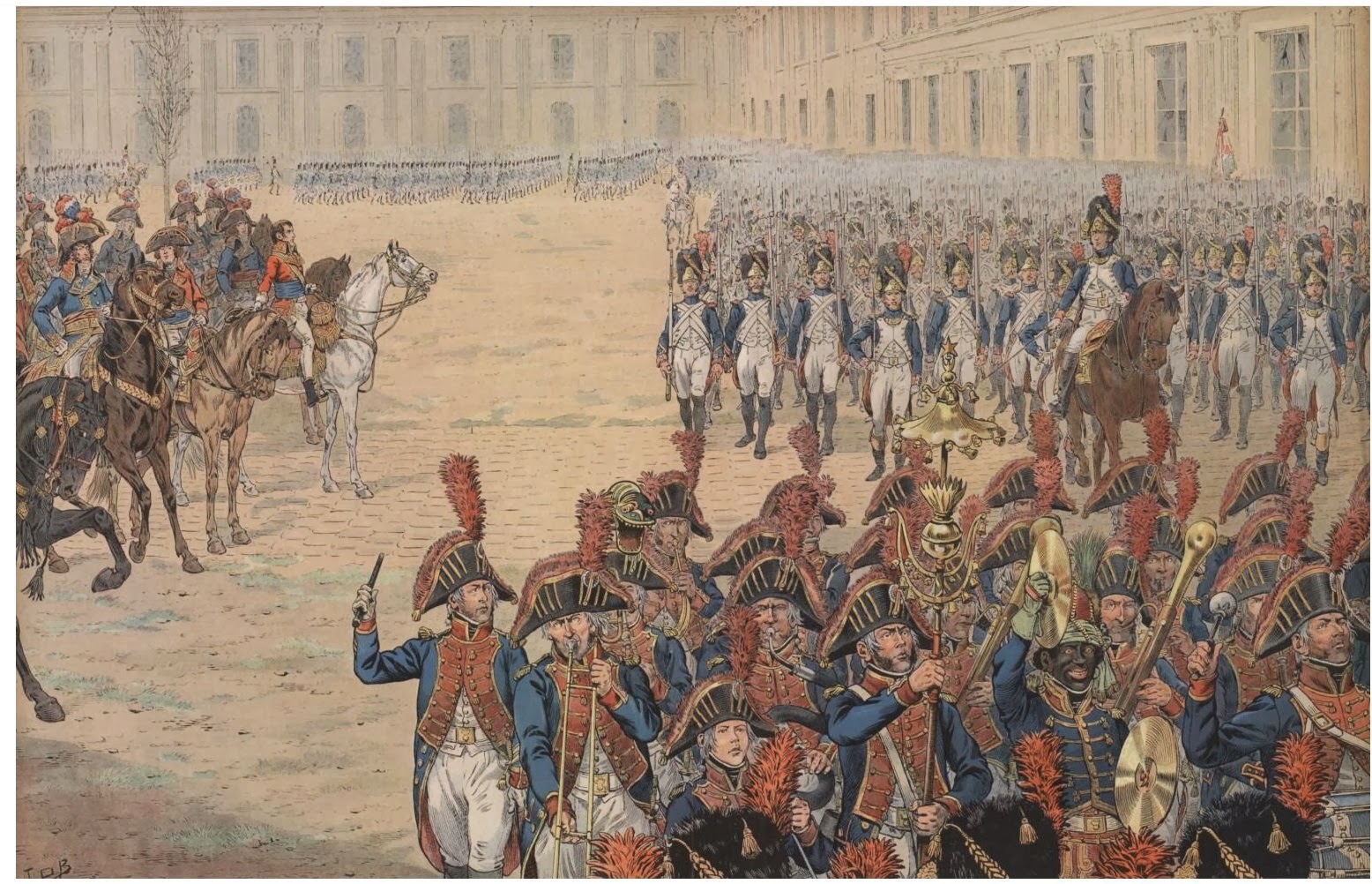
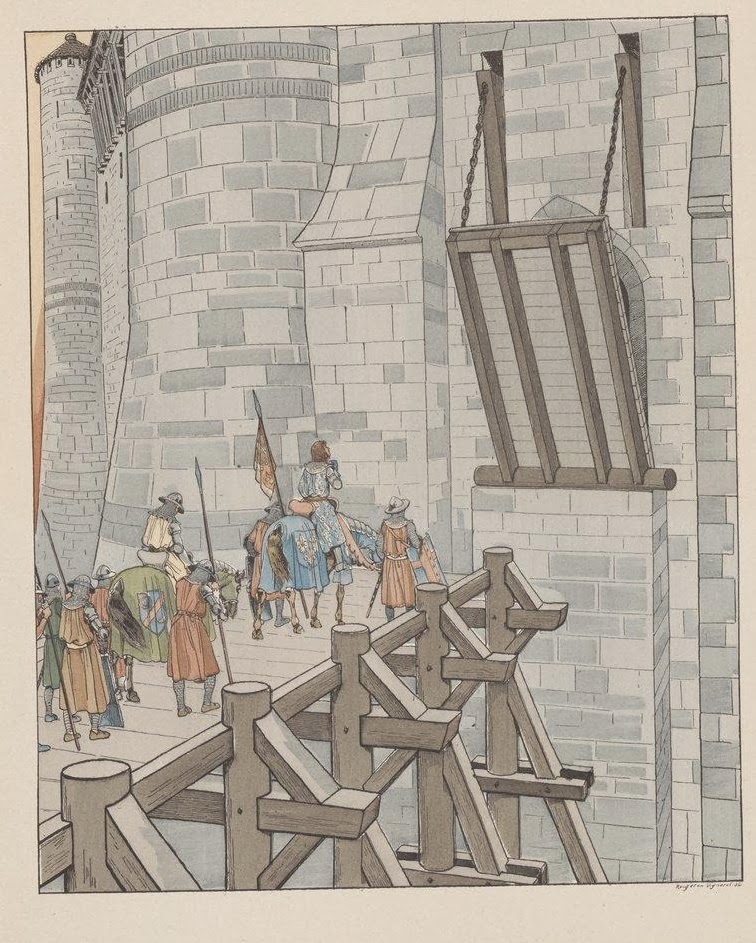
 from time to time I write about artists who have drawn and painted horses amongst their creations, and today I would like to add a new name to this list, namely a Frenchman, monsieur  Jacques Marie Gaston Onfroy de Bréville known under his nom de 'guerre' as JOB. Monsieur JOB worked during the so called Golden Age of Book Illustration and as you can see created lots of historically diverse subjects, from ancient to contemporary to his time, his art was dedicated to French history and glory. 

I collected below some of his works where equine companion to the cavaliers and travellers or soldiers figures prominently. Most of them are of Napoleonic Age - and display the horses of Napoleon Ier, Empereur des François, Roi d'Italie . (link points to Conservapedia,  described on Wikipedia and as one can see they are  adversaries of sorts).
Napoleon Ier


.. variae


..
Polish soldiers of Napoleon


 ..
enjoy :)

Saturday, December 7, 2013

Winged hussar circa 1770 - Osprey

Salve,
continuing from yesterday on the theme of winged hussars circa 1770, I copied, with the addition of  boots and left arm - the Osprey Polish armies winged hussar as it appears on plate B in the book.


 The author of the Osprey book,  Mr. Vincent w. Rospond, called this soldier from the above plate a 'Towarzycz* of Crown Hussars, c.1770 ( nota bene painted by Raffaele Ruggeri).
He goes on explaining that ''towarzycz*'' was a 'comrade', 'typically riding in the front rank with a lance.'

The description of the uniform:  'a tall quilted cap [...] had a red top. The comrades had  a medium blue zupan and facings. [ Presumably, as firstly the author describes an officer not shown in the plate, they wore a   'red kontusz -an over-jacket with split sleeves- lined in white' over their zupan but again in the text this part seems to address only the officer's uniform].  This lance pennant is halved in the uniform colours, red over blue. Waist sashes at this period were usually fastened by being wrapped around themselves' on the left side.'
Author even writes about the 'saddle cloth, it being red with blued edging,' although there is no saddle nor saddle cloth visible in the plate (page 44-45)
 My most important question about this reconstruction is with the depiction of the kontusz -  I have not seen this closing of the kontusz over the chest in any period art dating to XVIII century! By the way scholar Irena Turnau, in her book 'History of Dress in Central and Eastern Europe from the Sixteenth to the Eighteenth Centuries, Warszawa 1991,' gives the following definition of kontusz - an outer caftan worn on the zupan. The cut was characterized by the back being formed down to the waist from a long rectangle of cloth, to which wedge-cut sides were added. The sleeves, slashed  from the armholes to the elbows and thrown to the back, were called 'wyloty'  and 'łapcie. '(Turnau :162)
 Also, the curious additions are two additional elements of his attire: the use of gloves and the 'pendant' across towarzysz's chest.

In order to see a beautiful example of period Polish nobleman attire one has to look at  the drawings and paintings of  Jean-Pierre Norblin de La Gourdaine, whom we call Jan Piotr Norblin in Poland :)
Here a great depiction of a nobleman national costume:

Depiction is finalised with an attribution of the source - the figure is based on a painting by Canaletto (Bellotto) in Anusiewicz.
Now this Anusiewicz is a curious one - the  Selected Bibliography on page 43 lists the following title;
Anusiewicz, Marion*(ed) & Bronislaw Gembarzewski , Zolnierz polsk* od 1697 do 1794 roku (Wydawnictwo Ministerstwa Obrony Narodowej; Warsaw, 1963)

I have the book and the editorial page reads as follows:
Pod redakcją ogólną RADY MUZEALNEJ MUZEUM WOJSKA POLSKIEGO
Do druku przygotowała ZOFIA STEFAŃSKA
Konsultant ANDRZEJ NADOLSKI
Kolory plansz barwnych odtworzył STANISŁAW GEPNER
Okładką, obwolutę i stroną tytułową projektował WŁADYSŁAW BRYKCZYNSKI
Opracowanie graficzne JERZY CZERNY
Redaktor MARIAN ANUSIEWICZ
Redaktor techniczny ZYGMUNT PŁATEK

 This volume, number 2 of the series devoted to the history of the Polish fighting men from XI century to 1960, is always cited as pan Bronisław Gembarzewski's work - eg World Catalog
 
 Also, the name for  'comarade' spells 'towarzysz' in Polish and not 'towarzycz'
 - more to come :)
*original spelling

Friday, December 6, 2013

Winged hussars circa 1770 - Bellotto

Salve,
In November I posted a photo of XVIII century painting by Italian artists residing in Polish Kingdom Bernardo Bellotto showing Warsaw as seen then from the right bank of Vistula.
I wrote that you could see king's Royal uhlans there, detail of this painting below. But this is not the case.

Well, as you can see I had a rather tiny copy of a photo and I assumed that these were the Royal Uhlans, and my friend and winged hussaria historian Radek Sikora, via email, pointed to me that the colour of the riders' national uniforms, red 'kontusz' and navy blue 'żupan' underneath, correspond rather to the winged hussars uniforms of the period, in their final stages before conversion into the National Cavalry, and not to the uhlans, with their green uniforms

So I did some sketches of these hussaria uniforms of 1760s - showing towarzysz hussars.
I will continue this thread, as more sketches of  uniforms, arms and horse tack should follow


by the way the Osprey book on the Polish armies of 1770-94 has a very peculiar reconstruction of the winged hussar towarzysz, I will eventually copy the drawing and show you here with some discussion etc.
...
ps
I plan to address the pancerny (kozak) and petyhorcy cavalry of the same period, and other cavalry units of XVIII century Poland.
All comments and suggestions are always welcome.

Thursday, December 5, 2013

Józef Piłsudski's birthday and his Kasztanka


Salve,
 every nation has or should have a number of heroes and 'big men' (using an Amerindian word for leaders) whose actions imprinted themselves on that nation's history and perhaps current trends.

In case of Poland no one is more prominent than Józef Piłsudski, military and political leader of what we, the 'Polonians' (I like this name used by this English traveller and writer Moryson in XVII century ), understand as free Poland, Poland  reborn after 1918; and perhaps the father of  idea of bigger Poland, larger in size and ideals than her present state, while even today his memory and especially legacy of Polish raison d'etat are still dwarfing any leadership that Poland has had since his death in 1935.

Well, today is the birthday of pan ''Marszałek'' (marshal/marechal or Poland's military supreme commander).

I like this man, his choices and cherish his idea of free and strong Poland, where all citizens, no matter what religion or ethnicity, enjoyed equal rights and carried on their equal duties, to further the well being of all citizens of Poland.


'Imci' pan Marszałek had a horse, the most famous horse in Polish modern history - it was a mare, named 'Kasztanka' (chestnut after her sorrel coat), not especially athletic nor brave, but loving and faithful, and thus she won pan Marszałek's heart, and the rest is history.
.
.


above, 3 paintings by Wojciech Kossak, a portrait by Jacek Malczewski, a woodcut by Władyslaw Skoczylas, and a sculpture (but I do not know the author)
some more images of pan Marszalek on horseback, with horses and of course with Kasztanka :)


last two photos show Pan Marszałek  along with a gentleman wearing a hat being per pedes,  dear to many a horse art lover, namely this is pan Wojciech Kossak, author to the most famous equestrian portrait of Piłsudski.
...
ps
images from Wikimedia commons etc

Friday, November 22, 2013

Racławice Panorama


Salve,
last month I talked about visiting Wrocław in October and among monuments and museums seeing the Museum of Racławice Panorama (here the entire painting). Bellow, a real peasant wagon  placed along with the ground and vegetation all along near the foot of the painting, to create the illusion of three-dimensionally. The illusion works pretty well -:)


Well, I would like to start showing my photos of this masterpiece, its painters and the events taking place on canvas, as this is a historical piece describing some of the vents that took place during the battle of Racławice, AD1794..
 First, the battle in period art
by Aleksander Orłowski, participant of the Kosciuszko Uprising
.

 Michal Sachowicz, contemporary artist and witness to the Uprising
.

.
 perhaps it would be nice to start this topic with a little history on how it all came about:
 our Polish painters Jan Styka  (who came out with the idea in 1892, 2 years before the centennial of the Kosciuszko Insurrection))

and

Wojciech Kossak  got together to paint this cycloramic painting, being influenced by similar works painted by the Germans ( Anton von Werner  in Berlin,) and the French (Alphonse de Neuville & Eduard Detaille in Paris - example of battle of Champigny from gallica )  during 1880s. Also it is very commendable and perhaps astonishing that  the Committee, for the Austro-Hungarian State Fair  to be held in Lwow (Lviv)  in 1894, quickly came about having a design made  and construing the necessary building in Lwów.
Munich in Bavaria was another center for fine art at that time, and both our painters went there to study the art of painting the panorma. Also they had to order necessary and specially woven canvass (as always from Belgium), study or ask around the circle of miltiray hsitorians about the period uniforms and wepaons, study period art, and visit the locality, i.e., Raclawice village.  Kossak painted 4 large oils (1: 10 scale of the original size, they became known as Mała Panorama Racławicka bought by prince Adam Sapieha for his Krasiczyn castle ) in April 1893, and Styka took two of them to Lwow to finish them while Kossak took the remainder to his atellier in Krakow. In July 1893 the building was finised and canvas was streched, all 120 meeters long and 15 meters high.
The research for the historical accuracy led them to the Vienna war Office archives where they found a plan of the battle, drawn shortly after the engagement in 1790s.Then Styka, Kosska and Ludwig Boller(from Munich) went to scout the landscape near Racławice, and made landscape sketches.  Two historians, Tadeusz Korzon , who finished then a new and monumental biogaphy of Kosciuszko, and Konstanty Górski , military historian, aided them with historic information. also museums in Krakow, Lwów and other private collections around the Austrian Poland (partitions of Poland  ) were opened to them to allow for study of the art and material history of the Kosciuszko Uprising.

Our two principal painters chose painters to assist them in painting this behemoth: Teodor Axentowicz, already mentioned Ludwig Boller, Tadeusz Popiel, Zygmunt Rozwadowski (great painter of horses), Michał Sozański, Wlodziemierz Tetmajer and Wincenty  Wodzinowski. They got to work and worked hard , with many conflicts between the principal artists.

As art historian Kazimierz Olszanski, great biographer of Kossak family, writes the work assignment etc was as follows:
Jan Styka was the mastermind of the project and one who organised it. He painted the praying group, woman with the killed husband before the hut, the mounted figure of Kosciuszko; and with Wlodzimierz Tetmajer he painted 'kosynierzy '(scythe-armed peasant levies) attacking the cannons and troops of regular Polish infantry and peasant levies marching to fight. Wojciech Kossak painted 70 % of all figure composition of the entire panorama (he also painted the horse for mounted Kosciuszko painted by Styka) The landscape was painted by  Ludwig Boller  and Tadeusz Popiel. Following Kossak's sketches Teodor Axentowicz painted the infantry of Wodzicki regiment of foot while Zygmunt Rozwadowski National Cavalry regiments. Periodically Wincenty Wodzinowski and Michal Sozanski helped to paint various scenes.

After 9 months they finished  on May 28 1894, all the rest was added and synchronised with the painting  within a week, and on June5, 1894 the panorama opened its doors for the visitors.

Interestingly enough the painting was to have a short life for it would have been cut into sections and sold off, as  most of these pre-cinematic works had been, but another painter Stanisław Batowski came its defence, and in 1912 city of Lwow took possession of the artwork, thus it became the main tourist traction for the city of Lwow and National Treasure of Poland
It survived the World War II, although the Germans tried hard to find it (it was hidden by patriots) and the Soviets agreed that the Polish authorities of Soviet Poland would take possession of this artwork (although countless other works taken from Polish museums and private collections stayed in Ukraine and her museums) was brought to Wrocław (Stalin took Lwow and gave us Wrocław I guess) in 1946, where finally the Communists allowed for the new rotunda built and painting restored.
The newly restored Panorama was opened for visitors in 1985 and continues to draw crowds from all over Poland and abroad.

Anecdotes are always interesting - so there is one
     After the work was complicated and prises sung, the conflicts between Styka and Kossak grew as to the authorship of the project, and continued for many years.
Writer Tadeusz Boy-Żeleński wrote that Jan Styka was not really the one who 'pinxit' but the one who 'combinavit,' and so many words it was Kossak who who 'pinxit' most of it.  Tetmajer  used to say, Boy-Żeleński added, that when he just finished a section of panorama and paint was still wet, Styka would come in with the visiting officials or sponsors and show them the very piece as his own. But to Tetmajer  it was just funny or annoying,  but when Styka tried to do the same to Kossak ,  show his still wet work as his own,   he even chased him across the scaffolding with intent to cause bodily harm, being himself rather temperamental. Several times the said  Committee had to devote a session to these quarrels and one of the official notes stated (October 11, 1893) the names of the creators would be listed in an alphabetical order. It did not help much
The quarrel never really ceased between the artists,  and lived on after 1894, and actually Jan Styka's sons continued with it.
Both artists went to paint more panorama paintings, Styka 2 more while Kossak 2 more as well.  Theses hudge paintings were cut and sold off as smaller pieces.
.

 Kossak painted this picture later on, after the Panorama, circa 1924
.
to be continued
.

Wednesday, November 20, 2013

Visiting pan Jacek & Akhal-Tekes in Boska Wola

Salve,
gloomy November is all around us, in the Northern Hemisphere, so to enliven the atmosphere I will add some photos from my trip to Pan Jacek at his birch horseranch in  Boska Wola, southern Mazowsze.
I met pan Jacek and his lovely linguist wife, for the first time in person, and during that short October afternoon visit we talked horses and politics, while sampling excellent mint tea from their garden and enjoying warm afternoon, with horses grazing in their birch-covered grasslands :).
Here are the horses - a stallion and his dames along with offsprings. Stallion was awfully relaxed for a stud, while little filly and two colts were playful but already trained
The horses did not pay much attention to us, just grazed away,  also enjoying the warm sunlight, unusual for late October in central Poland.


Ps
One sad news - I just learned that great French artists and military horse painter maitre Eugene Leliepvre passed away  yesterday,   - pacem aeternam, maestro!
there are plenty of his images on the web, just a sample:
Maestro's own website
some work here