Salvete omnes,
I love monumental sculpture, especially when it contains horses and /or horsemen.
Long time ago I visited Baltimore and among the places where we walked was the area of the J. Hopkins University and Wyman Park (no mention of it in the Wyman Park Wikipedia page) where there are two very interesting monuments
- Union Soldiers and Sailors Monument
- Stonewall Jackson and Robert E. Lee Monument
The two Southern rebel (Confederate United States) generals monument is a great equine sculpture, powerful and full of emotions.
But it carries more than the beauty, for its symbolism and uncertain fate is part of the hot and divisive quarrel about the place of the monuments to the Civil War in the current American society and culture.
The city wants to remove this monument, along with 3 more monuments including the monument to the US Supreme Court chief judge who authored then famous or nowadays infamous case of Scott vs Sanford of 1855.
While I do not like the idea of the removal of these monuments, especially the beautiful Jackson & Lee, it is the way democracy works, without any regard towards history or beauty, whatever it useful to the politicians at the moment.
Some articles and voices supporting the idea here, here , here and here. Including here is the piece authored by the historian[sic!] of the official proposal to remove Jackson & Lee monument.
Ad rem, the sculptor of this fine monument was a woman named Laura Gardin, who married the famous sculptor James Earl Fraser, hence she is known as Laura Gardin Fraser. (interestingly the Wiki Commons page about the artist does not show any photos of her Jackson & Lee monument).
Nota bene, their studio in Westport, Connecticut, where they both had worked since the early XX century, when they died without heirs was demolished and many sculptures and casts there were destroyed, in the true American fashion of total disregard of history and beauty.
A short article about the monument by Scott L. Mingus, with photos. Scott also put his 2 cents about the issue of the monuments removal.
A piece by James LaFond against the removal, with many insights into the Baltimore politics. (interview with LaFond about living in a failed modern city, could be pretty scary to most)
enjoy
Equestrian Polish, Eurasian and the Americas history and horsemanship - from Bronze Age to circa1939AD. Historical equestrian art, my own artwork; reconstructions, and some traditional art media and digital artwork-related topics. All rights reserved unless permitted by 'Dariusz caballeros' aka DarioTW, copyleft or fair use.
Sunday, July 9, 2017
Saturday, July 8, 2017
Winged Hussars and POTUS & US Cavalry
Salvete omnes,
US President Donald Trump came to Warsaw, capital of Polish Republic, last Wednesday (5th of July), and on the 6th of July he delivered the historic speech in front of the thousands of cheering people from around the country, having behind him the Warsaw Uprising Monument (Krasiński Square), with the Krasiński Palace giving the Baroque opulence to it all. You can also watch this speech here.. and also read the transcript ( the National Review's look at the speech and reactions to it). As Polish-American I truly thank Mr. Trump for this speech.
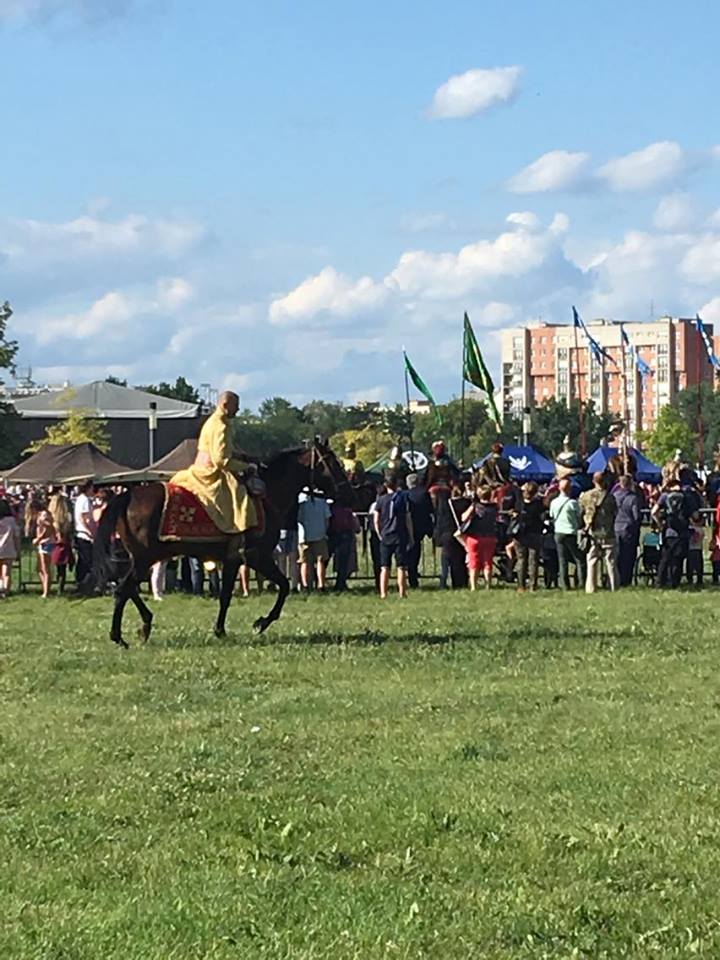
Winged hussars, small poczty or 'lances' from 4 reenactment companies in Poland, also came to Warsaw, in order to establish a camp and then to display the ancient and moder feats of horsemanship and military skill and decorum, and to deliver mock charges for the thousands of folks who gathered in this field to enjoy the Ministry of Defense festivities set up at the National Stadium - located in Praga (borough of Warsaw).
![]() |
| Radoslaw Szleszynski winged hussar companion tent |
![]() |
| Copyright @ Zelazny Jan - Pasja Fotografowania |
I came with Radoslaw Szleszynski & dr Radoslaw Sikora, and my son & sister, we had a jolly good time, showing the camp and explaining the history of the winged hussars to many a visitor until the late evening.
![]() |
| inside of the tent vsible, with dr Radoslaw Sikora presiding - :) |
As you can see some of the visitors were the American soldiers from the US Army, 2nd Cavalry, doing their rotation in the Mazury lake district in Poland.
![]() |
| mounting the winged hussar Pawel Moczkowski's tall, over 170cm at withers, gelding - wielkopolski |
![]() | |
| with the Gniew Castle castellan, husaria hetman and world famous jouster imc Pan Jaroslaw Struczynski |
Tuesday, July 4, 2017
4th of July
Salvete Omnes,
Happy 4th of July to all Americans - :)
especially to my fellow Polish-Americans - equestrian monuments to Tadeusz Kosciuszko and Kazimierz Pulaski in the US
enjoy your barbecue and good drink and the fireworks
ps
images are all from Wiki Commons
Happy 4th of July to all Americans - :)
especially to my fellow Polish-Americans - equestrian monuments to Tadeusz Kosciuszko and Kazimierz Pulaski in the US
![]() |
| Detroit |
![]() |
| Chicago |
| Milwaukee |
![]() | |||
| Providence |
![]() |
| Washington DC |
![]() |
| Hartford |
enjoy your barbecue and good drink and the fireworks
ps
images are all from Wiki Commons
Sunday, July 2, 2017
Gonitwa do Pierscienia - AD 1578
Salvete omnes,
[in Polish]
Tym razem przeniesiemy się do AD 1578 roku, kiedy turnieje rycerskie typu bohurt i rennen przechodziły do przeszłości, gonitwy i inne gry konne zastępowały owe turnieje średniowieczne. Ale w czasie pierwszych 3 królów elekcyjnych wciąż 'goniono się nawet i na ostre', z długimi kopiami i gdy po husarsku z tarczami.
Nasze rycerstwo, wzorem płynących do nas z Cesarstwa i Italii zabaw i ćwiczeń, uprawiało gry i zabawy z kopia powodując koniem, czyli w dzisiejszym przykładzie mamy tutaj gonitwę do pierścienia (artykuł o pozostałościach toru do gonitwy na panoramie Korytowa z AD1642 roku wyjaśnia nieco zawiłości tych gier). Była to gra zręczności i sprawności jeździeckiej, gracji męskiej i splendoru szlacheckiego, a własnej fantazji w stroju rycerskim i rzędzie końskim. O gonitwach w Encyklopedii Staropolskiej.
Ciekawe czy kopie do gonitwy do pierścienia w państwie polskim były tak długie jak te husarskie ówczesne (dochodzące nawet do 6m). Z wyżej linkowanego artykułu dowiadujemy się, że źródła mówią kopiach o 3m długości, wadze okolu 3kg, miały być bogato zdobione (wedle inwencji jeźdźca). Zaś sam stalowy bądź mosiężny pierścień wieszano na wysokości głowy jeźdźca a wielkość jego zależała od sprawności rycerzy biorących udział, np jak pisze autor artykułu o Korytowie pierścień miał miedz miedzy 6 a 10cm średnicy.
powyzej 'Ring rennen' lub 'Ringelrennen' czyli gonitwa do pierścienia na rycinie z II polowy XVII wieku ze Szwecji (opis)
[in Polish]
Tym razem przeniesiemy się do AD 1578 roku, kiedy turnieje rycerskie typu bohurt i rennen przechodziły do przeszłości, gonitwy i inne gry konne zastępowały owe turnieje średniowieczne. Ale w czasie pierwszych 3 królów elekcyjnych wciąż 'goniono się nawet i na ostre', z długimi kopiami i gdy po husarsku z tarczami.
Nasze rycerstwo, wzorem płynących do nas z Cesarstwa i Italii zabaw i ćwiczeń, uprawiało gry i zabawy z kopia powodując koniem, czyli w dzisiejszym przykładzie mamy tutaj gonitwę do pierścienia (artykuł o pozostałościach toru do gonitwy na panoramie Korytowa z AD1642 roku wyjaśnia nieco zawiłości tych gier). Była to gra zręczności i sprawności jeździeckiej, gracji męskiej i splendoru szlacheckiego, a własnej fantazji w stroju rycerskim i rzędzie końskim. O gonitwach w Encyklopedii Staropolskiej.
![]() |
| fragment obrazu Pehr Hillestrom'a |
powyzej 'Ring rennen' lub 'Ringelrennen' czyli gonitwa do pierścienia na rycinie z II polowy XVII wieku ze Szwecji (opis)
,,Artykuły gonienia do pierścienia" na uroczystościach weselnych Zamoyskiego.
Warszawa,G I 1578. [za Archiwum Jana Zamoyskiego, wyd. Sobieski Tom 1, 1904]
Arch. xx. Czartorys. Teka Naruszewicza 86, nr. 142 (Kopia z w. 18 z napisem:
Ex Ms. arch. Stan. Aug. regis. )
Artykuły gonienia do pierścienia podczas przenosin po weselu Jana
Zamoyskiego z Radziwiłłówną.
Andrzej Opaliński z Bnina, marszałek Wielki Koronny, Rohatyński,
Szremski starosta.
We wszystkich narodziech, przy których obyczaie dobre y uczciwe dworskie zabawy
zostały, zachował się ten zawżdy obyczaj, iż na ziezdziech wielkich, a
zwłaszcza na dworzech monarchów zacnych, ludzie dworscy a młodzi rozmaite
krotofile wywodzili, czyniąc to częścią dla tego, aby panom swym ucieszenie
jakie uczynili y pięknemi postępkami, tudzież też y dworskiemi inwencyami
im się przypodobali.
A iż do tych czasów uczciwy ten zwyczay na dworzech wszystkich z pochwałą
ludzibacznych iest statecznie zachowań, rozumieiąc ia też, iż na dworze
Króla JM., naszego m. p., na ziezdzie tym, na którym ma bydź ludzi konkurs
niemały ku ozdobie zacnych przenosin JM. Pana Jana Zamoyskiego, podkanclerzego
koronnego, przez Ich M. Pany bracia rodzone małżonki JM. Pany Radziwiły,
xiążęta z Ołyki, naydować się będzie ludzi młodych dworskich
niemało, którzyby tych krotofil radzi użyli, pozwoliłem za pozwoleniem
chętnem Króla JM. placu na gonitwę do pierścienia przed oczyma
pańskiemi w Uiazdowie [dzisiaj Warszawa] na przyszły czwartek [9 lub 14 stycznia]).
A iż pewnie tak sobie obiecuią ludzie dworscy, iż się naydą ci, którzy y
sobie gwoli,y dla zabawienia Króla JM., y dla przyzuania każdemu chęci
ćwiczenia y inwencyi iego, więc też y dla ozdobienia tego festu zacnego,
ochotnie się do tej krotofili przyczynią, tedy tern pismem się
publikuie y pobudka daie.
Będą sędziowie zacney tey krotofili, zaczem y
szlacheckiemi znakami y upominki będą poczczeni, to iest tym kształtem:
pierwszy upominek weźmie, który nayczęściey pierścień brać będzie,
wtóry, który z naycudnieyszą inwencyą na plac przyiedzie,
trzeci, który naykształtowniey drzewce podniesie.
A iżby się to porządkiem swym toczyło, tedy temi artykuły to
gonienie się obwieszcza:
1. Ktokolwiek będzie chciał gonić, ma bydź w słusznym do tego
ubiorze; bronią żadną, któraby ku zwaśnieniu bydź mogła przyczyną
a miasto krotofili niepokoy uczynić, nie ma bydź ozdobion.
2. Przyiechawszy na plac a naznaczone mieysce do gonitwy raz
obiachawszy, ma spokojnie stanąć na tym końcu, z którego maią począć
biegać.
3. Żaden przedtem gonić niema, niż mu będzie od sędziów roz-
kazano.
•i. Kto pierścień weźmie, za każdym razem napiszą mu razów sześć.
5. Kto w T zgórę krawędzi pierścienia, uderzy, razów trzy.
6. Kto w nadolny krawędź uderzy, razów dwa.
7. Kto w stronę pierścienia lewą albo prawą, raz.
8. Kto drzewcem sznur przeniesie, na którym pierścień będzie wi-
siał, wszystkie razi traci, ieśli iakich przed takową omyłką dostał.
9. A ieśliby ich nie miał, a potem równo z kim innym dostał, iuż
będzie bliższy wygrania ów co takiey omyłki nie uczynił.
10. Komuby z strzemienia noga wypadła w biegu, traci wszyst-
kie razy.
11. Komu sie głowa odkryie, traci wszystkie takie razy.
12. Komuby kopia z rąk wypadła, albo komu się o ziemię ułamała,
traci razy wszystkie y potem zgoła nic do gonioney nie ma.
13. Ktoby z miejsca poskoczywszy w pół kresu dla nieudatnego
złożenia drzewca konia zastawił, drugi raz się poprawić nie może,y owszem
on raz idzie mu na zgubne imię.
14. Wolno też będzie każdemu kopią tą gonić, którą sobie na plac
przyniesie.
Dan w Warszawie, 6 Ianuarii 1578 roku.
![]() |
| fantazja - stroje uczestników gonitwy do pierścienia circa 1609 w Rzeszy |
Saturday, July 1, 2017
Birth of the Polish-Lithuanian Commonwealth AD 1569
Salvete omnes,
on this summer day of AD 1569 the Polish-Lithuanian Commonwealth was born.
Jagiellonian monarch Sigismund Augustus, the King of the Crown of the Kingdom of Poland and Grand Duke of the Grand Duchy of Lithuanian, and his subjects - representatives of the Crown of Kingdom of Poland and of Duchy of Lithuania - came to sign the real union between two states during the Sejm Walny (three-tiered - king, senators and representatives - parliament) gathered in Lublin. His Royal Majesty ratified the union on July 4 [sic!] Ad 1569.
The childless king ruled over a realm that had been already in personal union under himself and prior elected rulers of the Jagiellonian Dynasty since AD 1385. The act changed the two-state uneasy personal union into one-state union, preserving some not too small differences. In 1791 the Parliament abolished the Union retaining a single state.
The document was singed in the royal city of Lublin, now in eastern Republic of Poland, back then it was the center of the vast state.
... perhaps for the first time the name 'Rzeczpospolita Obojga Narodow' (Commonwealth or Republic of Two Nations)) was used in an official document where it is inserted in there under the promise of using their lances to defend the more violent needs of this new Republic.
Modern Republic of Poland still officially calls herself Rzeczpospolita (with Polska or Polish added) in all official and unofficial documents, 448 years after this christening.
The coat of arms of the new union was eventually a white (silver) eagle (White Eagle) and a white (silver) charging knight on a white horse ( known as Pogon/Pahonia) in a escutcheon parted quarterly, the color of the shield was gules or red.
enjoy
ps
images are from the Statuta y Przywileie Koronne published in 1570, from Marcin Bielski Kronika circa 1594, and also Wikimedia Commons.
Subscribe to:
Posts (Atom)