Monday, July 18, 2016

Millennium Polish Cavalry Monument

Salve,
the Polish military celebration of the 1050 anniversary of the Polish state is fast approaching - August 15, 2016. There will be marches and parades, including a mounted parade in front of the Poland's President in Warsaw.

In the capital of Polish Republic there is this busy intersection called the Rondo Jazdy Polskiej ('Polish Cavalry Roundabout'), and to the side of this roundabout just where Mokotów Field park beings there stands the 'Pomnik Tysiąclecia Jazdy Polskiej' ( 'Millennium Polish Cavalry Monument' ).
The monument arose due to the popular demand, it was founded by the money collected from the donations, and it was designed by Mieczysław Naruszewicz, sculptor and industrial designer, and so it stnad today in its unfortunately it is not the best example of how to display a monumental sculpture of this caliber - basically the monument is facing the park and not the traffic (viewers) at this quite busy Warsaw intersection. Some say the cavalry is charging south, towards our Czech brothers.

For the ideological reasons, built during the Communist Jaruzelski Junta reign,  the monument does not include any figure of the winged hussar, or a knight or any reference to the noble traditions of the Polish cavalry. Instead it consist of two figures - a mythical mounted druzhina warrior and a Communist cavalry horseman.


The plates on the column list some of the battles Polish cavalry participated in, from Ad972 to AD1945, but the list does not linclude the last charge by the Polish cavalrymen, this one being an action in 1947, when the 'WOP Konna Grupa Manewrowa' (Mounted Maneuver Group') charged the UPA sotnia at the foot of the Chryszczata Mountain in the Bieszczady Mountains.


enjoy
ps
The Wołyń (Volhynia ) Genocide - traditionally commemorated by the Poles around the world on July 11 or the Bloody Sunday - was remembered last week, I am eagerly expecting the very first feature film, Wołyń,  by Wojtek Smarzowski hopefully coming out this Fall to the theater near you.
Perhaps should tell you a story - when I lived in Brooklyn, my landlady, then an elderly woman but full of life and 'joke,' was a Pole from Volhynia who luckily survived the genocide, but losing her parents and a sibling and many other relatives during these horror times. First, her father had been killed by the Germans and their Ukrainian helpers (she was not sure who did it, he had been first interrogated and tortured by the German police but was allegedly released to go home to have been found murdered when his way),  then a year later in 1943 being a little girl she saw her very mother and her little brother murdered by the Ukrainian neighbors. Her brother and she hid in the attic of their home, where another Ukrainian neighbor found them there but mercifully allowed them to run away to their family (auntie) in the distant village (she was 8 and her brother  was not yet 10 years old).
Their home and the farm buildings and their lands were taken by the Ukrainian state and neighbors, so they, being refugees from their village and Poland being occupied by the Soviet Army and Volhynia lost to the Soviets, were never compensated for their property (eventually the brother and she  found home and started their own new families in the US).
[all photos are from Wikimedia Commons)

Friday, July 15, 2016

Titian's Ecce Homo and 2 horses & bridles

Salve,
let us move deeper into the European history today, and thus I would like to invite you for a little excursion into the world of the Italian master Titian or Tiziano Vecellio...
Should I add that I absolutely admire and enjoy Titian's works (eg 1, 2,3, 4, 5... ), especially his religious and mythological works, his nudes and portraits. Perhaps I should - :)
I own one large album of his works by Sir Claude Philips, but then Wikimedia Commons users and Google Art project allow us, by providing high resolution photos, to get so close to many of the paintings that we can almost touch the brushwork , or so it seems.

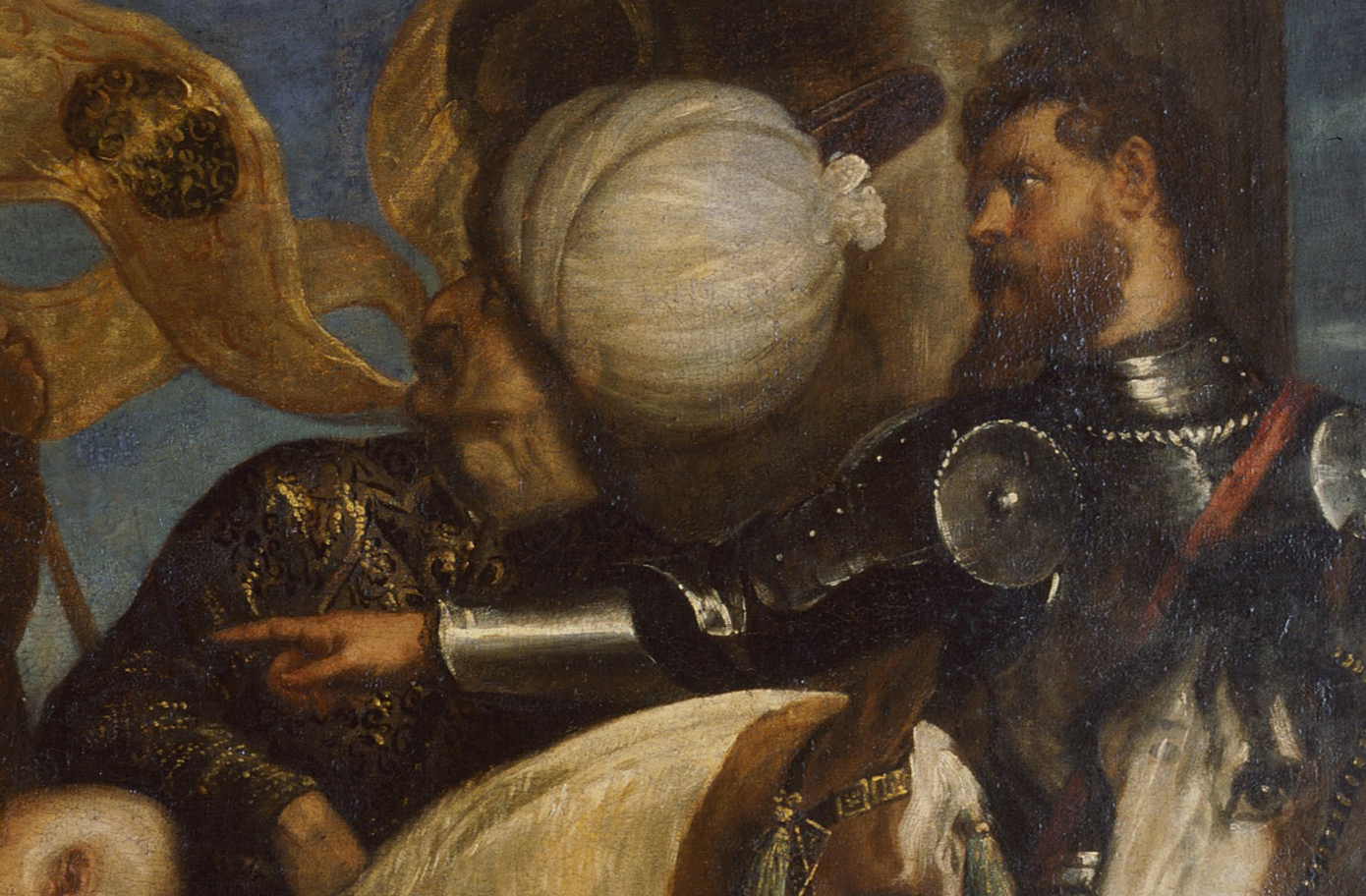
So, while looking a this large painting by Titian - Ecce Homo - (the painting is quite dark in the area of horses, perhaps due to the aging process and various restoration/protection efforts) I noticed several interesting aspects of the contemporary riding equipment, costumes and finally quite naturalistic horse portraits.

First horse and rider - going left to right - is a Saracen (Ottoman Turk in costume and appearance) thus his horse also might be Turkish - nota bene it is a palomino. The bridle appears to be influenced by the Turkish design, but the curb-bit has some long 'S' shaped shanks.

a closeup on the bridle - the low noseband is very interesting.

but then this net-like covering with tassels is similar to the French XVI century equestrian tack, often designed by the Italian artists. Perhaps it was copied from the Ottomans?

German/Italian/Spanish? - note the long, narrow head, small ears, and a bold face

a closeup - large, expressive eyes and neighing mouth (another very animated horse in this Titian's painting)

 actually the horse is not dissimilar to the horse face in the famous Breda painting by Diego Velazquez - perhaps an Iberian horse then?

this horse and the Velazquez horse have stockings - coincidence, or preference for colorful horse markings...


a breastplate and short-shanked curb-bit

Riders appear in contemporary outfits - one a Saracen (Ottoman Turk) and the other a 'Roman' (Italian or German nobleman)

the soldier in a foreground wears an interesting short crimson velvet? coat with long kontusz-like sleeves (going back to the Median/Persian riding coat kantuš), while the figure behind him has a long expensive chain-of-mail coat on the second figure. Both are wearing swords, with two different kinds of suspension.

 Nota bene in this painting this costume was used as well, except over the armor

staff weapons - a halberd and a partisan, also a flag
Finally, I could not tell if these two horses are shod..
enjoy

Thursday, July 14, 2016

Zhao Mengfu's horses

Salve,

again thanks to the users of the Wikimedia Commons, we are given  a rare glimpse into the world of Chinese painting some 700 years ago.

First, I am going to add that I do have a favorite dynasty of the Chinese awfully long imperial history - that would be Tang China and her multiethnic empire (at least until the An Lushan rebellion).
Yuan Dynasty is a Chingizid Borjigin Mongol dynasty that had conquered then much partitioned China, unified the country into one imperial state but eventually, after about a 100 years, was forced out of the 'Han' China by the nationalistic Han revolt which in turn  gave raise to the Ming Dynasty etc (I am sure you can read all about this on the Web).
Chinese arts did not stop flowing under the Borjigin Celestial Emperors - eg article on the subject here.  A sample of figurative art under the Mongol rule.
Yuan Dynasty, Yang Guifei Mounting a Horse, by Qian Xuan (1235-1307).

So, this artist Zhao Mengfu came from the highest circles of the Mandarin clans, from the imperial (Song Dynasty) clan of Zhao. He was a prolific artist and awfully skillful calligrapher.


for now we will just enjoy the paintings themselves, but in the fure I may exlpore some interesting info appearing in these works of art.

enjoy

Tuesday, July 12, 2016

Some horses from Charles V de Lorraine Buda triumph

Salve,
several days ago while showing the painting by maestro Gyula I wrote a little bit about the battle of Buda AD 1686 and its victorious general prince Charles V of Lorraine. I attached a photo of a painting, now at the Nancy Museum in France, showing prince Charles' Buda triumph.
Prince Charles on spirited Turkish? pinto
Well, I looked closer at the painting and there are some interesting horse-related matters that I would like to share with you.
First, let me share with you a painting showing the Holy Roman Emperor Leopold I, the sovereign of prince Charles, armored, Roman Caesar-like on a fine dappled horse with some rather fine horsetack.

secondly, it is said that Charles was a disciple of Raimondo Montecuccoli, Hapsburg field marshal (victor at Saint Gotthard of 1664) and writer (here his quotes including the famous È la lancia la regina dell’ armi a cavallo ) - hence I found this very fine portrait of this man of arms and letters.

Finally, the horses from the Charles' triumphal procession
the center is occupied by a chariot with a team of four horses - all buckskin in color, in a typical fashion used throughout the Polish Kingdom, perhaps also in the Hapsburg and Turkish Hungary, and Danubian Ottoman principalities, where pairs or larger teams as shown here were used, typically carriage horses of  this color. The driver is shown in a Hungarian or generally speaking East-Central European hat, but his coat has unusually large cuffs, typical of the Western European dress.

this group shows cavalrymen carrying captured Turkish standards and war paraphernalia and other insignia like the turban on a lance and horse tails standard. The rider in from rides a gray horse, perhaps a sign of high rank and is wearing a typical 'uniform-like' attire of the period. Note his large long boots, long coat, breastplate,  and tricorne  hat -
Here, in spite of low quality of this photo, we perhaps can decipher some detail - so I think we have the prince's own horse, held in the most ancient manner by a retainer also on horseback. Noble steed's tail is tied, denoting a warhorse of some standing? Horse appears to be of unusual color, perhaps an appaloosa?


More military commanders, some in cuirasses (eventually the heavy line cavalry using breastplates would be called cuirassiers during the next century and later). The mounted horse in the front is in full collection, well rounded, with a splendid hindquarters and untied tail.
The infantrymen next to the prince's chariot are dressed in a typical fashion of the Hungarian Kingdom hajduks, perhaps they formed a bodyguard to the prince? Behind the chariot we can see some bound Ottoman prisoners...

enjoy

Friday, July 8, 2016

Gyula Benczúr's horses

Salve,
Gyula Benczur was a Hungarian genre painter, and amongst his many works he painted this canvass showing the taking of Buda in 1686 during the long war between the Ottoman Turks and the Holy League.
The battle saw the fruitless but heroic defense of the fortress by the Turkish (and presumably Jewish inhabitants of this 150 years old Ottoman town)  defenders and the masterful strategy and ultimate victory by Charles V duc de Lorraine.

During the siege both the defenders and the besiegers used large artillery pieces, including very large mortars. There is a very interesting article on the Ottoman firearms and artillery via academia.edu
Nota bene the long siege saw several cavalry engagements between the besieging regiments and approaching Turkish relieving forces. The Turks were defeated and thus Buda was stormed by the besiegers, followed by looting, rape, pillage and massacres of the defender population.
For the British readers this fateful siege can be of much interest, because of the participation of numerous subjects of king James II, volunteers in the noble crusade against the Turk. There is also a journal of the siege written by Jacob Richards and published in 1687.
Interesting article on the British military participation in the siege can be found here.
Maestro Gyula painted this huge , wonderfully crafted piece

 The Kingdom of Hungary, now reduced to a pitifully smallish Hungary, had been famous for the war and riding horses since the  Middle Ages. During the Hapsburg rule in Hungary, after the wars against the Turks in the XVII c.,  various stud farms had been established, including Bábolna, Mezőhegyes, Radautz, Piber, and Topolcianky etc. The horses in this painting represent the horse breeding achievement of that Hapsburg period, thus horses contemporary to maestro Gyula's times.
But look at these horses, please :)


modern 3-d visualization - in Hungarian - and the video, separately, on Vimeo
enjoy
ps
I am a bit baffled with the lack of digitized British pre-1800s books or I have not encountered their general access site (other than google books which I am not very fond of), on the opposite end sit Polish libraries where the librarians are digitizing their collections and archives in tens of thousands, all available for free. The French Gallica or vast German digital libraries are other great places of research.

Wednesday, July 6, 2016

Borysthenes Alanus


Salve,
July has begun, hopefully it will be a good month for all of you, dear web visitors.
Today a little ancient horse story.
I  introduced the story of the Sarmatian/Alan horses among the Romans during the ancient empire in this post.
I also wrote there about the emperor Hadrian's mount Borysthenes Alanus. This hunter's name was preserved for posterity because a poem was written and it is thought  that the poem had been composed by Hadrian himself. 
Lately  I copied the poem in its Latin original that is thought to have been carved in stone as a part of a funerary monument set upon this horse's grave.

 Borysthenes Alanus,                                       
 
  Caesareus veredus,                                          

 
per aequor et paludes                                    


et tumulos Etruscos                                                                                      
 
  Pannonicos nec ullus

 
apros eum insequentem

 
  dente aper albicanti

 
ausus fuit nocere,

 
  sparsit ab ore caudam

 
vel extimam saliva,

 
  ut solet evenire.

 
Sed integer iuventa,

 
  inviolatus artus,

 
die sua peremptus

 
hic situs est in agro.


 [English translation here or here]

So, scholars believe that  this avid hunter (even shown on his coins hunting from horseback), horseman and great Roman emperor had his spirited Borysthenes Alanus buried near or in a town called Colonia Apta Julia (Apt in France) in Gallia Narbonensis situated on the ancient Roman military road called Via Domita. Most likely the horse died during a boar hunt in Gaul.
 The stone, a bit damaged and in two pieces, was excavated in Apt at the beginning of the XVII century. However, the poem was already known during the Middle Ages, eg Huguccio of Pisa(died 1210AD)

From Cassius Dio and Historia Augustae we know that Hadrian had several monuments erected to his pets, however, neither of the sources mentions this Borysthemes Alanus.
 
ps
the roundels come the Arch of Constantine, and are thought to depict emperor Hadrian hunting.