Sunday, November 24, 2019

Andrzej M. Fredro - Militarium w opinii geostratega Jacka Bartosiaka

Salvete omnes,
[Polish]
dzisiaj parę słów jedynie - bo mówić będzie mecenas Jacek Bartosiak - o dziele kasztelana lwowskiego Andrzeja Maksymiliana Fredry, herbu Bończa (z Herbarza Bonieckiego opis krotki zywota pana Andrzeja)
 
, Militarium seu Axiomatum belli ad harmoniam togae accommodatorum libri duo, które AD 2016  zostało wydane w tłumaczeniu na język polski, jako ze orginał był opublikowany po łacinie w 1668 roku, owej lingua franca Rzeczpospolitej Obojga Narodów.
Jacek Bartosiak ze Strategy & Future video link
tłumaczenie dzieła - Biblioteka Staropolskiej Myśli Politycznej - Bartłomiej Bednarek et al.
herb Bończa z dzieła Kochanowskiego


strona z wydania łacińskiego pełną ciekawostek militarnych - np mamy kopie z choragwią i dzidę,

nota bene mości kasztelan był pochowany w kościele Ojców Reformatów w Przemyślu.
fragmenty z dzieła Militarium przetłumaczone i wydane ponad 100 lat temu bo  w AD 1856.

ergo, książkę szczerze polecam - jako, że coś tam czytuję, bo i posiadam.
Valete

Thursday, November 21, 2019

Pierre Belon. Les observations & Mamelukes, Turks etc

Salvete Omnes,
short entry on this particular XVI century travel - Pierre Belon. Les observations de plusieurs singularitez & choses mémmorables, trouvées en Grèce, Asie, Judée, Égypte, Arabie, aux autres pays étrange.(AD 1588 edition at the French national Library Gallica and English introduction & synopsis with images). English translation (2012) here - but to be purchased not free.

Already an illustrious scientist Pierre Belon, a Frenchman in his country service and protege of the Montmorency family, was sent along with the grand French embassy under Gabriel de Luetz, Baron et Seigneur d'Aramon et de Vallabregues   to the High Porte & the sultan Suleiman (even went to see the campaign against the Saffavids) - here Gabriel d'Aramon portrayed with the Turkish arrows, presumably. Jean Chesneau, who was the secretary to the ambassador, wrote Le Voyage de Monsieur d'Aramon dans le Levant  that we may take a look at  but  at some other time.
 
The scientist voyaged within the Ottoman Empire and upon return in 1549 monsieur Belon may have started composing the aforementioned work for publication, first printing in AD 1553, many later editions. He, being a Roman Catholic, was murdered by some protestant/s in Paris (Bois) in 1564, as France was inherently dangerous place due to the wars  between the Catholics and the protestants.

There are many woodcuts in this work, and two are interesting more than others as they show:
a Circassian  lord on an Arabian horse.


and an Egyptian couple, the faris (knight) with his lance and next to him his wife mounted on a mule, modestly riding side-saddle.


 Arabian nomad? from the Syrian desert, with the bow and arrows.
 

very interesting images worth studying

Valete

Wednesday, November 13, 2019

Turkenbeute from Karlsruhe

Salvete Omnes,
today a little entry -  Ottoman horse-related treasures to be found within the Federal Republic of Germany, the federal state of Baden-Württemberg, in the city of Karlsruhe. 

 Imperial commanders (field marshals ) and Baden-Baden princes Ludwig Wilhelm von Baden-Baden(Turkenlouis)  - below dressed as a Ottoman warrior
 
participated at the battle of Vienna (AD 1683), victor of  Battle of Niš (AD1689) and Slankamen (AD 1691) where the grand visir Fazıl Mustafa Köprülü perished with his army;  prince Ludwig Wilhelm participated as sub-commander at the battle of Zenta ( AD1697) .
 
and his uncle Hermann von Baden
 
fought the Ottoman Turks during the war 1683-99. They brought many captured trophies from the battles  and this collection known as Der Turkenbeute constitutes the large part the fabulous art collections at the Karlsruhe Palace Musuem.
Schloss Rastatt , a nother of the Badenian palaces - build by and for Turkenlouis
 
Some of the images taken from Wiki Commons. - the exhibit and some of the Ottoman horse tack and weaponry, including the most fabulous carpets etc


 they also have many more saddles, including Polish XVII  c saddle, and lost of horse tack - like the woven Ottoman cinches and bridles etc.
Valete

ps
 the very  palace-museum also contains some fabulous examples of the ancient art from Europe, Western Asia and North Africa . The medieval period is very well represented - eg great representation of Saint Martin.

Monday, November 11, 2019

Saint Martin Feast

Salvete Omnes,
 Today, on this Veterans Day and Polish Independence Day  we also have saint Martin of Tours Feast day.
In Poznań, one of the oldest cities of Poland  and also one of the early capitals of the Piast Kingdom of Poland, they celebrate the feast with the Saint Martin Feast Day Parade along the Swiety Marcin Street, eating cooked or baked goose and a very special pastry: Rogal świętomarciński (Saint Martin roll), and visiting museums and many churches, perhaps especially the Swiety Marcin Catholic Church in the center of Poznan.
 
Let us celebrate with some XV and early XVI century manuscript illuminations from Europe.


 from this Burgundian Breviary of Jean San Peur and Marguerite of Bavaria.
their  funerary effigies below

and from the Hours of Anne de Bretagne:

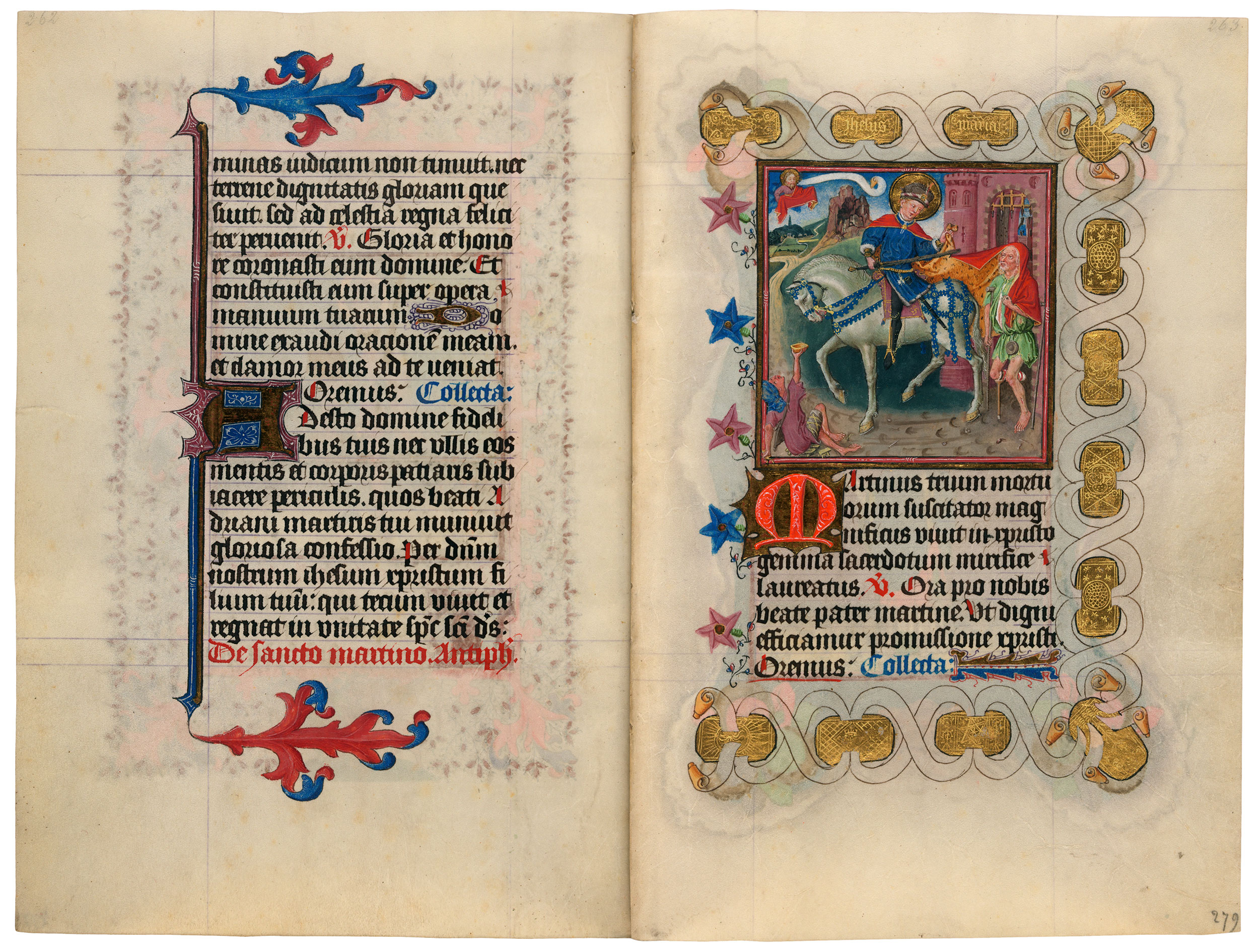
   The New York City-located Morgan Library has plenty of priceless manuscripts,   and in this XV century Hours of Catherine  de Cleves, showing beautifully painted illuminations painted  by an anonymous  scribe for the pious patron, you can see Saint Martin portrayed as a wealthy nobleman and knight of the times sharing his fabulous cloak with a beggar. You can study his horse tack by enlarging the page...

Valete

Sunday, November 10, 2019

Jan Sobieski from National Museum at Krakow

Salvete Omnes,
on the eve of the Polish Independence Day - I hope the Warsaw Marsz Niepodleglosci  , taking place tomorrow in Warsaw, will be peaceful and joyful to all participants and the police forces providing security.

Vivat Polonia Restituta!

for some time the wiki commons platform held a painting of Jan Sobieski from the Czartoryski Collection - titled 'Jan III Sobieski w towarzystwie Murzynka*. ( Jan III Sobieski accompanied by a little black African [servant]) - at Krakow, the ancient capital of our medieval and early modern Polish Kingdom.

The government officials representing the Polish peoples (the Respublica's Treasury) bought the entire collection from the Czartoryski family for a hefty sum of money. It was well spent money I daresay. The Czartoryski collection has become the permanent part of the National Museum at Krakow.
Lately the National Museum at Krakow has been digitizing and making the digital copies available on their site.
and this very painting has been digitized - here.
The fantastic digitizing allows for some nice closeups and plenty of study here. eg


The painting is the apotheosis of our famous warrior, pained after a much larger painting showing Jan Sobieski victorious at the battle of Chocim 1673 - fought on Nov 11, 1673. Pan Jan, coat of arms, sits astride his fine buckskin stallion(in many paintings Jan Sobieski, Janina rides buckskin horses, and Polish military men rode stallions or geldings)  holding the regimentum (marshal baton) (in this painting he is shown as the grand hetman of Polish Kingdom - here with a very ornate baton, when already the victorious king of 1683) is clad in the karacena armor and with the leopard skin wrapped around his hips. He carries a shield that appears to be a very antique type, sort of XVI century Balkan shield.
 Jan Sobieski also carries under his thigh a very ornate buława or mace, sign of his office as the grand hetman and military commander. The head of buława is full of precious stones and is gilded.
 The servant is carrying his winged hussar helmet, oriental recurve bow and a number of arrows with fletching done in the Tatar or Ottoman manner.

Note the horse tack - the saddle skirt done in the 'Sarmatian' fashion, ornate horse shabraque, metal breastplate, and elaborate bridle with a curbbit. Stirrups are after the Ottoman and Crimean Tatar fashion, and his yellow riding boots are without stirrups.

Valete
*
Murzynek - diminutive of Murzyn(masculine) -  which can be translated as black African boy- and it is no pejorative at all.

Sunday, November 3, 2019

Saint Hubertus Feast Day

Salvate Omnes,
past three days Poles around the world celebrated  All Saints Day, Dzien Zaduszny and those following the Slavic pagan beliefs  Dziady feast.
Staying quite a bit within the religion-influenced traditions of Central Europe today we have the Saint Hubertus Feast Day -


 so there is opportunity to share some historic images showing the patron saint of hunters ( there are two - Saint Eustace is the other patron saint of hunters ) and riders, and in Poland also foresters.


In Europe there used to be celebrations of the feast day by doing large mounted drag hunt and rides across the countryside and estates eg:


In Polish equestrian and hunting tradition there used to be a large gathering of hunters for a special hunt, prior to the actual hunt there was  specially celebrated main eucharistic liturgical service  or mass; nowadays the riding clubs celebrate the feast day  with with a 'fox hunt' horse game - gonitwa/bieg swietego Huberta aka Hubertus - where a group of riders chase after a 'fox' or a rider who has a fox's tail loosely attached/affixed to the left shoulder or upper arm. The capture of the fox tail ends the chase. And the winner of the chase will become the 'fox' the following year. afterwards the participants and their pedestrian friends and families will often celebrated by eating a bigos or hunter's stew and toasting with some stronger drink one another. These horse chases were popular with the Polish cavalry regiments and their  officers prior to the World War II - eg photos of Narcyz Witczak-Witaczynski

 
While on this day the Polish hunters (grouped exclusively within the hunting or game clubs) gather in their club game areas for a special group hunt, often started with a mass by a small chapel or , and they end the day with a celebratory dinner of bigos  from one or many large kettles heated over the bonfires. Drinking a certain quantity of nalewka and other drinks like zubrowka has also been a tradition


Nota bene  Kazimierz III the Great,  our Polish king of the Piast dynasty, got injured and died due to injuries sustained during his stag  hunting accident near Przedborz castle (now non-existent) on the Pilica River
 

In the city of  Rzeszow there is a chapel dedicated to Saint Hubertus, founded by one of the Lubomirskis in the XVIII century; the veneration of this saint came about perhaps as the result of the Saxon kings' influence on the Polish culture and customs.
Below Jerzy Kossak's painting showing Saint Hubertus and the

Valete
ps
nota bene
Darz Bor - or 'may the forest give you plenty, may the forest grant you its  gifts'-  to all hunters this hunting season... and best of luck to the game animals running away from the hunters.

Thursday, October 31, 2019

Wywiad z Radoslawem Sikora

Salvete Omnes,
[in Polish]
 krótki wywiad z Radosławem Sikorą na temat husarii et nie tylko.
Przy okazji  parę szkiców dla zwrócenia uwagi.. moje wizualne 'przemyślenia' nad husarską kopią , długością tylca kopii, nad przechodzeniem od kopii przy kolanie  do złożenia się przez kopijnika etc.


Valete