Monday, January 29, 2018

Sassanian Military Books 'libre' from University of Siedlce

Salvete Omnes,
this January will be ending shortly
I have some links for you - via prof. Katarzyna Maksymiuk's page on academia.

- Geography of Roman-Iranian wars. Military operations of Rome and Sasanian Iran, Siedlce - 2015

- Crowns, hats, turbans and helmets The headgear in Iranian history volume I: Pre-Islamic Period
Edited by Katarzyna Maksymiuk & Gholamreza Karamian, Siedlce-Teheran 2017
excellent collection of scholarly articles, from the conference that took place at the University in the Fall of 2016


A Synopsis of Sasanian Military Organization and Combat Units, Siedlce-Tehran 2018 - authored by Kaveh Farrokh, Gholamreza Karamian & Katarzyna Maksymiuk,

enjoy
ps
prof. Jordan Peterson's lecture on personal growth  - I enjoy prof. Peterson's lectures, debates and blog.

Tuesday, January 23, 2018

Edwin Henry Landseer - Arabian horses

Salvete Omnes,
just three good morning images -  oil on canvas paintings by the preeminent British animalist Edwin Henry Landseer - beautiful Arabians, the pride of the Bedouins and noble stables in the XIX century Europe .
Nota bene Polish nobleman and scion of the Polish Borderlands family  Waclaw Rzewuski, Krzywda Coat of Arms,  made his famous and fabled first trip to the Bedouin tribal breeders in  1810s, on behalf of the Russian Tsar Alexander I and other royal patrons,  and brought back finest quality Arabians from the desert upon his return. Eventually he owned almost more than 80 Arabian blood mares, more than any other private breeder in Europe at that time.

Arab mare inside the tent


Stalion Selim


enjoy

Monday, January 22, 2018

Carl Goebel - watercolors

Salvete omnes,

Carl Goebel - Viennese Austrian painter, watercolorist, who depicted genre scenes of the XIX century Europe, especially of the Austrian empire (remember that since 1849 it became Austria-Hungarian Empire).
Below it is Belgrade in the XIX century, true that there are very few horses visible, but the colorful scenery and human types are present, giving this capital of Serbia a very Near Eastern character (more than 400 years of the Ottoman domination would have done it).
I have been to Belgrade a few times, great city.
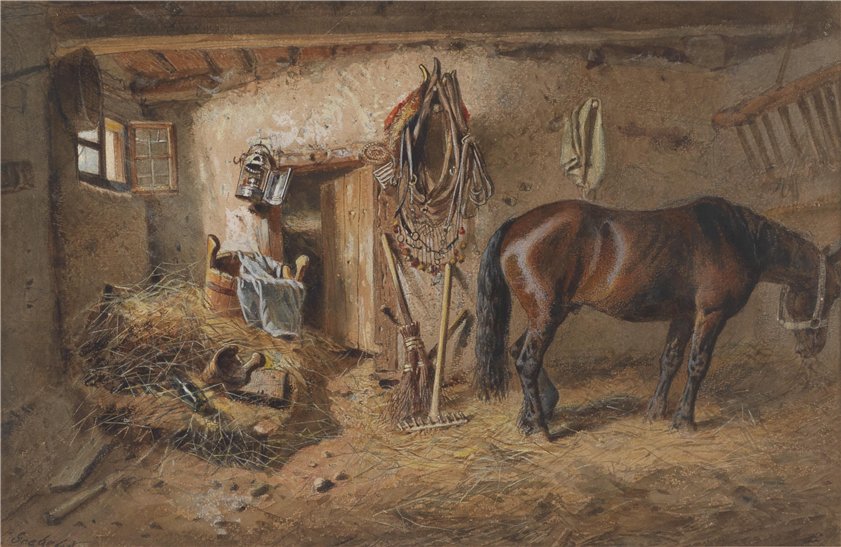
 A peasant stable with a peasant horse and its working tack
 Carriage horses getting a break with a grey getting a new set of shoes
Smithy in the winter
 The nomads of XIX century Central and Eastern Europe - the Gypsy (today it is used more politically correct their own name  Roma or Romani , which is kind of strange, since e.g. in the English speaking world they use  names like Poles or Polish for the Polish people, instead of using our own name Polacy/Polki - :) , nota bene I love the old name they used for us - Polonians, just lovely) - one of their traditional occupations was trade in horses, but also the art of horse stealing and illicit trade across the international borders.
In the Polish legal history annals there are tons of stories about Gypsy banditry, thievery and mischief, but we also have a saying <kowal zawinil cygana powiesili> Blacksmith committed a crime but they hung the Gypsy; a little proverb about the scapegoat who was sacrificed for the sins of others . Nota bene love this saying by Mark Twain - There are many scapegoats for our sins, but the most popular is providence.

fortune telling was another Gypsy 'occupation' and quite popular with the gentry, peasantry or town folks. I enjoy the look on the boy's face as he looks lovingly at the horse he holds for the two ladies that came for some divination and magic..

 Sables with some Oriental looking horses
 In Poland 'cyganska muzyka,'   Gypsy music and song, is popular, and some of the artists hold national acclaim and popularity.

and back to less exotic XIX century Europe, just this little delightful rendering of an Alpine water mill, with women doing laundry in the creek

enjoy
ps
one of my most favorite films of all time - Табор уходит в небо or Gypsy wagon camp escapes to Heaven -   (release title in English is odd, isn't it? - Gypsies Are Found Near Heaven  )  it is about the Gypsy passion for horses, women, music (eg Евгений Дога - Яблоко (Табор Уходит В Небо) - look for it on youtube) and love.

Sunday, January 21, 2018

Alfred de Dreux - Oriental horses

Salvete Omnes,
Sunday morning and here we can enjoy some wonderful XIX century paintings where the horse is the very subject, sort of in the tradition of Carl Vernet and Theodore Gerricault .

Master-painter, from Fra nce,  Alfred de Dreux's works are for the first time presented separately on my blog; sadly, the prolific author died in his prime, depraving the world of his talented brushwork.
So here we will look at some of his oli on canvas works showing Oriental, North African horses - be it Arabians or Barbs.
Below, clearly an Oriental bay stallion, with two grey stallions in the back of the pasture - European setting.
and two paintings that show the same Arabian? bay horse and his owner? groom?


clearly the same horse and and this time clearly a groom in this painting, for it is titled Horses of Abd el Kader, and emir  Abd el Kader was the famous religious and military leader of the  Muslim resistance against the French invasion of Algeria in the first half of the XIX century.
So perhaps the black man in the other paintings is the groom of emir's horses. Presumably this Hassan was taken as a slave, perhaps in Sudan or Niger etc. Note that Abd el Kader was taken with the ruler of Egypt, famous Albanian Mamluk warrior Muhammad Ali, and perhaps this Algerian emir had some Egyptian Arabs in his stables, as the grey horse is clearly an Arabian stallion.

An African groon with a blood horse on the beach - Arabian or Barb steed.

and a Sudanese groom  mounted on the white Arabian? stallion

Enjoy the beautiful brushowork of this talented Parisian artist.

Friday, January 19, 2018

Fiore Mounted Techniques I - Arne Koets et company

Salvete Omnes,
ecuyer Arne Koets added a video of the famous Italian master of the European martial arts messer Fiore de Liberi and his Mounted Techniques (part I) on his youtube channel - in the past I linked Arne's videos to my blog. Presumably there will be more parts to come in the future.

Fiore Mounted Techniques I - video

Bibliotheque Nationale MS Fr. 2643


study and enjoy
Valete
ps
Fiore at Gallica or the National Library of France

Les Grandes Chroniques de France II

Salvete Omnes,
back to blogging from a little hiatus  - :)
Medieval manuscript painting, very beautiful as usual,  is back,

three young women appear to be riding side-saddles, their mounts are palfreys that have been bitted with a curb-bit
and we are back in the XIV century Les Grandes Chroniques de France,continuing from my  last post.
This time I am sharing with you more images of tack and riding technique - details of the page illuminations*

the length of the dress skirts on the grey horse-mounted rider seems to indicate that this is a woman, so perhaps she is riding a side saddle

A Royal female personage is riding astride and is carrying a baby, the bushes hide horses front so we don't know if it is a pacing horse

Palfreys and hunting dogs, horses appear not to be shod

the small horse seems to be used as a sumpter or pack horse, but it has been bitted with a curb-bit,so perhaps a rouncey?

clearly a team of carriage animals - royal personage is being carried in a basterna(litter)

the basterna drivers-riders use but a whip or stick while instead of a full bridle they use a rope halter or a version of hackamore
enjoy

Valete!

*each image has a title after its manuscript page number

Tuesday, January 9, 2018

Palfreys in Les Grandes Chroniques de France circa 1350AD

Salvete Omnes,
just a short entry this early morning:
Jean le Bon (John II, king of France) when he was the Duke of Normandy (1332-1350) commissioned a manuscript that became part of  Les Grandes Chroniques de France, today the codex is  kept at the British Library - Royal MS 16 G VI - information here, viewing on line here,
Within the wiki commons collection there are several larger photos of the illuminations from this codex showing riding horses of the period, these are palfreys or pacing horses of the nobility.


I will be returning to these manuscripts from time to time, I hope.
Valete

ps
nota bene - there is this petition to save the wild horses and burros from removal and slaughter in the US; as the Bundys have been cleared (dura lex sed lex - the Bundy affair - Cliven Bundy speaking here - have been monitored by the environmental groups eg here , the voice on the wild horse & cattle grazing from 2014), so this is the matter of the America public lands (managed by BLM, US Corps of Engineers, US Department of Defense, Forrest Service etc), rights of ranchers and citizens, taxpayers' subsidized  cattle (cow and sheep ) grazing on public lands (fees have been lowered), and the fate of  constitutionally protected (Idaho LawReview article) Wild Horse and Burro in the American West.
also a rather hostile to wild horses article from the Smithsonian

Saturday, January 6, 2018

Happy Epiphany or the Magi have arrived

Salvete Omnes,
and so we have arrived at the end of the Journey of the Magi, and today we have the Feast of Epiphany.
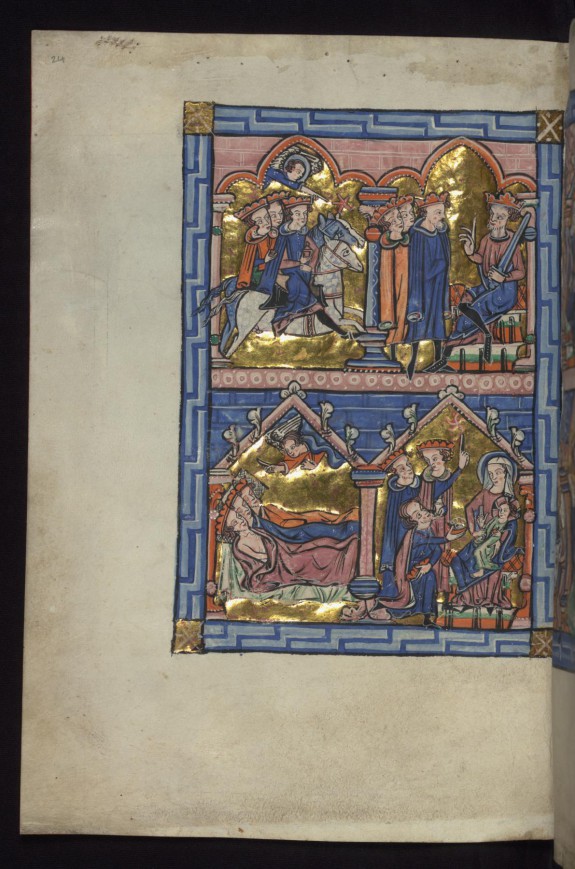
For this occasion I selected this illumination from an East Anglian codex titled Carrow Psalter presently held at the Walters Art Museum in Baltimore, USA.
It was created during the mid-century and is very important in many ways, including the depiction showing the murder and martyrdom of Saint Thomas Becket by 4 knights (with their retainers) of king Henry II of England inside the Canterbury Cathedral.
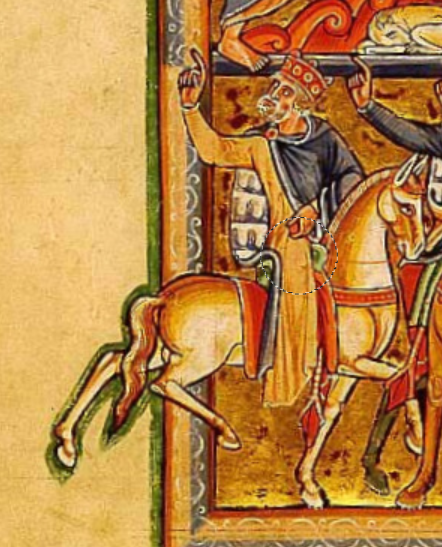
The Magi are shown riding at the flying gallop (?), or with the front and hind horses' legs extended as in a jump, a traditional way to show fastest gait of the horse before the XIX century. They are following the Bethlehem Star with their gifts shown a bit in right hand, while guiding their mounts with the left, or at lest the two Magi are doing this.
The mounts are presumably stallions as their sex is shown, and again are grey, just the middle one is shown to be a steel grey for the sake of contrast I presume.
The monk painting this illumination created flying tails which is perhaps another indication of the fast speed.
 Horses have multicolored tack, their bridles have no curb-bit but what appear to be a snaffle and a single set of reins. Perhaps they are riding in full collection, as their heads are elevated etc. The bridle has no throatlatch but a browband.
The saddle of the front Magi has black color covering the saddle skirts and shabraque or just longish skirts, extending and tapering to the back, and light brown high arches, typical of the period saddles.
Whether the saddle skirts were in fact this long or painted & dyed black, or dyed some other color we will not know, but the single cinch is also typical, note its width and the criss-cross pattern on it most likely indicating that it was made out of  woven fabric.

Matthew of Paris pinxit - war saddle of the period, note the breastcollar arrangement in relationship to the saddle, also the cinch buckle


Matthew of Paris, saddle with larger skirts, underneath rectangular shabraque
Matthew of Paris,  a saddle with short saddle skirts, but large textile shabraque edged with loose fringe

the second half of XIIIc, saddle with either saddle skirts or a saddle shabraque
There is also a typical for the period breast collar strap, simple and without any additional adornments

Magi riding and then visiting Herod the Great
 The foremost Magi is riding with his legs fully extended forward, feet in stirrups and spurs indicated,
Adoration of the Magi - detail from the illumination

Valete!

Friday, January 5, 2018

Magi - Codex Bruchsal from Karlsruhe

Salvete Omnes,
one more day to los Reyes Magos - so one more medieval manuscript illumination we can ponder..
So another High Middle Ages wondrous painting - via Wiki Commons- from Badischen Landesbiliothek in Karlsruhe, Germany.

Journeying Magi
Our three kings are shown in the fashion of the Holy Roman Empire costumes and outfits. Their horses are stallions, all are shod and of uniform grey color.
All  bridles are similar - with large metal discs for bridle adornments, including the bit,  and metal studs complementing the bridle straps. Note that there are no nosebands and bits used are of a curb type. There is large and wide embossed (presumably) but different in design leather brestcollar on each horse. Saddles with the saddlepads and /or shabraques are quite ornate and also uniform; sort of roundish saddle skirts, not unlike many centuries later in Old California or Mexico (mochilla leather covering the wooden saddle tree).
Saddles are of high arches type, used for combat with a couched lance and apparently travel too. Unless this high saddle represents the idea of a nobleman saddle in the Medieval art? Some time later we see similar tack features in a three-dimensional Holy Roman Empire sculpted figure at the Bamberg Cathedral - known as der Bamberg Reiter.
Riders use one hand to hold the reins, military style but rather loose and thus perhaps indicating neck-reining and highly trained mounts, while seated astride their steeds in la brida (legs extended) style. Stirrups and spurs are present.
Note that we see only one cinch on each saddle.
following the Star of Bethlehem, this stallion appears highly collected while cantering
this stallion is clearly pacing, hence a palfrey. Also, there are two leather bands adorning the neck


this one is perhaps pacing too
 the Codex is associated with the XII century Archdiocese of Trier.

Valete!

Thursday, January 4, 2018

Magi Journey - St. Albans Psalter

Salvate Omnes,
Magi journey - this time another illuminated page from a medieval manuscript - a fine example of the Norman art called Saint Albans Psalterpainted around 1130AD, for or at the Saint Albans Abbey. Believed to have been ordered by the abbot Geoffrey of Gorham for his friend an anchoress Christina of Markyate.
The manuscript is kept at the Basilica Library at St. Godehard, Hildesheim, Germany.


We see here no horseshoes (but they were in use as seen here  or here), but they do appear in other XII century illuminations, the saddles have high arches and what appears to be  some very colorful saddle blankets while the visible horse tack contains a breastcollar, bridle with a curb-bit  and single pair of reins. Stirrups are long and our magi ride military style, holding reins with the left hand. No crouper is visible, but there are perhaps two cinches, the rearone clearly visible with its buckle etc.
the XII century illumination showing  pack animals - a mule and a donkey with a attendant on foot carrying an instrument of not a small persuasion aka three-thonged whip (I wonder if of any association with Jehudiel)

Valete!
ps
Siculo-Normans and Stauferian tradition in this manuscript  by Petrus of Ebulo -  lots of horses and also a sidesaddle-riding queen.

Tuesday, January 2, 2018

Magi in Journey - Leiden Saint Louis Psalter

Salvete Omnes,
ha, and there we have a very first post in the brand new calendar year of 2018.
We should go right back to the Magi and their journey ( still several days ahead of this sweetly warm holiday of gift-giving and celebrating the birth of Jesus) as portrayed in the noble medieval art while keeping up with the hipology theme.

So here we have this page from the Leiden Saint Louis Psalter - painted for Geoffrey, Archbishop of York in around 1190AD and later on used by young Saint Louis. The manuscript is presently kept at the Leiden University Library.

Magi - riding pacing horses, highly collected


Holy Family - Madonna and Child are riding a grey mule, as probably the monk-painter and his milieu could not fathom Madonna riding a donkey.  Note that Madonna and Child Jesus are riding side-saddle. The bridle is also very interesting, as we see here a curb-bit and a curb-chain or a chin-strap. 

and another horse from this Psalter, Joseph sold by his brothers is being taken to Egypt as a slave


Valete!
ps
images from Wiki Commons