Wednesday, April 4, 2012

Richar F. Burton on the Western bridle


Salve,
yesterday I quoted the interesting observations  the famous British traveller Richard F. Burton made about the California saddle (1860).
Well, today I will finish his depiction with his critique of the bridle used along with the saddle:

    "The bridle is undoubtedly the worst part of the horse’s furniture. The bit is long, clumsy, and not less cruel than a Chifney*. I have seen the Arab ring, which, with sufficient leverage, will break a horse’s jaw, and another, not unlike an East Indian invention, with a sharp triangle to press upon the animal’s palate, apparently for the purpose of causing it to rear and fall backward. It is the offspring of the Mexican ''manége,'' which was derived, through Spain, from the Moors."
 as we know Sir Richard was not a cavalry officer (he served with infantry regiments), but as an English gentry, he most likely trained in fox hunting, riding horses with snaffle bits and using a typical flat saddle (aka English hunt saddle). He did not like or most likely did not understand the California spade bit - a 'form of curb bit with an exaggerated extension of the port that ends in a curved enlargement in the shape of a spoon' (Gehrad A. Malm, DVM, 1996:4). Also he did not understand that California horse tack was just simply a Mexican horse tack, that in turn was Spanish horse tack. He did not mention 'mecate' (horse hair reins) nor arduous training (involving hackamore, snaffle and finally curb bit0that horse underwent in order to be ridden in spade bit or ring- or Chileno bit (what he calls Arab ring, used to be called also a Morisco bit - in this link you can find one of the most knowledgeable horsewomen, Dr Deb Bennett giving her view on the historical use of curb bits/horse training equipment/method in the context of Spanish/Mexican/California versus Anglo-Texan horse traditions)

American William S. Tevis jr stated in his 1922 book "The Horse" :
   ''A horse is generally used in a hackamore for about a year, and then he is doublereined for another year. Double-reining consists in putting a Spanish bit bridle over the hackamore and allowing the animal to carry the spade bit in his mouth for this length of time. During this period, however, he is controlled almost entirely by the hackamore, and merely allowed to carry the bit in his mouth in order to become used to it and play with the wheel at the fore part of the spade, which has the tendency to keep his mouth wet.
The horse by this time should be completely bridlewise to the hackamore and by degrees this knowledge can be transferred to the spade bit, so that he will stop and turn by a pull on this bit and the feel of the reins on his neck.''
 The best description, from a position of a working cowman and practitioner, of the hackamore to spade bit training can be found in Ed Connell's books, eg Hackamore Reinsman
The best description of working California vaqueros can be found in the works of Arnold R. Rojas, collected in These were the Vaqueros.
 Professor Robert W. Miller wrote, in "Western Horse Behavior and Training" (1975:139-41) that spade bit is  'one of the most misunderstood curb bits.' He says that "a good spade bit, properly fitted to the horse and properly handled, is just the opposite of being cruel. It is really designed to keep  horse very light and soft mouthed." But "it takes considerably more time  and patience to train a spade bit horse."
Sir Richard was not a spade bit rider nor Morisco bit rider, he was a snaffle rider, and thus his biased opinion above, shared then by many who had no clue about its proper use. The bad legend of these types of curb bits continue today.
*Chifney bit:

  as described by 'my' trusted XIX century expert in hippology Captain Matthew Horace Hayes (Riding on the Flat and Across Country, 1891):
The celebrated Sam Chifney, who fell into disgrace with the racing public, on account of having been suspected of intentionally losing a race at Newmarket on the 2oth October, 1791, when riding the then Prince of Wales's horse, Escape, invented this form of curb, in which the objectionable downward pull on the headstall is entirely dispensed with; for its headstall is attached to short arms, that revolve on the mouthpiece, independently of the cheeks of the bit, to which the curbchain is hooked.
The Chifney bit is very severe, and is inapplicable to most horses that are ridden by men with indifferent hands; for its curbchain alone resists the forward action of the upper arms of the cheeks of the bit. Thus, the whole of the pressure falls on the gums, tongue and under part of the lower jaw, and none of it is taken, as with the ordinary curb, by the animal's poll, which, I need hardly say, is not as sensitive as the parts just named.
 (drawing above come from Cpt. hayes book)
 
as described by John Henry Walsh (1866)
The Chifney bit is provided with a joint at the junction of the lever and mouthpiece, so that the action of the former is not confined by the head of the bridle. But though in theory this is all very pretty, in practice it is found to be of no service whatever.


as described by  Elizabeth Platt Karr (1884)
The Chifney bit is another very severe one, and is very useful in managing a horse that pulls hard. But if the animal have a tender mouth, this bit should be used with great caution, and not at all by an inexperienced rider.
(image comes from Ms Platt Karr book)

ps
my son has been working on his own blog - being almost 11 years old he is very interested in mythical creatures, dinosaurs and zoology while inventing his own creatures. 

Tuesday, April 3, 2012

Richard F. Burton on California saddle


Salve,
today I will point my 'virtual horse' towards XIX century and writings of one of the pre-eminent travellers of the United Kingdom of the Victorian era.
Well, I dare say that any person with some interest in the past should have heard of Richard Francis Burton, extraordinary traveller and adventurer, linguist and writer ( translator of ''1000 and 1 night,'' & ''Kama sutra'' etc) of the  Victorian United Kingdom.I should add that I am a great fan of Sir Richard's writings.
In 1860 Burton came to the US and stayed here for a while travelling, eg he visited the South, went to visit the Mormons in Utah etc. He published a book about this visit and edited another, that edied work, in due time, should become the subject of my blog.
In his own book, published after the visit to the US, titled ''The city of the Saints : and across the Rocky mountains to California (1862)'' Sir Richard describes the California saddle as he saw it, with all his biases of an English-bred and educated gentleman, in his travels across the Great Plains, Rocky Mountains and California:
-->
   ''The Californian [saddle] is rather oval than circular; borrowed and improved from the Mexican, it has spread from the Pacific to the Atlantic slope of the Rocky Mountains, and the hardy and experienced mountaineer prefers it to all others: it much resembles the Hungarian [you can compare Burton's impression of the Hungarian saddle with contemporary depiction by Dwyer from my earlier blog post ], and in some points recalls to mind the old French cavalry 'demipique.'
It is composed of a single tree of light strong wood, admitting a freer circulation of air to the horse’s spine — an immense advantage  — and, being without iron, it can readily be taken to pieces, cleaned or mended, and refitted. The tree is strengthened by a covering of raw-hide carefully sewed on; it rests upon a “ sweat-leather,” a padded sheet covering the back, and it is finished off behind with an “ anchero”* of the same material protecting the loins.[see my depiction of the vaquero saddle and its elements in my earlier blog]
The pommel [fuste delantero] is high, like the crutch of a woman’s saddle, rendering impossible, under pain of barking the knuckles, that rule of good riding which directs the cavalier to keep his hands low. It prevents the inexperienced horseman being thrown forward, and enables him to “hold on” when likely to be dismounted; in the case of a good rider, its only use is to attach the lariat, riata*, or lasso.
The great merit of this “ unicorn” saddle is its girthing: with the English system, the strain of a wild bull or of a mustang “bucker” would soon dislodge the riding gear. The “sincho”*[cinch] is an elastic horsehair cingle*, five to six inches wide, connected with “lariat straps,” strong thongs passing round the pommel and cantle; it is girthed well back from the horse’s shoulder, and can be drawn till the animal suffers pain: instead of buckle, the long terminating strap is hitched two or three times through an iron ring.
The whole saddle is covered with a machila* [mochilla], here usually pronounced macheer, two pieces of thick leather handsomely and fancifully worked or stamped, joined by a running thong in the centre, and open to admit the pommel and cantle [fuste trasero]. If too long, it draws in the stirrup-leathers, and cramps the ankles of any but a bowlegged* man. The machila is sometimes garnished with pockets, always with straps behind to secure a valise, and a cloak can be fastened over the pommel, giving purchase and protection to the knees.
    The rider sits erect, with the legs in a continuation of the body line, and the security of the balance-seat enables him to use his arms freely: the pose is that of the French schools in the last century, heels up and toes down.[ well, see these posts of mine showing French riding school images from XVIII century]
   The advantages of this equipment are obvious; it is easier to horse and man probably than any yet invented.
On the other hand, the quantity of leather renders it expensive: without silver or other ornaments, the price would vary from $25 at San Francisco to $50 at Great Salt Lake City, and the high got-up rise to $250:£5O for a saddle!
If the saddle-cloth slips out, and this is an ‘accident which frequently occurs, the animal’s back will be galled. The stirrup-leathers can not be shortened or lengthened without dismounting, and without leggins* the board-like leather macheer soon makes the mollets* innocent of skin.
   The pommel is absolutely dangerous: during my short stay in the country I heard of two accidents [sic!], one fatal, caused by the rider being thrown forward on his fork. Finally, the long seat, which is obligatory, answers admirably with the Californian pacer or canterer*, but with the high-trotting military horse it would inevitably lead—as has been proved before the European stirrup-leather was shortened-—to hernias and other accidents.
    To the stirrups I have but one serious objection—they can not be made to open in case of the horse falling; when inside the stiff leather macheer, they cramp the legs by bowing them inward, but habit soon cures this. Instead of the light iron contrivances which before recovered play against the horse’s side, which freeze the feet in cold, and which toast them in hot weather, this stirrup is sensibly made of wood. 
In the Eastern States it is a lath bent somewhat in the shape of the dragoon form, and has too little weight; the Californian article is cut out of a solid block of wood, mountain mahogany being the best, then maple, and lastly the softer pine and cotton-wood. In some parts of the country it is made so narrow that only the toe fits in, and then the instep is liable to be bruised. For riding through bush and thorns, it is provided in front with 'zapateros'* or leathern curtains, secured to the straps above, and to the wood on both sides: they are curiously made, and the size, like that of the Turk’s lantern, denotes the owner’s fashionableness; dandies may be seen with the pointed angles of their stirrup-guards dangling almost to the ground.
The article was borrowed from Mexico-—the land of character dresses. When riding through prickly chapparal, the leathers begin higher up, and protect the leg from the knee downward. I would not recommend this stirrup for Hyde Park, or even Brighton; but in India and other barbarous parts of the British empire, where, on a cold morning’s march, men and officers may be seen with wisps of straw defending their feet from the iron, and on African journeys, where the bush is more than a match for any texture yet woven, it might, methinks, be advantageously used.
The same may be said of the spurs [old book - The History of the Spur] which, though cruel in appearance, are really more merciful than ours. The rowels have spikes about two inches long; in fact, are the shape and size of a small starfish; but they are never sharpened, and the tinkle near the animal’s sides serves to urge it on without a real application. The two little bell-like pendants of metal on each side of the rowel-hinge serve to increase the rattling, and when a poor rider is mounted upon a tricky horse, they lock the rowels, which are driven into the sincho, and thus afford another point d’appuii. If the rider’s legs be long enough, the spurs can be clinched under the p0ny’s belly. Like the Mexican, they can be made expensive: $25 a pair would be a common price.
 -----
well, I hope you find this depiction of this particular piece from the large arsenal of the American Western Horse Heritage written by a British writer, for all intensive purposes a foreigner.  This is my intro in the subject of California horsetack and horse, more will come in the future.
* original spelling

Tuesday, March 27, 2012

Interview with Dave Nicholson, DVM, famed endurance rider

Salve,
a quick post on something very interesting and enjoyable, while educational with plenty of history to all who like horses, Arabians, endurance riding and horse stories etc:
The Arabian Horse World magazine has made available an interview with famous endurance rider, horseman and author, Dave Nicholson,DVM (doctor of veterinary medicine) done 20 years ago. Amongst others he participated in the Great American Horse Race of 1976 (interesting article here) and the Pony Express Ride of 1979, and many Tevis Cup rides.
enjoy
Bellow a postcard of the Antoniny Stud Farm in Polish Borderlands showing Arabian mares at Pasture. This famous stud farm and its horses were destroyed by the Bolshevik Revolutionaries - here Polish poem titled the  ''Śmierc Ibrahima'' ('Death of Ibrahim') commemorating this disaster, from the webpage of Bask stud at Albigowa.

Monday, March 26, 2012

Cavaliere d'Arpino's horses

Salve,
 as I imagine most of the people educated in the Western Civilisation history are somewhat interested in the Greek and Roman mythology and legendary history, I am also passionate about them, and my passion has been sustained and  'fuelled'  by more than 2,500 years of Western-influenced art.

I had been perusing flicker and I found some great photos of a Mannerist murals depicting Roman legendary history, amongst them the battle between the Horatii and Curiatii.
The below version of the battle is by Helen A. Guerber ( The Story of Romans, 1870)
''Romans and Albans had all assembled to view the battle between their champions, and were eagerly awaiting the struggle which was to decide their fate. They had agreed that the nation which won should rule over the one which was worsted in the fight that was about to begin.
Encouraged to do their best by the feeling that so much depended upon their valor, the Horatii and Curiatii met. The Romans and Albans, stationed on either side, watched the encounter with breathless interest and in anxious silence.
The six young men were equally brave and well trained, but before long two of the Horatii fell, never to rise again. Only one of the Roman champions was left to uphold their cause; but he was quite unhurt, while all three of his enemies had received severe wounds.
The Curiatii were still able to fight, however, and all three turned their attention to the last Horatius. They hoped to dispatch him quickly, so as to secure the victory for Alba before the loss of blood made them too weak to fight.
The Roman champion knew that he would not be able to keep these three foes at bay, and he noticed how eager they were to bring the battle to a speedy close. To prevent that, he made up his mind to separate them, if possible, in order to fight them one by one.
He therefore made believe to run away, and was followed, as quickly as their strength allowed, by the Curiatii, who taunted him for his cowardice, and bade him stand and fight. The three wounded men ran on, as fast as they could, and were soon some distance apart; for the one whose wounds were slightest had soon left the others behind.
Horatius turned his head, saw that his enemies were now too far apart to help one another, and suddenly rushed back to attack them. A short, sharp encounter took place, and the first of the Curiatii fell, just as one of his brothers came to help him.
To kill this second foe, weakened as he was by the loss of blood and by the efforts he had made to hurry, was but the work of a moment. The second Qiriatius sank beneath his enemy's sword just as the last of the Alban brothers appeared beside him. With the courage of despair, this Curiatius tried to strike a blow for his country; but he too fell, leaving the victory to Horatius, the sole survivor among the six brave warriors who had begun the fight.
The Romans had seen two of their champions fall, and the third take refuge in what seemed to be cowardly flight; and they fancied that their honor and liberty were both lost. Imagine their joy, therefore, when they saw Horatius turn, kill one enemy after another, and remain victor on the field! Shout after shout rent the air, and the Romans were almost beside themselves with pride and gladness when the Alban king came over and publicly said that he and his people would obey Rome.
Leaving the Albans to bury their dead and bewail the loss of their liberty, the Romans led their young champion back to the city, with every sign of approval and joy. Compliments and praise were showered upon the young man, who, in token of victory, had put on the embroidered mantle of one of his foes.
Every one received him joyfully as he entered the city, —every one except his sister Camilla. When she saw the mantle which she had woven and embroidered for her betrothed, she burst into tears. In her sorrow she could not hold her tongue, and bitterly reproached her brother for killing her lover.
Horatius, angry at being thus reproved, roughly bade Camilla dry her tears, and told her she was not worthy of being a Roman, since she welcomed her country's triumph with tears. As she kept on crying, after this harsh reproof, Horatius suddenly raised his hand and struck her a deadly blow with the same sword which had taken her lover's life.
The sight of this heartless murder made the Romans so angry that they wanted to put the young man to death, in spite of the service he had just rendered his country. But his aged father implored them to spare his life. He said that two of his sons were lying on the battlefield, where they had given their lives for Rome; that his lovely daughter Camilla was no more; and that the people ought to leave his only remaining child as a prop for his old age.
When Tullus Hostilius heard this pitiful request, he promised to forgive Horatius upon condition that he would lead the Roman army to Alba, and raze the walls of that ancient city, as had been agreed. The Albans were then brought to Rome, and settled at the foot of the Caelian hill, one of the seven heights of the city.''
 
The painting of Horatii and other frescoes from which the horses are shown are located at the Capitoline Museum in Roma (Rome), Italy. They were painted by then famous Italian painter Giuseppe Cesari known as Cavalier d'Arpino.
And here are the horses or rather war horses created/imagined by the brushes of Cavaliere d'Arpino and, presumably, his atelier.
...

...

...

...

...

...
The photos above are by mharrsch under the creative commons licence
...

...

...

Thursday, March 15, 2012

Sassanian Sketches...

Salve,
 some time ago I did many sketches of the Sassanid horse warriors based on my friend Patryk Skupniewicz research into their arms and armour, and, I should add, my own observations of various Sassanian monuments and  of other researchers' work. Here one of them, of a royal warrior


Lately I did some drawings related to the horse bridles, esepcially the early curb-bits,psalion snaffle bits, cavessons and muzzle-cavesson 'mixes' from the Sassanian Period - III through VII century A.D.
First a sketch of a horse armour with a 'horned saddle' that came to Europe from Central Asia some time during late II century B.C. and stayed in use until the later Antiquity.

...

Various cavessons and muzzles of bronze


...
a curb-bit and horse mask or chamfron


...

Wednesday, March 7, 2012

Researching XVII century military wagons


Salve amici mei,
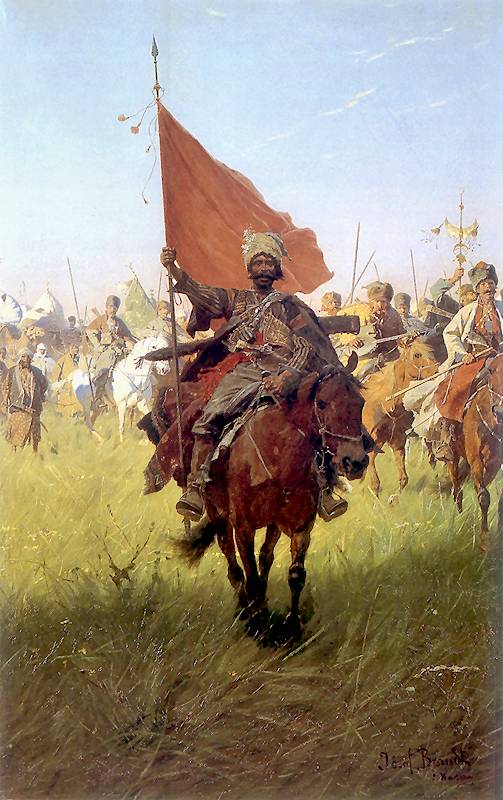
.. as I have been working on a project involving horse wagons and carriages for yet another book on XVII century hussaria,  I did a quick  sketch in Art Pen and watercolour of a Kozak standard bearer via an Orientalist painting by Józef Brandt's Powrót Zwycięzców (Victors' Return), it appears to be a Sich Kozak - interestingly at this time our Kozaks (Zaporozhian Cossacks) were not noted horsemen, fighting as fine infantry and marines (on their swift boats raiding Ottoman Turks all the way in their capital, Istanbul), with some weak light cavalry. Their strength laid in skilful use of early muskets, especially early versions of flintlock as 'doglock' or 'snaphance,' and in use of the "tabor" (wagon train (Wagenburg)) for defence - following the offensive tactics of Old Polish armies 'tabor' that in turn followed Czech Hussites that had re-invented the tabor and used it successfully during their battles with German knightly lancers during the 1420-30s. After the Bohemian mercenaries exported their tactics all over Europe, it was the Central and Eastern European armies and Ottoman Turkish armies became more or less skilful in its use.

At this moment I am after the construction of XVII century wagons and carriages, and I have been using both few iconographic sources eg


...and our Polish painters of the realist school led by aforementioned maestro Józef Brandt and  his contemporary maestro Juliusz Kossak.
Especially in the paintings of 'pan' (sir or master)Brandt these wagons can be see quite clearly. And at the same time we can enjoy these wonderful paintings by pan Brandt, also showing the colourful world of Old Commonwealth.

...

...

...

...

...

...

Tuesday, March 6, 2012

Giants of long distance horse travel 1889-2004

Salve,
I have been dormant most of this winter and it looks as the spring may come to this corner of the Great Plains soon. I did very little riding past 2 months, and have been dreaming about some long distance riding in the Rocky Mountains - the most I have don is 30 miles in saddle...
So reading about riders of the past I decided to start my retunr to this blog with some recollections on men,woman and horses that made some of the longest rides in last 120 years.

First could come travellers of Asia, the largest land mass on this Earth.
Allow me to start with a fine rider, gentleman and military man


Kozak officer Dmitri  Peshkov (Дмитрий Пешков), member of Amur Cossack Voisko/Host, who crossed Imperial Russia  astride a grey horse (photo above) named Serko (Серко) - a Manchurian horse -  notabene about this famous ride Russians made a movie in 2006. 
Dmitri and Serko rode "five thousand five hundred miles in one hundred and ninety-three days" (or 9000km in 193 days) from Blagoveshchensk on the Amur River in Siberia to Saint Petersburg on the Baltic Sea during the late 1889 to May 1890. Gospodin Dmitiri was decorated by the Tsar with an order of St.Anna and a leave from his military duty, and he then travelled to Palestine to visit the Holy Land. He fought in Boxer Rebellion, being a member of invading Russian army and later in Russo-Japanese war. Retired in 1908 with a rank of colonel of the Russian army, for his military service he was awarded not only plenty of Russian Imperial orders, but also Italian and French. Manchurian grey Serko died in Saint Petersburg and was buried there and his burial still exists.
There is a Russian book published in 2001 describing his adventures based on documents etc - Путешествие амурского казака Дмитрия Пешкова от Благовещенска до Петербурга. Here an article in Russian...


Next a Japanese officer and scion of a samurai family,
Fukushima Yasumasa, who from Berlin, German Empire,  started on horse ''Gaisen,'' left him in Moscow due to sickness, bought Russian horse ''Ural''(that bit him repeatedly) and in the Altai Mountains(Kazakhstan) bought two Kazakh horses that took him to Russian port city Vladivostok, and eventually these horses went to Japan - from February 1892 to June 1893, some 488 days.

 ''MAJOR YASUMASA FUKUSHIMA, military attaché of the Japanese Legation in Berlin, has started on one of the longest rides on record. He proposes to travel on horseback to Tokyo, a distance estimated at ten thousand miles, exclusive of waterways, on which he will have to take to a boat. He expects to ride six days in the week, and to make from thirty to thirty-five miles a day. His journey will last about fifteen months, and will subject him to extremes of heat and cold and to the most varying conditions. He weighs one hundred and fifty-four pounds, and will carry with him fifty-eight pounds of luggage.'' (the Illustrated American, vol.10, 1892)

 Fukushima continued his service in the Japanese Army (became a general) and wrote a book about his travel, in Japanese, titled ''A travel in Central and Southern Asia''

Next three American Continents travellers who used famous Argentinian horse breed - the criollo - to accomplish their tasks:
 most famous Aimé Tschiffely , in 1926-29 he rode from Buenos Aires, Argentina to NYC on two criollo horses Mancha and Gato, later wrote a book (and many others) about his ride, published in English under the title "Tschiffely's ride; ten thousand miles in the saddle from Southern Cross to pole star." by Simon in 1933.

[...]*
...and finally completely unknown and unfortunately passed away, the giant of horse long distance travel, Polish teacher and breeder Tadeusz Kotwicki who between 1995-97/98  rode from the end of Patagonia  in Argentina, along the Pacific side of South America to Kansas, US. Pan Tadeusz had ridden in Asia prior to his Americas' adventure, in 1992 he rode a Akhla-Teke mare from Jambyl Province, Kazakhstan to Moscow, Russia, some some 4000km in 120 days. He was also a breeder of Akhal-Teke horses in Poland.
The article below, from Polish daily, "Głos Pomorza" (Voice of Pomerania) from January 1997, tells us about the moment in his voyage when he reached Bogota, Colombia,  that Pan Tadeusz was going to ride all the way to the Bering Straits, yet from the article given in the link (http://boskawola.blogspot.com/2012/03/wspomnienie-tadeusza-kotwickiego-28.html ), we learn that he finished his epic journey in Kansas. I hope to learn more about his voyage from article the author of the blog will publish in Polish magazine "Koński Targ" (Horse Market).

Returning to Pan Tadeusz ride, from the newspaper article we learn that he rode a 142cm-at-withers tall grey criollo mare, bought in Argentinian Province of Santa Cruz, in 'Stag River' horse stud. 6 years old grey mare named ''Kropka'' (''Dot'') was gentled and trained by pan Tadeusz, who had brought his own saddle from Poland for this trip; during his trip rode her for 2-3 hours and walked the same distance, making daily 40-50km a day. During his passage through Peru, he was attacked by the Indian villagers, who believing a fold tale about a white man on a white(grey) horse eating children, beat him and he was only saved by a public official travelling with journalists.

well, until  the next time
ps
 by the way the so called Extreme Mustang Makeover finished in September last year and look at the winner of the Supreme Class
*
16th of June 2012, I am removing this fragment from the main body of the post - 
South African Marianne du Toit, who allegedly followed the footsteps/hoofsteps of Tschiffely on two criollo horses, from  2002-04, claimed she had ridden from Buenos Aires to NYC  and actually later wrote a book,  Crying with Cockroaches, about her claims.

- due to the substantive and  material claims against this story. 

Wednesday, February 1, 2012

Alans in Flavius Josephus, Jewish Wars, ch.VII (4)


Ushta os,
 today a quick visit to some of the most warlike horsemen in the ancient western Eurasia: the Sarmatians.


Alans were most likely the eastern division of the Sarmatian 'nation' or as Iranica defines them a tribal grouping of the Northeren Iranians   -  'an ancient Iranian tribe of the northern (Scythian, Saka, Sarmatian, Massagete) group, known to classical writers from the first centuries A.D. (see, e.g., Seneca, Thyestes 630; Annaeus Lucan, Pharsalia 8.223, 10.454; Lucian, Toxaris 51, 54, 55, 60; Ptolemy, Geographia 6.14.3, 9, 11; and other sources below). Their name appears in Greek as Alanoi, in Latin as Alani or Halani. The same tribes, or affiliated ones, are mentioned as the Asaioi (Ptolemy 5.9.16), Rhoxolanoi, Aorsoi, Sirakoi, and Iazyges (Strabo 2.5.7, 7.2.4; 11.2.1, 11.5.8; 7.2.4). In early times the main mass of the Alans was settled north of the Caspian and Black seas. Later they also occupied the Crimea and considerable territory in the northern Caucasus'

Below the Alan/Sarmatian incursion into Western Asia of 72 A.D. as described by the famous ancient Roman historian Titus Flavius Josephus who is describing the Alans using a lasso to take down and capture enemy warriors - here a king of ancient Armenia.

I. Traill translation, crica 1850

''The nation of the Alans — whom, I think, we have elsewhere stated to be Scythians inhabiting the banks of the river Tanais [Don River], and the lake Maeotis [Sea of Azov] —designing at this juncture to penetrate into Media and the parts beyond it, for plunder, addressed themselves to the king of the Hyrcanians, who was master of the pass which king Alexander [the Great] had closed with iron gates.

Being granted ingress by him, they fell in great numbers upon the Medes, who entertained no suspicions, and pillaged a populous country, abounding in flocks and herds, no one venturing to oppose them. For Pacorus [Pacrus of Media Atropatene, later Great King of Parthia], later Pacorus II of Parthia], the sovereign of that country, fled in terror to his fastnesses; and, having abandoned all besides, with difficulty recovered from them his wife and concubines, who had fallen into their hands, by a ransom of a hundred talents.

[coin of Pacorus when the king of Parthia from above given webpage]
Prosecuting, therefore, the work of rapine unresisted and quite at their leisure, they proceeded as far as the confines of Armenia, laying every thing waste. Tiridates [Tiridates I of Armenia], who reigned there, meeting them, and giving them battle, was on the point of being made prisoner in the engagement; a noose having been thrown over him by one at a distance, who would have dragged him away, had he not instantly cut the cord with his sword and effected his escape. The invaders, only rendered the more fierce by this opposition, desolated the country; and, carrying off' a vast multitude of men, with much booty besides, from both kingdoms, returned once more to their own homes.''*
Interesting article on the waves of the Sarmatian migration by Jurij Vinogradov
At the top a sketch-in-progress of a warrior throwing a lasso 

 ----

*
original spelling

Tuesday, January 31, 2012

Some Sketches

Salve,
 just some sketches I have been working on in my 'digital studio':

 ...

...

...

...

...

...

...

...

Sunday, January 22, 2012

Maurice de Saxe & ... mechanical hackamore

Salve,
I have been interested in the life and works of the spirited German prince Maurice de Saxe, son of our awful Polish king Augustus II der Starke and beautiful Aurora von Königsmarck.
Prince Maurycy Saski, as we call him in Polish, was a very brave and talented soldier who won many important victories, mostly against the enemies of the French Crown, amongst others he defeated Duke of Cumberland at Fontenoy. He dictated his ideas about military, in the fashion of other famous military commanders, and these were published as ''Mes Reveries'' in 1757, almost 10 years after his untimely death. Had he lived perhaps the world would not have been celebrating that Prussian king Frederic the Great, soldier, philosopher, and thief. Why Frederic of Prussia was a thief? well, that is a story for another time, but perhaps for now it suffices to say he had the counterfeit Polish money minted in Prussia, but with much reduced amount of gold and silver in each respective coin, and then introduced that fake and injurious currency into the Polish market thus taking millions in gold and silver from Poland  and then in 1772 he took our lands and people, building his military state.
Ad rem, in volume I article III of''Mes Reveries'' prince Maurycy goes in detail about cavalry, its types and their equipment. Amongst the detailed description of the horse trappings we have a description of the bridle without a bit, looking like a curb-bit thus I naturally call it a 'mechanical hackamore'.
Well, ladies and gentlemen, there is prince Maurycy Saski's ''bride sans mors,''after the one invented by warrior-king of Sweden Charles XII while the Americans call mechanical hackamore, awfully inaccurate name for this device I daresay, for it has little if nothing to do with the vaquero's hackamore aka jaquima. One set or reins and plenty of control needed in one-handed military riding.

'Je ne veux point de bride avec ùn mors. II faut qu'il ait une têtière  avec deux branches droites, comme il y en a à nos brides, avec des bossèttes. De la place où est le mors ordinairement , il passe un cuir sur le nez du cheval; la gourmette venant à serrer, lorsque l'on tire les rênes, ramène parfaitement bien le cheval, & mieux qu'aucune bride : il n'y a point de cheval que l'on n'arrête avec cela, & que l'on ne manie bien; l'on ne sçauroit leur gâter la bouche, hi leur échauffer les barres.
II en résulte un autre avantage qui est trèsgrand; c'est que les chevaux peuvent tepaître sans que l'on soit obligé de débrider : dès que l'on lâche les rênes, ils peuvent ouvrir la bouche toute grande; & lorsqu'on les tient dans la main, ils ne sçauroient l'ouvrir, tirer la langue, & s'accoutumer à quantité de mauvaises habitudes qu'ils prennent avec la bride. D'ailleurs cela les relève plus, & fait fort bien. Cette invention est de Charles XII roi de Suède.'


'' I do not see a point in having a curb-bit (bride avec un mors): instead of which, it should have a head-stall (une tetiere) having two straight shanks like those of our curb-bits, with small round ornaments (avec des bossettes); and from the spot where the bit is usually placed, a leather [strap] passes over the horse's nose, [while] a curb bit chain (la gourmette) comes to draw close [this bridle], in proportion as the rider tightens his reins, will govern a horse effectively, and better than any curb-bit: one may stop and manage the most headstrong horse at pleasure, without spoiling his mouth, or inflaming (echauffer) his jaws.
There is another advantage [to this bridle] that is very important, in that horses will be able to feed with it on, without obligation to take it off (debrider): for, by only slackening the reins, he is able to to open his mouth all the way, and again by gathering them in hand ('one hand' riding), he is not able to open his mount  and will prevent  lolling out his tongue, and put a stop to number of bad habits, that take hold with [use] of a bit. By the way, it will moreover make him raise and carry well [his head] ( elevating the front and lowering the hindquarters - better collection). This invention belongs to Charles XII, King of Sweden.''

I will bring more of prince Maurycy writings and inventions regarding cavalry, the next of his writing brought here should be the saddle prince Maurycy invented. By the way, when we get to the cavalry , he may shock some of you, enthusiasts of XVIII century warfare,, for he advocated using an armoured cavalryman with a 15 feet long lance a la Polish winged hussaria.

Saturday, January 21, 2012

Winter time - kulig/sleigh time


Salve,
It is winter time in the Northern Hemisphere and in the olden days our ancestors in Europe (and to some extend in North America) used sleigh as transport vehicle, and in the Old Poland lands this was time for for going hunting and''kulig'' or a sleight party :)


Kulig described
In a short time the court was filled with sledges, and the saloon with guests. The ladies were all dressed in the costume of their villagers, and accompanied with their husbands, cousins, or admirers, all likewise dressed as the peasants of the neighbourhood. Madam Wabinska received them with a gladness and welcome that could only come from the heart, and had a compliment ready for every lady or gentleman, sometimes upon their dress, at other times on something else, but all delivered with that grace, which we can admire and appreciate, without being able to imitate, and which belongs exclusively to the ladies. The table was already covered, and the guests, when assembled, had nothing more to do than to sit down to their light repast, before proceeding farther, as they well knew that Kurowo was not the end of their journey. The house of Madam Wabinska was only the rendezvous; the horses had ten good English miles to travel further before they reached their goal.
[...]
The judge mounted the same sledge with a young widow, to the great mortification of a young gentleman, who had already, in anticipation, occupied the seat. The musicians were all placed in the first sledge, and although not one of them knew how to play a rondino, or a rondolletto, yet they knew how to please the travellers, and played la polonaise of Kosciuszko.
The principal sledge, and that which followed immediately after the musicians, was covered with Turkish tapestry, and built in the form of a stag reposing in the midst of a forest after a tiresome chase. The head, formed of wood, and turned towards the horses, was adorned with real antlers, the numerous tines upon which gave them the appearance of two trees stripped of their leaves by the wind. The pedestal, upon which the stag reposed, and which represented the green sward, was supported by four little pillars fixed in the skates, about four feet distant from each other, at the end furthest from the horses, describing a half circle, and narrowing by little and little until they approached the front of the sledge, where they were united, and terminated in a gilded ball, elevated a little in front of the stag's head. These skates serve in place of the wheels of a carriage, and enable the sledges to slide along upon the frozen snow. The back of the stag was hollowed out in such a manner as to allow two persons to sit in it; and behind, upon the extremities of the skates, stood a servant, who guided the horses, crackling his whip, at the end of which was fixed a red ribbon, making a noise in the wind blowing keenly from the north.
Felicjan Andon Wolski – A sledge party in Poland 1830 (Glasgow, 1835)


A JOURNEY BY SLEIGH
FRED BURNABY
"BRING out another sleigh," said my friend. "How the wind cuts! does it not?" he continued, as the breeze, whistling against our bodies, made itself felt in spite of all the precautions we had taken. The vehicle now brought was broader and more commodious than the previous one, which, somewhat in the shape of a coffin, seemed especially designed so as to torture the occupants, particularly if, like my companion and self, they should happen to be endowed by nature with that curse during a sleigh journey — however desirable appendages they may be when in a crowd — long legs. Three horses abreast, their coats white with pendent icicles and hoar-frost, were harnessed to the sleigh; the centre animal was in the shafts and had his head fastened to a huge wooden head-collar, bright with various colors. From the summit of the headcollar was suspended a bell, while the two outside horses were harnessed by cord traces to splinter-bars attached to the sides of the sleigh. The object of all this is to make the animal in the middle trot at a brisk pace, while his two companions gallop, their necks arched round in a direction opposite to the horse in the centre, this poor beast's head being tightly reined up to the head-collar.
A well-turned-out troika with three really good horses, which get over the ground at the rate of twelve miles an hour, is a pretty sight to witness, particularly if the team has been properly trained, and the outside animals never attempt to break into a trot, while the one in the shafts steps forward with high action; but the constrained position in which the horses are kept must be highly uncomfortable to them, and one not calculated to enable a driver to get as much pace out of his animals as they could give him if harnessed in another manner.
Off we went at a brisk pace, the bell dangling from our horse's head-collar, and jingling merrily at every stride of the team.
(1904)


Sights of Saint Petersburg:
If we stand in any frequented part of St. Petersburg, and watch the passing crowd of shaven and unshaven Russians, the latter predominating according as it is a more or less fashionable quarter, we observe as great a variety in the appearance of the vehicles which whirl them by, as in those who ride within, or constitute the stream of foot-passengers. In the winter season, when St. Petersburg is in its glory, let us take the corner of the Nevsky prospect.
...
The old body of a chariot placed upon a sleigh without its wheels, is rapidly whisked past by four rough-looking little horses, wiry and uncouth as the rudest of Welsh ponies, with long ragged tails and manes. Two footmen, in furred greatcoats, with enormous cocked-hats, stand behind the carriage; a coachman, bearded, caftaned, and wearing the quadrangular velvet cap which distinguishes his profession, sits on the box, the reins in both hands, without a whip. One of the leaders is mounted by a boy dressed like the coachman, sitting on a high Tartar saddle, the skirts of his ample caftan being tucked round his legs. This may be a minister, a counsellor of state, or some man high in office, driving to the palace. His dingy equipage shows the negligence to externals of the man in power. His four horses are not worth forty pounds; but these are the hacks which save his fat, sleek, showy nags, of which he has many sets. These horses are harnessed according to the fashion which the Russians have derived from their former Tartar conquerors. The collar is very light, so are the breeching and traces, and all of black oiled leather, which, in dry weather, wears eternally. In the mouth, the horse has nothing but a snaffle.
[...]
Then dashes by us, at an astounding pace, the bearded coachman shouting as he drives along, a light
sledge, of polished walnut or maple wood, scarcely heavier than an arm-chair. The horses are bright bay or jet-black, glossy in coat, and so sleek and fat, that the near horse, as he canters or gallops along, covers the trace with foam ; for the near horse gallops always the same shoulder foremost, his neck being rounded, from his head being strapped down, so that his long mane almost trails in the snow. The off horse in reality draws the vehicle. He is harnessed between shafts, and these shafts are held forcibly apart, so as to yield him some support, by a bow about the thickness of a man’s wrist, which rises high over his head, above the collar, and to which he is bound by a bearing-rein. This horse trots, whilst
the one beside him canters, and the effect is very graceful, when the galloping horse, or pristastcluz, is
showy; but it is painful to behold, when the curb of the neck, instead of appearing natural in a fiery animal, is evidently torturing some worn-out brute, which flounders wearily along, as is so often the case. In this sledge sits an ofiicer in the guards — a Russian nobleman — enveloped in the light bluish-grey cloak of the Russian army, with a collar of the beautiful fur of the sea-otter muffling up his face, and a white cock-tail feather streaming from his preposterously large cocked-hat. He is a man of family and fortune ; his conversation will amuse you for an hour; he appears high-bred and gentleman-like ; but converse with him for a thousand hours, and the theme is always the same — champagne, cards, and French actresses.
...
Next […] vehicle is also driven by a Russian bearded coachman ; but it heavy and gaudy old harness, in the English fashion, fastens the horses to the pole. The horses themselves have a touch of the heavy Mecklenburg breed about them. They are nicked, and retain the smallest imaginable stump of a tail. If there are four horses, a heavy postilion, parodying the costume of an English postboy, sits in his saddle like an Austrian dragoon.
...
he next is the equipage of a Russian magnate in all its glory […] The horses, light-limbed, arch-necked, and sleekcoated, show all the useless points of breeding, and the skillful grooming of their dark, glossy coats, shows off the light and elegant harness, which is relieved by silver ornaments and studs, like the cowrie-shells on the Morisco bridles. But perhaps one of those gorgeous footmen standing behind the carriage shows the toe of his foot coming through his boot, one of those showy horses wants a shoe, and some part of the brilliant harness is fastened with a piece of rope.
By Richard Hildreth (1843)

Of the sleigh horses:
The fast trotters are a breed in common use for hackney carriages and winter sleighs: their movement consists in trotting with the fore-legs and cantering with the hinder, proceeding at this rate fifteen or sixteen miles an hour. There are some of them higher bred that will go the pace of twenty miles, but how long they can keep it up is not quite satisfactorily ascertained. These animals are rather long for their height, very well shaped, with a square head, and mane so exuberantly long*, that their masters knot them up to keep them from trailing on the ground.
*This long-maned race is extensively spread towards the south into Poland, the Ukraine, and Podolia, there being, in the Dresden Museum, a stuffed specimen; it had belonged to the last Saxon king of Poland (Augustus III of Saxony), and had a mane which measured twenty-four English feet in length, and the tail thirty feet.
Charles hamilton Smith et al (1841)

Paintings attached are by pan Juliusz Kossak, one of the most amazingly talented and prolific horse painters of XIX century 

Thursday, January 12, 2012

Jana Krasinskiego opis Polski et wjazd Walezego do Krakowa

Salve,
today's entry will be mostly in Polish, I hope I will translate the passages in not too many days, so please bear with me :) 
Dear Samuel pointed to me this work - Jana Krasińkiego Polska  written in Latin by a Polish scholar, clergyman and nobleman Jan Andrzej Krasiński (a fellow Mazur aka mazowszanin like me) under a Latin name: ''Joannis Crassinii Polonia. Ad Sereniss. et Potentiss. Henricum I. Valesium, Deigratia utriusque Poloniae regem. Bononiae apud Peregrinum Bonardum, venia ab superioribus concessa.''  (published 1574). It was translated by XIX century Polish scholar Stanisław Budziński and published in Warsaw (under Russian occupation) in 1852.

...
Polska Jazda w tym dziele:


''Liczne są w Polsce wybornego żołnierza chorągwie; dzielą się one na chorągwie pieszych i jezdnych. Jezdni bogato uzbrojeni (pancerni) mają zdatne do upartej walki konie, których przednią część zbroją żelazną pokrywają. W boju używają włóczni, a następnie dwóch ''mieczy'': jednego długiego ku spadku czworograniasto kończatego (koncerz), drugiego zakrzywionego i krótkiego do zadania cięcia [szabla]; walczą także gdy tego potrzeba krótkiemi rusznicami, podobnie jak Niemcy, lub żelaznemi buławami, jak to u Węgrów jest zwyczajem; do zasłonienia się tarczy używają (1). Inny rodzaj jazdy stanowią lekko zbrojni, t.j. tak nazwani w Polsce i Węgrzech usarze. Ci prawie wszyscy zbroje i przyłbice noszą, używają lekkiej kopii, zakrzywionego miecza i tarcz podobnych do tureckich. Niektórzy zwyczajem Scytów strzały z łuków ciskają, inni z krótkich rusznic strzelają do nieprzyjaciela. Trzeci rodzaj jazdy stanowią kozacy,którzy bardzo są wytrzymali na zimno, głód i trudy wszelkiego rodzaju. Uzbrajają się oni bardzo lekko, podobnie jak Tatarzy. Konie mają bardzo rącze i do małych utarczek zdatne. Siodła na koniach tak urządzają, iż bez trudności na wszystkie strony mogą się obracać i z łuku strzelać. Do walki używają najczęściej łuku, rażąc gradem pocisków jeźdźców i konie nieprzyjacielskie. Używają także szabli na wzór wschodnich, i krótkich drzewców. W kraju nieprzyjacielskim bardzo szybko posuwają się, niszcząc wszystko ogniem i mieczem; a właśnie na szybkości i bezpieczeństwo żołnierza i zwycięztwo polega. Przebywając w obszernych stepach podolskich, gdzie ciągle z Tatarami krymskiemi wojnę prowadzą, wożą z sobą w jukach całą swą żywność, składającą się z chleba, wędzonki i soli z pieprzem zmieszanej. Każdy prócz tego opatrzony jest w hubkę i krzesiwo, aby gdy zwierzę jakie (którego pełno jest w tych bezludnych szlakach) ubić się zdarzy, mógł zaraz ogień rozniecić i upiec zdobycz, sola i pieprzem zaprawioną. Polacy zwykli także urządzać chorągwie piechoty, częścią w rusznice, częścią w oszczepy uzbrojonej, której używają do odległych wypraw, powierzając jej wszelkiego rodzaju machiny wojenne. Ona toruje drogę wojsku, buduje mosty, dobywa miast i twierdz; wielce zatem jest na wojnie przydatną. Jednak Polacy najwięcej na jazdę liczą, a pieszego żołnierza nie-tyle co Włochy i Hiszpanie cenią.''
 
(1) Dokładniej I bardziej malowniczo ten rodzaj jazdy opisuje Ogier (Iter polonicum, w zbiorze Miclera I, 720, 726.), zowiąc ją właściwiej usarzami, ponieważ tak nazywano w Polsce najcięższy rodzaj jazdy. Mieli oni zbroje z żelaza kute; przeciwnie pancerni (od niemieckiego Panzerheinde— kolczuga) okrywali się kolczugą t. j. koszulą z kotek stalowych złożoną. —Włócznie (rohatyny) husarzy były to kopie do 19 stóp długości. Mlecze do przebijania, na pice; stóp długie, przymocowane były do siodła pod lewem kolanem; spód u rękojeści miały płaski dla tem łatwiejszego przebicia leżącego już na ziemi nieprzyjaciela. Buławy były to młotki żelazne dla rozbijania żelaznych pętlic i spięcia zbroi. Zob. Niemcewicza: Panowanie Zygmunta III we wstępie, i Wójcickiego: Obrazy starodawne w tomie I o husarzach.[przypis mości Budzińskiego)

 
'WIADOMOŚĆ O PEZYBYCIU I KORONOWANIU HENRYKA WALEZYUSZA KRÓLA POLSKIEGO.
We czwartek dnia 15 lutego J. K. M. przybył na nocleg do Balic majętności wojewody krakowskiego, o półtorej mili od stolicy. Następnego dnia bardzo rano, gdy J. K. M. z Balic wyjeżdżał, przyciągnęli tam panowie polscy z licznemi hufcami. Liczby ich dokładnie nie wiem; ale naliczono do 32 pocztów, każdy we 300 około ludzi z francuzka, z niemiecka jak rajtary, lub z węgierska uzbrojonych. To ostatnie uzbrojenie składa się z hełmu, kolczugi, wielkiej tarczy, zasłaniającej aż po głowę, oraz z kopii długości małej dzidy, dosyć grubej, lecz wewnątrz wydrążonej. Konie pokrywają skórą niedźwiedzią lub lamparcią i po większej części przywiązują im dzwonki; a siebie i konie ubierają w takie mnóstwo wielkich piór oraz w skrzydła orle w pręgi zfote pomalowane, że zdają się być raczej widziadłami lub maszkarami, jak rycerzami; a jeśli dodać długie chorągiewki które mają przy kopiach, to zaiste wszystko to wyda się bardzo potwornem. Muzykę ich stanowią trąby, rogi, wydające gł os jak kobza wysoko wzięta, oraz dwa małe bębenki miedziane, które jeździec siedząc na koniu trzyma przed sobą i jeden o drugi uderza. Czwarty sposób uzbrojenia jest kozacki, którego używają Litwini i Rusini. Broń ich składa się z krótkiego drzewca .czyli spisy, kołczanu i strzał; konie mają szybkie jak wiatr. Uzbrojenie Kozaków i Tatarów jest jednakowe. Niektórzy dla lepszego przebrania się prowadzili niedźwiedzia na koniu, zupełnie uzbrojonego i trzymającego kopię.'
 ...
Konie:
 O koniach ukrainnych czyli Rusi Czerwonej, Podola i Wolynia:
Konie ruskie pod względem szybkości i piękności ledwie że nie dadzą się z hiszpańskiemi i tureckiemi porównać, a daleko są od nich silniejsze.
 O rzedach polskich, w tym o malowaniu koni
'Jeżdżą [Polacy] na koniach kosztownym rzędem strojnych; szyje ich i piersi srebrnemi lub złotemi blachami oraz futrem ze szlachetnych zwierząt pokrywają; siodła zaś, czoła koni ponad oczami i ogony drogiemi kamieniami ozdabiają. Wielu różnemi kolorami konie farbuje.'

o okrywaniu koni wyszczególniam tutaj: 'Konie pokrywają skórą niedźwiedzią lub lamparcią i po większej części przywiązują im dzwonki; a siebie i konie ubierają w takie mnóstwo wielkich piór oraz w skrzydła orle w pręgi złote pomalowane, że zdają się być raczej widziadłami lub maszkarami, jak rycerzami'

 ..
O Litwie i jej jezdzie:
'Liczną mają jazdę [Litwa], która stanowi znaczną dla króla polskiego pomoc; gdyż (jak o tem słyszeliśmy od tamtejszych mieszkańców dobrze rzeczy świadomych) są oni w stanie do 40,000 jeźdźców zgromadzić. [I]Konie ich sa piękne, silne i raczę[/I]. Prowadząc z Moskwa prawie ustawiczną wojnę o granice, niekiedy tylko cieszą się pokojem'
  ...
I na koniec, dodatkowo, opis mieszkańcow tego krolestwa nad Dnieprem, Niemnem i Wisłą:

..Zwykłym zaś napojem jest piwo z wody, pszenicy lub jęczmienia i chmielu przyrządzane. Piją także wyborny miód. który się robi z miodu pszczół i chmielu. Szlachta i możniejsi używają wina, które morzem z Hiszpani i Francyi, a lądem z sąsiednich Węgier i Niemiec sprowadzają. Ubiór mieszkańców po większej części długi, niewiele od węgierskiego i dalmackiego różniący się. Kolor twarzy, jak u wszystkich północnych mieszkańców biały. Ludzie obojej płci są po większej części wysokiego wzrostu, silni i pięknej urody. Mężczyźni w ogóle siłą obdarzeni i na wszelkie niebezpieczeństwo odważyć się gotowi. Shańbionym przez wyrok sądowy tak jak trucizną się brzydzą. W ogóle naród ten lubi strojność w ubraniu. Szlachta i znakomitsi bardzo kosztownie odziewają się: noszą bowiem suknie ze złotogłowu t. j. z jedwabiu przerabianego złotem, obszywane perłami, futrem sobolim lub kunim podbite, a wyłogi ich srebrem i złotem aż do dołu przerabiane; pierścienie złote lub srebrne pozłacane, perłami zdobne, na palce kładą. Bardzo kosztowne zakrzywione miecze, szablami perskiemi zwane, w srebrnych lub złotych pochwach do boku przypasują; pochwy i rękojeście drogiemi kamieniami zdobią.
...
ps
 I would like to welcome all new followers of my blog - Witajcie!

Tuesday, January 3, 2012

Polish horse - first post in 2012


Salve,
we made it into the new year of 2012 (2011 was a rough year by far), so here I am blogging anew. And my first post is obviously on the most favorite subject of mine: Polish horses in historical sources. I must admit upon finishing all the novels by John Maddox Roberts 'SPQR' I will be inclined to write more about ancient Roman and later Italian horses, sometime during this year.
Ad rem, in December I wrote about Polish embassy to England, and included two images from a Swedish carousel of 1672, and now I am attaching a better version of that hussar horses. In my version this splendid mount is shown dyed with Brazilwood dye (most likely) or our native Polish kermes dye, a custom that we had gotten from the Turks and the steppe in general.
Now the historical text - this is the very description from a printed work by John L. Cadwalader (1735) titled ''The sportsman's dictionary: or, The country gentleman's companion, in all ...” vol. II (repeated by Thomas Wallis in 1767, ''Farrier and horseman's dictionary '').

The Polish Horses. These are much like the Danish horses, and are generally about the size of the Spanish Genet [jennet], are of a middle stature, but their limbs are much better knit together, and are of a much stronger make, than the Spanish ones. This horse is in many respects, like our natural English horse, except that their heads are somewhat slenderer, like the Irish hobby; but their necks and crests are raised upright, and very strong; their ears are very short and small, and their backs capable of bearing any weight ; their chines are broad, and their hooves are judged to be as good as those of any horse in the world. They are very good for a journey, and will endure long ones, with more ease than any other hores.
....
*original spelling