Monday, September 12, 2016

BLM voted to kill off our mustangs in their 'holding pens'

Salvete os,
the not so far away XX century was a difficult one to the wild horses and burros in America, but under the administration of the present US president the XXI century has been even worse.
I am keen to see more dialogue and discourse on the American wild horse and its future on the public lands out West. Like such articles - from High Country. Even The Washington Post chipped in.  But with the blessing of the BLM and other federal officials the stock ranching and energy resources extraction interest groups are on the offensive - eg in New Mexico.
In this environment quite explosive and incurious to the federally protected wild horses and burros I just read on the page of the Cloud Foundation that the BLM Advisory Board voted to kill some 45,000 mustangs and  burros held at the present in their short and long term holding facilities. Here they give some more details. Even the India Times wrote about this.

Does this mean the end of these equids and thus awfully sad news for the horse country and the history of the American wild horse.

Write you senator and congress representative...

Sunday, September 11, 2016

Hunting bison on horseback - R.I. Dodge's observations

Salvate os,
I came across another interesting observation about the bygone method  of hunting American bison on horseback in the XIX century.  The book is titled 'The hunting grounds of the great West: a description of the plains, game, and Indians of the great North American desert.' Lieutenant-Colonel [1] of the US Army Richard I. Dodge wrote this work circa 1877, a military man with a huge experience on the American Plains during the so called Indians Wars.

Here the text:

  Buffalo hunting on horseback is a very different thingy and, to a novice, full of excitement. A buffalo can run only about two-thirds as fast as a good horse; but what he lacks in speed he makes up in bottom or endurance, in tenacity of purpose, and in most extraordinary vitality.
  A herd will stand staring at an approaching horseman until he is within about 300 yards. It will then begin to move off slowly, and, when he is within about 250 yards, it will probably break into a gallop. This is the sportsman's moment. A good horse ridden by a man who knows his business will be among them before they have gone 200 yards, to shoot and slaughter at his pleasure. A poor horse, or careful rider, and the hunter will find to his sorrow that ' a stern chase is a long chase.' If a herd is not overtaken in 500 or 600 yards 'the chase had better be abandoned, if any regard is to be had for the horse. The difficulty in this hunting is that the herd is enveloped in a cloud of dust, which prevents very careful aim; the explosion of the pistol creates a turmoil, confusion, and change of places among the flying animals, rendering it almost impossible to shoot at any individual buffalo more than once; and their vitality is so great, that it is an exceedingly rare exception when one is brought down by a single shot.
  The danger is not so much from the buffalo, which rarely makes an effort to injure his pursuer, as from the fact that neither man nor horse can see the ground, which may be rough and broken or perforated with prairie dog or gopher holes. This danger is so imminent that a man who runs into a herd of buffalo may be said to take his life in his hand.
  I have never known a man hurt by a buffalo in such a chase. I have known of at least six killed, and a very great many more or less injured, some very severely, by their horses falling with them. The knowledge of the danger, the rush of the horse, the thundering tread of the flying brutes, the turmoil, the dust, the uncertainty, and, above all, the near proximity and ferocious aspect of the lumbering throng, furnish excitement enough to set wild the man who is new to it. There is, however, a sameness about it which soon palls, and an old buffalo hunter rarely runs buffalo. It is very good for an occasional ' flyer*,' but frequent repetition is like eating quail on toast every day for a month monotonous. However ardent the sportsman, however ardent for this especial sport while new to it, two or three seasons will dull the edge of the keenest appetite. 
  The running is very different under different circumstances. A single buffalo offers very little sport even to an enthusiastic novice. He is generally an old fellow whom solitary life has rendered self-reliant. He has little disposition to run from any enemy; and, when he does start, he runs so slowly and wastes so much time in ' gibing and filling ' to watch his pursuer, that he is generally a prey so easy that, after the killing, the murderer's conscience smites him, and his self-respect is gone. ' I'd as lief shoot an ox,' has often been the report, in a lachrymose, self-abashed tone, of a beginner whom I had sent off in a fury of excitement after a solitary old bull.
  The pursuit of a small herd of bulls is equally unsatisfactory. A race after a small herd of twenty or thirty cows and six months' calves gives to the hunter a much more ample compensation for his time and trouble. When from three to six months old, the calves run like the wind; and to dash into such a herd, single out a calf, pursue and bring it to bay, is a feat worthy of record for the novice. This selection of the animal is the beauty and perfection of buffalo hunting. On account of the confusion of numbers and the dust, it can scarcely be done in a large herd, except by first splitting it up into small herds. 
  This is much more easy than would appear. When a hunter rushes into a large herd, the buffalo on each side of his horse push from him laterally. As he gets farther into it the buffalo passed do not close in his rear, but being now able to see him more clearly, press farther and farther away. The consequence is that the hunter finds himself riding in a V, the point of which is only a little in advance of his horse's head. By going completely through the herd it is not only split, but the leading buffalo on each side, now clearly seeing the position of the foe, immediately diverge from him, and consequently from each other.
  All this requires an excellent horse, a cool and skilful* rider, and, what is difficult to find on the plains, good ground and plenty of it. Among steep ravines or very broken ground the buffalo can travel better than the best horse.
  Once when on a hunt I came upon two Mexican buffalo hunters, one of whom possessed the finest and most perfectly trained buffalo horse I have ever seen. They were encamped near a water hole to which the buffalo came to drink. On the approach of a herd the horses were saddled, the fine horse and rider dashed into it, split it up as I have described, singled out a victim, always a fat two-year-old, separated it entirely from its companions, and headed it towards his camp, all at tremendous speed. They were soon met by the other hunter, and the two, placing themselves on the flanks of the now tired animal, drove it to their camp, when a pistol shot finished the race. They had a fine lot of meat and a goodly pile of skins, and they said that every buffalo had been driven into camp and killed as the one I saw. ' It saves a heap of trouble, packing the meat to camp,' said one of them, naively.
[..]
 I am sure colonel Doge will be visiting this blog again :)
enjoy
*original spelling
[1] Mr Dodge retired as a full-bird colonel of the US army in 1891, but also note that he was a fine son of the South in his manner and style.
ps
an article to read and ponder

Saturday, September 10, 2016

One fine Australian artist - Mortimer Menpes


Salve,
again perusing the big world digital library I came across some publications by Mortimer Menpes, one of the great illustrators of the late XIX and early XX centuries.
I was surprised  and delighted to discover that maestro Menpes was from Australia, bread and butter so to speak.
I am yet to study his work on the Boer War,

but for now I would like to share with you the illustrations I have 'collected' from his book title 'The Durbar,' the images illustrate the 1903 coronation of His Royal Majesty Edward VII as the Emperor of India in Dehli, at the Dehli Durbar.


elephants


camel troops


enjoy

Sunday, September 4, 2016

Morisco style Curb-bit from Dorohostajski

Salve,
on the Polish digital library site Polona there is a 1620 version of Krzysztof Dorohostajski Leliwa coat of arms book titled 'Hippica to iest o koniach xięgi' (Hippica or books on horses)
Hippika title page engraved by Makowski

with etchings done by a Polish master engraver Tomasz Makowski (circa 1575-1630AD), also a very skilled cartographer as we will see below, including this beautiful rendering of a Morisco bit
Morisco bit

Master Tomasz worked for the Grand Duchy of Lithuania  prince Mikołaj(Nicolas) Krzysztof Radziwiłł nicknamed Sierotka (the Little Orphan) Trąby coat of arms, author, pilgrim (went to the Holy Land, and to Egypt- where he got mummies, and wrote a book about this experience here 1607 translation from Latin to Polish by a Jesuit father Andrzej Wargocki, 1925 edition by a linguist, librarian and historian of literature Jan Czubek ), warrior, statesman and also the builder of many manors, churches, and among them the famous castle at Nieśwież/Nesvizh
prince Mikolaj painted circa 1590

Makowski etching of prince Mikolaj

Nieswiez engraved by Makowski
and among many projects engraved a map of the Grand Duchy of Lithuania..
with these interesting details showing Polish-Lithuanian soldiers advancing against some mounted foes, most likely the Crimean and/or other Pontic steppes Tatars
The engraved map was 'stolen' by the Dutch printmakers and published without attribution to master Tomasz  in their world atlases etc (eg here ) - no American FBI and no copyrights then _:)
enjoy

Wednesday, August 31, 2016

Article on a late medieval fighter's motion and energy cost of locomotion


Salve,
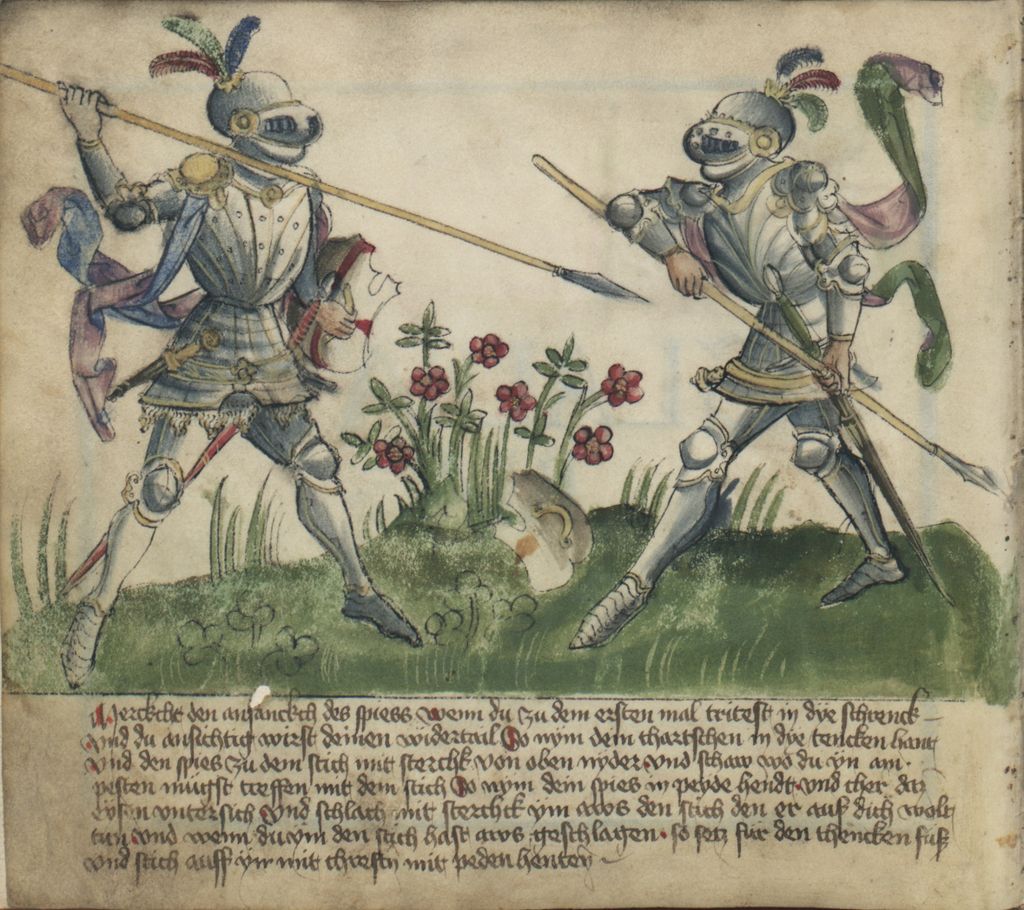
Medieval knights and their world have been the focus of many modern studies and I would like to share with you this very interesting article, the fruit of cooperation between various researchers and disciplines that is free to download and to study at your own leisure.
The subject matter is the armour and its use in the XV century, the approach presented can be summarized  via the statement by the XV century master of arms Pedro/Pietro Monte who listed the most important armor qualities: 'lightness, protection and freedom of movement.'
Gladiatoria
some images from the Talhoffer Fechtbuch (MS XIX.17-3) by the German master Hans Talhoffer available via the great HEMA alliance project


enjoy