Showing posts with label XII century horse. Show all posts

Tuesday, February 14, 2023

Favila de Asturias' Last Kiss

 Salvete,


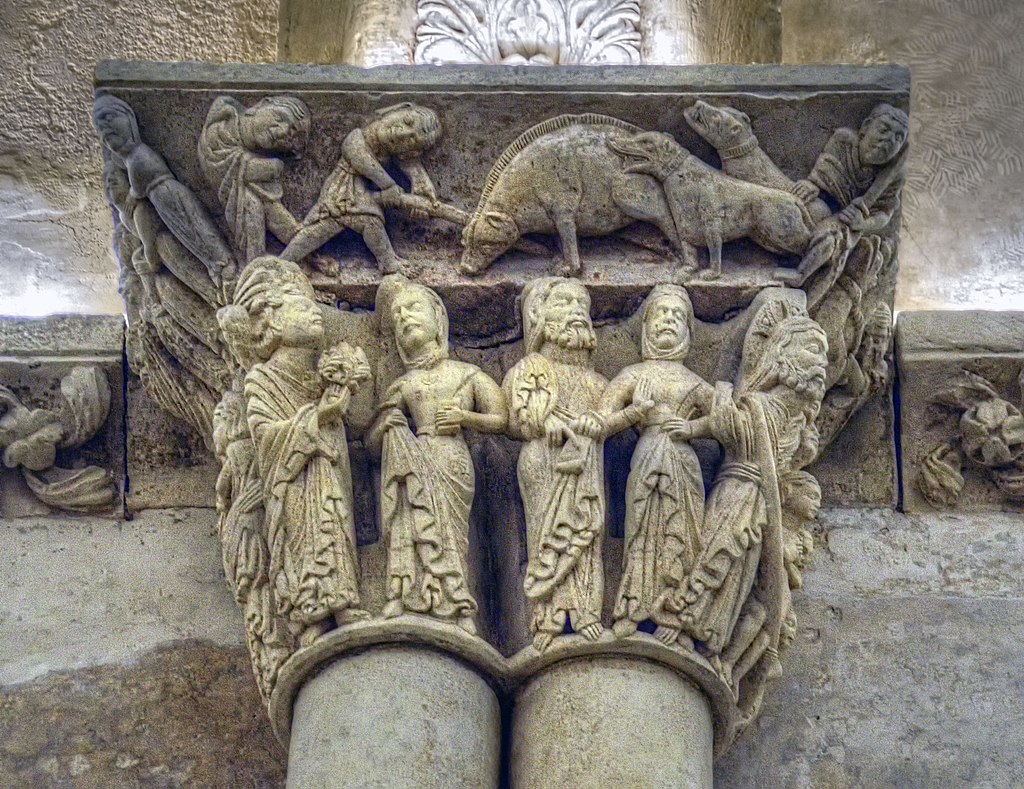
The occasion seems apt - the Valetnine's Day - so let us look at this XII century Spanish art showing king Favila de Asturias (son of king Don Pelayo and the 2nd king of the Kingdom of Asturias) and his wife Foiluba.
The Christian Reconquista (reconquest) of the Iberian peninsula from the Moorish occupation started with these Visigothic Asturian dynasts, with the legendary battle of Cavadonga, 722AD.  


From his capital Cangas de Onis Don Favila ruled but for two years, and in 739 was killed by a bear while hunting. He was burried


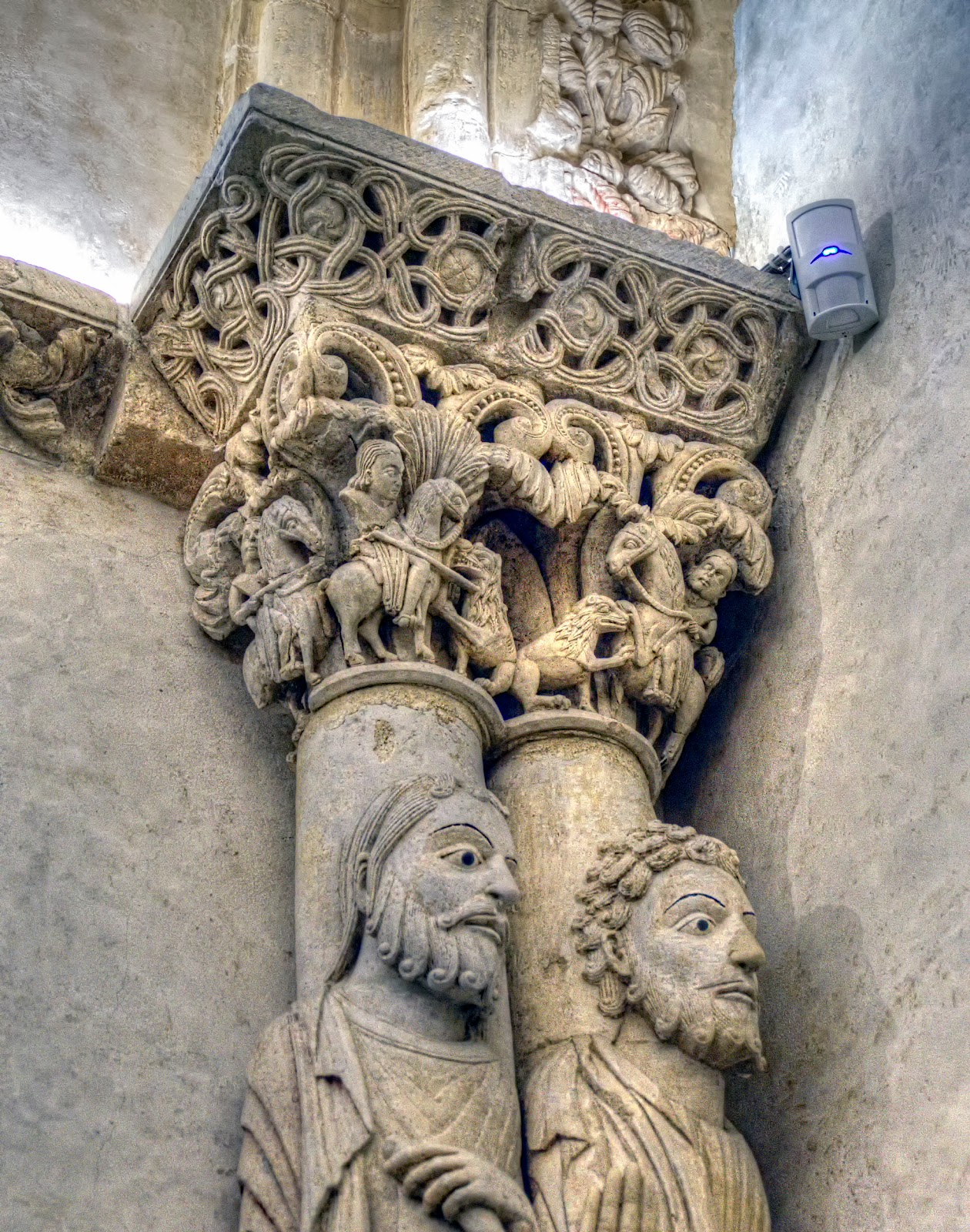
At the defunct monastery of San Pedro de Villaneuva (presently a parador aka hotel) there is Romansque art showing this Asturian king and his, in the spirit of Valetine's Day, beloved wife.


and there is a capitel carving  showing the royal couple in their last farewell
 and another capital sculpture showing hunters (XII century attire etc) hunting lions? or bears?


King was buried inside the small church he had founded - the  Santa Cruz de Gangas de Onis, and where he wife was also buried with him. but this temple   was destroyed and rebuilt twice (in 1632 and during the Spanish Civil War in 1936, when local Republicans? or Communists? destroyed the building to show the ancient dolmen that had been an integral part of the Christian temple) in its history, . But no trace of the  earthy remains of these royals can be found nowadays. 


enjoy your Valentine's Day

Valete

Saturday, December 24, 2022

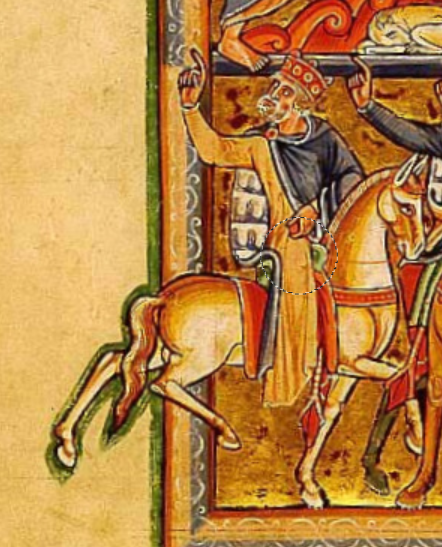
Three Kings - XII century Psalter illumination

 Salvete Omnes 

this evening we will celebrate Christmas Eve


shepherds and their Holy Land flocks in this late XII century central Italian illumination

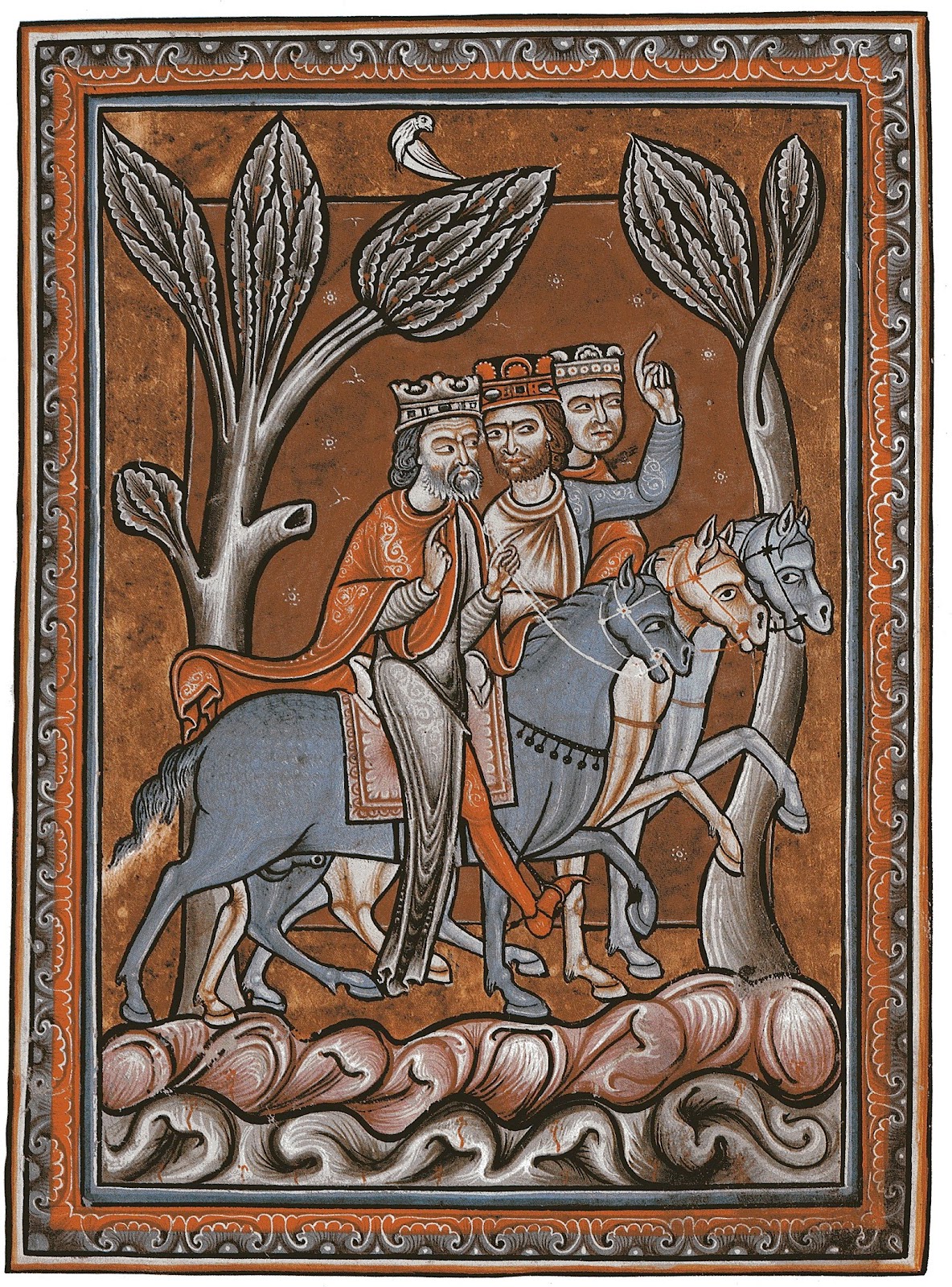
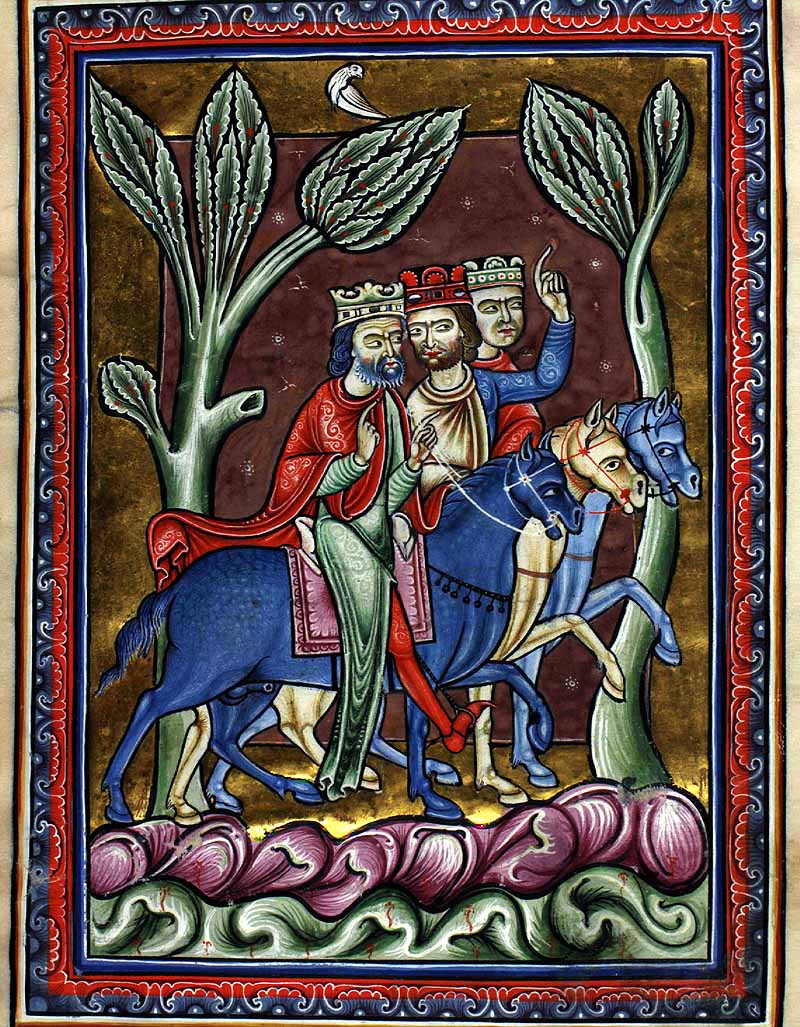
meantime enjoy two beautiful renderings of the Nativity -  The Annunciation to Shepherds and Three Kings going to Bethlehem in this XII century English (when Anjou kings ruled the English realm and parts of France) Psalter perhaps made for the Danish Royal family between 1175-1200 held at the Royal Library in Denmark


all XII century horse and tack in one painted illumination -

from Wiki Commns


Merry Christmas *

 Feliz Navidad *

Wesołych Świąt - :)

may peace come to Ukrainian and Russian people

Valete

Sunday, June 14, 2020

The Lewis Chessmen - Gaelic-Scandinavian warriors

Salvete Omnes,

I love playing chess, and often the chess pieces are beautifully hand carved, painted and lovely to behold.
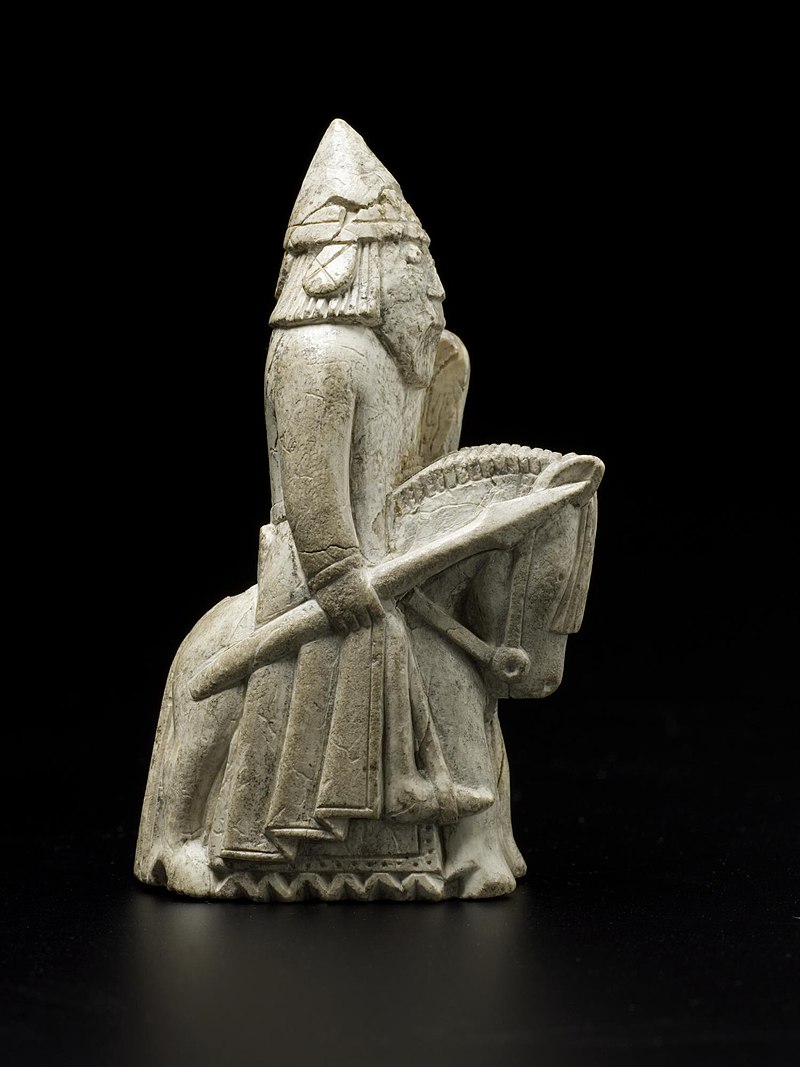
So making long story short I would like to bring to your attention the famous Romanesque period Lewis chess pieces, discovered on the Isle of Lewis, Scotland, UK in 1831, and it is thought to have been made in the XII century, when this part of Scotland was a Norse Kingdom of mixed Gaelic and Scandinavian traditions.

There are 11 pieces held at the National Museum of Scotland out of 93 pieces found,
 
the remainder is kept at the British Museum in London, UK.
Most of them were made out of walrus ivory (perhaps from Greenland), and there is the dispute where the ivory  might have originated and where they were carved - Norway or even Iceland. The dispute has been very interesting, eg this article. Wiki also has an entry on this collection and Wiki Commons plenty many of photos and drawings of the famous chess figurines.
The hoard contained plenty many of knights - this article says 15 horsemen (so one seems to be missing).
In one of Dr David Nicolle's many Osprey books - Medieval Scandinavian Armies 1100-1300AD, there is some discussion about the information contained in the chess pieces and a plate (plate E) painted by Angus McBride.


I could not resist to include the berserker as a warder

Valete

Monday, May 4, 2020

The Twelfth Century Horse & Rider I

Salvete Omnes,
I would like to collect on my blog this gallery of XII century Medieval horse and rider images, or related to the use of horse and other equids, and occasionally even the bovines used in transportation.
I already made three posts about the Magi where several images each from St. Albans Psalter Psalter of Saint Louis and Codex Bruchsal from Karlsruhe (but since more of the pertinent illumination are there  I will return to them too).

I am going to start with the illuminations from Madrid Skylizes - sometime during the XII century these illuminations were painted by a School of Miniaturists (?) in one of the monasteries in or around Messina (the linked article argues for the Messina Orthodox Monastery of the Saviour), Sicily, and those copious miniatures are illustrating the Byzantine chronicler Ioannis Skylitzes'  'Synopsis of Histories' or the Eastern Roman Empire history.

The illuminations showing the Eastern Romans aka Byzantine rulers and their enemies artistically and stylistically combine the Byzantine, Arabic/Saracen (like the horse tack and furusiyya motives), and the Western or Italo-Norman? elements .


Valete!

Friday, January 5, 2018

Magi - Codex Bruchsal from Karlsruhe

Salvete Omnes,
one more day to los Reyes Magos - so one more medieval manuscript illumination we can ponder..
So another High Middle Ages wondrous painting - via Wiki Commons- from Badischen Landesbiliothek in Karlsruhe, Germany.

Journeying Magi
Our three kings are shown in the fashion of the Holy Roman Empire costumes and outfits. Their horses are stallions, all are shod and of uniform grey color.
All  bridles are similar - with large metal discs for bridle adornments, including the bit,  and metal studs complementing the bridle straps. Note that there are no nosebands and bits used are of a curb type. There is large and wide embossed (presumably) but different in design leather brestcollar on each horse. Saddles with the saddlepads and /or shabraques are quite ornate and also uniform; sort of roundish saddle skirts, not unlike many centuries later in Old California or Mexico (mochilla leather covering the wooden saddle tree).
Saddles are of high arches type, used for combat with a couched lance and apparently travel too. Unless this high saddle represents the idea of a nobleman saddle in the Medieval art? Some time later we see similar tack features in a three-dimensional Holy Roman Empire sculpted figure at the Bamberg Cathedral - known as der Bamberg Reiter.
Riders use one hand to hold the reins, military style but rather loose and thus perhaps indicating neck-reining and highly trained mounts, while seated astride their steeds in la brida (legs extended) style. Stirrups and spurs are present.
Note that we see only one cinch on each saddle.
following the Star of Bethlehem, this stallion appears highly collected while cantering
this stallion is clearly pacing, hence a palfrey. Also, there are two leather bands adorning the neck


this one is perhaps pacing too
 the Codex is associated with the XII century Archdiocese of Trier.

Valete!

Thursday, January 4, 2018

Magi Journey - St. Albans Psalter

Salvate Omnes,
Magi journey - this time another illuminated page from a medieval manuscript - a fine example of the Norman art called Saint Albans Psalterpainted around 1130AD, for or at the Saint Albans Abbey. Believed to have been ordered by the abbot Geoffrey of Gorham for his friend an anchoress Christina of Markyate.
The manuscript is kept at the Basilica Library at St. Godehard, Hildesheim, Germany.


We see here no horseshoes (but they were in use as seen here  or here), but they do appear in other XII century illuminations, the saddles have high arches and what appears to be  some very colorful saddle blankets while the visible horse tack contains a breastcollar, bridle with a curb-bit  and single pair of reins. Stirrups are long and our magi ride military style, holding reins with the left hand. No crouper is visible, but there are perhaps two cinches, the rearone clearly visible with its buckle etc.
the XII century illumination showing  pack animals - a mule and a donkey with a attendant on foot carrying an instrument of not a small persuasion aka three-thonged whip (I wonder if of any association with Jehudiel)

Valete!
ps
Siculo-Normans and Stauferian tradition in this manuscript  by Petrus of Ebulo -  lots of horses and also a sidesaddle-riding queen.

Tuesday, January 2, 2018

Magi in Journey - Leiden Saint Louis Psalter

Salvete Omnes,
ha, and there we have a very first post in the brand new calendar year of 2018.
We should go right back to the Magi and their journey ( still several days ahead of this sweetly warm holiday of gift-giving and celebrating the birth of Jesus) as portrayed in the noble medieval art while keeping up with the hipology theme.

So here we have this page from the Leiden Saint Louis Psalter - painted for Geoffrey, Archbishop of York in around 1190AD and later on used by young Saint Louis. The manuscript is presently kept at the Leiden University Library.

Magi - riding pacing horses, highly collected


Holy Family - Madonna and Child are riding a grey mule, as probably the monk-painter and his milieu could not fathom Madonna riding a donkey.  Note that Madonna and Child Jesus are riding side-saddle. The bridle is also very interesting, as we see here a curb-bit and a curb-chain or a chin-strap. 

and another horse from this Psalter, Joseph sold by his brothers is being taken to Egypt as a slave


Valete!
ps
images from Wiki Commons