Showing posts with label Charles de Warnery. Show all posts

Wednesday, July 19, 2023

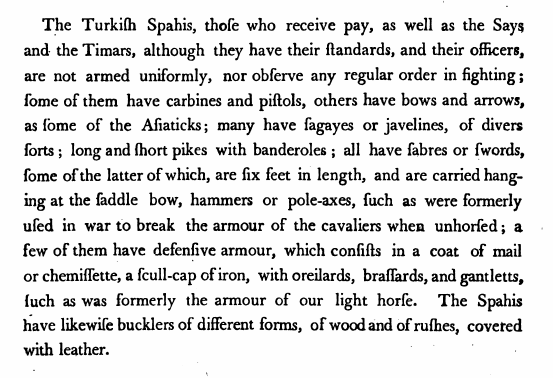
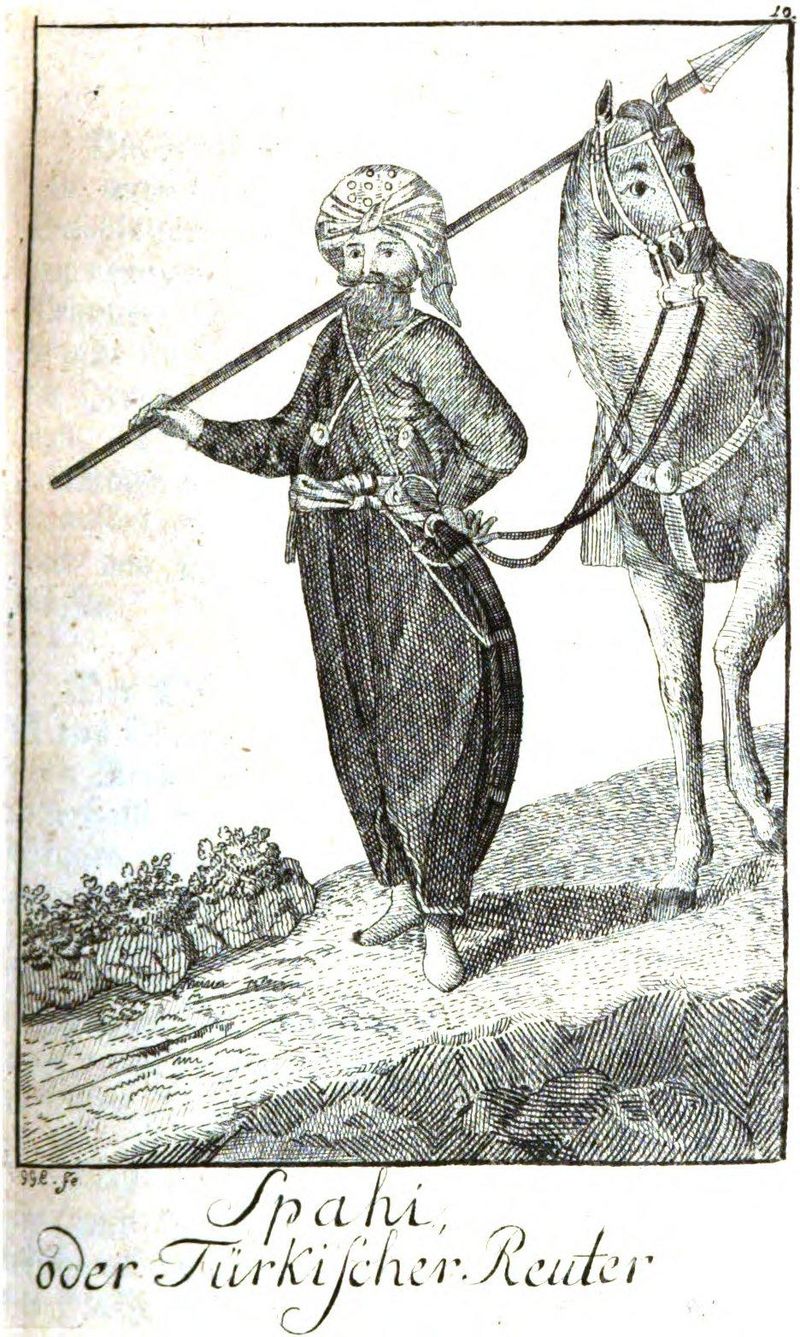
De Warnery on Ottoman Turkish Spahis

 Salvete Omnes,


long time ago I brought here the book by a Prussian & Polish cavalry general Charles de Warnery - Remarks on Cavalry

Today, I would like to bring to your attention the short description of the Ottoman Turkish spahis/sipahi as seen by general de Warnery. 


and some other late XVIII century images of the Ottoman Spahis


enjoy

Valete

Sunday, February 28, 2021

De Warnery on cavalry horses and horsemen II

Salvete Omnes,


continuing from the previous post on our good general de Warnery and his remarks on cavalry

(again, second half of the XVIII century):

''A squadron formed in [..] three [ranks] be much more difficult for an enemy to penetrate, even should several of the front rank be fallen or disabled: for as it causes no opening in the line, the horse will not fail to advance even without his rider, feeling himself pressed on each side and behind, as it always happens: for a horse must be very much wounded to make him fall upon the spot. One without his rider, at Strigau, which had one of his hind feet carried away by a cannon ball, joined the left of the squadron, where he ran with the others during all the battle, although we were several times dispersed; at the sound of the call he always fell into the same place, which was, without doubt, the same that he had before belonged to in the squadron.''
 One without his rider, at Strigau, which had one of his hind feet carried away by a cannon ball, joined the left of the squadron, where he ran with the others during all the battle, although we were several times dispersed; at the sound of the call he always fell into the same place, which was, without doubt, the same that he had before belonged to in the squadron.''

''Another time a curiassier's horse fell, in the grand attack at the exercise of Breslau, the cuirassier got him up again, and mounted him; at three hundred paces he fell down dead. The late General Krokou, (Colonel of the regiment), had him opened, and it was found that the sword of the curiassier had penetrated his heart a tenth of an inch. These facts prove that a horse is not easily to be brought suddenly down, unless a ball should break his scull.''

Horses of the cavalry regiments of the day, note that Great Britain is excluded, curiously so... while the Polish, Hungarian etc horses were mentioned  my earlier post on the uhlans.


'' The House of Austria, as well as the other Princes of Germany, France, and Sardinia, procure horses for their curiassiers, and other heavy cavalry, from Lower Saxony, particularly Holstien, and from Friezeland, which are not the most approved: but where are better to be procured  Austria has, in her vast estates of Germany, enough large and strong horses, but they are more proper for draught than the saddle; it would be easy to remedy that by procuring stallions from other countries, after having made experiments which would most improve the race of horses intended to be bred. 

''The Swiss afford art example of this kind, before the last war in Italy their horses were the worst in Europe: but when the Spanish army marched into Savoy, a great many Dragoons and other troopers, who are in general mounted upon stone horses, having deserted to them, the Swiss purchased their horses, and I am assured that they have at this time a breed of horses, very very proper for the service of cavalry, but it is very certain that they will again degenerate unless they continue to supply their studs from the fame, or other foreign countries.''
 
''Notwithstanding that the states of the King of Prussia furnishes pretty good horses, that Monarch does not make use of any of them in his army, he purchases those for his curiassiers in Holstien, and those for the Hussars and Dragoons, are procured from the Ukraine; within these few years arrangements have been made to breed horses in Silesia, proper for the cuirassiers, but I very much doubt their success.'' [ I guess de Warnery was wrong, hence the Silesian horse finally came out as its onw breed  in  early XIX century]
''The Danes and the Hanoverians have the finest horses of the north, and they are very high priced, but as the troop horses are the property of the captains, their cavalry is not superior to those who are not so well mounted, for the reasons before suggested.''

 ''The Swedes and the Norwegeins, have nothing but nags: ''

''The Russians, by establishing good harras, or studs, have succeeded to breed a sufficient number horses very proper for their cuirassiers, and carbiniers; they are not fine, but are strong and more durable than those of Holstien, from whence they still continue to procure some; in doing which, General Seidlitz was of opinion they were wrong: horses proper for mounting Dragoons, Hussars, and other light cavalry, being abundant in their own meridional provinces. ''
-------------------------------------------------------------------
* original spelling 
Valete!

De Warnery on cavalry horses and horsemen I

Salvete Omnes,

let us take trip to the XVIII century Europe with an expert-  


and so we will return  to  a Prussian cavalry general Charles E. de Warnery, whom I quoted in my  posts in the past,  and these are  some of his observations about military horsemen and horses of his days:


" For a soldier to be really a light horseman, he must be able to turn his horse quick and short, when in full speed, to raise up and catch any thing from the ground;

he will find himself much firmer in his seat, have greater command of his horse, and much more agility in the exercise of his arms, & by being mounted on an eastern saddle, that is to say, upon a Hungarian, Turkish, or Polish one; to those who have been accustomed to other saddles, they appear at first to be inconvenient, but they very soon find themselves perfectly at ease in them, and ever after, prefer them to all others; they are very light, cheap, and durable, and do not so often require repairing as the others do.'

 ''The service of light horse requiring them to be as it were always in presence of the enemy, and ready to mount on horseback in an instant; they ought not to have either breast-belts or cruppers to their saddles, which will enable them to saddle much quicker than they can do otherwise: besides, as the saddles above described have double girths, they are sufficiently firm without them.''


''In every species of cavalry the man ought to be proportioned to the size of his horse, and the arms with which he is to serve, adapted and proportioned to them both, and the nature of service to be performed;

thus
''...consequently the cuirassier should be larger, and his arms heavier than the dragoon, and those more so than the Light Horse or Hussars; a small man has great difficulty to mount a large horse, particularly with a cuirasse, they should all however be muscular and robust, but not heavy; the Prussian Dragoons are too heavy for their horses, and it is ridiculous to see a large man upon a small horse: which by being strained with too much weight, is very soon ruined, and the trooper dismounted; a man who is more than 5 feet 8 inches, ought not to be received into the cavalry, but will find his proper place in the infantry.''

When a recruit is enlisted he is taught to hold himself upright, to march with an easy air, and to shake off the lounge of the peasant; he is taught the exercise of the broad-sword, with small basket-hiked sticks; nothing contributes more towards rendering him active and dexterous; he is exercised on foot, until he is sufficiently prepared to begin it in the squadron. Whatever may be said, I hold it very essential, that cavalry soldiers, and particularly dragoons, should be acquainted with the exercise on foot, almost as well as the infantry; but always in two ranks, as the cuirassiers; they may also preserve their bayonets, provided they are not too weighty: the English and Hanoverians have taken them from their cavalry. It is however very advantageous that cavalry should be enabled to defend themselves at all times, and even on foot, if necessity required it,''

''It will be found very useful to practice on foot, at least once, any manœuvres which you would perform with the squadron, before you try them on horseback, this not only saves the horses, but very much assists the ready and correct conception and execution of it, particularly should it be an intricate or complex manœuvre.
When the recruit is sufficiently instructed on foot, he is mounted upon a wooden horse, much like those made use of in riding-schools for vaulting, but it must have a neck and head, to fix a bridle to; there should be two of those horses per troop, the recruits must be instructed by them how to place the saddle on their horses, to mount and dismount on both sides, with or without stirrups, how to fold his cloak, to put on his baggage, and a truss of forrage, to vault into the saddle without aid by the croup, that he might be enabled to do it on his horse, without having occasion for a knot instead of a stirrup; he must be exercised to bend forward and take his hat from the ground; to dismount, to stand and hold the bridle properly; in a word, every thing but vaulting; to place himself in every position of the exercise, to draw, handle, and return his sword; to load and fire his carbine and pistols; and to exercise and make use of his arms with spirit and address: this is the manner in which recruits are formed in the service, and is very nearly the fame that is recommended by Vegecius.  These two wooden horses should be placed as in a rencounter, on the right hand of each other, and those that are upon them mould thrust and cut with the point and with the edge, with  basketbasket-hiked sticks, and they should be taught all the guards, to ward off, and to parry the fame. ''
 ''A soldier should not be taught to ride as it is practised by professed riding-masters, because the greatest part of the aids given by them must be with the bridle, which for that purpose must be held short, but without stiffness, the left shoulder a little forward, extending his hand in an easy manner to the mane of the horse; a trooper in the ranks can give false aids only with his legs. When he has been properly exercised in this manner, his horse is given to him, and he is quartered with a non-commissioned officer, or some old steady trooper, who is to mew him how to take care of his horse, how to saddle and to bridle it, to comb his mane without tearing out the hair, and never to touch the tail but with his hand, to wash it once a week, and after the new moon to cut the points of the hair; experience has proved this to be the true means of preserving that fine ornament of a horse. Every thing should now be taught the recruit which might be requisite on actual service, very near the exercise of the carousel, except the exercise of the javelin, which would be useless to him. He ought to be able to turn his horse suddenly upon his haunches, to run at the the ring with his sword instead of a lance, which very much suples the horse, and forms the trooper to dexterity and firmness in his feat, without however attending to all the minutia required in the riding academies."
''A squadron ought to be often exercised without saddles, and manœuvre every day at least half an hour: this is absolutely necessary, to keep the horses in wind, and to harden them; it is with them as with racers, if they are not kept in continual training, they are very soon incapable of performing the service required of them.''
''There are few horses but which might be made to run; when we had bought those which our Hussars had taken from the enemy, the greatest number of them were given in the re-mount; at first those troopers who receieved them where disatisfied with their want of activity, but after having felt the Prussian spur for a few weeks, they were as fleet as the others.''  
"As soon as the squadron is mounted the troopers are practised to leap ditches, enclosures, poles put across for that purpose, etc. At other times two troopers run together full speed, trying to get before and carry off each other's hats: they are practised to swim their horses across rivers, to manoeuvre in broken and intersected ground, etc.[...] and they must be made to trot a good deal, by which they will acquire a firm seat on horseback, and not to fall upon the saddle at each motion of the horse; they ought to ride with shorter stirrups than in the riding-schools, because they must be able to raise themselves four inches above the saddle.''

There are targets to be fired at by the troopers, with their pistols* walking, trotting, and full gallop, and even in leaping over a bar.

''A head of felt, stuffed with wool or straw, is fixed to a branch or post, which the soldier is to touch with the thrust or the cut, both in passing and repassing, in full gallop. It would very much stimulate the soldiers to emulation, by attaching some gratification to those who acquit themselves with the greatest address.''
''They should frequently be made to move briskly forward, and then suddenly halted upon the spot; at the word halt, the trooper presses upon his stirrups, keeping his body a little backward, retaining the bridle by bending his wrist a little, but without moving his arm; by these means he puts his horse upon his haunches.''

''A squadron should be accustomed to move off its ground at once, and all the troopers to be in motion at the fame instant, at the word of command, either at a walk, trot, or gallop; they should even be made to traverse in line. It will sometimes happen that when they are not perfect in this exercise, some horses will receive atteintes, or blows with their fore feet, from the odiers, but the performance of this manœuvre on service, is too important to prevent their acquiring it under any apprehensions of this inconvenience. It is absolutely necessary that good cavalry should be able to traverse, and that they should move the whole line at the same instant, and not successively, as I have seen it practised by some which has rather the appearance of counter than traverse marching; nothing can contribute more towards supleing of horses than the traverse movement. It is pityful to see a squadron be obliged to break off by divisions to gain ground obliquely to the right or the left, when by traversing this is performed in an instant, and gracefully.''
''A squadron ought often to be exercised in a single rank, and to advance obliquely to the right and left, upon a variety of alignements and points of view, and appui, in a rank entire; the faults are more easily discovered, and the trooper learns to march in line with more exactness: for which purpose more attention and accuracy is required, an extensive line in single rank being much more subject to waving than in two or three; sometimes even the whole regiment should manœuvre in this manner.''


''Since the lance has been rejected, the sword is, without contradiction, the queen of arms for the cavalry; and it is upon that alone, that they should depend in action, until the enemy is dispersed: it is only then that they might be allowed to make use of their pistols. Opinions are very much divided with regard to the advantage or superiority of the edge or the point of the sword for cavalry in action; each have their advocates equally zealous, who produce such instances as are in favour of that they prefer: but after much reflection on this important subject, frequent observations of the advantages and disadvantages of each, and some experience, during many years actual service in the cavalry, I hope I shall be permitted to mention my reasons for giving a decided preference to the latter.
''The point of the sword is more advantagous than the edge, because with it you can reach your enemy at a greater distance than with the other, the smallest wound with it renders the wounded incapable of serving during the remainder of the action at least; it does not require so much force to give a dangerous wound with a thrust as with a cut, and the effect of the latter. is much more uncertain, unless it happens to be particularly well placed, which it is hardly possible to do, unless you have your enemy as it were under your hand...''


''A squadron formed in two ranks is very subject to waving, and much easier broken than one of three, which also must naturally have a greater weight in the shock, and be much more difficult for an enemy to penetrate, even should several of the front rank be fallen or disabled: for as it causes no opening in the line, the horse will not fail to advance even without his rider, feeling himself pressed on each side and behind, as it always happens: for a horse must be very much wounded to make him fall upon the spot.
_________________________________________

* original spelling

valete!

Sunday, June 29, 2014

Uhlan - Kurhannoversches Scheither-Corps Ulan circa 1760

Salve,
quite interesting image surfaced on the Web - namely Wikipedia Commons - of an Uhlan (with a lance etc) that is described as a member of the Hanoverian army, a light cavalry unit known as Scheither-Corps (1758). Hanover fought on the side of Prussia and United Kingdom during the Seven Years War. However, the Seven Year War Project known as ''kronoskaf'' has a page devoted to the Scheither-Corps and there is no mention of any Uhlans.


He is dressed in a peculiar set of clothes, but his red 'czapka' with fur trim and feather (?) adornment, his red leather boots, red pants or ''szarawary'' are typical of the period for the Polish and Turkish cavalry, but the red dolman under his kaftan (by the way I think the artist had no concept of a ''kontusz'' or a kaftan with empty sleeves like the ancient Median kantuš) is more akin to the Bosniaken (Bosniaks),

light cavalry  with the Prussia,   armed with pikes/lances, sabre, perhaps pistols or carbine too.

In any event this uhlan reflects the fashion of Polish military of the first half of the XVIII century, although the dolman is a novum, for our Polish uhlans would wear a żupan under their kontusz or kurtka.  The similar uniforms were worn by the Polish Uhlans in Saxon service ( kronoskaf has two units reconstructed here and here), Gallica has an image of one Polish uhlan from 1736 (he appears to be wearing a kurtka), and there the uniform colours and lance pennon are generally the same (more on these early uhlans in the future) , so perhaps this horseman represents some rouge company that served with the Hanoverians, after having been taken prisoner or switched service under more profitable circumstances?

I like the way this artist represented the mount of this light cavalryman - a rather smaller, spirited war horse, and by the way a Luckner Hussar rides a similar horse, while perhaps it worth observing that quite similar mounts would appear in de Warnery's work on cavalry.

I should add that this uhlan is most likely  a towarzysz (following Polish miltiary tradition and enlistment), or a noble trooper thus armed with lance, as opposed to a pocztowy (retainer/trooper) that was armed with a carbine (cavalry musket) etc.

The officers of the 'Saxon'- Polish uhlan regiments wore a bow case hanging from their belts, perhaps a sing of their noble Tatar and equestrian tradition.

Finally, I played with this Uhlan a little bit, sketching with an ink pen (enjoying my manga Kuretake pen nibs & Hero manga fountain pen), and in the left corner included a sketch of the szarawary as they appeared in the period art, showing Polish cavalry etc. I did not give him a lance etc, as more sketches will come, I hope.


Enjoy

Saturday, October 9, 2010

The mid-XVIII century Uhlan, der Ulan, Ulan, Улан in the Prussian soldier writing


Salve.
long time ago I wrote this http://dariocaballeros.blogspot.com/2010/02/uani-introduction.html , so now let us jump to this remarkable book from the end of the XVIII century, when a Polish-Lithuanian Tatar (and Polish) lancer was yet to become the famous ulan [uhlan] of the Napoleonic wars. Note that Prussians were actually great importers of Polish horses in the XVI,  XVII and XVIII centuries,  and most likely the so called Trakehner horse breed was created by the Prussian breeders out of some foundation mares and sires that were of Polish imports in the XVIII century.

'Remarks on Cavalry; by the Prussian Major General of Hussars Warnery' for the first time published in 1781.


on the lance, the 'queen of cavalry battle':

“There was formerly in European armies, a species of cavalry called lancers: they were armed at all points; […] they were all noble or lived nobly, but they could not be employed on all occasions, they were too expensive, each of them was obliged to have two horses for his own person, a large one for battles and tournaments and another for marches and detachments; and beside these, one for the servant who had the care of them: and it was in consequence of the great expence that these troops were discontinued, when the armies were augmented
[our general is obviously simplifying the reason why heavy lancer of  XVI and early XVII centuries became obsolete in the Western European theater of war]. It is nevertheless certain, that the lance will always be the Queen of Arms for defensive of this nature of cavalry.”

About Polish-Lithuanian ulans:

“Ulans are nowhere to be found, except in Poland, unless you assimilate them with the pretended Prussian 'Bosniacks'; they have faithfully served the Kings of the House of Saxony [Saxon kings that also were the kings of Polish_Lithuanian Commonwealth in  a from of in personal union between the countries, similar to Wladyslaw Jagello] and the present one has three regiments of them in his service; they are well mounted and disciplined, and form an admirable corps of light cavalry: they ought to be all Tartars of Lithuania ( still Muslim), brave, faithful, and steady, and by no means drunkards. There are however amongst them a few Poles; the Respublica [Polish-Lithuanian Commonwealth] has also a few corps or 'pulks,' but they are by no means in the same order that the others are. They have preserved their ancient institutions; the Towarischs [towarzysz] or Noble Comrades [who] have their Podstowy [pocztowy] or servants [retainers], who are Poles; the Towarisch are the masters, and the Podstowy the privates, as formerly in France, the latter perform the ordinary service. […] the arms of the masters are, a pike [a lance] with a banderole [pennon], (or small flag) a sabre and pistols; those of the servants the same as the Hussars [sabre, carbine, a pistol or two]. In an action the latter form in second line in two ranks, in small squadrons, and the masters attack or charge in single rank, which was the custom amongst all the Gen's d'Armes [knights and later lancers].”

“no light troops are better appointed or more active or allert on horseback, than the Polish Ulans: the equipage and appointments of the Ulan and his horse, are admirable, commodious and proper: and although I am not very partial to those of the Hungarians, yet I am persuaded it is very proper for several nations, particularly those in which it is national dress.”

a little on the Polish, Tatar, Moldavian horse and Hungarian too:
...Polish, Tartar, and Moldavian horses, answer better for them [service as light cavalry] than Hungarian, those being extremely degenerated within these fifty years; without doubt, for want of attention to procure stallions from Turkey, which are found to be the best in the Hungarian Haras (or studs,) and they never had any other, while the Turks were in possession of that country.
and when talking about a light horseman's steed  our general states :
[...] for Polish horses, as light, strong, and excellent for all the operations of war.
[...]In a course of 600 paces, a good German horse, in condition, will get before a Polish, Tartar, or other horse of that description : but if the course is continued to a greater distance, the latter will regain its ground, leave the other behind, and continue in wind for a much longer time : and should the heavy horse be forced a little beyond his wind, he becomes insensible to the bit and spur, and looses all his activity.


On a light horseman and his equipment, and Polish [sic!] saddles:
For a soldier to be really a light horseman, he must be able to turn his horse quick and short, when in full speed, to raise up and catch any thing from the ground; he will find himself much firmer in his feat, have greater command of his horse, and much more agility in the exercise of his arms, &c. by being mounted on an eastern saddle, that is to say, upon a Hungarian, Turkish, or Polish one [as one can see we Polish people had our own saddles similar to Hungarian and Turkish]; to those who have been accustomed to other saddles, they appear at first to be inconvenient, but they very soon find themselves perfectly at ease in them, and ever after, prefer them to all others; they are very light, cheap, and durable, and do not so often require repairing [sic!] as the others do.


Continuing:
A good goat or sheep's skin, should be used instead of a housse [textile], they will cover at the same time, the pistols and the portmanteau [in a Polish  and Hungarian fashion, I should add] ; the bridle also ought to be as light as possible, without any unnecessary buckles or straps; there should be but one attached to the pommel of the saddle, to strap on the cloak rolled up before the trooper, which will be very important, to protect his belly from a thrust with the bayonet or sword, the stirrups should be bronzed; and by these means, the trooper, on his arrival at camp or quarters, has but few straps and buckles to clean. He covers his arms, accoutrements, &c. with the goat-skin, and has time to attend to his horse and himself; in short, every thing should be light and proper, without affectation. I have been informed, that except as to the saddles, the English regiments of Eliott, and Burgoyne, are thus equipped.
The Hussars do not require tents, [...] no light troops are better appointed or more active or allert on horseback, than the Polish Ulans: the equipage and appointments of the Ulan and his horse, are admirable, commodious and proper...
 until the next time :)
ps
Juliusz Kossak's watercolor  is to show one of the foremost Polish light horse commander and 'zagończyk' (zagonchikh) of the XVIII century Kazimierz (Casimir) Pulaski, 'father of the American cavalry', hero of USA and Poland. Here our Kazimierz  is shown during the action against the Russians near the fortified and very Holy monastery of Częstochowa (where our only  Queen of Poland resides :) ),  that monastery  he successfully defended (for 2 years) against the Russian invaders and their Polish supporters during the Bar Confederacy 1768-72.
..the saddles come from the Polish Army Museum in Warsaw, and represent XVIII century Polish-Lithuanian saddlery, most likely from the old royal city of Lwow (Lviv) :)

Wednesday, February 10, 2010

Ułani - introduction

a Halan, Uhlan, der Ulan, Ułan, Улан - an introduction


Today there was one snowy day on the East Coast of the US of A. Good day to do some painting and reading, I suppose.

     I always wonder how our ancestors could cope with  the freezing winter months, when they liked to wage war and invade their neighbors like the winter 1664 campaign against the Grand Duchy of Muscovy aka Russia.  It was during this unfriendly season that they started serious military operation over the frozen swamps, lakes, and rivers across the large areas of the Northeastern Europe. Polish-Swedish Wars and Polish-Muscovy  (nota bene Poland stopped using Muscovy and adopted new name  'Russia' around 1772 or so) Wars of the XVI-XVIII ( 16-18th) centuries were conducted during all seasons, including the coldest months. I guess they, the people of the Northeastern Europe, were the exception to the rule in the European warfare of the early modern and modern eras. Only Polish-Lithuanian  and Mongolian-Tatar armies were able to defeat and capture Moscow and do that to the Russian in their wintry country while the Western European armies of Napoleon and  later the German armies of the notorious  psycho and murder of millions Hitler could not withstand the cold and snow, eventually perishing under the snow, sleet and ice.

Eh, so many horses died in those wars, and the Napoleonic defeat in 1812 had direct bearing on the collapse of the so called Old Polish Horse as viable breed/type. But it also spelled the beginning of the Polish Arabian breeding, so successful in the late XIX and XX (20th ) centuries.

And this leads me to this subject – 'Ułani' or English Uhlans (actually older form was 'Halani') - the Polish lance-armed, wearing a 'czapka' ('chapska' square-topped hat of the Great Steppe origin) and 'kurtka' (a double-breasted Polish cavalry jacket), cavalry. They appeared in Western military history during the War of Polish Succession (1733=38) http://en.wikipedia.org/wiki/War_of_the_Polish_Succession in the army of the Saxon and Polish King. It took almost a 70 odd years for these uhlans to become famous due to their service with the Napoleonic armies. I will write about that some other time...
So I wanted to start this theme, and I will be returning to it every so often, because I found some early images of the Polish Uhlans from the XVIII ( 18th ) century.
Two horsemen in full uniforms, showing all the distinctive characteristics of the early Uhlan uniforms. From Charles de Warnery's book on the light horsemen writtine in late XVIII century.

   For a moment let us return to the origin of the name - uhlan. I will skip for now all the Mongolian-Turkish origin of the word Ułan or oghlan, for sake of brevity and just turn to the origin of the cavalry formation name.

Polish name "Ułan" for these fine horse soldiers comes from the Polish-Lithuanian Tatar noble family surname 'Ułan,' and it was made especially famous and thus survived into the posterity because of one cavalry regiment commander named 'Aleksander Ułan' who was commanding the Polish cavalry 'pułk' - sort of a  regiment - in the Polish-Saxon king's service (during the Saxony-Polish-Lithuanian Commonwealth Union 1733-64) and this regiment was known via his surname as 'dzieci Ułanowe' (Ułan's children) and as such name was Germanized into 'der Uhlan'.

Nota bene there were several 'pulks' in the king's service but they all took this new name for light lance armed cavalry after Aleksander Ułan had died. They returned to Poland from Saxony in 1764, because our king Augustus had died, and they carried the name 'Ułan' in the Polish-Lithuanian army, during the Bar Confederation days and later after the Partitions
So after the Partitions of Poland (1772, 1793, 1795) some of the Polish cavalry regiments were forcibly incorporated into the practitioners' armies (Russia, Prussia and Austria), but only the Napoleonic wars made them Europe-famous and most desired in all European armies and beyond...


I must add that the first Ułan regiments were of the Polish (Lithuanian ) Tatars origin, who at first made the uniform to their liking and used their favorite weapon – a light lance (dzida or rohatyna) with a pennon, along with a sabre, pistol while the officers even carried bows as sign of prestige and rank.

In some not so distant future these Tatars and their history will be told here in some detail, or so I hope.
Pa ka
ps
 the picture that I use for my 'avatar' is of such pre-1795 Polish-Lithuanian uhlan officer - done some years ago.