Showing posts with label Polish Kingdom. Show all posts

Thursday, April 24, 2025

Polish Kingodom of Boleslaw I the Great - 1025-2025

 Salvete Omnes,

glorious anniversary

king Mieszko II

more than a thousand years ago  some of the Polish tribes unified into one state under the their own dynasts from Greater Poland. 

Traditionally and in the Polish Christian lore and historiography duke Mieszko I is considered the first ruler of Polish realm circa 966AD, but naturally this could not be not true, as if duke Mieszko appeared from a thin smoke.
Especially since the Polish archaeologists have been digging into the soils of Greater Poland for more than a century and can reasonably show the sudden development of large strongholds around 920-40s AD within the heartlands of Polish state, i.e., Greater Poland - Wielkopolska, the center of the Polish state for the next centuries to come. It was duke Ziemomysl and his son Mieszko I who unified the tribal territories and make Polish tribes into one realm. Mieszko I chose Roman Catholic Christianity as his state's official religion in 966AD, and wed Czech princes Dobrawa for wife and mother of his children.

a chalice from Gniezno Archdiocese museum


Fast forward to duke Boleslaw I, the son and successor of Mieszko I, who after a long war against the German Empire, which he won in 1018AD.
Duke Boleslaw I was crowned king, according to the primary sources, in 1025AD. There are many ideas why and how this Piast (the name Piast as the name for the Polish dynasty was used by Polish XV century chronicler Jan Dlugosz)  dynast fought and negotiated his way to the crown.
The date of the coronation and the site are unclear - it is thought that the ceremony was performed on Easter or close to it in 1025AD, which was the 18th of April 1025. Some historians theorize that it was April 23, 1025AD.

Emperor Otto III gave this spear to duke Boleslaw I in 1000AD

Curiously the younger son of our first king, Mieszko II, was crowned king of our Polish Kingdom along with his father and lord.

Boleslaw I's coin 992-1000AD

Bolesla I's denarius


This is the greatest anniversary in Polish history - the birth of Polish Kingdom.

here you can download  Mariusz Kozik's' very high resolution of his digital painting


the beauty of  all things is that  my friend Mariusz Kozik created a digital painting, true, an imaginary scene of this coronation - Boleslaw I in the Gniezno cathedral.
(Note that Boleslaw I had this first cathedral  built before 1000AD, and created then and there the sanctuary to the martyred Saint Adalbert. 
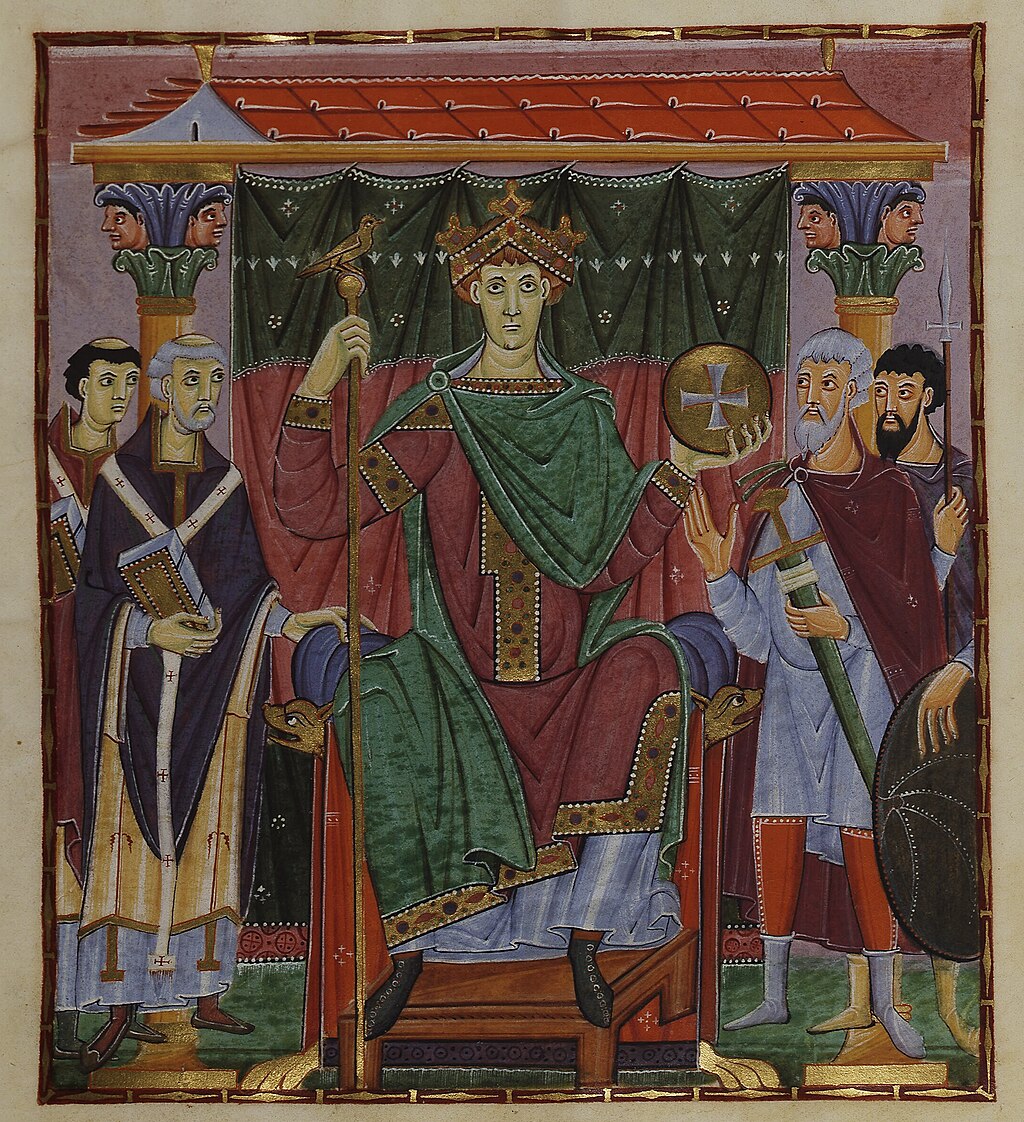


Emperor Otto III visited the cathedral and the sanctuary in the year 1000AD. 

Gniezno Door's detail  (1170AD) - Boleslaw I pays for the body of martyred Bishop Adalbertus

Unfortunately in 1038AD Czech duke Bretislav destroyed the city and the cathedral, which was rebuild in a Romanesque style by our king Boleslaw II in 1064AD)

Polish Kingdom during the reign of Boleslaw I and Mieszko II


Maestro Mariusz Kozik made his fine work available for free to any and all - if you are teacher or aficionado of all things medieval you can download and print this digital work for free.

Vivat Polish Kingodm, vivat Polish people around the world - some say circa 65-70 million strong.

this time - the X & XI centuries were the period of the Ottonian Golden age in art


Enjoy

ps

if you understand Polish  then the Yt page of prof. Gosciwit Malinowski is a great place to visit for a great journey into the world of sources and their interpretations  

Monday, October 2, 2023

The Banners in the Battle of Grunwald 1410

 Salvete Omnes,

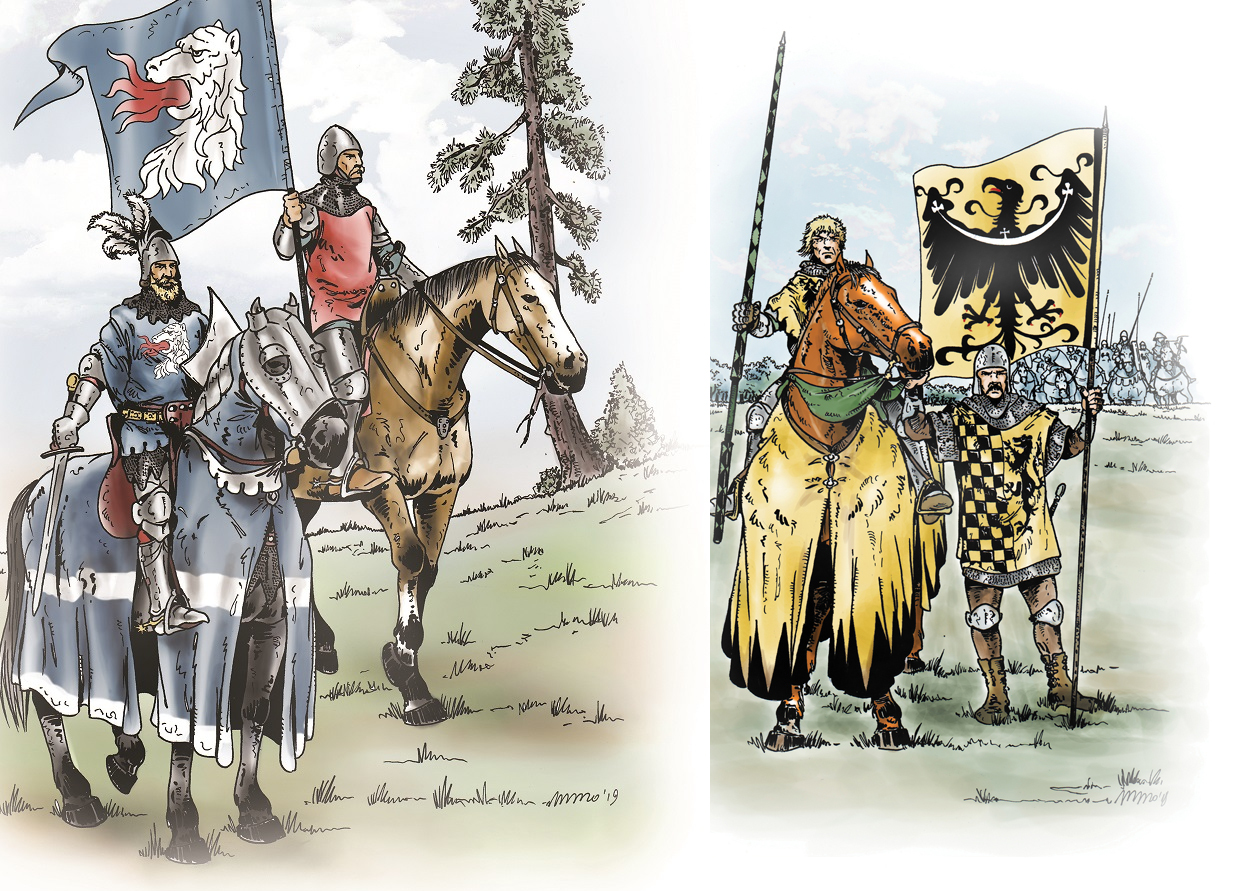
copyright of Mariusz Moroz & Winged Hussar Publishing LLC

a quick but happy entry  about a project carried out to fruition:

lastly  I have been involved in the translating, editing and fine tuning of the English language edition of the Polish company - Wydawnictwo Kameleon - publication titled 'Choragwie pod Grunwaldem' (Banners in the Battle of Grunwald) which deals with the famous battle of Grunwald AD 1410. 
The plates for this album had been drawn and painted by Mariusz Moroz , Polish artist, including being a successful tattoo artist. The Polish text, that I helped translate and edited, had been written by a seasoned writer and publisher Robert Zareba. 

copyright of Mariusz Moroz & Winged Hussar Publishing LLC

The book allows for a final one-volume collection of the banners of the opposing sides, and also contains banners captured by the Polish knights at Koronowo and Dabki (two victorious for the Polish side battles of the fall 1410). 

The American publishing company - Winged Hussar Publishing LLC -  produced this  edition of this book - 208 pages. The project has been a challenge on many levels, like the names of historic persons involved,  localities and  historic regions, the chronology and terminology etc, but finally has been completed and it will be available for your pleasure and enjoyment by the end of October 2023. Also in the United Kingdom eg on Amazon UK. 

copyright of Mariusz Moroz & Winged Hussar Publishing LLC


copyright of Mariusz Moroz & Winged Hussar Publishing LLC


enjoy

Valete


Wednesday, May 11, 2016

Castles, towns and palaces on youtube - Polish Kingdom and Polish-Lithuanian Commonwealth


Salve,
los caballeros or knights and alike naturally had to live in castles, palaces, manors, and towns. Due to the wars, partitions and Communists regimes in all our lands most of these places do not exists in their glory being ruins or most often they have disappeared under the dust of times. But thanks to hobbysts, historians and archaeologists and businessmen some have been restored, either as real functioning museums and/or places of business or as virtual presentations. The most famous are the Teutonic Castles, most taken by the Polish Kingdom by 1466 - in this video presentation.

Zamek (castle) Bobolice , one of the Eagle Nests (video)of Jura(Upland) Krakowsko-Czestochowska, has been brought to life, after more than 3 centuries of ruin -  see this video. For our Polish readers this is an interview with the owner and spiritus movens of the rebuilding by the Lasecki family.
Another example of a stronghold  being rebuilt in this area is the zamek Korzkiew - their website.
In present day Lithuania the government finally rebuilt the famous castle of Troki/Trakai - nice photos here - but the reconstruction was originally started in 1929 and almost completed by the Polish Republic in 1939.
Belorussian government finalized the  rebuilding of the famous Mir castle - Мірскі замак - where in 1812 Duchy of Warsaw uhlan regiments  fought a defensive action against the Russian Imperial cavalry and the owner, one of the richest men of the world, 8th Uhlan Regiment commander prince Dominik Hieronim Radziwill lost the castle because he had decided to become a Polish soldier, he later died  of the injuries in 1813-  nice video here.

There are many multimedia projects in the former Polish-Lithuanian Commonwealth lands that strive to recreate the appearance of these historic sites in animated renderings and videos.
some examples (links to videos are in [..] ):
Żółkiew/Zhovkva - established by the Crown grand hetman Stanisław Żółkiewski in Ukraine - [1 ]
Lębork - Pomerania - a medieval town [2]
Zamek Krzyżtopór - magnate residence [ 3]
Zamek Rabsztyn - [4]
Nieswież/Nesvizh, Radziwill residence in Belarus, [5]
Dobczyce - medieval town and castle [6]
Nieszawa - medieval town [7]
Royal City of Krakow & Wawel Castle-  a thousand years ago - [8a] [8b]
Ostróg/Ostroh - [9]
Biecz - XVI century appearance [10] [11] [13]
Tustan, castle in Ukraine built by Kazimierz Wielki [13]
Wieliczka , famous salt mines and their castle - [14]
 Kamieniec - castle [15]

and many others eg Kamieniec Podolski.

During the XIX century Polish patriot (veteran of the November Uprising  where he received Virtuti Miltiari cross for his bravery) artist Napoleon Orda drew, then engraved his drawings of former Polish-Lithuanian and Polish Kingdom castles and towns, and had these engravings published in a mutlivolume publication titled ''Album Widoków Historycznych Polski...'' - example here
enjoy
ps
all images are in Public Domain

Sunday, June 14, 2015

O wyginięciu rasy konia polskiego - Radoslaw Sikora

Salve,
bardzo udany, moim zdaniem,  artykul dr Sikory o koniu polskim konca Rzeczypospolitej Obojga Narodow, i o domniemanych powodach jego wyginiecia opublikowany  na portal kresy

Jedrzej Kitowicz pisal w swoim 'Opisie Obyczajow.. o koniach polskich, woloskich i ukrainskich uzywanych w zaprzegach:
  ''Cug koni kiedy miał być paradny, powinne były być wszystkie sześć koni rosłe, piękne, jednakowej szerści i jednakowej więzi, czyli jednakowego składu; najbardziej dobierano, aby łby miały równej proporcji, aby karki równo załomywały, nie trzymając jeden wyżej, drugi niżej, żeby nogi miały gładkie i zbieranie nóg kształtne; taki cug był w najpierwszym szacunku. Dobierano do takiego koni dzielnych wierszchowych tureckich, angielskich, wołoskich, ukraińskich i polskich stadnych; i te gatunki koni były w używaniu pierwszych lat panowania Augusta III; potem zarzucili polskie, tureckie i ukraińskie konie, z przyczyny że do figury karet zbyt wysokich zdawały się małe do wielkiej parady, która wszystkiego wielkiego i ogromnego wyciągała. Więc się udali do wielkich szkap niemieckich, duńskich, meklemburskich, pruskich i saskich, jako też i hiszpańskich. A że te konie miały nogę grubą i kosmatą, więc ją szkłem skrobano, aby się wydawała gładka i cienka.''
Fragmenty z artykulu:

„Koń Polski wzrostu miernego, ale silny, składny, szypki w biegu, w pracy niepożyty, w iedzy pomierney, a przeto do znoszenia woiennych prac y niewygod bardzo sposobny, stał się koniecznie potrzebny Sąsiedzkiem Potencyom do letkiey iazdy którą coraz bardziey pomnażaią. Co y iakich by nie wprowadzało do kraiów kapitałów? ale po odpadnieniu w wieku przeszłym [czyli XVII] wielkiey części Ukrainy, y nowych kraiów naszych rozerwaniu [chodzi o pierwszy rozbiór Polski], z mnieyszyło się bardzo tych wybornych koni gniazdo, które ostatnie domowe zawieruchy [konfederacja barska] ledwie nie doszczętu wytępiły. Już teraz nie tylko dla woysk postronnych, ale nawet y dla naszego, z Ukrainy Moskiewskiey [czyli wchodzącej w skład Rosji] konie po większey części kupuią.”

''Bardzo wyraźnie widać spadek pogłowia końskiego, jaki miał miejsce po 1768 roku. Z drugim spadkiem mamy do czynienia pod koniec XVIII w. Ten drugi ma związek z ostatnim rozbiorem Polski. Pisał o tym Julian Ursyn Niemcewicz, który w latach 1777 – 1778 był adiutantem księcia Adama Kazimierza Czartoryskiego, właściciela tych dóbr. W latach 1823 – 1825 uwiecznił na papierze swoje wspomnienia, które opublikowano w 1958 roku. Niemcewicz opisał w nich drogę, którą pod koniec 1794 roku był prowadzony do carskiej niewoli. Przy tej okazji wspomniał:

„Niedaleko stamtąd[13] było sławne stado księcia [Adama Kazimierza Czartoryskiego] z tysiąca klaczy i stu pięćdziesięciu ogierów polskich, arabskich, hiszpańskich, angielskich złożone. Zapewne tak piękne i tak liczne stado nie znajdowało się nigdzie. Wszystko skradzione lub sprzedane było na skarb wielkomyślnej Katarzyny za najpodlejszą cenę.”

ps
fragment obrazu przedstawiajacego elekcje elektora saskiego Augusta Wettyna na tron polski, po smierci Jana III Sobieskiego, w 1697 roku, autorstwa italskiego malarza Marcina Altomonte.

Thursday, June 11, 2015

JAZDA ZACIĘŻNA KRÓLESTWA POLSKIEGO W XV WIEKU


Salve,
 today I am  announcing a newbook,  new to me at least,  on the subject of  Polish XV century mercenary cavalry written by a scholar from the University of Łódź, Tadeusz Grabarczyk Ph.D., titled 'Jazda zaciężna Królestwa Polskiego w XV wieku,  [Mercenary horse of the Polish Kingdom], published in Łódź, this winter 2015. Dr Grabarczyk is the author of 'Piechota zaciężna Królestwa Polskiego w XV wieku (The Mercenary Infantry of Polish Kingdom),  published in Łódź AD 2000.

I have not read the book but just the preview available on academia.edu , and I find it awfully interesting,  important and a must for me.
It covers the period 1409-1500, and it is a study of organization, arms and armor, finishing with some examples of battle performance etc.
I will have to order my copy, but I learned from this discussion that this was a very small publication.
There is this review in Polish - SMDBiB
Many thanks to my friend, author and  researcher Michał Chlipała for letting me know about this publication. a review of his book on the Armenian armies during the Crusades period is here.
enjoy

ps
Images from the Holy Cross Chapel at the Wawel Castle Cathedral  - 1460s-1470s - from the Cracow school of painters