Showing posts with label Polish kings. Show all posts

Thursday, April 24, 2025

Polish Kingodom of Boleslaw I the Great - 1025-2025

 Salvete Omnes,

glorious anniversary

king Mieszko II

more than a thousand years ago  some of the Polish tribes unified into one state under the their own dynasts from Greater Poland. 

Traditionally and in the Polish Christian lore and historiography duke Mieszko I is considered the first ruler of Polish realm circa 966AD, but naturally this could not be not true, as if duke Mieszko appeared from a thin smoke.
Especially since the Polish archaeologists have been digging into the soils of Greater Poland for more than a century and can reasonably show the sudden development of large strongholds around 920-40s AD within the heartlands of Polish state, i.e., Greater Poland - Wielkopolska, the center of the Polish state for the next centuries to come. It was duke Ziemomysl and his son Mieszko I who unified the tribal territories and make Polish tribes into one realm. Mieszko I chose Roman Catholic Christianity as his state's official religion in 966AD, and wed Czech princes Dobrawa for wife and mother of his children.

a chalice from Gniezno Archdiocese museum


Fast forward to duke Boleslaw I, the son and successor of Mieszko I, who after a long war against the German Empire, which he won in 1018AD.
Duke Boleslaw I was crowned king, according to the primary sources, in 1025AD. There are many ideas why and how this Piast (the name Piast as the name for the Polish dynasty was used by Polish XV century chronicler Jan Dlugosz)  dynast fought and negotiated his way to the crown.
The date of the coronation and the site are unclear - it is thought that the ceremony was performed on Easter or close to it in 1025AD, which was the 18th of April 1025. Some historians theorize that it was April 23, 1025AD.

Emperor Otto III gave this spear to duke Boleslaw I in 1000AD

Curiously the younger son of our first king, Mieszko II, was crowned king of our Polish Kingdom along with his father and lord.

Boleslaw I's coin 992-1000AD

Bolesla I's denarius


This is the greatest anniversary in Polish history - the birth of Polish Kingdom.

here you can download  Mariusz Kozik's' very high resolution of his digital painting


the beauty of  all things is that  my friend Mariusz Kozik created a digital painting, true, an imaginary scene of this coronation - Boleslaw I in the Gniezno cathedral.
(Note that Boleslaw I had this first cathedral  built before 1000AD, and created then and there the sanctuary to the martyred Saint Adalbert. 


Emperor Otto III visited the cathedral and the sanctuary in the year 1000AD. 

Gniezno Door's detail  (1170AD) - Boleslaw I pays for the body of martyred Bishop Adalbertus

Unfortunately in 1038AD Czech duke Bretislav destroyed the city and the cathedral, which was rebuild in a Romanesque style by our king Boleslaw II in 1064AD)

Polish Kingdom during the reign of Boleslaw I and Mieszko II


Maestro Mariusz Kozik made his fine work available for free to any and all - if you are teacher or aficionado of all things medieval you can download and print this digital work for free.

Vivat Polish Kingodm, vivat Polish people around the world - some say circa 65-70 million strong.

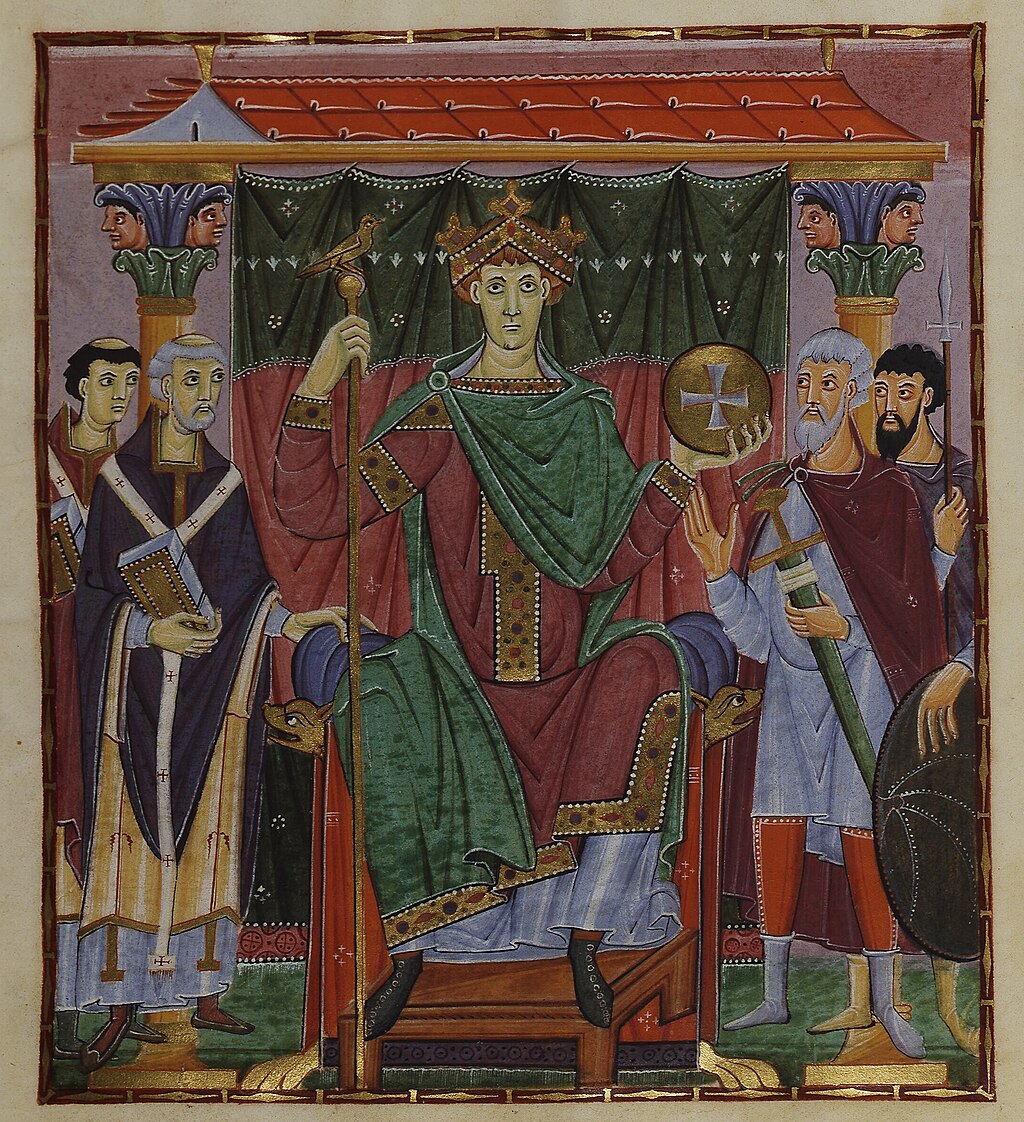
this time - the X & XI centuries were the period of the Ottonian Golden age in art


Enjoy

ps

if you understand Polish  then the Yt page of prof. Gosciwit Malinowski is a great place to visit for a great journey into the world of sources and their interpretations  

Tuesday, April 16, 2019

Notre Dame i relikwiarz koronacyjny królów polskich Drzewa Krzyża Świętego

salvete Omnes,

 [in Polish]
Wczoraj rozpoczął się Wielki Tydzień i poniedziałek zakończył się ogromną tragedią:


 pożarem katedry gotyckiej Notre Dame w Paryzu, i jest to tragedia na skalę kultury światowej. 

Dla nas Polaków to bardzo ważna świątynia, gdyż w Notre Dame, a dokładnie w skarbcu, był przechowywany arcyważny skarb polskiej kultury  tzw relikwiarz alias pacyfikał koronacyjny królów polskich Drzewa KrzyżaŚwiętego, cześć skarbów koronnych bezprawnie wywiezionych ze skarbca koronnego przez Jana Kazimierza do Francji i zawłaszczonych przez Gonzagów po śmierci Wazy.
Nota bene nie tylko Prusacy niszczyli polską kulturę (przetopienie klejnotów koronnych), również francuscy rewolucjoniści zniszczyli skarby naszej kultury przetapiając te wazowskie skarby, oprócz relikwiarza, w 1793 roku
Może nadszedł czas, żeby Polska poprosiła o zwrot tego zabytku kultury polskiej?
 Zamieściłem 2 skany z artykułu o relikwiarzu.
[English]
The Holy Week has begun yesterday and it started with an ominous sign the tragic  fire and burning of the Gothic Notre Dame of Paris, France, is a disaster of gargantuan proportions and the most sorrowful world tragedy.
There are Polish accents, namely the Paris' Notre Dame Treasury contained the Polish National treasure - medieval jewel and symbol of the Polish Crown, the Polish Kings Coronation Reliquary  of True Cross - unlawfully taken from our Polish treasury by the former Polish monarch Jan Kazimierz Waza in 1667-8. 
This Reliquary was part of the ceremonial in our Polish monarchy and the most exceptional treasure. After Jan Kazimierz's death it was illegally appropriated by the Gonzaga family, his wife's sister took it , and in spite Polish protestations and demands it has been kept in France since 1668-9.
Nota bene our failed king Jan Kazimierz took unlawfully more Crown Treasures in his exodus from Polish Realms, and those were melted by the French revolutionaries in 1793 (the other evildoers - the Prussian monarchs had  our Polish Crown Jewels melted in 1810-11).

Perhaps the time has come  that  the Polish state could ask the French Republic for the return of our Crown Reliquary? 


Valete
ps
images from Wiki Commons

Saturday, March 28, 2009

Zygmunt III king of Poland and grand prince of Lithuania


I found this image of our king Sigismunt III Vasa on wikipedia. We know now, based on the primary sources of his reign, that he was the first to receive the newly bred Spanish Andalusian Horses from the studs in Cordoba and Austrian at Lippica, his wife's family, the Austrian Habsburs, were the givers/ senders of these horses. We had used to call them Dzianet, after Jennet Genette, prior to the Corboban breed being established (AD 1576-9), so naturally they kept calling them 'dzianet's from Spanish 'el jenet', genete etc, as 'rumak' (from Turko-Persian argamak) was still reserved for the Oriental horses. Perhaps in this print Zygumunt III rides a Cordoban Spanish stallion, celebrating his armies' victory over the Turks at Chocim (Khotin) A.D. 1621.

Note that Richard Brzezinski et late Angus McBride (painter) reconstructed a winged hussar wielding a hussar lance (plate depicting Vienna AD 1683) in the same manner as Zygmunt here, in their Osprey book "Polish Armies 1569-1696" vol1. Perhaps the print was their inspiration, and obviously wrong, as the hussar lance or kopia was many between 3,5m to over 6meters long. Impossible to hold this lance in this manner. My friend Radek Sikora writes about the hussar lance in his articles accessible at http://www.hussar.com.pl/162/husaria-cz-3-radoslaw-sikora accidentally in this particular article there is my own drawing showing a long lance wielding hussar attacking a pikeman, circa AD 1626-33.