Showing posts with label Zygmunt III Waza. Show all posts

Tuesday, September 19, 2023

Stockholm Roll / Rolka Polska - scans from Warsaw Royal Castle collection

Salvete Omnes,

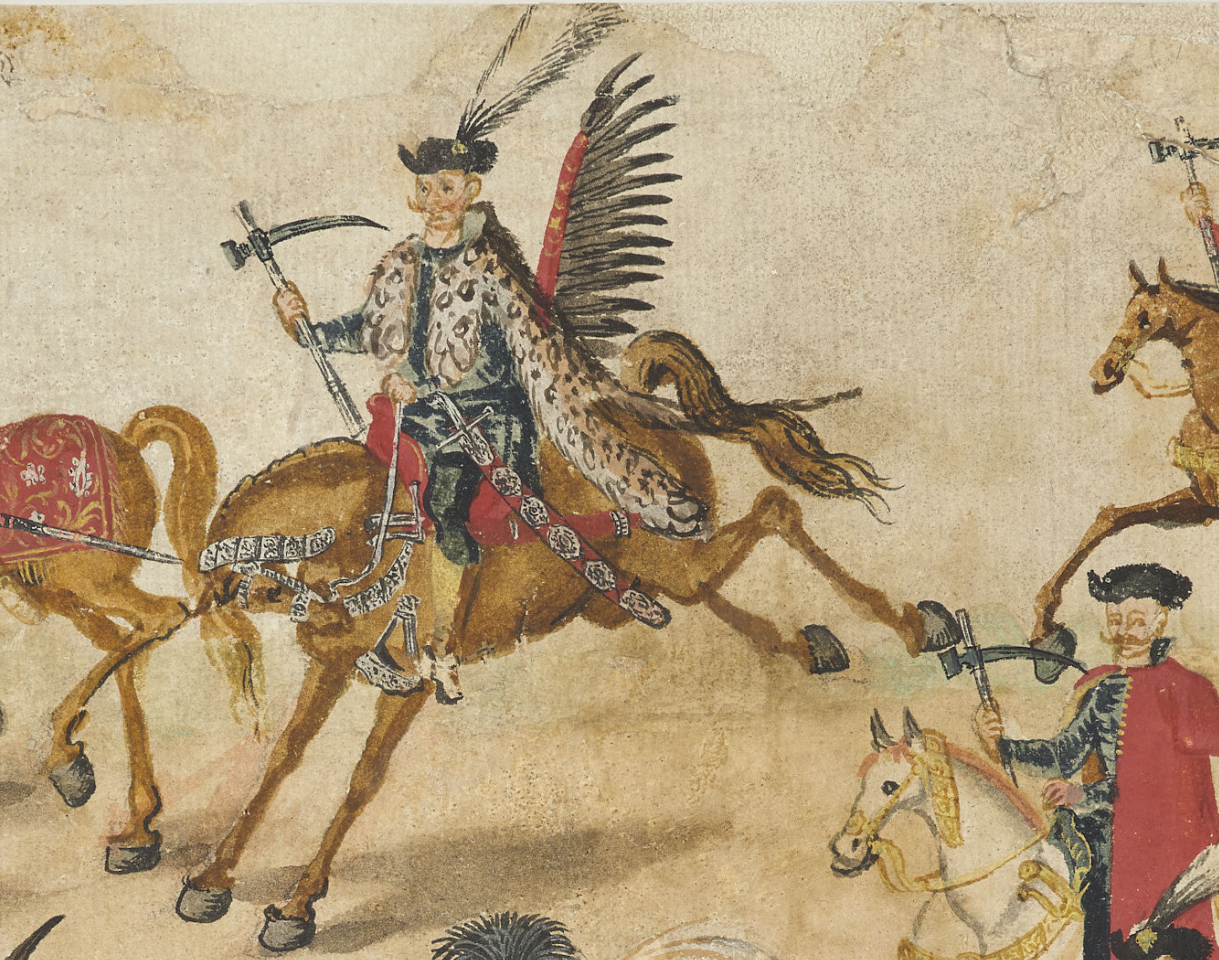
king astride a chestnut horse


I am happy to provide this newest event in the saga* of the Rolka Polska or Stockholm Roll frieze-like painting on paper -  a gouache work of art circa 1605 AD, that was painted in the aftermath of the nuptials of our king Zygmunt III with the imperial princes Konstanza (Konstancja/Constance - known for the privilegium de non tolerandis Judaeis in her estates ) of Austria, and their triumphal entry into the Old Capital, i.e. Krakow.
We see a display of horsemanship, bejeweled arms and armor, and horse tack, painted horses, variety of horse tack (Italian perhaps and Polish and Eastern i.e., Ottoman and Crimean and Transylvanian ), variety of splendid costumes - Polish, Spanish and Italian and Eastern (Ottoman, Muscovy, Persian etc) . 
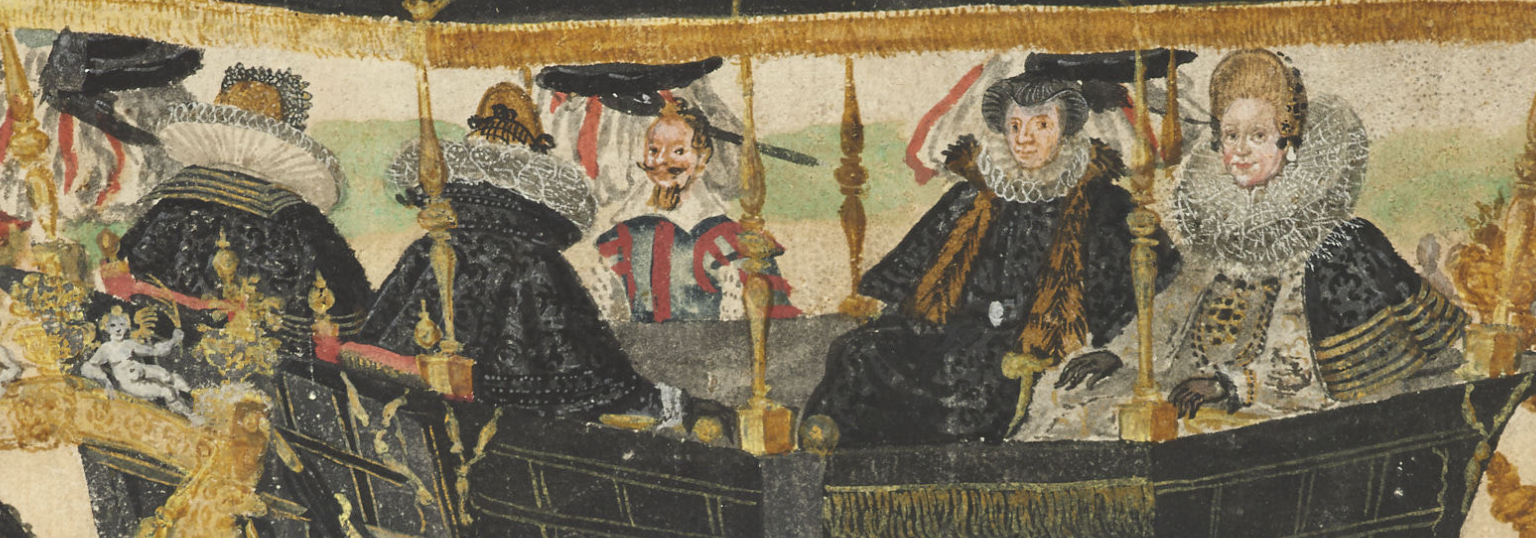
future queen of Polish Crown - princess Konstanza of Austria, her mother Archduchess Maria Anna of Bavaria, her sister Maria Christina, and princess Anna Vasa of Sweden.


Polish infantry - drummer with a white eagle drum 

king's ecuyer on a bay horse


                                                                           and the future king Wladyslaw IV - 10 years old at that time 
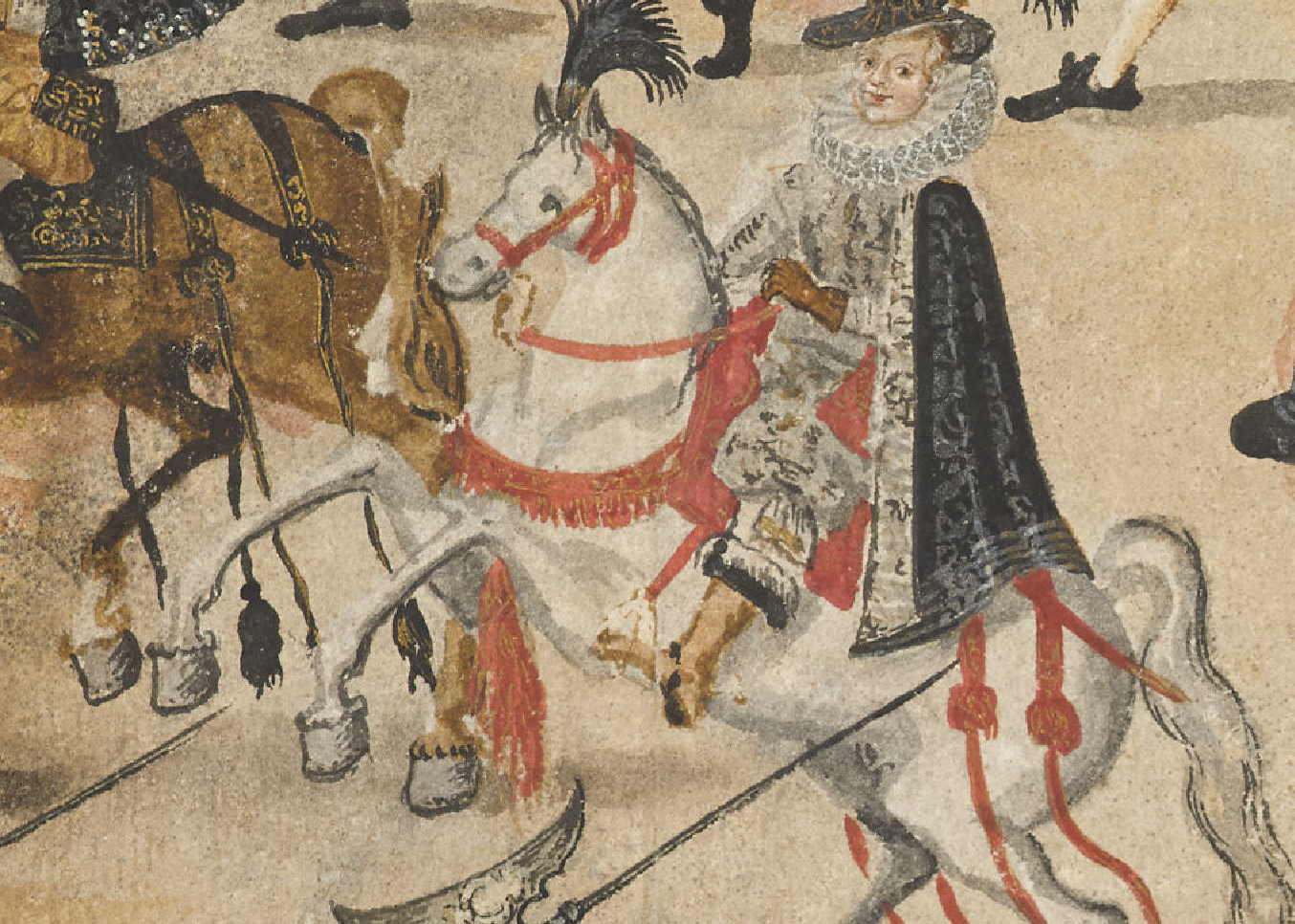
young prince on a gray horse 


Link to the Royal Castle Museum portal in English / here Polish .

But Wiki Commons has some great scans from Swedish Royal Armory - here's the link

enjoy

Valete

*Rolka was painted for the king and his wife and their family and court, and in 1655 (during the Deluge) the special Swedish art commando while robbing valuables and even marble architectural  elements from the Royal Castle took the Roll to Sweden, and it was stored at the Livrustkammern, Sweden having violated the return of cultural treasures' condition  specified in the treaty of Oliwa 1660. In 1960s some Polish & Swedish historians started collaborating on a book publication about the Polonica (Polish and Poland related  objects taken from Poland during the Polish-Swedish wars) in the Swedish collections and the Roll was included. In 1969 Sweden allowed for the Roll to travel to Poland for the exhibition, and in 1974 Swedish Prime Minister Olof Palme, while visiting Poland, returned officially the Roll to Poland, directly to the collection of then newly restored from the World War II German barbarity our Royal Castle at Warsaw. 

Sunday, October 25, 2020

List JKM Zygmunta III do Jana K. Chodkiewicza - Kircholm

Salvete Omnes,

[in Polish]

Add caption


we wrześniu minęła kolejna rocznica Chodkiewiczowego zwycięstwa nad uzurpatorem tronu Królestwa Szwecji pod Kircholmem, ku glorii Jego Królewskiej Mości Zygmunta IIII i wszystkich stanów Rzeczpospolitej Obojga Narodów :

Załączam kolejne źródło z epoki
List JKM Zygmunta do hetmana napisany po zwycięstwie :


Valete

Monday, September 30, 2019

Jan K. Chodkiewicza list do JKM Zygmunta III

Salvete omnes,
[in Polish]
w temacie Kircholmu to listy z epoki są wielce ciekawe, zwłaszcza listy uczestników bitwy, tutaj mamy list głównodowodzącego armią polsko-litewską hetmana Jana Karola Chodkiewicza do JKM Zygmunta III: 


co ciekawe, w końcowej części listu hetman litewski bardzo chwali księcia kurlandzkiego i jego stałość i dzielność we wspieraniu orężem własnym majestatu Rzeczpospolitej i JKM w bitwie i w tej wojnie.

valete

Monday, August 12, 2019

Polish reenctors at the court of Philip III at Lerma

Salvete Omnes,
Polish reenactors - winged hussars, pancerni, hajduk infantry , etc - visited Lerma, Spain on 2nd-4th of August , 2019, where their respective colleagues, the Spanish reenactors, held the festive weekend going back to the 1610s when Spain was ruled  by Felipe III  et his minister duke de Lerma.
This was the era of the iron Spanish tercio infantry, treasure fleets from the Americas, the flowering of Spanish literature - like the famous sword fighter and poet Francisco de Quevedo, Miguel de Cervantes, Gongora, Lope de Vega etc -  and fine and applied arts - Jose de Ribera, Vinvente Carducho, Juan Cotan or young Velazquez . 

Spanish gallery on Facebook - cuando eramos invencibles. And another Spanish gallery.

On the Polish side and Polish reenactors participation in this festive occasion, so it can be associated with the embassy Polish monarch His Royal Majesty King Zygmunt III sent to the court of Felipe III in 1614-15AD.
This embassy was lead be the castellan Krzysztof Korycinski, Topor coat of arms. His aim was  to bring some substantial financial Spanish assistance for the Polish war against the Muscovy, instead it resulted in the Spanish monarch bestowing on the Polish prince Wladyslaw , son of  Zygmunt III, an Order of Toison del Oro(Golden Fleece) eg visible in this painting.
Also pan Korycinski negotiated with the Spanish court the issue of the so called Neapolitan sums attempting to get some payments on the interest etc. Eventually, due to the outbreak of the so called 30 years war in 1618, the cooperation between Polish-Lithuanian Commonwealth and Spanish realm grew ever closer.


...


Below please  find the gallery of photos taken by (c) Radoslaw Szleszynski, whose masterly artisanal work .i.e. reconstructed horse bridles, cruppers and breastplates and pistol holsters can be seen on the horses ridden by the Polish reenactors, while the saddles were made by Marcin Ruda, known by his saddlery works throughout the medieval reenactors equestrian groups.


nota bene the horses in these pictures are Spanish horses that are veterans of the arena and other equestrian sports.


Valete

Friday, March 23, 2018

Two Polish Eagles - Vasa dynasty

Salvete Omnes,
a common saying goes: ''beauty is in the eye of the beholder,''  - but I rather subscribe to the views expressed by Roger Scruton in his works and talks on Beuaty.
Hence I am pleased to share with you  these two objects from the Waza (Vasa) kings period in Polish history, mostly because they are unusual and beautiful at the same time, methinks - :)  Note that these two represent what must have been a vast number of the sumptuous art objects made for the elites of Polish-Lithuanian Commonwealth.
First, the unusual one -  it is a beautiful Persian carpet!
Safavid carpet with the White Eagle

this carpet comes from the time of king Zygmunt III Vasa reign, when Polish rulers were looking to find allies against the Ottoman menace to Polish lands and interests, and the carpet is associated with the unusual expedition of His Royal Majesty faithful servant, merchant and traveler Sefer (Seweryn) Muratowicz to shah Abbas I of Safavid Persia .
from Wiki

Pan Sefer, being a private diplomatic envoy of our king,   during his trip to the courts of shah Abbas in 1601-1602 commissioned this rug in the imperial workshop.
and the Polish Eagle in the center
Sefer Muratowicz' voyage to shah Abbas I is described in a document, so called 'Relacyja,' and you can read Michal Polczynski (from Georgetown University) fine article here.
The article also includes the translation of the Relacyja and many interesting details, icluding the list of obejcts brought from Iran:

Official Persian embassy visited Polish-Lithuanina Commonwealth in 1605, and some of its members are depicted on the Stockholm Roll, painted for the Royal Castle in Warsaw (completely destroyed by the Germans 1939-45 and rebuilt mostly during the post-war Polish Peoples Republic).

Second object is simply breath taking and also unusual
White Eagle from Paris

   It is our Polish eagle made out of gold, pearls, precious and semit precious stones, commissioned circa AD 1638, it was commissioned by our second king of Waza family, Władysław IV. 
Created out of enameled gold, hessonite garnet, 149 rubies, emeralds, pearls.
King gave this jewel, along with other gifts, to his much beloved  Cecilia Renata of Austria, note that the king and queen had a son, Zygmunt Kazimierz, a boy of great expectations and greatly beloved, but he passed away to the bottomless sorrow of the whole kingdom and his grieving father.

The jewel, being part of the treasure owned by our next king from the Waza family
  Jan II Kazimierz (John II Casimir) shared his royal owner's fate. The king, 
upon abdicating our Polish throne, took his private treasure and possessions and moved to live in France under Louis XIV. There the jewel was transferred to Louis XIV in 1673 and has been in the French possession ever since, housed at the Louvre Museum in Paris. 

Note that Jan II Kazimierz had a son, Jan Zygmunt, with his French wife but he died in infancy, but had a nephew Wladyslaw Konstanty 'Snopkowski' also known as count Wasenau/Vazenault or Vasenok, who was his brother Wladyslaw IV's son by his beautiful mistress  Jadwiszka Łuszczkowska from city of Lwow.
Wladyslaw Konstanty was even named in part of the deposed king's last will and testament, among others he was to get 30,000 gold livres, but in fact he did receive less than 900 livres from his uncle's estate, thanks to duke de Conde's cordiality and good nature,  Louis XIV took the rest.  The last Polish Waza went to queen Kristina living in Rome, and there he died in 1698.

Saturday, March 10, 2018

Sigismund III & winged hussars - by Tommaso Dolabella

Salvete Omnes,
yesterday I linked a photo album from PAU, today I found out that there is another version of this album from Polona (both part of Polish digital libraries or  FBC).
Looking at both scans I noticed I omitted 3 figures on the left of the royal eagle.
the two winged hussars on top appear to have wings, they are carrying kopia or winged hussar lances


His Royal Majesty Sigismund III, grandson of Sigismund I Jagiellon. The first Sigismund lost the city of Smolensk, and a 100 years later his grandson recovered it. He was a good king, just too bad he did not annex the bastardly Ducal Prussia, the sum of Polish sorrows in centuries to come.
glorious Sigismund III is riding in a Polish costume,  equipped as a winged hussar with a koncerz or tuck/estoq and hussar sabre, also his saddle appear to have been in winged hussar style 

winged hussars

a rider with wings and two other riders, also a Polish infantry soldier

Two officer wearing shishaq helmets, carrying a mace

nota bene for the first time I had seen this print in a publication titled Lisowczycy (The Lisowski Cossacks) by Henryk Wisner (by Bellona Publishing House) many years ago, then in a book on the Polish early modern equestrian portrait from 1986 edition  . Never in this detail
enjoy