Showing posts with label Legiony Polskie. Show all posts

Sunday, May 1, 2022

Horses at the pasture - Ajdukiewicz

 Salvete Omnes,

Let the peace return to Ukraine - Stop War!

...

 May has begun - it is a lovely time to be living in all that greenery, unless some pollen allergies are clogging your good spirits. Go 'Keto' and forget about the allergies.
so for a good start of this brand new month - a painting  by Tadeusz Ajdukiewicz, Horses in the Pasture painted in the 1870s, and at the present can be found in the Polish painting collection of Borys Voznytskyi Lviv National Art Gallery at Lviv(Lwow), Ukraine.

Not a disloyal subject of the Hapsburg kaiser Franz Josef's empire,  our maestro  Tadeusz Ajdukiewicz (1852-1916) was born in Wieliczka, where the wondrous salt mines still exist, and in his early years had a wide variety of teachers, from Krakow Academy to Jozef Brandt in his Munich atelier to French Paris masters of the late 1870s. He was very popular as the painter of horses and especially of equestrian portraits. The canvas  in question was painted early in his career when he was still very young. In 1877 he  made a trip, with count Wladyslaw Branicki to the Middle East and also to London, where he painted a portrait of then Prince of Wales.
When World War I erupted in 1914,  rather elderly but patriotic maestro Ajdukiewicz joined the Polish Legions, sub-command within the Austro-Hungarian Imperial army, and during the 1916 campaign his health gave way, he got pneumonia and succumbed to it in one of the Krakow's hospitals. He was buried there and his tombstone is located at the Rakowicki Cemetery. He had a first cousin  named Zygmunt Ajdukiewicz, who was a very successful painter in Vienna prior to World War I.
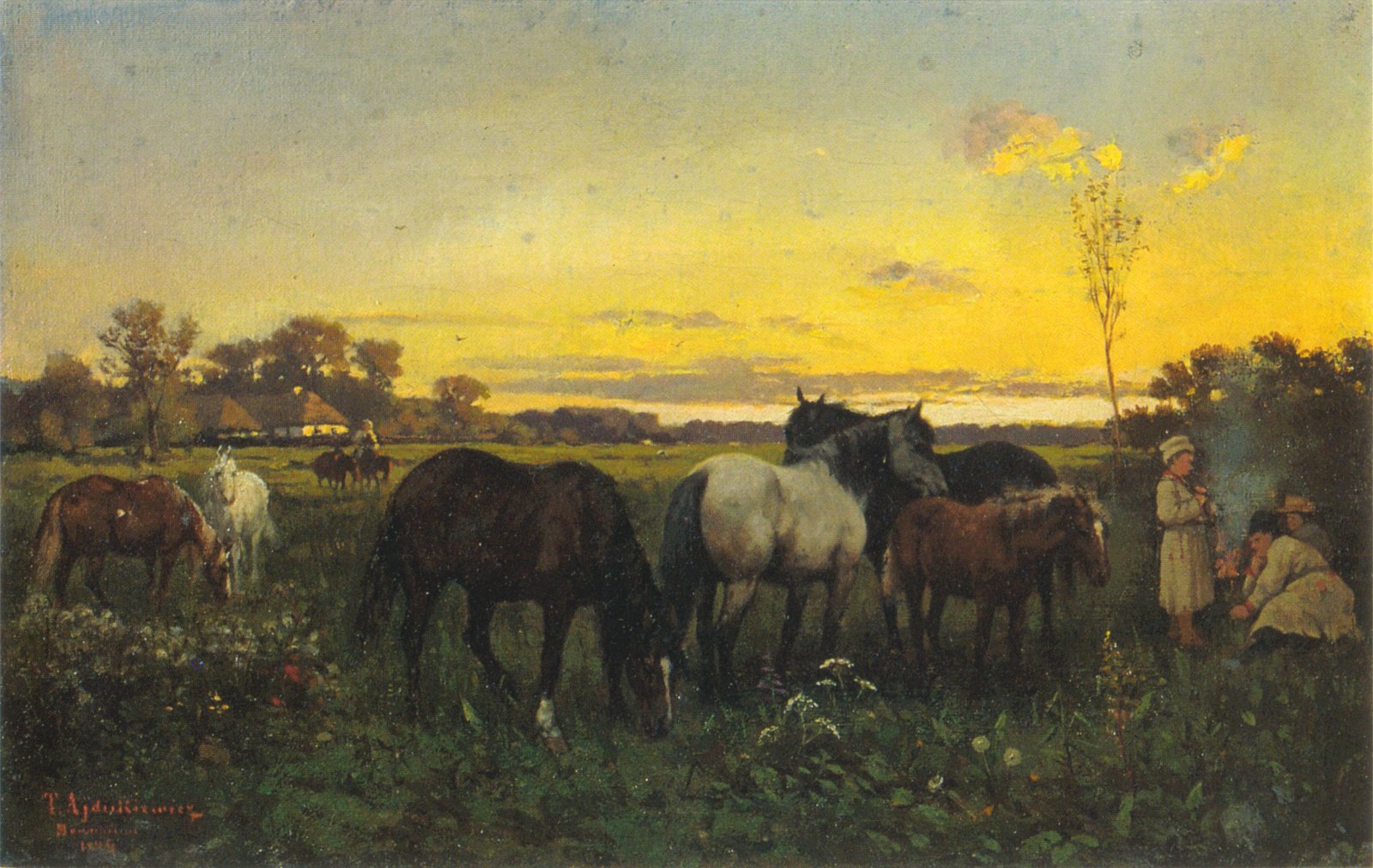
 

The painting appears to show a later part of the Spring, or perhaps early Summer. The grazing horses in this painting are of the peasant type, sturdy 'konik polski' type, and they are being watched over by the boys, the time immemorial in the Indoeuropean history of horse husbandry (ten copied by the ancient Turkish herdsmen and repeated in the Americans among the native boys).

Valete

Monday, September 14, 2020

Polish Legion cavalryman & horse- Austro-Hungarian army circa 1916

Salvete Omnes,
a very interesting photo from the collections of Polish National Library - Polona:
a Polish Uhlan of the 1st Uhlan Regiment, Polish Legions, of circa 1916 with his horse saddled with the Austro-Hungarian saddle and tack according to the 1883 regulations. He has also an Austrian regulations sabre.
The young woman holding the horse and the woman with a small child  are  unknown.
A while ago I posted the horse tack regulations for the Polish cavalry published in 1919, that were almost the same to the ones made in 1916.


and in order to get more information on these 'Austrian' saddles and tack we can turn to this book by  William H. Carter, 6th US cavalry titled  Horses, Saddles and Bridles (1906) where one may find  practitioner's information on the Austro-Hungarian cavalry tack etc of he pre-Great War and Great War period.


 there are two books by Osprey that really do not address horse and cavalry equipment:
1.Polish Legions 1914-19 by Nigel Thomas  but I am not too fond of it. Johnny Shumate's work is decent but my authority for this period, Krzysztof Komaniecki,   says that not adequate for the subject matter.
2. The Austro-Hungarian Forces in World War I - 1914 by Peter Jung -  not a dissimilar sentiment, but illustrations by Darko Pavlovic are very interesting and appealing.
Valete

Tuesday, May 30, 2017

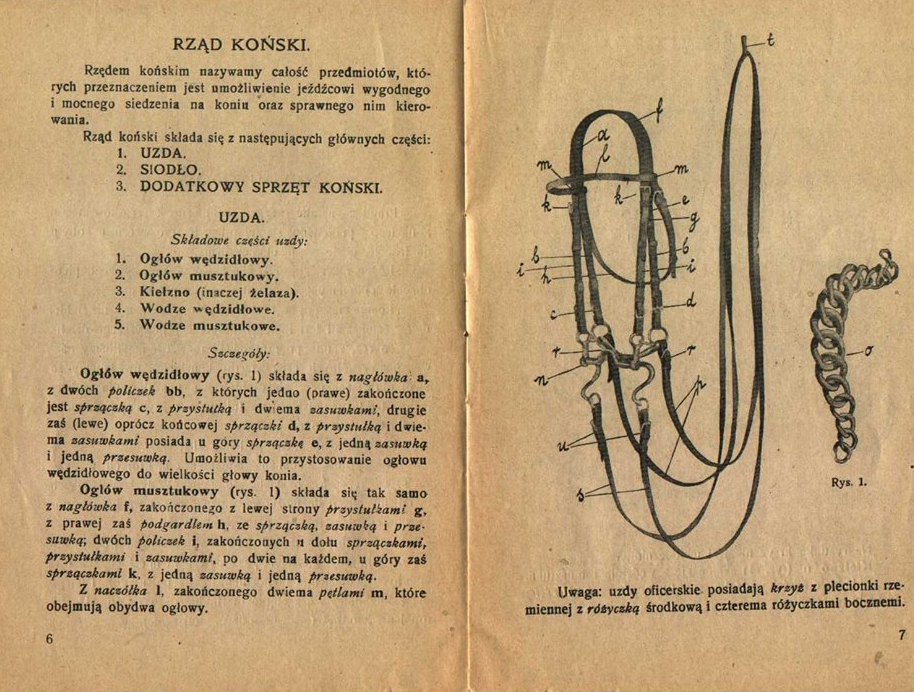
Rząd koński - Zaruski & Mecnarowski

Salvete omnes,
[in Polish]

Zaruski w 1920 roku
Dwaj Legioniści z 1szego Pułku Ulanów  Mariusz Zaruski, od 1919 dowódca 11tego pułku Ulanów,

Zaruski w jeździe Legionów Polskich
 i  Emil Mecnarowski napisali pracę pt  Rząd koński. Przepisy służbowe. do której to rysunki wykonał Kajetan Stefanowicz.
 Za Internetowym Polskim Słownikiem Biograficznym:
W r. 1916 opracował [E.M] , wspólnie z Mariuszem Zaruskim, podręcznik o charakterze instrukcji pt. Rząd koński przyjęty w W. P. (W. 1919) jako obowiązujący regulamin. Był to pierwszy tego rodzaju podręcznik w polskiej literaturze wojskowej.


Drugi raz wydana ta książeczka została w Warszawie w 1919, na potrzeby rozwijającego się wojska, przede wszystkim jazdy polskiej,  prowadzącego działania wojenne w obronie odrodzonej Polski.
Oto całość ten pracy - wydanie 2gie [w domenie publicznej]:


howgh