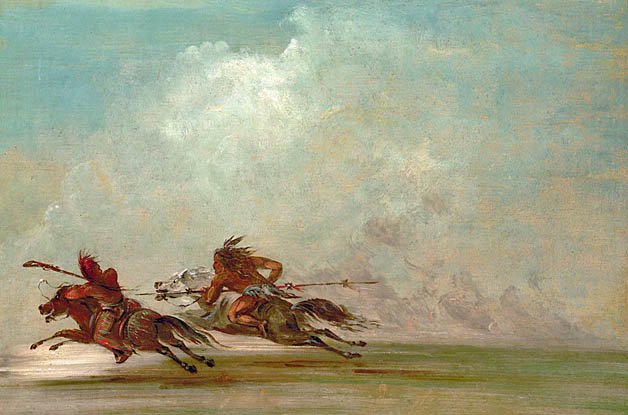
Showing posts with label Native American horse tack. Show all posts

Saturday, May 25, 2019

Federal Ranger Saddle - article link

Salvete Omnes,
today a little Americana - via a linked article
I came across this very interesting article on the very rare American saddle called the  federal ranger saddle or simply put a Spanish American saddle that was order by the federal government for the US cavalry, then  made, fitted with extras for cavalry use as M1859 McClellan saddle pattern and used during the American Civil War.
 
And in order to stay in the spirit of the times let me bring to your attention some art by the eyewitness to the great American war maestro Edwin Forbes - here are his studies of the  great army.


Valete

ps
nota bene - The photographic history of the Civil War - in ten volumes (1911) - for perusing at leisure

Monday, December 15, 2014

War bridle - Robert Jennings


Salve,
long time  I wrote about the Comanche war bridle, I recently found some description of its usage and application in a book titled ''Horse-training Made Easy: Being a New and Practical System'' Robert Jennings (published in 1866 by Potter and Company in Philadelphia, USA).

the whole book is available via archive.org


Enjoy

Thursday, June 21, 2012

Mustangs and methods of catching them in Catlin's journey across the Great Plains in 1834

Salve,


    summer is upon us and let us stay on the Great Plains of US, the homeland of the horse  - :) .
                                *
well, our artist-traveler George Catlin saw many wild horses in his journeys across the prairies - the image above was sketched during the First Dragoon Expedition in 1834 and finished in his studio some time later :

“There is no other animal on the prairies so wild and so sagacious as the horse . . . I made many attempts to approach them by stealth, when they were grazing and playing their gambols, without ever having been more than once able to succeed. In this instance, I left my horse, and with my friend Chadwick, skulked through a ravine for a couple of miles; until we were at length brought within gun-shot of a fine herd of them, when I used my pencil for some time, while we were under cover of a little hedge of bushes which effectually screened us from their view. In this herd we saw all the colours, nearly, that can be seen in a kennel of English hounds. Some were milk white, some jet black-others were sorrel, and bay, and cream colour - many were of an iron grey; and others were pied, containing a variety of colours on the same animal. Their manes were very profuse, and hanging in the wildest confusion over their necks and faces - and their long tails swept the ground.”
 but then:
''After we had satisfied our curiosity in looking at these proud and playful animals, we agreed that we would try the experiment of " creasing" one, as it is termed in this country; which is done by shooting them through the gristle on the top of the neck, which stuns them so that they fall, and are secured with the hobbles on the feet; after which they rise again without fatal injury. This is a practice often resorted to by expert hunters, with good rifles, who are not able to take them in any other way. My friend Joe and I were armed on this occasion, each with a light fowling piece; which have not quite the preciseness in throwing a bullet that a rifle has; and having both levelled our pieces at the withers of a noble, fine-looking iron grey, we pulled trigger and the poor creature fell, and the rest of the herd were out of sight in a moment. We advanced speedily to him, and had the most inexpressible mortification of finding, that we never had thought of hobbles or halters, to secure him—and in a few moments more, had the still greater mortification, and even anguish, to find that one of our shots had broken the poor creatures neck, and that he was quite dead.
The laments of poor Chadwick for the wicked folly of destroying this noble animal, were such as I never shall forget; and so guilty did we feel that we agreed that when we joined the regiment, we should boast of all the rest of our hunting feats, but never make mention of this.''


''The usual mode of taking the wild horses, is, by throwing the laso, whilst pursuing them at full speed, and dropping a noose over their necks, by which their speed is soon checked, and they are " choked down." The laso is a thong of rawhide, some ten or fifteen yards in length, twisted or braided, with a noose fixed at the end of it; which, when the coil of the laso is thrown out, drops with great certainty over the neck of the animal, which is soon conquered."
''The Indian, when he starts for a wild horse, mounts one of the fleetest he can get, and coiling his laso on his arm, starts off under the " full whip," till he can enter the band, when he soon gets it over the neck of one of the number''  - George Catlin wrote - [then the warrior ]“instantly dismounts, leaving his own horse, and runs as fast as he can, letting the laso pass out gradually and carefully through his hands, until the horse falls for want of breath, and lies helpless on the ground; at which time the Indian advances slowly towards the horse's head, keeping his laso tight upon its neck, until he fastens a pair of hobbles on the animal's two forefeet, and also loosens the laso (giving the horse chance to breathe), and gives it a noose around the under jaw, by which he gets great power over the affrighted animal, which is rearing and plunging when it gets breath; and by which, as he advances, hand over hand, towards the horse's nose, he is able to hold it down and prevent it from throwing itself over on its back, at the hazard of its limbs. By this means he gradually advances, until he is able to place his hand on the animal's nose, and over its eyes; and at length to breathe in its nostrils, when it soon becomes docile and conquered; so that he has little else to do than to remove the hobbles from its feet, and lead or ride it into camp.”

''This "breaking down" or taming, however, is not without the most desperate trial on the part of the horse, which rears and plunges in every possible way to effect its escape, until its power is exhausted, and it becomes covered with foam; and at last yields to the power of man, and becomes his willing slave for the rest of its life. By this very rigid treatment, the poor animal seems to be so completely conquered, that it makes no further struggle for its freedom; but submits quietly ever after, and is led or rode away with very little difficulty. Great care is taken, however, in this and in subsequent treatment, not to subdue the spirit of the animal, which is carefully preserved and kept up, although they use them with great severity; being, generally speaking, cruel masters.
The wild horse of these regions is a small, but very powerful animal; with an exceedingly prominent eye, sharp nose, high nostril, small feet and delicate leg; and undoubtedly, have sprung from a stock introduced by the Spaniards, at the time of the invasion of Mexico; which having strayed off upon the prairies, have run wild, and stocked the plains from this to Lake Winnipeg, two or three thousand miles to the north. *
This useful animal has been of great service to the Indians living on these vast plains, enabling them to take their game more easily, to carry their burthens, &c.; and no doubt, render them better and handier service than if they were of a larger and heavier breed. Vast numbers of them are also killed for food by the Indians, at seasons when buffaloes and other game are scarce. They subsist themselves both in winter and summer by biting at the grass, which they can always get in sufficient quantities for their food.''
 
 and then he writes about their own party pursing the wild horses: 

 ''Beatte and several others of the hunters asked permission of Col. Dodge to pursue a drove of horses which were then in sight, at a distance of a mile or more from us. The permision was given, and they started off, and by following a ravine, approached near to the unsuspecting animals, when they broke upon them and pursued them for several miles in full view of the regiment. Several of us had good glasses, with which we could plainly see every movement and every manoeuvre. After a race of two or three miles Beatte was seen with his wild horse down, and the band and the other hunters rapidly leaving him.
Seeing him in this condition, I galloped off to him as rapidly as possible, and had the satisfaction of seeing the whole operation of "breaking down," and bringing in the wild animal. When he had conquered the horse in this way, his brother, who was one of the unsuccessful ones in the chase, came riding back, and leading up the horse of Beatte which he had left behind, and after staying with us a few minutes, assisted Beatte in leading his conqured wild horse towards the regiment, where it was satisfactorily examined and commented upon, as it was trembling and covered with white foam, until the bugle sounded the signal for marching, when all mounted; and with the rest, Beatte, astride of his wild horse, which had a buffalo skin girted on its back, and a halter, with a cruel noose around the under jaw. In this manner the command resumed its march, and Beatte astride of his wild horse, on which he rode quietly and without difficulty, until night; the whole thing, the capture, and breaking, all having been accomplished within the space of one hour, our usual and daily halt at midday.
Several others of these animals were caught in a similar manner during our march, by others of our hunters, affording us satisfactory instances of this most extraordinary and almost unaccountable feat.

The horses that were caught were by no means very valuable specimens, being rather of an ordinary quality; and I saw to my perfect satisfaction, that the finest of these droves can never be obtained in this way, as they take the lead at once, when they are pursued, and in a few momenta will be seen half a mile or more ahead of the bulk of the drove, which they are leading off. There is not a doubt but there are many very fine and valuable horses amongst these herds; but it is impossible for the Indian or other hunter to take them, unless it be done by " creasing" them, as I have before described; which is often done, but always destroys the spirit and character of the animal.''

Catlin, Letters and Notes, vol. 2, 1841

+
original spelling

Monday, June 4, 2012

Plains Indians sketches - shield and armour

Salve,
some sketches of the Plains Indians and ways of carrying the shield:  work-in-progress

horse armor in concept
idea of the Plains Indian horse armour of XVIII century, especially Comanches, Plains Apaches (then Lipan, Mescalero, Jicarilla etc) and Shoshones
Comanche shield of the mid-XIX century, and some sketches showing ways of carrying the shield

Crow warrior, horse with a pad saddle and long shabraque - old sketch

Cheyenne mounted on a horse with a bison hide horse mask, early 1800s

Lakota warrior

late XIX century generic war chief mounted on a horse with a leather mask and breastplate


Wednesday, May 2, 2012

Old Sun's wife - Piegan warrior


Salve,
American Indians of the Plains are famous for their association with horses and horsemanship feats, but not seldom it is forgotten or omitted that often (the wholly nomadic tribes) and at times (in case of the earth or grass lodge dwellers)  the entire household was also transported on horseback (and dog back) or pulled loaded on travois, especially during the golden era when the Comanches ruled the southern plains while various nations and tribes skirmished over the northern and central plains...

The work of setting up or taking down of the conical tents/lodge known as tippi / teepee (from the Dakota Sioux language ), gathering and cooking food, working hides, making clothes, carrying for children, accompanying the men on hunts to dress the carcass and prepare meat for the most important food product of the plains pemmican, tending to small gardens etc was done by women and girls  while their men were hunting, stealing horses or on war-party, and boys were busy watching the horse herds and gentling horses or hunting for small game.

Notwithstanding these domestic and economic duties and obligations that the women carried in the very masculine and bellicose societies of the Great Plains nomads, some women undertook taking active role in the war parties (as we know from the records of the frontier wars between the US military and the nomads - eg Mo-chi, Buffalo Calf Road Woman, Moving Robe Woman, Minnie Hollow Wood, The Other magpie ), while others took active part in negotiations and other diplomatic relations leading to cessation of hostilities or simply truces.

In pre-horse era of the Great Plains Indians cultures during the historic period (after 1500AD) their women were obviously the desired target of kidnapping/slaving parties carried by the enemy warriors, thus those women would become captives and slaves, and some eventually would change their status to adopted tribal members  and wives to their captors.

Once the horses became companions of the Plains Indians during XVII century Apacheria (excellent dissertation on the subject, plus Frank R. Secoy's work)/Jumano/Ute/Caddo horse distribution period and later during the Comancheria of XVIII century domination, the entire warrior ethos of the Great Plains Indians turned to horse capturing and coup counting as the primary pursuits for the warrior. Researchers like professor John C. Ewers ( in this book ''Plains Indians Culture,'' p.196 ) suggest that the custom of stealing women during the pre-horse era and the honours associated with that activity  were actually appropriated/addopted as the model for the horse stealing raids during the post-horse era (that lasted until the 1880s AD).

Well, there is a tale gathered from XIX century Blackfeet by an Anglo traveller named Julian Ralph. He was travelling in company of Frederic Remington (and Charles M. Russell's drawings and paintings) whose art (in public domain) is gracing this post.

Old Sun and his wife:
 "...to our joy, we found seated in that room the famous chief Old Sun. He is the husband of the most remarkable Indian squaw in America, and he would have been Crowfoot's successor were it not that he was eighty-seven years of age when the Blackfoot Cæsar died. As chief of the North Blackfeet, Old Sun boasts the largest personal following on the Canadian plains, having earned his popularity by his fighting record, his commanding manner, his eloquence, and by that generosity which leads him to give away his rations and his presents. No man north of Mexico can dress more gorgeously than he upon occasion, for he still owns a buckskin outfit beaded to the value of a Worth gown. Moreover, he owns a red coat, such as the Government used to give only to great chiefs.
    Mr. Remington was anxious to paint Old Sun and his squaw, particularly the latter, and he easily obtained permission
Old Sun's wife sits in the council of her nation—the only woman, white, red, or black, of whom I have ever heard who enjoys such a prerogative on this continent. She earned her peculiar privileges, if any one ever earned anything.[...] When Old Sun [24]brought his wife to sit for her portrait I put all etiquette to shame in staring at her, as you will all the more readily believe when you know something of her history.
    Forty or more years ago she was a Piegan maiden known only in her tribe, and there for nothing more than her good origin, her comeliness, and her consequent value in horses. She met with outrageous fortune, but she turned it to such good account that she was speedily ennobled. She was at home in a little camp on the plains one day, and had wandered away from the tents, when she was kidnapped. It was in this wise: other camps were scattered near there.
    On the night before the day of her adventure a band of Crows stole a number of horses from a camp of the GrosVentres, and very artfully trailed their plunder towards and close to the Piegan camp before they turned and made their way to their own lodges. 
    When the Gros Ventres discovered their loss, and followed the trail that seemed to lead to the Piegan camp, the girl and her father, an aged chief, were at a distance from their tepees, unarmed and unsuspecting. 
Down swooped the Gros Ventres. They killed and scalped the old man, and then their chief swung the young girl upon his horse behind him, and binding her to him with thongs of buckskin, clashed off triumphantly for his own village.
That has happened to many another Indian maiden, most of whom have behaved as would a plaster image, saving a few days of weeping.
Not such was Old Sun's wife.
When she and her captor were in sight of the Gros Ventre village, she reached forward and stole the chief's scalping-knife out of its sheath at his side. With it, still wet with her father's blood, she cut him in the back through to the heart. Then she freed his body from hers, and tossed him from the horse's back. Leaping to the ground beside his body, she not only scalped him, but cut off his right arm and picked up his gun, and rode madly back to her people, chased most of the way, but bringing safely with her the three greatest trophies a warrior can wrest from a vanquished enemy. Two of them would have distinguished any brave, but this mere village maiden came with all three. From that day she has boasted the right to wear three eagle feathers.
   Old Sun was a young man then, and when he heard of this feat he came and hitched the requisite number of horses to her mother's travois poles beside her tent. I do not recall how many steeds she was valued at, but I have heard of very high-priced Indian girls who had nothing except their feminine qualities to recommend them. In one case I knew that a young man, who had been casting what are called "sheep's eyes" at a maiden, went one day and tied four horses to her father's tent. Then he stood around and waited, but there was no sign from the tent. Next day he took four more, and so he went on until he had tied sixteen horses to the tepee. At the least they were worth $20*, perhaps $30*, apiece. At that the maiden and her people came out, and received the young man so graciously that he knew he was "the young woman's choice," as we say in civilized circles, sometimes under very similar circumstances.
     At all events, Old Sun was rich and powerful, and easily got the savage heroine for his wife. She was admitted to the Blackfoot council without a protest, and has since proven that her valor was not sporadic, for she has taken the war-path upon occasion, and other scalps have gone to her credit.""
Julian Ralph, On Canada's Frontier, NY 1892
[via The Project Gutenberg]
---
*dollar amounts in 1890s

ps
More on the Plains Indian tribes and their horses in the future, I hope :)
ps'
Italian comix dell arte master Paolo Eleteri Serpieri used Remington's image of Old Sun's wife killing the Gros Ventre warrior for creation of his own image in the series  L'Histoire du Far-West ("The Story of the West") - can be seen in this collection of Western images - caveat - some drawings explicit)

Saturday, July 9, 2011

Plains Indians in some sketches

Salve,
finally there is weekend and to round up the week some Plains Indians in my sketches:

Monday, July 4, 2011

Cornucopia of Plains Indian research - Arnie Brownstone's site

Salve,
a quick notice to all who like to read on the Plains Indians culture, artifacts and history -  Royal Ontario Museum's website has a section devoted to the works of one of its curators - Mr. Arnie Brownstone ROM curators brownstone
Every article, presented in a 'pdf' format, is but a goldmine of information to many a student of Plains Indians.
Also, to all the 'fans' of the famous Lakota Sioux leader and shaman Sitting Bull, there is a rare glimpse into some of his surviving regalia, namely the headdress, shirt and other personal artifacts Sitting Bull once used - podcast rom media podcastsSitting Bull headdress

ps
a quick sketch after a painted war record robe image of a warrior on horseback from the ROM Mr Brownstone's page.
ps"
Two days ago I started a Wikipedia entry dedicated to the Mandan and Hidatsa women society known as White Buffalo Cow Society and the entry already has been nicely developing into a full blown article  en.wikipedia.org White_Buffalo_Cow_Society  
Also expanded on this Lakota Sioux personage of many sorts ;) - American Horse the younger  and earlier created this entry on one of Piast early family members Czcibor

Thursday, June 30, 2011

Reworking old sketches of the Great Plains horsemen

Salve,
I am practicing with different 'brushes' and 'pencils' in MyPaint and I have started reworking some old sketches  of the Great Plains warriors


I must add that three of these sketches were based on the books by Thomas E. Mails in my collection - biography  he was a great man whose work and art I greatly admire -   Mistic Warriors of the Plains  and ''Dog Soldiers Societies of the Plains'' - Mails Dog Soldiers

Sunday, June 26, 2011

Greasy Grass -Little Big Horn 1876

Salve,
yesterday, June 25, 2011, there was the 135th anniversary of the battle of Little Big Horn that is the best recognized battle between the Native inhabitants of the Americas (Native Americans, American Indians - that  includes all Native peoples, even those from down south of the US-Mexican border :) ) - and the European colonizers of their Homeland. In this case, the war was fought by the members of various bands of the Lakota Sioux and their Cheyenne and Arapaho allies against the US Army, the instant battle was fought between the mounted Plains warriors and US  7th Cavalry regiment  led by the Civil War hero Armstrong Custer.
There are two heroes that come to my mind when recalling the battle - Crazy Horse  and Sitting Bull

here Sitting Bull, in his own drawing done circa 1881, more of his art here collections.si.edu Sitting+Bull+drawing

And in this drawing by Amos Bad Heart Bull these two principal leaders of the Oglala Lakotas and their allies during the war of 1876-77 drawn together


Warriors, who took part in the battle, drew their own recollections of this conflict, in form of ledger books drawings or single sheet drawings, collectively known as ledger art. One of the most famous was the Amos Bad Heart Bull ledger art, the original lost now, bu the photographs of the original drawings were published by Szwedzicki and then in 1967 by the University of Nebraska Press as Pictographic History of the Oglala Sioux by Amos Bad Bull Heart  In 1999 Herman Viola published Little Big Horn Remembered, Untold Indian Story of Custer's Last Stand  that included numerous Indian warriors drawings showing the battle and Plains Indians combat lore  -   . Recently, in 2003, there was a book published in Spokane title ''For All to See: The Little Bighorn Battle in Plains Indian Art'' by Sandra L. Brizée-Bowen, having been a compilation of art draw by the Plains Indians on the subject (I am waiting for this book from my interlibrary loan :) ), and last year another book has been published - Rubbing Out Long Hair Pehin Hanska Kasota: The American Indian Story of the Little Big Horn in Art and Word by Rodney G. Thomas, here a review www.custerbattlefield.org Rubbing Out review.


I mustn't forget the fine little book, size wise, published by Osprey, where late Richard hook wrote and illustrated the Indian warriors of the Little Big Horn -  ospreypublishing Hook Little Big Horn . I must recommend books by Richard M. Hardorff – author of “ Lakota recollections of the Custer fight: new sources of Indian-military history” (U. of Nebraska 1997),''Cheyenne memories of the Custer fight'' (U. of Nebraska Press, 1998), ''Hokahey! A good day to die!: the Indian casualties of the Custer fight'' (U. of Nebraska 1999), ''Indian views of the Custer fight: a source book'' ( U. of Oklahoma 2005)

Cheyenne warrior and artist Wooden Leg  story of the battle wooden_leg_little_big_horn

 Fine article on the Half Moon Ledger with images booktryst.com rt-of-war-lakota-style here a very interesting side story, the return of tribal artifacts to the tribal museums and burial grounds under wiki/Native_American_Graves_Protection_and_Repatriation_Act , as may be the case with this ledger as it was allegedly taken from the funerary lodge.
Interesting blog article here, in the context of American Indian, artists and Little Big Horn   danielduford.blogspot.com 
Obviously one interested in the Plains warrior art must visit this awesome site, already listed on my blog,  plainsledgerart.org

Saturday, November 20, 2010

American themes

Salve,
some native Amerindian themes, I hope to do many more in the future, especially Cheyennes (I admit I have been looking at the XIX century Cheyenne Ledger art) and Comanches and Utes (been lately to a old battlefield place where more than 160 years ago Comanches and Utes fought, and 240 years ago Spanish-Apache-Pueblo expedition  was crossing the Continental Divide searching for the Cuerno Verde's Comanches)


Saturday, August 28, 2010

Comanche war bridle

How kola (Lakota greeting),
 my little sketch of what various horse trainers of the XIX century perceived as  the 'Comanche war bridle'   ( the Lords of Southern Plains texasindians.com/comanche   ), just a rope  and nothing else...


1830s, Texas still in Mexico, Comanche warriors Comanches de Texas Occidental
 Catlin's (   georgecatlin.org/  ) Comanche Osage duel -  Comanche_Osage
Greeting the Anglo-Americans ( George Catlin did this scene in 1834, when he went with the United States Dragoons to Indian Territory ) catlin's comanche chief horsemanship
and in  Catlin's words:  ....one of their party galloped out in advance of the war-party, on a milk white horse (look at the rope trailing behind him, this was a typical arrangement, in case of falling off), carrying a piece of white buffalo skin on the point of his long lance in reply to our flag  (and a large buffalo hide shield on his back, and a rifle in a beaded holster hanging from the horn of his saddle, horned saddle with stirrups ). This moment was the commencement of one of the most thrilling and beautiful scenes I ever witnessed. All eyes, both from his own party and ours, were fixed upon the manoeuvres of this gallant little fellow, and he well knew it .  The distance between the two parties was perhaps half a mile, and that a beautiful and gently sloping prairie; over which he was for the space of a quarter of an hour, reining and spurring his maddened horse and gradually approaching us by tacking to the right and the left, like a vessel beating against the wind. He at length came prancing and leaping along till he met the flag of the regiment, when he leaned his spear (my note, look at the length of it, Catlin gives more details below)  for a moment against it, looking the bearer full in the face, when he wheeled his horse, and dashed up to Col. Dodge with his extended hand, which was instantly grasped and shaken...my eyes were fixed upon the gallant and wonderful appearance of the little fellow who bore us the white flag on the point of his lance. He rode a fine and spirited wild horse, which was as white as the drifted snow, with an exuberant mane, and its long and bushy tail sweeping the ground. In his hand he tightly drew the reins upon a heavy Spanish bit, and at every jump, plunged into the animal's sides, till they were in a gore of blood, a huge pair of spurs, plundered, no doubt, from the Spaniards in their border wars, which are continually waged on the Mexican frontiers. The eyes of this noble little steed seemed to be squeezed out of its head ; and its fright, and its agitation had brought out upon its skin a perspiration that was fretted into a white foam and lather. The warrior's quiver was slung on the warrior's back, and his bow grasped in his left hand, ready for instant use, if called for. His shield was on his arm, and across his thigh, in a beautiful cover of buckskin, his gun was slung—and in his right hand his lance of fourteen feet in length. Thus armed and equipped was this dashing cavalier; and nearly in the same manner, all the rest of the party ; and very many of them leading an extra horse, which we soon learned was the favourite war-horse (the practice of leading the war horse along, saving it for  the battle or chase only  ); and from which circumstances altogether, we soon understood that they were a war-party in search of their enemy..

Catlin -  Comanches'  horsemanship

  1. and little original description by the  artist :   ...amongst their feats of riding, there is one that has astonished me more than anything of the kind I have ever seen, or expect to see, in my life: a stratagem of war, learned and practiced by every young man in the tribe; by which he is able to drop his body upon the side of his horse at the instant he is passing, effectually screened from his enemies’ weapons as he lays in a horizontal position behind the body of his horse, with his heel hanging over the horses' back; by which he has the power of throwing himself up again, and changing to the other side of the horse if necessary. In this wonderful condition, he will hang whilst his horse is at fullest speed, carrying with him his bow and his shield, and also his long lance of fourteen feet in length, all or either of which he will wield upon his enemy as he passes; rising and throwing his arrows over the horse's back, or with equal ease and equal success under the horse's neck. ....  I was continually frustrated, until one day I coaxed a young fellow up within a little distance of me, by offering him a few plugs of tobacco, and he in a moment solved the difficulty, so far as to render it apparently more feasible than before ; yet leaving it one of the most extraordinary results of practice and persevering endeavours. I found on examination, that a shorthair halter was passed around under the neck of the horse, and both ends tightly braided into the mane, on the withers, leaving a loop to hang under the neck, and against the breast, which, being caught up in the hand, makes a sling into which the elbow falls, taking the weight of the body on the middle of the upper arm. Into this loop the rider drops suddenly and fearlessly, leaving his heel to hang over the back of the horse, to steady him, and also to restore him whau he wishes to regain his upright position on the horse's back. fragments form Catlin Letters and Notes vol. 2)
    Comanche war party http://americanart.si.edu/images/1985/1985.66.596_1a.jpg
    Some good books I have read and own on the pre-Anglo invasion Comanches and their society
    G. Betty, Comanche Society:  Before Reservation
    D. Weber, Barbaros, Spaniards and their 'Savages'
    J. Barr et al, Peace came in the form of a woman
     P. Hämäläinen, Comanche empire
    B. De Lay, War of the thousand deserts
    more on the Comanche warriors and horses in the near future


Saturday, July 3, 2010

American Indians - old drawings II


Salve,
 watercolor, pen and ink drawings of Native American horsemen - after all it is 4th of July, US Finest Day -  na zdrowie (to your health) America!

American Indians -old drawings I


Salve,
 more old Native American watercolor, pen and ink drawings, Kiowa above and Crow (Absaroke) below..

Friday, July 2, 2010

American Indians - my old drawings


Salve,
I am in Poland and I have found some of my old sketch books with some old drawings.
I am going to show some of these here, as I am going to talk more about the American Indians/Native Americans and their horses, and their horse tack.
 So allow me to start with some two decades old pen and ink and watercolor drawings.

Sunday, April 25, 2010

Chaco & Patagonia horse tack - visit to the American Museum of Natural History

   We often visit  the American Museum of Natural History. my son loves it and I share his admiration for this museum.

I often scout its exhibits of the horse related material culture objects, and my searches are quite fruitful at times - :).

This time I found, in the section on the South American tribal peoples, two intersting objects. They come from the nomadic tribes of the two great horse areas of South America - Gran Chaco http://en.wikipedia.org/wiki/Gran_Chaco and Patagonia  http://en.wikipedia.org/wiki/Patagonia .


The objects at hand - spurs -  belong to two distinctive Native American tribal groups that became horse riders after horses had come into their domains with the European invaders -  Qom-lik (Toba) http://en.wikipedia.org/wiki/Toba_%28tribe%29  http://farm4.static.flickr.com/3437/3891493961_9f05c0520a.jpg    and     Tehuelches http://es.wikipedia.org/wiki/Tehuelches  http://www.argentour.com/images/tehuelche2.jpg    http://www.flickr.com/photos/rsolar/3425200788/sizes/o/in/set-72157616425046463/   (nice jaquimas), both were very fierce warriors and horse riders. Here an intersting photograph of Tehuelche women https://blogger.googleusercontent.com/img/b/R29vZ2xl/AVvXsEjozMEXCxqrzWp6S6-LIuPr_DzjarOvYFeu78JE2s2WinZGFLX4c1oExNgm7F_OYgjdPpckLDe10vA0-3FPFbqEcc5yePKyveZ2-4F3QYoT3A6krTK_HTKMtmI_DjZSPrDRpTsRehVZLbk/s400/Onas+-+Tierra+Del+Fuego+rcd+Jun07%2301.JPG and some text on them In this extract from THE CONDOR'S FEATHER (due July), Thia Beresford comments on the Tehuelche Indian girl who travels with them on their expedition:
...............................................................
‘Her heart is as deep and silent as the pampas,’ Thia said. ‘It is as though she is in tune with the vast countryside around her. A kind of innate animism which native people posses, which we civilized people seem to have lost.’
William had no answer. There was certainly something about this Indian woman which he could not explain. Without meaning or intention, she attracted him like a pin to a magnet, yet she hardly ever spoke, showed little expression, even conserved her gestures to essential movements. She was as tall as a longbow and moved like a willow in the breeze. Was as strong as any man he knew and slightly taller than he. She was not beautiful by English standards with her plucked eyebrows and painted skin, but she had the elongated face and forehead of the high priestesses he had seen engraved on the walls of the ancient temples in Cairo. Now he wished he had drawn her portrait as he could never replicate it accurately. Yet her face was engrained in his mind and he knew he would never forget it. ( source http://haleauthors.blogspot.com/2009/06/kattn-tehuelche-indian-from-condors.html  )

Anyway, I find these spurs very interesting and quite ingenious. I have some more photos and depiction of their tack and I will post it soon.
I do intend to write more and draw more about the South American natives and their relationship with horses, both in war and peace. I am very interested in the so called caballo criollo, and in this article - http://www.manosart.com/PIEZAS%20DE%20LA%20SEMANA/Fotografia/Antigua_Fotografia.html   - there is a very interesting image of a Tehuelche woman  with her typical horse tack on a very interesting horse - the very  horse is described :  
"El caballo Criollo
Esta fotografía tomada en 1899 no sólo es rica por cuanto describe las formas de la equitación indígena femenina, sino que también nos habla del biotipo del caballo ahí ensillado. Para Carlos R. Dowdall -autor entre otras obras de "Criollo el caballo del país" -, este animal es algo más liviano, de grupa derribada, convexilíneo de tipo oriental. Dowdall explicará que años más tarde se buscó un caballo más pesado, el que fuera identificado bajo la denominación de biotipo "europeo". . "   More on it in the future.
By the way, more on the vaquero, horse, and his horse tack will be coming as well, especially the various Argentinian saddles etc. IN this photo the most famous long distance horses Gato  and Mancha http://www.aimetschiffely.org/images/2-in-hand.JPG
http://www.aimetschiffely.org/images/AFT-NewYork.JPG