Showing posts with label Rudolph Friedrich Kurz. Show all posts

Monday, July 25, 2016

Kurz Journal p. 5.1

Salvete Omnes,
continuing from yesterday (Kurz Journal 5.0) we are still on September 23, 1851, and while returning from the bison chase Rudi Kurz heard the story of mustang capture that did not end well:

[140-141]
On our way home Mackenzie pointed out to me on the left bank of the Yellowstone a prairie where several years ago he caught a wild mare — an adventure that came to a tragic end.
Kurz drawing of horses


He was riding the fleet-footed John at the time and found that he was some distance ahead of the pack horses that were to carry the meat as usual to the fort as soon as he should have the luck to kill a buffalo.
In the distance he saw a drove of dark-colored animals grazing ; he directed his course so as to gain the wind and take them by surprise. He made ready his rifle and gave fiery John the reins as soon as he thought the distance favorable.
But when he got sight of the herd again he saw that they were not buffaloes at all, but wild horses. As the horses took to flight immediately, for they were just as shy as the former, Mackenzie laid his gun across his lap and seized his lasso of twisted leather, fixed the noose, and pursued the fleeing herd at a riotous gallop. John soon drew near his wild blood relations and Mackenzie selected from among them a black mare that was accompanied by a young foal. He rode after her and with his right hand swung the lasso, catching her head in the noose, while, with his left hand, he held fast to the other end of the rope. He drew in the thong, choking the imprisoned animal by a violent jerk backward that forced her to stop, while at the same time he reined in his own horse. The foal turned back and kept near its mother, now brought to a stand by means of the choking noose and thereby subdued. Then, with the assistance of Spagnole, who happened to be hurrying by, Mackenzie bound together the mare's feet, so that he could leave her lying there while he followed the chase, for he dared not return home without meat.


Unfortunately he did not find buffaloes as soon as he expected and his return to the place was delayed until the next day, when he found only the colt's head, tail, and feet. The mother also, his captured mare, had already fallen a prey to wolves.
enjoy

Sunday, July 24, 2016

Kurz Journal p.5.0

Salvete omnes,
I have decided to return to the Kurz' Journal  and this episode the author would tell you about his first bison hunt in the Upper Missouri prairie country.
Kurz arrived at  Fort Berthold on July 8 1851 and was to stay there working as a clerk. Due to a cholera outbreak among the Indians in August,  the manager from Fort Clark Dorson arrived there and ordered Kurz to go across the Missouri River to stay at the second post run there by the American Fur Company - 170 miles as crow flies,  said Kurz. His guide Bellange and he left on  September 1, and arrived on the 6th (or so) at the destination. (some other time I will pull interesting bits and pieces from that journey, as well as about the return to his station or post at Fort Berthold).

Buffalo Chase begun on September 23, 1851[p.138-40]:
This has been a splendid day in my experience; I have been on the chase for the first time and shot my first buffalo. Sketched my first buffalo from life.

After breakfast old Spagnole [Joe Dolores], our cattle herd (doesn't look like a shepherd) brought news that huntsmen from the opposition fort ['dobies']  were running buffalo on the lower prairie. At once Mr. Denig*, with much kindness, offered me the pacer so that I could chase buffaloes with Owen Mackenzie [half-Indian, half-Scott] and so have an opportunity to study them. 

Mackenzie rode Condee. We were therefore admirably mounted, and having no orders to bring meat back we followed the hunt with no other object in view than our own pleasure. Mackenzie was to kill a fine specimen so that I might have the chance to make a sketch. My equipment consisted of my sketchbook, carried in my pouch, which was swung over my shoulder, a rifle laid across my lap, hunting knife stuck in my belt at the back, and a bullet pouch hung beside
the powder horn, also suspended from my belt. Mackenzie had returned only this morning at breakfast from a buffalo hunt of several days in another region; it was therefore most kind of him to ride out again with me before he had taken any rest.

How different are one's sensations when sitting a fiery courser whose desire is always to advance beyond the pace, which one must constantly restrain, lest the animal be carried beyond control from excess of high spirits, from sheer delight in the chase — how  different from riding a weary, melancholy nag that one wears oneself out with beating and prodding without getting on any faster. What a difference it makes in one's feelings ! 
When provided with an excellent mount, the blood courses more rapidly through one's veins, one's heart leaps for joy; Nature seems entrancing! 
We could not have chosen more beautiful weather — warm sunshine, clear air, a cloudless sky, and the wide, wide horizon, in the far distance, merged in blue
haze. The ground was dry — no dusty stretches, no bogs or fens. 

We had to go 5 miles at a brisk pace before we reached the herd we were
in pursuit of. We were beginning to think that the "dobies" had spoiled our sport when, near the so-called Butte de Mackenzie (named for the father of my companion on the chase), we came unexpectedly upon a small group of both old and young bulls. Some of them were lying in the grass near a spring at the upper end of a coulee; others were comfortably grazing round about them. We changed our course at once, rode around the hill, along by thickets of wild cherry and
plum trees that covered the coulee, in order to fall upon the buffaloes unawares. But the sound of hoof beats had already warned them; those we had seen lying on the grass had sprung to their feet, and, with tails aloft, speedily took to flight.

At a mad gallop we crossed the brook and followed close upon the fleeing herd. Even the horses shared our eagerness and tried to outdo each other, but I allowed Mackenzie to get ahead so that I could observe him. With his keen eye he had already selected his victim, approached within 2 feet, and fired. So true was his aim that the animal lay dead as I passed on a gallop. It might be truly said that suddenly he fell to earth. In the grip of death he groaned, beat the
ground with his hoofs, and rolled over on his side. So accurately had the ball pierced his heart that I thought at first he had fallen from sheer fright. But we went much farther. I had a great desire at least to shoot at a buffalo. Mackenzie bade me follow him; we set out again at a gallop and came up with the herd. 

 Kurz described his own achievements at hunting bison and then drawing in situ:

He singled out a bison for me and forced the animal apart from its companions. I pursued it over the rolling prairie until I was so close I couldn't miss aim.
At my first shot the ball entered just a little too high; he turned in such a way that my second shot struck his right knee. 
Then Mackenzie rode forward and in passing the old fellow sent a bullet into his heart. 
The pouch swung across my shoulder was a great hindrance when I was shooting, because I was forced to keep it in position with my left arm and yet found it difficult to do that and at the same time fire a gun.

While in full chase, drawing nearer and nearer the fleeing herd, we reloaded our rifles. Mackenzie was laughing the while at the wounded buffalo, who was trying to run, notwithstanding a bullet in his heart. In truth he was killed ! He could go no farther. All at once he stood as still as a block and looked angrily toward us, his nose dripping with blood. I reined in my pacer and took aim, intending to shoot the animal in the head and bring him down. My horse, all
in a heat from the swift gallop, could not stand quietly; he snorted, he foamed, he pawed the ground; as a result, my shot went amiss, merely grazing the forehead of the monster. He hardly moved his head. But he began at last to sway, placed his feet wide apart to balance himself, but nothing could help him more. He was obliged to come down, first on a fore knee, then on his side. The beast was too thin to serve me for a model buffalo; therefore, we left him lying
there and rode back to the first one we had shot. We dismounted, tethered our horses with long halters, and allowed them to graze while I made as exact drawings as I could, showing different views of the fallen bison. As soon as I had finished my sketching, Mackenzie cut out the tongue and other choice bits of meat to take to his wife. Then we galloped home. 
What joy ! 

until the next time 

ps
*Mr Denig, the factor (manager) or bourgeois at Fort Union - as described by Kurz himself [page 120]
 
Bellange delivered the letter he brought to a small, hard-featured 

man wearing a straw hat, the brim of which was turned up in the back.
He impressed me as a rather prosy fellow. He stopped Bellange short, just as the
 latter was beginning a long story he wished to tell; on the other hand, he ordered 
supper delayed on our account that we might have a better and more plentiful meal.
 A bell summoned me to the first table with Mr. Denig and the clerks. My eyes almost 
ran over with tears ! There was chocolate, milk, butter, omelet, fresh meat, hot bread — 
what a magnificent spread ! I changed my opinion at once concerning this new chief; 
a hard, niggardly person could not have reconciled himself to such a hospitable 
reception in behalf of a subordinate who was a total stranger to him. 
After we had eaten he apologized for not having a bed in readiness for me; 
that night I must content myself with buffalo robes in the interpreter's room; 
better arrangements would be made next day. [...]


...

Sunday, November 30, 2014

Kurz Journal - p. 4

Salve,
last day of November 2014, so a little recollection by Mr. Kurz during his adventures in the United States (this time 1850 summer and 1851)
First, our author bought yet another horse, he named her Fashion:

'On August 7 I bought a dainty black mare with white feet —
all four white.
She is a genuine mustang. What a joy to wander
about the forest, where Fashion carries me to distances I could
not otherwise accomplish and so widens the sphere of my observa-
tions. With Fashion's aid I have been able to visit often the
Hundred-and-Two River (so named because it is said to be 102 miles
long), to bathe in its clear waters, to sketch groups of trees on its
shores that are hardly surpassed by those on the Cahokia.'

then Mr Kurz met the Potawatomis, who had been forced to migrate to Kansas from the Old Northwest:

''Potawatomi fromKansas and those on the land known as the
"PlattePurchase" visited one another frequently, I made sketches
of some of them and, in exchange, furnished the young fellows with
10-cent pieces of rods out of which they make arrows for the
hunting season.

'At 20 feet they hit small objects with great accuracy; at a greater
distance the least movement of the air may exert an adverse effect.
At 100 feet they fly the arrows with great skill but can not be sure
of piercing the heart of the animal.'

Later that autumn of 1850 Kurz decided to invest in horses and the following story developed:
 
''In the autumn newspapers began to publish articles about a plan
that was being considered by the United States Government, in con-
nection with the highway to California and Oregon, to enter into
negotiations with the Indian tribes concerned and for that purpose to
invite the most notable men among them to a conference next sum-
mer at Fort Laramie. At once it occurred to me that I might enjoy
an agreeable adventure and at the same time make it profitable
if I would occasionally buy good horses, ride about the country on
horseback, sell the animals at a profit next spring at Salt Lake, then,
on my return, attend, if possible, that most interesting assembly at
Fort Laramie and witness the signing of the treaty.
Then, of course, horses declined in value. I lost a great deal of
money. The cost of feeding the animals was out of proportion to
the amount their work brought me. I was too fond of them and
spent too much taking care of them.

One misfortune after another induced me to sell the horses and
give up the idea of going to Salt Lake.
First, I suffered the loss
of an excellent mare that I lent to an acquaintance who wished to
attend a Christmas ball at Rochester. After he had run a race on
a bet, after the manner of Americans, and over a rough, frozen road,
he left my fine animal standing in front of a public house all in a
sweat and without the protection of a blanket. In spite of all efforts
to save her, the mare died from pneumonia. I suffered another
mishap in a pasture where I allowed my four horses to exercise on
a beautiful March day. A boy took great delight in playing tricks
on the spirited animals and, to give himself further amusement, set
a dog on them just to see them run an extended course. Having
become once frightened, they did not stop running for several miles,
until they were far into the forest. After a long search I came up
with them at last but, as I drew nearer, calling gently to them, and
w'as sure of getting hold of at least one of them, Avhinnying, they
turned abruptly about, extended their legs, shook their manes and,
in a trice, had disappeared from view.
 
For the reason that Lily, one of my mares, appeared to be going
in the direction of the place where she had been bred, I thought I
should find all of them next morning at her old home. So early
in the day I hired a horse and rode over there, through a region
that was unfamiliar to me. My road, a most romantic one, led
through a magnificent forest, over two beautiful streams, and across
a waste. Not a trace of my horses anywhere ! Then I remained at
home two days, hoping that my runaways might be induced by
hunger to return or else that some news might come to me concern-
ing their whereabouts. But they did not return. No news came.
On the fifth day after their flight I hired another horse and rode
to the place where two other mares of mine had been bred, i. e., to
the "Round Prairie" on the high road to Fort Kearney near Newark.
There, fully 9 miles from the city, I heard specifically that they had
been seen. Fortunately, they had kept together and were so wild
and spirited that no one could catch them; otherwise I should cer-
tainly have lost one or the other. A young farmer who had seen
the two colts and knew the range of their earlier pasture mounted
his horse and helped me trace them. For several hours we followed
them from one farm to another. It was perfectly evident that they
wanted to play with their former companions and were searching
for them, and as the brutes went visiting around in their old neigh-
borhood and tarried here and there with their former playmates
we drew constantly nearer.

Still following the trace we came, late in the evening, into the
highroad again, where dust made it impossible any longer to dis-
tinguish their tracks.

Well, I spent the night in Newark. Next morning, the sixth day
of their "spree," I was up with the sun to follow any trace I might
find on the highway. Over a wide stretch I searched but could find
neither on the right nor on the left any tracks made by sixteen feet.
I did find a place beside the road where they had lain down together,
but on what night? That was a puzzle too difficult for my wits to
solve. My only possible clue was fresh dung. After breakfast I
mounted my hired pad with the intention of going home, hoping that
my straying animals would instinctively return, finally, to the place
where they had received good nurture and rich forage. Upon my
inquiry at a farm on the highway I was told that toward sunset the
previous evening four horses — according to the description, they
must be mine — were seen prancing along the way in the direction of
Savannah.

A little farther on, where the road from Marysville branches off
from the highroad to Fort Kearney, I heard from a countryman
living there that during the night four horses wanted to rest on the
straw lying in front of his fence, that the roan mare (my Bet) had
already lain down but, for fear that their presence might tempt his
own beasts to break out, he had driven them away. Which way they
went he did not know.

"Home, of course, to their own comfortable stalls," I said to myself.

I rode rapidly back to Savannah in happy expectation. There I
found no trace of my runaways' return. So, after I had eaten, I
had to mount a fresh horse and renew the search. Following my
latest clue, I rode until the evening in all directions, through forest
and over plain, without result. Vexed and tired, I returned to the
Savannah road. Suddenly I was aroused from my ill-humored
reverie by hearing some one call out as I was passing a farm,
"Hulloa, Dutchman!" Turning my head, I saw a man sitting on
his fence. He called out again, "Look here ! Are them your
horses?" Sure enough, there they were, evidently half -starved.
There was no grass. At best, they could only have fed on tender
buds just appearing on the shrubs. Besides, they had been racing
about the country without rest.
Several hours earlier, the man said, those hungry horses had
stopped at his fence, cast longing looks toward his stacks of corn,
and then made known their desires by an eager neighing. He took
them in, because he had heard that I was searching for them. The
birds were caught, to be sure, but I had trouble still to get them in
hand. So wildly they ran about, so persistently parried our efforts
on every hand, that I thought they must be possessed with the devil.

Finally we got them in a corner and held them in fear by cracking
a whip until I had bridled them. I saddled the filly, because she
remained uncontrollable longer than the others. Then I paid the
man for his assistance and set out home on a gallop. Never in my 
life have I ridden as fast; the horses seemed really running a race
with one another to see which could reach home first. I thought
I should he jerked off the saddle.

I had hardly got my team of four in good condition again when
they ran away with me and plunged with the vehicle down a hill.
To practice driving a four-in-hand and to accustom the horses to
that mode of traveling I took drives every day in the vicinity. I
got excellent practice on the usual American roads, for they abounded
in stumps, steep slopes, and many running streams, but to learn
how to manage with sloughs, ditches, narrow passes, curves, and
the turning of corners I chose the forest road to Nodaway Island,
to the Hundred-and-Two, and along the Little Platte River, all the
way out to the parade ground. The horses pulled so well together,
traveled with such uniform gait, were so instantly responsive to
the rein, always stood so quietly when halted, backed without plung-
ing, trotted so well without need of the whip, and the roan mare
proved such an excellent lead horse, I was planning with much
pleasure to take a journey with them to Deseret.

In April I drove alone to St. Joseph to talk over plans for the
journey with my future traveling companion. On my return, about
3 miles from Savannah, the offside horse cast a shoe on her left rear
foot. I stopped immediately, for she seemed to be limping. Since
no one was there to take the reins, I threw them lightly on the seat
cushion and went to examine the hoof. In spite of the care I took,
stroking her soothingly and speaking gently, the instant I attempted
to raise her foot she gave a leap and off and away all of them went
over stock and stone, up hill and down dale, as if in a mad pursuit.
I tried at once to seize the bridle rein of the lead horse but, in run-
ning, I stumbled over a stump and fell. When I got up I saw the
vehicle plunging on — here a cushion hurled away, there my cloak.
"Adieu, je t'ai vu!" I thought. "Confound it all!'

I ran after them, of course, as fast as I could. I had an idea
that they were stuck fast in the forest. Sure enough, below the
first hill, I found Bet wallowing in the dust, trying to get free
from the harness and the long lines that were wound about her.
Having set her free, I ordered her to get up. She could hardly
stand ! She was trembling in every limb and spread her feet wide
apart for fear of falling. She had lost her head entirely. I led
her away from the road and tied her tight and fast at a spot where
there was grass; then I went in search of the others. About a
hundred feet farther on I found Lily, Bet's companion, standing,
bewildered, in the road.

Aside from a wound in her left rear shank, inflicted, most likely,
by the jDole, she had suffered no injury. I swung myself lightly
upon her back and went on after the two shaft horses and the hack.
I found them at the top of the hist steep hill as one approaches
Savannah. Fortunately they could go no farther; they had hardly
come out alive from the creek below. The two horses were caught
in some bushes and the vehicle was jammed against a tree. The
horse on the right had thrown her hind leg over the pole and was
evidently forced to stop. The vehicle had most probably been car-
ried on until it was held fast by striking the tree trunk.

I disentangled the beasts from their harness to see what damage
had been done. Lily had suffered no injury — was only lamed. The
hack could stand on its wheels, to be sure, but many screws were
gone. I went back to bring Bet, the cushion, and my cloak. Then,
having harnessed Lily and the colt together, I led them slowly home.
The horses had to be cared for and doctored ; the vehicle and harness
had to be mended.   
Finally, at the end of April I was ready for my journey; my
wagon was provided with a canvas top and provisioned with zwie-
bach, smoked meat, butter, eggs, sugar, tea, cooking and drinking
utensils, oats and corn meal for the horses, a saddle, a double-bar-
reled shotgun, a hunting knife, and four 30-foot cords with iron pins.
The last-named were to be used for tying the horses.

My intended companion on the journey, a young American, was
to wait in St. Joseph and be ready to set out with me on the first
of May. Notwithstanding that he had detained me with his prom-
ises to go, Steiner refused, when I arrived in St. Joseph, to con-
sider taking the trip. He had not the means, he said, to provide his
own personal outfit. Now, I had asked nothing more of him than
that he bring his own provisions, and, in return for his seat in my
wagon, that he look after the vehicle on the journey, while I took
care of the horses.

A fine predicament! To travel with four horses and a wagon
alone was not to be considered, for both team and vehicle would
have to be constantly guarded. To find another trustworthy per-
son to go with me could not be done at once. Therefore, my grand
display with four-in-hand came to a sudden end. I determined
to sell both wagon and team. But now, when I wanted a purchaser,
nobody would buy. Earlier, when I did not wish to part with my
horses, I had many advantageous offers.

May 9. Lily and the colt sold in Weston. Bet placed on a farm
so that she may grow strong again. Such a fine mare one is justified
in giving the best attention ; she will certainly bring $60 more. The
wagon and harness as well as the large mare, Landy, left behind
to be sold, so that on my return I shall have some funds. Trip to
Salt Lake and Fort Laramie given up''
 ...thus ended this horse story


another tribal warriors of the Old Northwest - the Winnebago painted by Charles Deas during the 1840s


enjoy

Saturday, November 1, 2014

Kurz Journal - p.3


Salve,
today is All Saints' Day - one of the most important  days in Polish religious and family calendar - I wrote about  the day after All Saints Day or 'Zaduszki'   last year. May your ancestors rest in peace and do light a candle. Pacem aeternam

                                           + + +

Meantime, back to Herr Kurz and his journal:
It was April 1848 and our artist left the civilised comforts of St.Louis to go upriver,  because:
 
I longed to study Indians and wild animals.

choosing as hus destination a newer settlement up the river
 
I decided to go to St. Joseph on the Missouri. There I should
certainly find Indians enough : The region in the midst of which the
town was situated was open Indian country, belonging to the Kicka-
poo, and the town itself was a rendezvous for fur traders of Missouri and 
Nebraska, just as Independence was a center for Santa Fe fur traders 
and, at an earlier date, St. Louis for the entire furtrading region of the West. 

where he arrived on April 18:
 
St. Joseph, once the trading post of Joseph Robidoux, is situated
at the foot of the Black Snake Hills on the left bank of the Missouri.
Though the town was founded only six years ago there are evidences
already of a rapidly expanding and flourishing city. In spite of the
fact that there are many new buildings, both of wood and of brick,
houses, either for homes or for business purposes, are hard to get.
Upon my arrival the principal streets were much enlivened by fur
traders and immigrants on their way to regions, as yet little known,
in Oregon and California. The rich gold mines were not then dis-
covered. Only the most daring fur traders had penetrated into that
far country and, following in their wake, a rough, lawless set of
adventurers, eager for gain and best pleased with what the strong
hand won, traveled the same trail in armed bands with pack mules
and covered wagons.

Hence there, at St. Joseph, he became introduced to the American Fur Trade and  finally met the fur traders and their 'field employees' - trappers aka mountainmen , before meeting the Indians:
Throughout the entire summer bourgeois or the heads of firms,
clerks, and other engagees or employees of the different fur companies
crowded the streets and public houses of the town. St. Joseph is for
them now what St.Louis was earlier — their rendezvous. Here all
staple commodities are supplied from St. Louis, but horses are
bought up for the purpose of selling them to the Indians on the upper
Missouri and on the Platte or Nebraska. There packs of buffalo hides
(as many as 10 packs at a time) are reshipped on the steamers, the
empty mackinaw boats sold and their crews discharged.
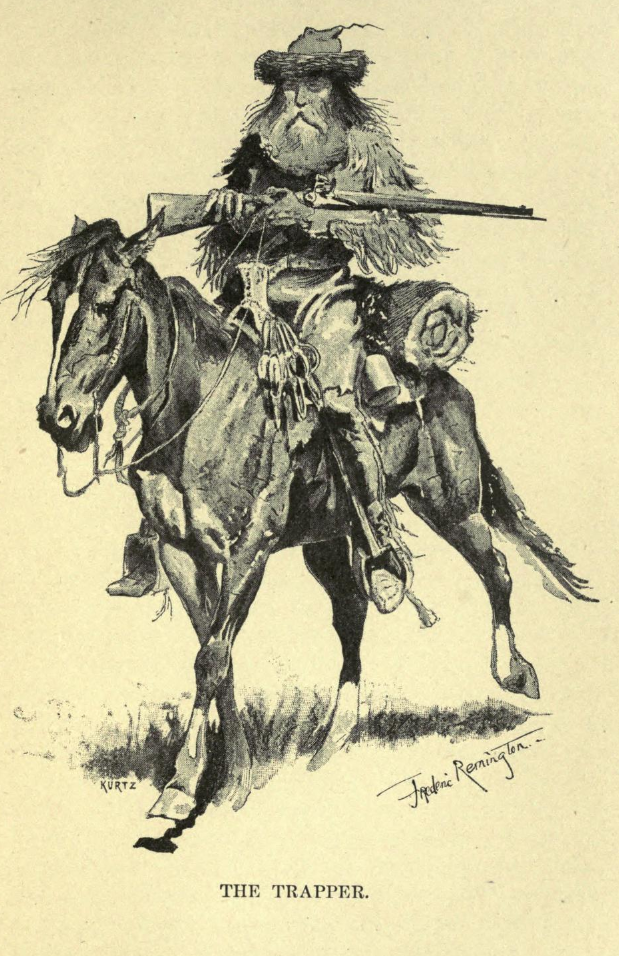
Those people are called Mountaineers,* a name associated with many 
dangerous adventures, much painful endurance, but also with much ro-
mance and pleasure. The Mountaineers like best to dress themselves
in clothes made of tanned deerskin, embroidered and fringed. One
recognizes them, therefore, at sight ; knows who they are and whence
they come. They are stared at as though they were bears. Not
infrequently they have no other apparel then their leather costume,
for after a long stay any other clothing would be entirely worn out.

It seldom happens, however, that these engagees have ever seen
the Rocky Mountains, much less braved their dangers. But, on the
other hand, they are compelled to work very hard in cold, rain, and
storm. The Canadian engagees, guides in the Canadian woods,
'mangeurs de lard,' ** are known to have swaggered through the most
breakneck dangers in which they were inclined to play an important
role. However, they cannot reckon courage as the most striking of
their fine qualities.

 
They have far too much regard for their own safety to fight for an
 employer about whom they constantly complain, because he
demands work done in return for his money. Later on, when I 
reached the upper Missouri, I observed a great many of
these swaggerers. In that distant region, beyond the pale of law, I
have often seen them cry out in alarm at the mere sight of a stranger
in the distance and take to flight — even throwing aside their weapons
or implements as if those instruments of defense did not belong to
them. They are, on the other hand, the most good-tempered people
and especially good patrons of the innkeepers if they have any part
of their wages left when they reach home. Few of them are provi-
dent enough to put aside any part of their earnings to buy house
and land or to settle down to their earlier employment.

We already know he is drawing a lot, so this time Herr Kurz was working with wild animals of the region:
   American Black Bear 
A black bear, captured and enchained, gave me the welcome oppor-
tunity to study his kind. He was absolutely black ; not even a trace
of gray or brown, even on his upper lip. 

To-day an Iowa farmer brought into the town a live
badger, in a piece of hollow tree, to exhibit him for sale. I bought
the animal for $4 and kept him about a month in my bedroom, pro-
viding him daily with meat, bread, and fresh fruit. He was quite
well-behaved toward me but during the night scratched out great
pieces of plastering at the foot of my bedroom walls. Now and then
I allowed him to run in the outlying fields to get some exercise and
to amuse me with his way of digging in. He could not run any
faster than I usually walked. If I went along behind him he moved
straight ahead; if I walked beside him then he tried to escape in
the opposite direction. In less than 10 minutes he would burrow
his whole length into the rich, loose soil and then I had to pull him
out by his tail. When he was set upon by dogs it was a matter of no
importance to him so long as they made a frontal attack; but as he
was not able to turn his head, on account of his stiff, thick neck, the
instant he was attacked from the side he was lost. He was skilled
in the art of biting ; he had a queer sort of bark somewhat like that
of a fox. After I made repeated drawings of him I was obliged to
have him killed ; the damage he did was so far in excess of his good
uses. I had his pelt tanned, in order to use it for a hunting bag, but

it proved to be too greasy to be of service. However, I brought it
home with me.

enjoy :)  
Original spelling in the 'Italicised text'  of the Journal. Drawings by Remington, paintings by Charles Deas, George Catlin and Alfred Jacob Miller - all public domain.

Note that the Platte Territory was purchased from the native tribes by the US government in 1836 -  being part of the so called Missouri Territory, officially acquired in 1812. Fur trader  Robidoux secured a piece of land within the Ioway tribe lands of the Blacksnake Hills country. Kurz claims in the Journal that the land around St. Joseph  belonged to the Kickapoo, who were newcomers to the region, unlike the native Ioways etc - perhaps this needs more investigating :)
ps
*
Mountainmen or trappers - fine library -  primary sources on and by the subject

**
mangeurs de lard - 'eaters of salted pork' - old term applied to the most inexperienced  voyageurs of the fur trade era in French Canada who paddled fur laden canoes between Montreal and Grand Portage.