Showing posts with label Diego Velazquez. Show all posts

Monday, February 6, 2023

Cardinal-Infante Ferdinand of Austria on horseback

 Salvete Omnes,

Peter Snayers pinxit


I already posted one Ferdinand Hapsburg , the joint- victor of Nordlingen 1634, hence it behooves me to post these portraits of cardinal-Infante Ferdinand of Austria. They were painted by many masters of brush and oil paint.

Let us start with this one by Gaspar de Crayer


and other famous masters of the ear - don Velazquez, maestro Rubes,
Diego Velazquez pinxit

Rubens or his atelier pinxit
Jan van den Hoecke pinxit

Cornelisu Schut pinxit


Alexander Voet I fecit

now, this portrait is accredited to Adam Franois/Frans van der Meulen (1632-1690 ) while whereas our Cardinal-Infante died in 1641.
So this is an imaginary portrait I suppose


this bridle is adjusted above the browband
large padding under the saddle?


Valete

Tuesday, February 15, 2022

Ambrogio Spinola Doria - maestro of war

 Salvete Omnes,


the clouds of war seem, according to the msn media and respective governments, to be hanging menacing low over the steppes  and shores of Ukraine, Belarus and Russian Federation in the east of Europe (and east of that funny union), and with mysharonacirrus-19 laid to rest (tell it to a certain, fancy socks wearing, prime minister of Canada and his afficionados ), let me share some images showing  one hell of a command master - XVII century condottiero/condottiere Ambrogio Spinola Doria from Genoa and in the service of the Crown of Spain. 

early (1609AD) portrait by Michiel Jansz. van Mierevelt


  - surrender of Breda detail - by Diego de Velazquez, 


Surrender of Julich/Juliers details - by Jose Leonardo


and another surrender of Julich by Peter Snayers


and a print by Crispin de Passe


and another, later  1628AD,  portrait by maestro van Dyck


Valete

Friday, July 15, 2016

Titian's Ecce Homo and 2 horses & bridles

Salve,
let us move deeper into the European history today, and thus I would like to invite you for a little excursion into the world of the Italian master Titian or Tiziano Vecellio...
Should I add that I absolutely admire and enjoy Titian's works (eg 1, 2,3, 4, 5... ), especially his religious and mythological works, his nudes and portraits. Perhaps I should - :)
I own one large album of his works by Sir Claude Philips, but then Wikimedia Commons users and Google Art project allow us, by providing high resolution photos, to get so close to many of the paintings that we can almost touch the brushwork , or so it seems.

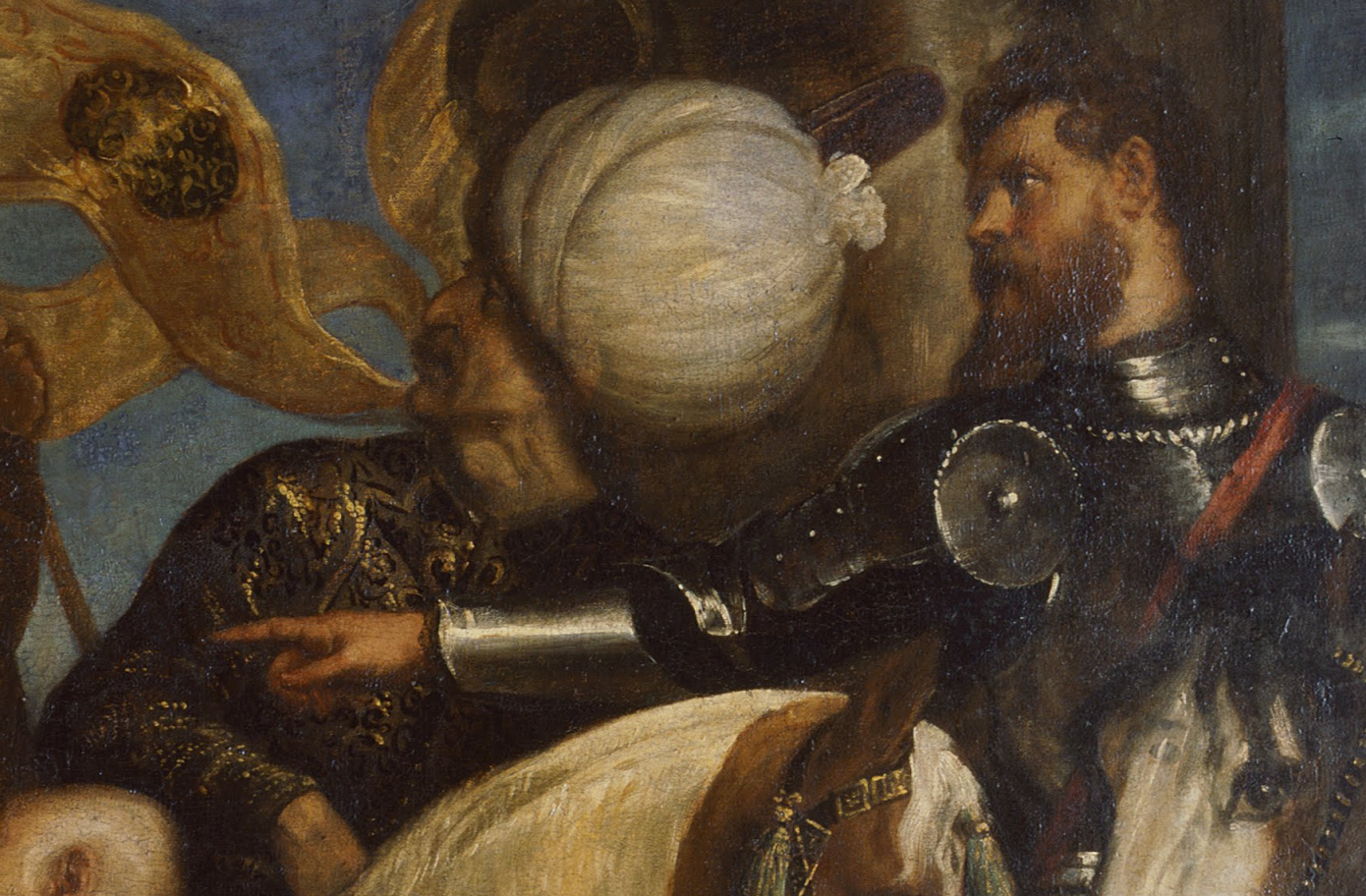
So, while looking a this large painting by Titian - Ecce Homo - (the painting is quite dark in the area of horses, perhaps due to the aging process and various restoration/protection efforts) I noticed several interesting aspects of the contemporary riding equipment, costumes and finally quite naturalistic horse portraits.

First horse and rider - going left to right - is a Saracen (Ottoman Turk in costume and appearance) thus his horse also might be Turkish - nota bene it is a palomino. The bridle appears to be influenced by the Turkish design, but the curb-bit has some long 'S' shaped shanks.

a closeup on the bridle - the low noseband is very interesting.

but then this net-like covering with tassels is similar to the French XVI century equestrian tack, often designed by the Italian artists. Perhaps it was copied from the Ottomans?

German/Italian/Spanish? - note the long, narrow head, small ears, and a bold face

a closeup - large, expressive eyes and neighing mouth (another very animated horse in this Titian's painting)

 actually the horse is not dissimilar to the horse face in the famous Breda painting by Diego Velazquez - perhaps an Iberian horse then?

this horse and the Velazquez horse have stockings - coincidence, or preference for colorful horse markings...


a breastplate and short-shanked curb-bit

Riders appear in contemporary outfits - one a Saracen (Ottoman Turk) and the other a 'Roman' (Italian or German nobleman)

the soldier in a foreground wears an interesting short crimson velvet? coat with long kontusz-like sleeves (going back to the Median/Persian riding coat kantuš), while the figure behind him has a long expensive chain-of-mail coat on the second figure. Both are wearing swords, with two different kinds of suspension.

 Nota bene in this painting this costume was used as well, except over the armor

staff weapons - a halberd and a partisan, also a flag
Finally, I could not tell if these two horses are shod..
enjoy

Sunday, June 21, 2015

Diego Velazquez and his horses


Salve,
some years ago I lived in Madrid , and there my favorite place to visit was El Museo del Prado with the adjacent parque del Retiro, probably the largest collection of the European XVI-XVIII century paintings.( I also liked the parque del Oeste in Moncloa).
Diego Velazquez, native son of the Imperial, Habsburg Spain,  is one of the stars of that museum, and I frequently stood in front of his canvasses looking and admiring...
Nowadays, with the Internet and Wikipedia, and Google etc, we can view the art on our computers et al, and I would like to take this opportunity to 'corral' some of the horses our esteemed Sevilla-born don Diego created with his brushes on canvass.
Mind you, Andalucia was the land of good horses in the Hapsburg Spain, and  in the not-so-distant Cordoba there was the most famous Royal Horse Stud that had been breeding the pure Spanish horses since 1570s.
Perhaps we can presume that the horses here are the Baroque steeds, but there are some interesting aspects of these mounts, and in some further entries I should explore them. For now I would like to point to you the size of these royal and aristocratic mounts - they look about 15 hands, or so.
Kings
  Felipe III

Felipe IV


Queens
Isabel
 Margaret 

royal child - Baltasar Carlos de Austria


officials -
Gaspar de Guzman, conde de Olivares


Cardinal-Infante Fernando

enjoy