Showing posts with label assyrian horses. Show all posts

Thursday, July 30, 2026

Saturday, October 14, 2023

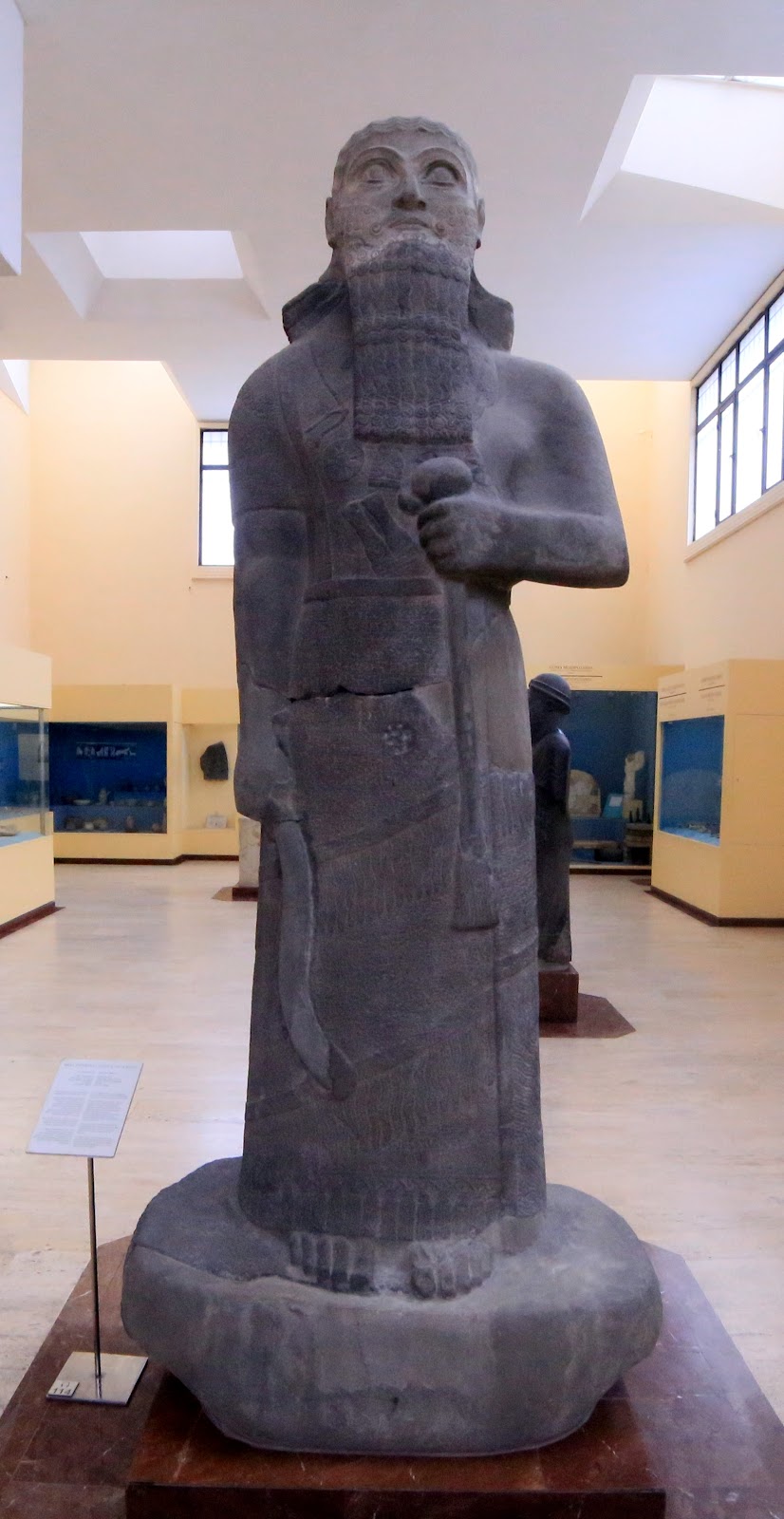
Shalmaneser III - Black Obelisk

 Salvete Omnes,


king Shalamanser III, son of Ashurnasirpal II, king of Assyria, ruled from 859-824BC

a little trip into the depths of the Western Asia during the early Iron Age, when Assyrian kings and their warriors dominated and told that world about their conquests and grandeur through monumental art and inscriptions. 

the martial and equestrian art & history connected to the Neo-Assyrian king Shalmaneser III and his conquests I have already presented on my blog.
Today we will visit the so called Black Obelisk, from the British Museum collections, when British subjects uncovered, pillaged and bought old art from many ancient but often forgotten locations. 


The Obelisk or stela, from 1846AD in the British possession, came from the Neo-Assyrian Kalhu (Nimrud, near present day city of Mosul) where sir Austen H. Layard discovered this obelisk there during his voyages (you can listen to his own writings about his explorations in Niniveh and Babylon on Librivox).

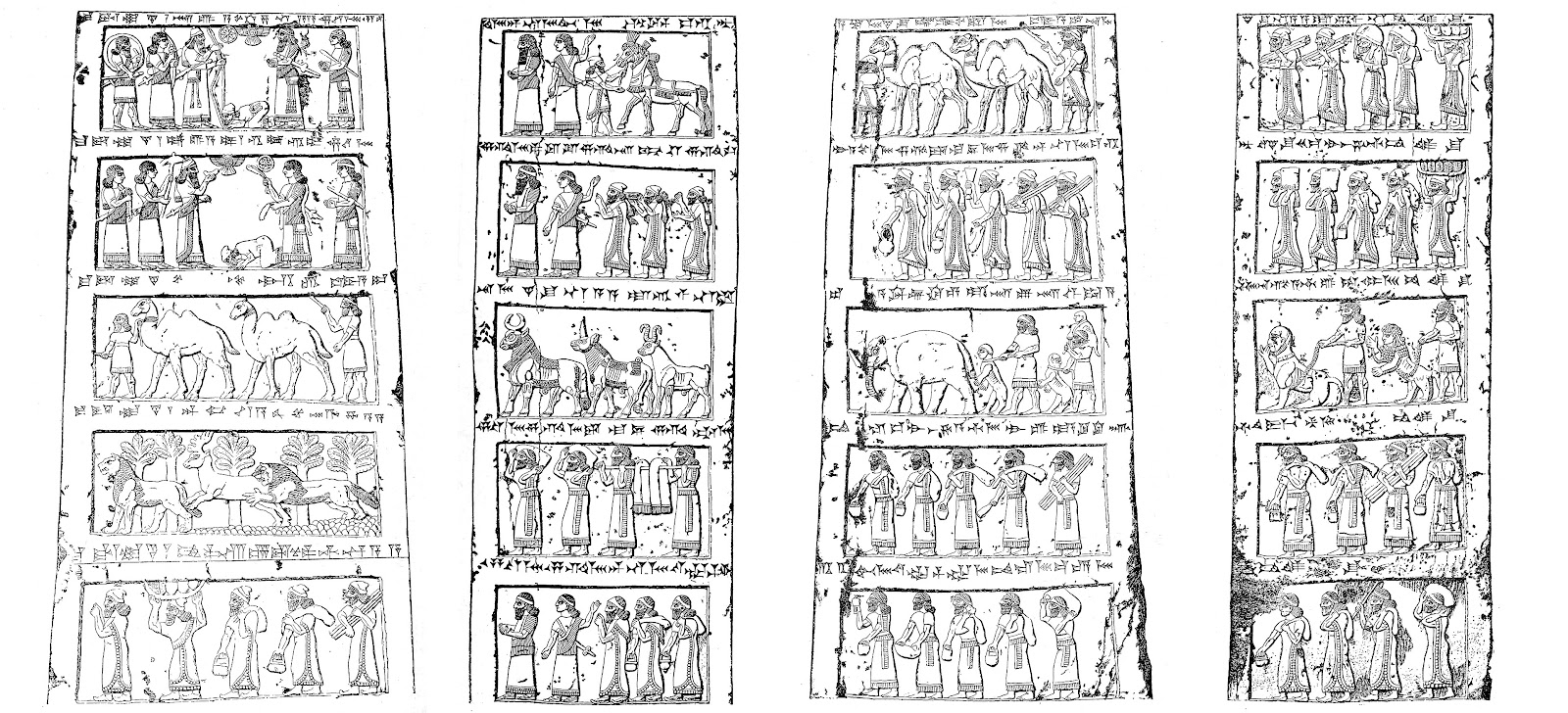
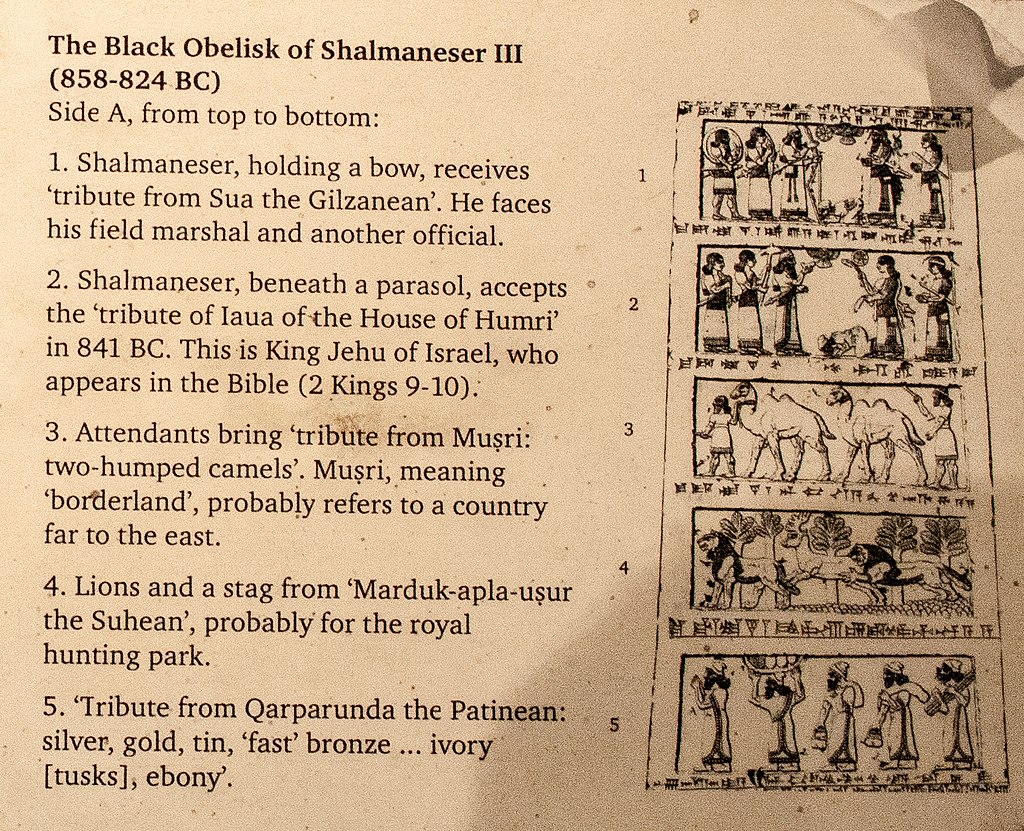
and shows the triumphal reception of many processions of various vassals and tribute bearers, showing obeisance to the Assyrian king and his court in his 31 year of campaigning and waging power from the land of Assur.


Among them we have a horse from Gilzanu brought by Gilzanean delegation led by Sua, the king - older article on Gilzanu here. Already at the end of the Bronze Age Assyrian sources mentioned Gilzanu (in present Iran) as the area where they got horses, by  tribute and commercial exchanges. During the period of of early Neo-Assyrian empire this Gilzanu region/kingodm has been associated with the sites in Northern Iran, among them there is one tepe (hill) known as Hasanlu in the Gadar River valley in the Zagros Mountains (shared nowadays between Iran, Iraq and Turkye). In the stela king had the tribute specified to have been horses trained to harness (chariot horses) and donkeys.

the led by a groom horse seem to have some sort of an armor covering his, it is a stallion, throat, neck and chest


with a bow in his hand great king Shalmaneser III receives obeisance from Sua, ruler of Glizanu


a close up onto the Bactrian Camels, also from Gilzanu

The Black Obelisk is also famous because it shows a royal personage from the Biblical scriptures, namely a member of the Omrid*  dynasty from his capital Samaria, Kingdom of Israel, king Jehu - more links to interesting articles enclosed below.

prostrated king Jehu son of Omri showing obeisance to Shalmanaser III 

Jehu's tributary procession
the Black Obelisk aka stela in the British Museum

ps

Polish historian prof. Lukasz Niesiolowski-Spano of the Department of History,  Warsaw University - his academia page - sees Omri as the first king of Israel, while he also wrote a fascinating article about David, the historical figure and the king of Hebrew Bible.

Valete

Monday, November 8, 2021

Shalmaneser III receives tribute in horses - dais from Nimrud

Salvete Omnes,
we have not visited the ancient Assyrian in a while.


so here we have something worthy of our look and study - the dais of the Neo-Assyrian king Shalmaneser III throne, where he himself was carved into several scenes along with his vassals and tributaries. 


And as usual with the Neo-Assyrian kingdom their horse is featured and it is shown prominently in this relief, these chariot horses are tribute from the Chaldeans and Neo-Hittites.

. This dais was found in the eastern end of the throne room (T1) at Fort Shalmaneser in the city of Nimrud (in modern-day Nineveh Governorate, Iraq) in 1962 CE. The front and sides of the dais were carved in relief depicting various tributary scenes. The dais was completed around 846-845 BCE (and that would be the king's 13th year of reign).


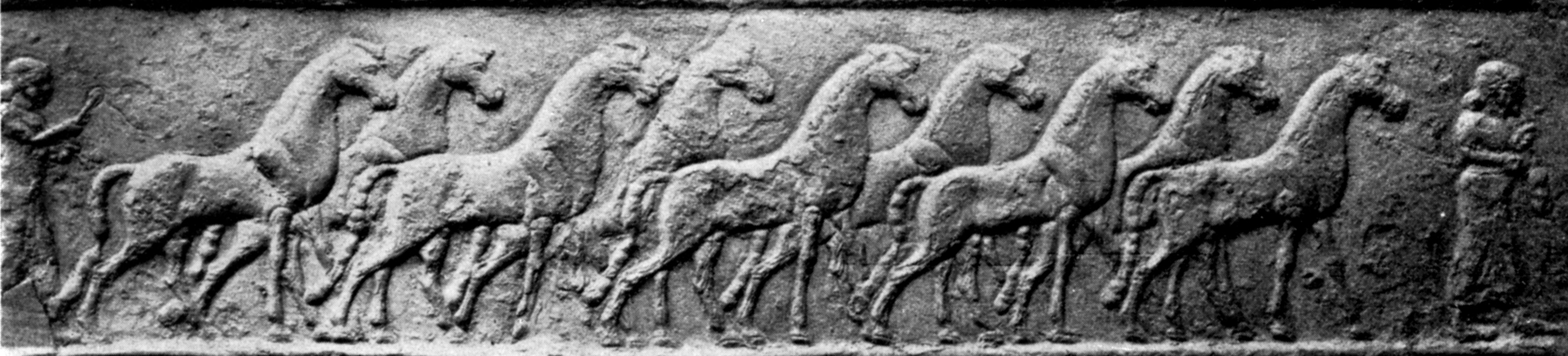
This scene is part of a long tributary one where the Shalmaneser III (r. 858-824 BCE) receives Chaldean tribute from Musallim-Marduk, son of Ukani. On the right, a groom leads a pair of horses, unharnessed except for the halter by which they are controlled. This is followed by a second group of tribute bearers. The procession is headed by a bearded male figure (probably the prince). Before him, a smaller male figure (child), probably his son, appears. Both raise their hands in a homage or submission gesture. They are followed by a chamberlain bearing his staff of office, followed by a bearded figure carrying in his extended hands a small tray of loaf-like objects, perhaps ingots of some relatively precious metal.


This scene is part of a long tributary one where Shalmaneser III (r. 858-824 BCE) receives tribute from Qalparunda (c. mid 9th Century BCE) of the Land of Unqi (a Luwian Syri-Hittite state, also known as Pattin). This is the rear part of the tributary procession. The rear is brought up by two grooms in long, belted tunics, one brandishing a whip, and each leading a pair of ornately caparisoned horses


During the ransacking of the Iraq Museum in April 2003 CE, this object[dais] was not vandalized and remained intact. It is on display at the Assyrian Gallery of the Iraq Museum in Baghdad, Republic of Iraq.

Valete

ps the description comes from the Wiki Commons page on the details of this dais - 

Friday, July 23, 2010

Neo-Assyrian kingdom and her neighbors equids


Salve,
Neo-Assyrian Kigdom ( List of Assyrian kings  ) and its  art ( wiki/Neo-Assyrian_Empire   books.google Arts of Assyria  ) always invokes the strongest feelings because of a degree of brutality shown (in this XIX century book there are many images taken from Assyrian sculptures showing that side of their art  Assyria  ).
But at the same time their art is the best place where to find images of fabulous horses, horse tack and ample evidence of horsemanship for the period between 900 to 600 ( I millennium) BC (BCE).
From the cuneiform tablets we can learn that the best breeding ground for the  horses were in Mannea, east and south of Lake Urmia (  wiki/Lake_urmia  ).  Their horsemen were allegedly the first non-steppe cavalry organized in the so called civilized world of Western Asia, and their art gives ample proof of gradual changes in the horse tack, seat and weaponry and armour for these horsemen.
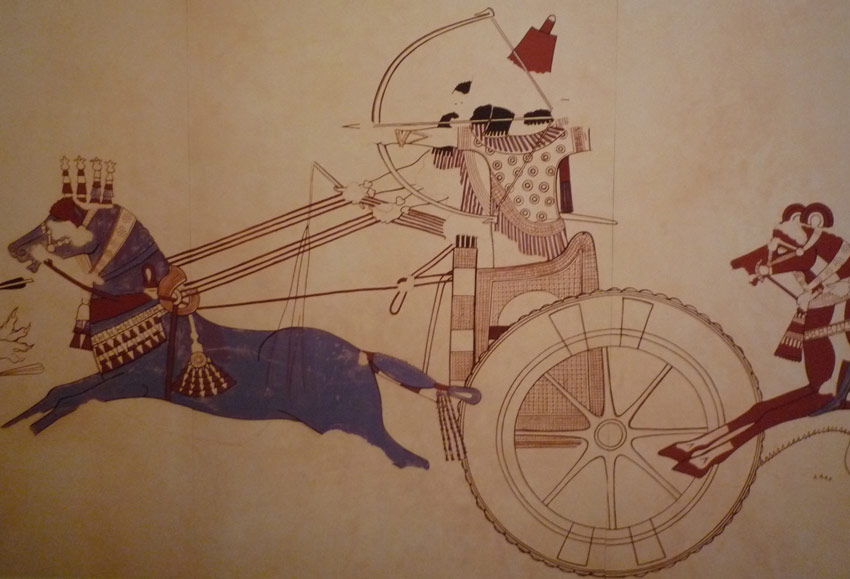
Paintings from Til Barsip, strategic Assyrian stronghold  located along the eastern bank of the Euphrates River, c.100km northeast of Aleppo, Syria, provide beautiful examples of Assyrian horses and their tack eg til barsip chariot  some originals at Louvre and Aleppo Museum, many paintings copied by Lucien Cavro (I got mine from Andre Parrot, The Arts of Assyria Arts Assyria Parrot  )
Assyria had many enemies, including Egypt, Syrian princedoms, Elam  iranica.com elam , desert nomads, Medes, Persians, Anatolians, Babylonians to name a few. War was essential to their survival and wealth, while a mighty stallion, whether mounted or pulling a chariot, was the symbol of it.

But since a picture is worth a thousand words lets show some links and pictures to these images.
horse head
horse head II
horse head III
horse head IV
this one is interesting as it shows king hunting the lion with a spear from horseback, a theme so common in the Iran's Sassanian art more than a thousand years later king with spear attacking a lion
onager or wild ass
hunting lions from a chariot
tribute
chariot horses
4 horses' team in king's chariot
using a horse whip while riding
a lion attackiing a king's saddle horse
grooming and watering horses
metal head protection -frontelet
luristan bronze horse tack
Assyrian influenced Cypriot bridle from VII century
enemies of Assyria Urartu Chariot
 Assyrian spolis Urarartian captured_horses
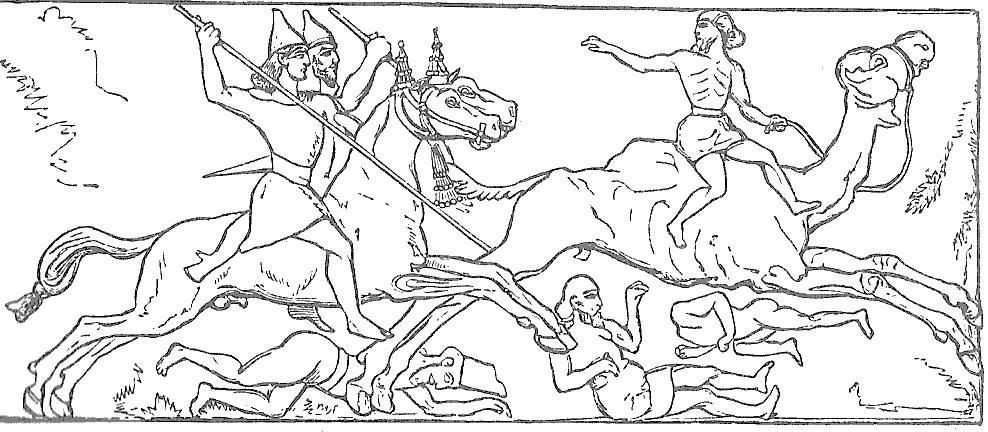
 Assyrian fighting the camel desert nomads
 Assyrian troops return
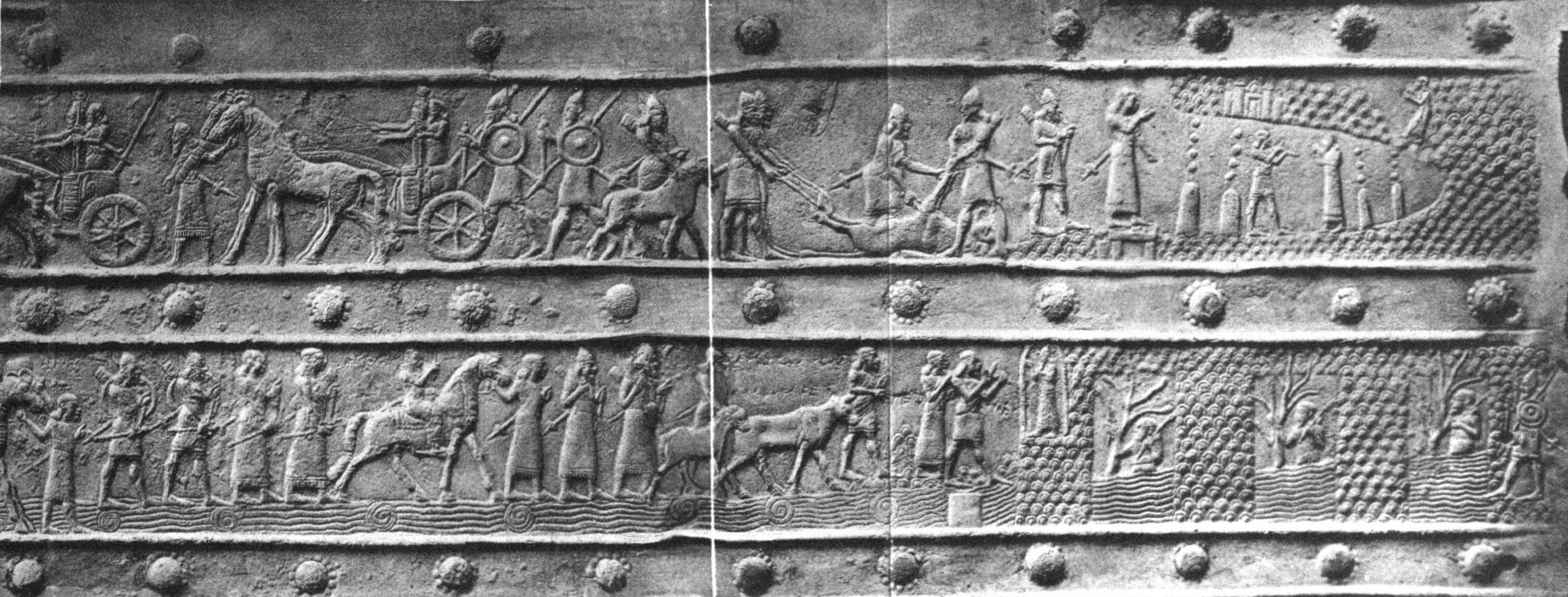
 Balawat palace door of Salmanassar
Balawat palace door of Salmanassar2

 elamite chariot
Assyrian horsemen
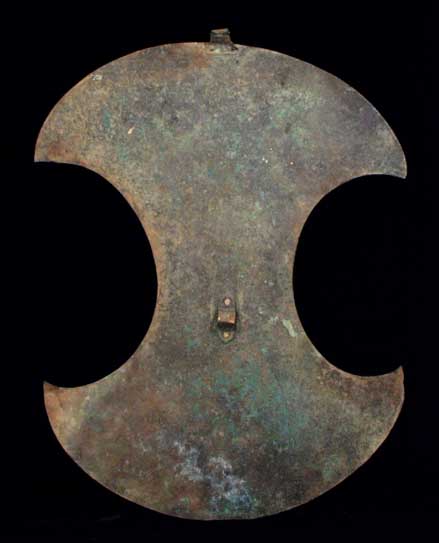
no metal breastplate for the Assyrian horse have been found thus far but this one was found at Mannean site of  Hasanlu Tepe, Iran ( CAIS hasanlu   hasanlu MET   CAIS porada-hasanlu   ) where best horses were bred for the Assyrians and their enemies alike,  and is dated to around 800 BC  hasanlu breastplate
with a book on this horse breastplate breastplate book

'Horse' books to read : 'Selected writings on chariots and other early vehicles, riding and harness' Littauer et al    Hyland Horse in the Ancient World   Azzaroli
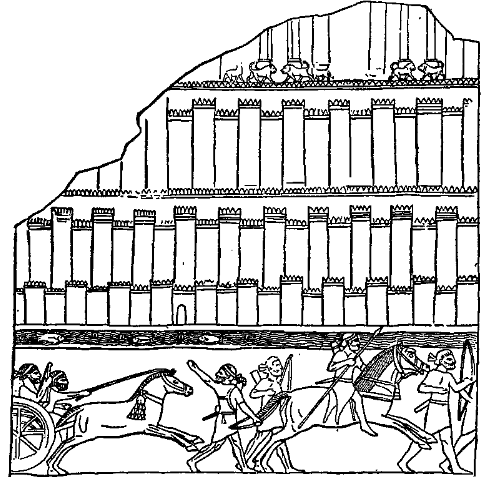
Finally, from Assyria we get the very first image (during the reign of Ashurnasirpal II or Shalmaneser III  - palace at Nimrud, ancient Kalhu) of so called 'Parthian Shot,' a tactic of turning around in the 'saddle' and shooting arrows,  from one's bow while  sitting astride a cantering or  galloping horse, at the pursing enemy. 
Here, the  Assyrian royal chariot is pursuing these most likely Iranian Skuda mounted riders and one of  them is about to fire his arrow at the chariot crew.


Head hunting and bow shooting Cimmerians and later Scythians/Skuda/Saka 


attacked and wrecked the kingdoms of  Assyria's enemies from Anatolia -   kingdom of Urartu and Phrygia  and  Mushki, but then next wave of these horsemen  lent their hands and bows   (in alliance with the Medes, who had finished off Urartu iranica.com/articles/media ) to the final destruction of  Assyria herself, at the end of the VII century,  and  the fall of the city of Harran marks the end of the Neo-Assyrian empire. Assyrian art would later surface in the Persian arts of the Achaemenid Empire etc.