Showing posts with label Polish cavalry XVIII century. Show all posts

Thursday, June 27, 2024

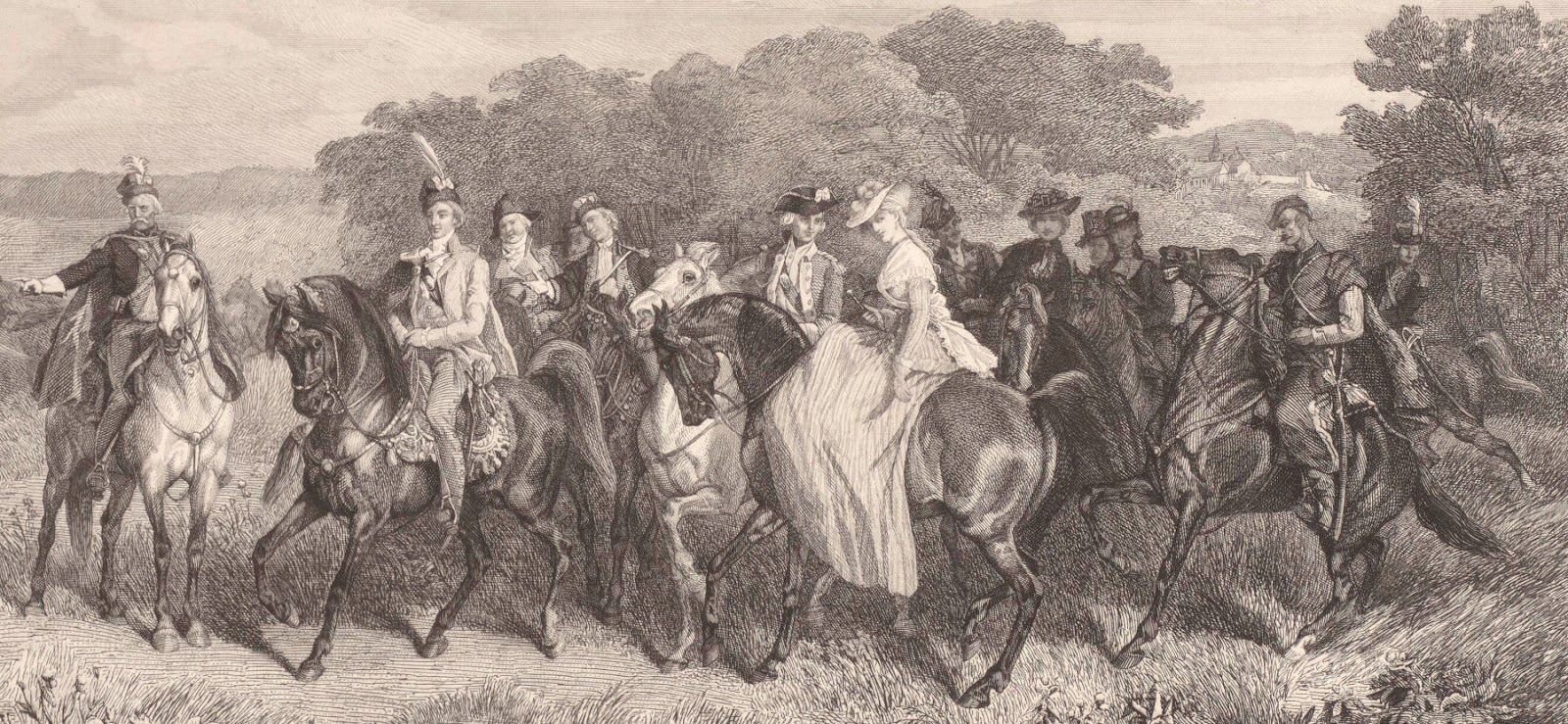
Juliusz Kossak, his stud presentation in print from National Museum in Warsaw

Salvete Omnes,

so the Dog Days of the summer have arrived.   

a little short entry 


I truly enjoy the art painted and drawn by the Polish XIX century painter Juliusz Kossak.

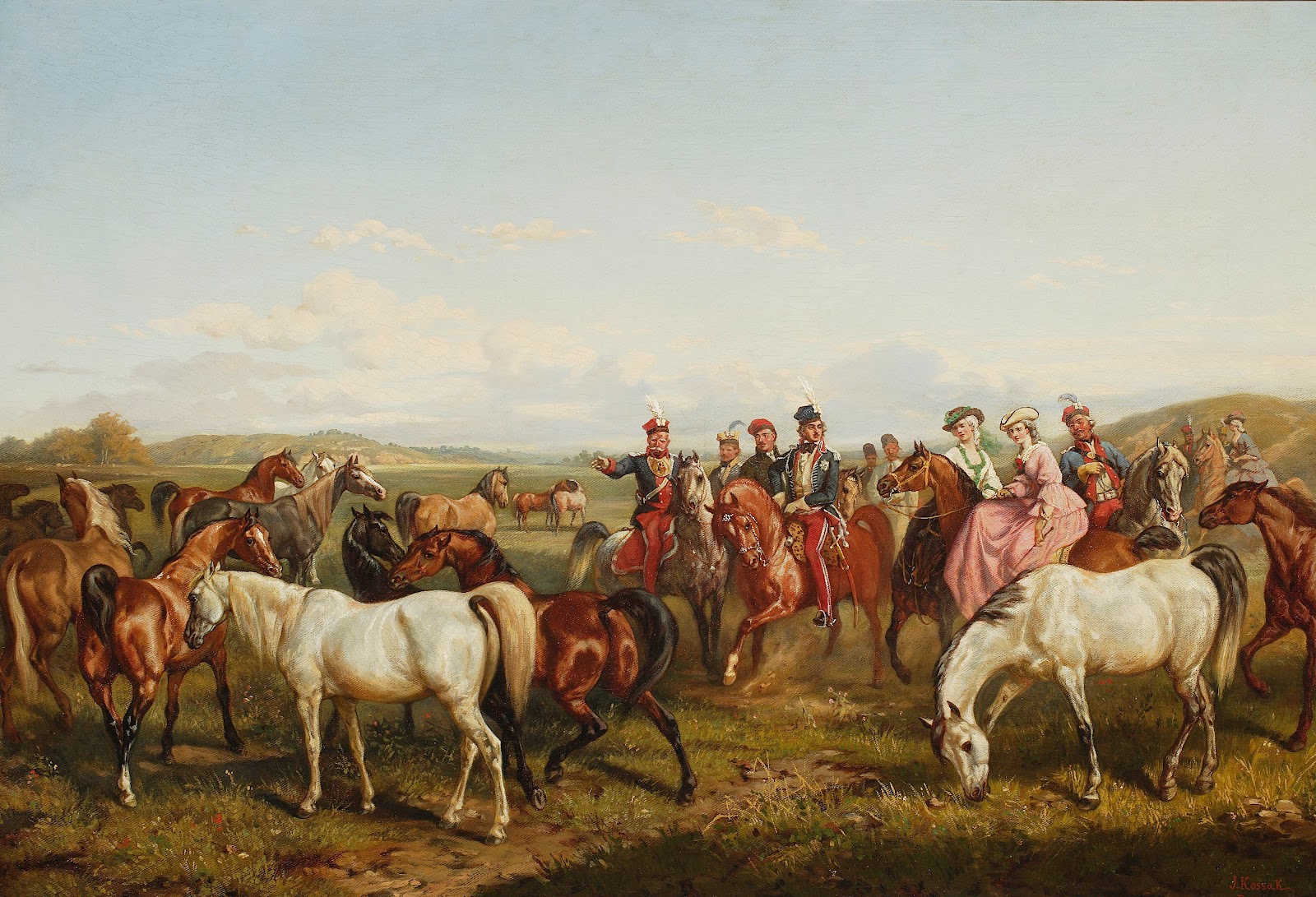
some year ago I posted this color version of Juliusz Kossak's oil painting - Mohort presenting the herd to prince Poniatowski.


Polish National Museum in Warsaw has a print (digitalized)  , showing the whole presentation scene in a  different composition, made circa 1870AD, the painting was owned by Mrs Eugenia Juszkiewiczowa.


enjoy
Valete

Saturday, May 27, 2023

Kossak - Mohort presenting the herd to prince Poniatowski

 Salvete Omnes,
a short entry - 
Juliusz Kossak's paintings have graced these blog 'pages' for many years.
National Museum in Warsaw has a good size copy of his painting on their digital collections webpage- Mohort prezentujący stadninę [Mohort presenting the herd ...to prince Jozef Poniatowski], painted in 1858AD. Unusually this painting is an oil on canvas work, whereas the typical medium used by Juliusz Kossak was watercolor (with some gouache, ink etc) . 
Here, the main protagonist is  a fictitious 'knightly' soldier-cavalryman, the defender of the Borderlands, the hero of Wincenty Poll's epic poem - Mohort. He rides next to a real hero and the last knight of the Old Poland - prince Jozef Poniatowski.
The three main male characters are portrayed in the late XVIII century Polish cavalry uniforms, while the ladies are perhaps dressed in some riding attire of that period? , I am not versed in the female fashions of the ear. 
The site is somewhere in the Old Poland's southern or eastern lands, that make today's central  Ukraine, our Polish lost mythical Kresy or Borderlands. 


The horses painted on this canvas most likely come from numerous sketches and in situ observations maestro  Juliusz Kossak made while visiting Polish studs and herds in those lands. He was friends with many Polish breeders and land owners of the era, painted many portraits of their horses and herds, while the very old Polish lands had been divided between the Russian Empire and Austro-Hungarian one during the three Partitions of Poland (1772-1795);  and in the past these lands were always Polish Crown centers of horse herds and war horse production. We suspect that the so called Old Polish Horse, used by the winged hussars and National Cavalry & Uhlans came from the Ruthenian and Podolian farms.
Perhaps it is worth noting that the majority of these fine Polish stud farms, breeding Polish Arabians as well, were destroyed during the World War I, Bolshevik Revolution  and the independence wars after the dissipation of both empires 1917-20

Valete

Sunday, June 30, 2019

Rzad konski Kawalerii Narodowej AD 1791

Salvete Omnes,
[in Polish]
gwoli wstępu:

ostatnio malowałem kawalerzystę epoki Insurekcji Kościuszkowskiej dla Infort Editions* -
a jazda liniowa epoki panowania zającem podszytego Stanisława Augusta herbu Ciołek to formacji nazwana Kawaleria Narodowa, która stalą się ta formacją poprzez amalgamat chorągwi husarii i pancernych(i petyhorskich w WKL)  zgromadzonych w tzw 'partiach' w Koronie i na Litwie i tworzenie z nich brygad jazdy AD 1775-6.
W Koronie numerem jeden była oznaczona  Brygada I zwana Wielkopolską o której jest artykuł na stronie Arsenału. W Wielkim Księstwie Litewskim pierwsza była
Brygada I zwana Kowieńską brygadą Kawalerii Narodowej. 

Wielki badacz polskiej wojskowości imć pan Bronisław Gembarzewski napisał pracę pt- Rodowody pułków polskich i oddziałów równorzędnych od r. 1717 do r. 1831, gdzie można sobie postudiować historię Kawalerii Narodowej do 1794 roku.


Ponieważ na blogu interesuje mnie przede wszystkim sprawa końska, ergo poniżej przytaczam fragment* za
imć panem Konstantym Górskim, Historya Jazdy Polskiej 
 
'' W marcu roku 1791r wyszedł następujący przepis końskiego ekwipażu [rzędu i osiodłania] dla towarzysza i szeregowego:

''UŹDZIENICA razem z tręzlą, z 3 kółkami i podgardlem na sprzążkę przypiętem. Kółko przy cuglach z werblikiem dla włożenia w kółko uździenicy.

MUNSZTUK z 2 sprzączkami u góry z nagłówkiem, przez który przechodzi pasek z łańcuszkiem do kuplowania koni; ten łańcuszek jest na lewej stronie i zapina się w kółko na prawej stronie będące. Powyżej sprzączki a niżej kółka tego jest na prawej stronie rzemień, który przypada koniowi przez chrapy, pod widełka i zapina się na sprzążkę z lewej strony. Pasek wspomniany do kuplowania służący, gdy konie nie są kuplowane, aby nie wisiał przypina się maleńka szlufką przy średniej sprzążce lewej strony.

PODPIERSIEŃ z jedną różyczką większa w środku, gdzie dawniej był orzeł 2 mniejszych różyczek jednej i z drugiej strony jak się olstra kończą. Ten podpiersień obejmuje kule przednią i na lewej stronie zapina się na sprzączkę. Przy tym podpiersieniu są 2 kółka rzemienne z jednej i drugiej strony, w które olstra się zakładają i one utrzymują. Przy tych kółkach są pokrywy ze sprzączkami do przytroczenia płaszcza. Od zwyż wspomnianej większej różyczki idzie rzemień czyli wytok ze sprzążką do przykrócenia lub podłużania który pod brzuchem konia wchodzi w trok. Na przedniej kuli zwierzchu antabka ze rzemykiem do przytroczenia płaszcza w samym środku.

PODOGONIE z trzema różyczkami rzemiennymi z których 2 mniejsze przy ogonie a jedna większa na krzyżu końskim przypada. Całe podogonie przypina się dwoma sprzążkami w tyle kulbaki.

SIODłO zwyczajne, z dwoma kulami, potebinkami i wysłaniem w samem siedzeniu, na bokach olstra zawieszone na antabkach dwóch skórzanych przy olstrach a jednej żelaznej przy siodle pokrymem na sprzążkę przypięte.
Z tylu kulbaki 3 antabki żelazne, do trzech pokrymow t.j. jeden na lewej stronie drugi w środku pod kula,trzeci na prawej stronie, Wszystkie trzy potrzebne do utrzymania mantelzaka i furaźnej torby[..].


MITUG [sukienny] towarzysza dawnym kształtem i kolorem z tą tylko odmianą że bez orłów i pogoni i frędzli być powinien.
 
MITUG unteroficerski, trębacza i szeregowego z futra czarnego baraniego w koło na cali 4 sukno czyli wypustka koloru
kraprotowego a kolo niego na 2 cale szeroka wypustka granatowa. Ten mitug przykrywa sobą mantelzak, ażeby zaś dobrze lezal, katy boczne tego mituga wchodzą na denko mantelzaka bez żadnego przerznięcia w kule siodłową, przydziury na folge do przypięcia karabina. Figura tego czapraka jest okrągła podługowata na przedzie ostrzej a z tylu szerzej trochę.
MANTELZAK
z sukna kraprotowego 30 cali przy denku na szwie wypustka granatowa przy nim guzików 6 do zapinania. Pod mantelzakiem przychodzi furaźna torba płócienna 32 cali, z obu stron zaszyta  i tylko pośrodku otwarta, be żadnego zapięcia. [..]

TORBA płócienna druga na siano dla konia[...].''

maly szkic w Krita, GIMP i MyPaint


 Valete!
* dzięki mości Piotr Zalewski - rekonstruktor kawalerii epoki stanisławowskiej i niebawem doktor nauk humanistycznych (obrona 4 lipca 2019) - za pomoc i konsultacje w temacie.
ps
w tekście historycznym zachowana orginalna ortografia

Thursday, June 27, 2019

OD BŁONIA DO TERESPOLA - new cover

Salvete Omnes,
a quick post- new book cover


I digitally - using Krita, MyPaint and GIMP-  painted this illustration for the cover of a new book published by Infort Edition from Poland.
Titled 'OD BŁONIA DO TERESPOLA. Działania dywizji generała Karola Sierakowskiego w insurekcji kościuszkowskiej 1794' (,From Błonie to Terespol. Actions of the general Karol Sierakowski's division during the Kosciuszko Insurrection 1794'). Authored by Miron Kosowski, this work constitutes a part of the author's scheme to cover various important but less-known or studied battles of the Kosciuszko Insurrection. For example his previous work , on the Chełm battle, was reviewed here by dr. Maciej Trabski.

The cavalryman depicted here might have belonged to one of the numerous but lesser known cavalry regiments and companies that had been organized alongside the Polish regular army cavalry regiments during the Insurrection. The uniform and equipment are only conjectural and come from general depiction in the period sources. 
This lancer is using a simplified Old Polish military saddle, akin to the Hungarian saddle of the XVIII and XIX centuries, and a similar horse bridle with a curb-bit.
The book [in Polish] can be had here.

Valete!

Monday, June 17, 2019

Chodowiecki - a Pole at the Prussian court

Salvete Omnes,
a little entry of Daniel Chodowiecki, a prolific artist active in the Prussian Berlin. Maestro Daniel was from Gdansk (Danzig, the most important Polish sea port and important cultural and economic center on the Baltic Pomeranian coast, staunchly with  the Polish-Lithuanian Commonwealth in spite of its large ethnic German population), and very very proud of his 'Polishness' although he lived and worked at the Prussian capital most of his rather long life.
He drew and etched many prints , including book illustrations - you can peruse them on wiki commons. These images offer lots of information on the daily life in Central Europe at his times (most of the XVIII century).


Both Prussia and Polish Commonwealth bred plenty of horses, Prussian kinds often buying horses for their ever growing armies, and after the Partitions of Poland (Prussia took the most important - in terms of ethnic Poles -  of all Polish lands between 1772-195) taking over many fine studs and breeding material from Polish horse stock.


note the small horses working the plow
 
 
 horse training and cavalry


 these may be old Polish cavalry - or some Polish units in Prussian service


 famous cavalryman von Zieten


Daniel knew and drew the Old Polish costume - there are a few here


a Polish stable

finally the soldier of Gdansk garrison - the mounted dragoon leading his horse and a nobleman on the right

valete

ps
He also illustrated the events taking place during the American Revolution.

Friday, July 21, 2017

Yekaterina II as equestrienne

Salvete omnes,
Canicula is upon us, so we should take a trip to the XVIII century and see some paintings of the Imperial Russia, namely the images of Yekaterina II or Catherine II (the Great), who being a nice Anhalt princess ended up as one the greatest Russian monarchs of all times.

True, she is not the most favorite with our Polish national tradition, being in effect one of three 'partitioners' - Russian Empire, Austria Hapsburg Empire, Prussia - of the Polish State, but upon the Polish Partitions she had become de jure the Polish peoples' ruler too.


and the last painting by Jan Bogumił Plersz from circa 1787 showing the ending of a conference at Kaniów on the Dniepr River (Dnieper) then in the Polish Kingdom, between Yekaterina and her one-time paramour, our Polish ruler, his majesty king Stanisław August (pretty much bovine in his approach to politics - his coat of arms was Ciołek), who was rather flippant and always in need of funding which he spent on art and sumptuous living, generating vast debts, thus he was constantly on Yekaterina's  pay roll and always asking her for money. His reign started with his election fully forced by the Russian arms (there is a book coming about the war of 1764 election), then continued with the first national uprising known as the  Bar Confederation, 1768-72) that also sought to dethrone  him but eventually ended up in a exhausting defeat by Russian armies, and in turn this complete subjugation of the Polish state lead to the First Partition of Poland. Nota bene this act was proposed by the Prussian monarch who at that time was a rather sly thief( why a thief, well amongst others  he debased Polish gold coins stealing gold etc), known as Frederic II the Great.
Twenty years later King Poniatowski led his kingdom into a war with Russia over the May Constitution in 1792, but being the commander in chief and the actual architect of the whole situation he refused to lead his armies in field, instead remianing in his castle and just ordering the armies through the letters to his commanders, among his many war 'achievements' he refused to even visit the army camps when they needed a boost in morale, but upon surrender he eventually singed off the 2nd partition - great book in English written by an American scholar in 1915. 1795 Kosciuszko Uprising was the last war for our independence with Poniatowski  as our king, and he did nothing to help the cause, worried about his private affairs more than the state's.  So when Polish armies were defeated, three powers went to divide the country.
Poniatowski abdicated on behalf of Russian Empire and thus singed off on the document dissolving the Polish Kingdom, on November 25, 1795, and then went to live his life in Saint Petersburg, Russian Empire, with 3/5of his debts and his life pension paid by Russia, Prussia and Austria. He died in 1798, again awfully in debt, leaving his estates under the Prussian occupation to prince Józef, who would become one of our national heroes. Rather disgraced former king Stanisław Poniatowski is not buried in the national sanctuary along our other kings and heroes inside the Wawel Castle Cathedral.
In the bottom left-hand corner there is our Polish national cavalry with lances.

enjoy

Monday, May 8, 2017

Parę słów o obronie Konstytucji 3 Maja

Salve,
[in Polish]
mamy początek maja i właśnie Rzeczpospolita długa i szeroka celebrowała rocznice Konstytucji 3 Maja.

Rzeczpospolita stoczyła nieszczęsną wojnę o te konstytucję, nieszczęsną bo nie była do niej przygotowana militarnie, politycznie ani ekonomicznie.
Twórcy konstytucji nie stanęli na wysokości zadania i skapitulowali bez poświecenia jednej kropli własnej krwi.
 Tymczasem jak oni kapitulowali   Wojsko Polskie pod wodza Józefa Poniatowskiego wciąż musiało przelewać krew w obronie tej konstytucji i króla.
Tadeusza Kościuszki opis kampanii r. 1792 z autografu Biblioteki Kórnickiej - do przeczytania tutaj.
Opracowanie całej wojny wciąż pierwsza klasa - Adam Wolański (2 tomy) - tutaj Wojna polsko-rosyjska 1792 r. T. 1, Kampanja Koronna.  tom II - Litewska.

Wódz armii koronnej, książę Józef Poniatowski był raczej młodym dowódcą, co prawda już zaprawionym indywidualnie w wojnie ( walki z Turkami w ramach armii austriackiej), ale  niedoświadczonym naczelnikiem wojska; jednakże był pełen energii i chęci walki, z dużym talentem wojskowym. Im dłużej trwała ta kampania tym większy był entuzjazm księcia i chęć walki za Rzeczpospolitą, wzrastała jego wiara w siebie jako wodza i stratega. 

Co innego działo się z królem (stryjem księcia Józefa), który w miarę postępowania kampanii,  - tutaj podkreślę, że była to wojna którą Stanisław August niejako sprowokował (patrz Jerzy Łojek i jego praca Geneza i Upadek Konstytucji 3 Maja) i którą zakończył swoją kapitulacją a przystąpieniem do Konfederacji Targowickiej - coraz bardziej stawał się chwiejny i tchórzliwy.
Prace historyka Władysława Smoleńskiego Konfederacja Targowicka i Materiały do Konfederacji Targowickiej. 
Poniżej zamieszczam parę fragmentów listów od księcia do stryja, zamieszczone w pracy wielkiego historyka polskiego Szymona Askenazego  -  Książę Józef Poniatowski 1763-1813


 Poniżej fragment z wyżej wzmiankowanej pracy Jerzego Łojka -  to wypowiedz historyka Bronisława Dembińskiego (praca imć Bronisława o korespondencji pomiędzy królem a księciem) o akcie kapitulacji króla Stanisława Augusta.
Nota bene praca Robert'a Howard'a Lord'a o sytuacji międzynarodowej wokół 2ego i 3ego rozbioru Polski, wydana 100 lat temu ale wciąż doskonała.

Ponieważ bloguję o końskiej historii, wiec parę wyobrażeń, w tym detali z obrazów, przedstawiających księcia Józefa w mundurach armii polskiej Rzeczpospolitej Obojga Narodów z końmi sprzed 1795 roku


howgh
ps Minister Obrony Narodowej Antoni Macierewicz o królu Stanisławie Auguście.

Friday, November 22, 2013

Racławice Panorama


Salve,
last month I talked about visiting Wrocław in October and among monuments and museums seeing the Museum of Racławice Panorama (here the entire painting). Bellow, a real peasant wagon  placed along with the ground and vegetation all along near the foot of the painting, to create the illusion of three-dimensionally. The illusion works pretty well -:)


Well, I would like to start showing my photos of this masterpiece, its painters and the events taking place on canvas, as this is a historical piece describing some of the vents that took place during the battle of Racławice, AD1794..
 First, the battle in period art
by Aleksander Orłowski, participant of the Kosciuszko Uprising
.

 Michal Sachowicz, contemporary artist and witness to the Uprising
.

.
 perhaps it would be nice to start this topic with a little history on how it all came about:
 our Polish painters Jan Styka  (who came out with the idea in 1892, 2 years before the centennial of the Kosciuszko Insurrection))

and

Wojciech Kossak  got together to paint this cycloramic painting, being influenced by similar works painted by the Germans ( Anton von Werner  in Berlin,) and the French (Alphonse de Neuville & Eduard Detaille in Paris - example of battle of Champigny from gallica )  during 1880s. Also it is very commendable and perhaps astonishing that  the Committee, for the Austro-Hungarian State Fair  to be held in Lwow (Lviv)  in 1894, quickly came about having a design made  and construing the necessary building in Lwów.
Munich in Bavaria was another center for fine art at that time, and both our painters went there to study the art of painting the panorma. Also they had to order necessary and specially woven canvass (as always from Belgium), study or ask around the circle of miltiray hsitorians about the period uniforms and wepaons, study period art, and visit the locality, i.e., Raclawice village.  Kossak painted 4 large oils (1: 10 scale of the original size, they became known as Mała Panorama Racławicka bought by prince Adam Sapieha for his Krasiczyn castle ) in April 1893, and Styka took two of them to Lwow to finish them while Kossak took the remainder to his atellier in Krakow. In July 1893 the building was finised and canvas was streched, all 120 meeters long and 15 meters high.
The research for the historical accuracy led them to the Vienna war Office archives where they found a plan of the battle, drawn shortly after the engagement in 1790s.Then Styka, Kosska and Ludwig Boller(from Munich) went to scout the landscape near Racławice, and made landscape sketches.  Two historians, Tadeusz Korzon , who finished then a new and monumental biogaphy of Kosciuszko, and Konstanty Górski , military historian, aided them with historic information. also museums in Krakow, Lwów and other private collections around the Austrian Poland (partitions of Poland  ) were opened to them to allow for study of the art and material history of the Kosciuszko Uprising.

Our two principal painters chose painters to assist them in painting this behemoth: Teodor Axentowicz, already mentioned Ludwig Boller, Tadeusz Popiel, Zygmunt Rozwadowski (great painter of horses), Michał Sozański, Wlodziemierz Tetmajer and Wincenty  Wodzinowski. They got to work and worked hard , with many conflicts between the principal artists.

As art historian Kazimierz Olszanski, great biographer of Kossak family, writes the work assignment etc was as follows:
Jan Styka was the mastermind of the project and one who organised it. He painted the praying group, woman with the killed husband before the hut, the mounted figure of Kosciuszko; and with Wlodzimierz Tetmajer he painted 'kosynierzy '(scythe-armed peasant levies) attacking the cannons and troops of regular Polish infantry and peasant levies marching to fight. Wojciech Kossak painted 70 % of all figure composition of the entire panorama (he also painted the horse for mounted Kosciuszko painted by Styka) The landscape was painted by  Ludwig Boller  and Tadeusz Popiel. Following Kossak's sketches Teodor Axentowicz painted the infantry of Wodzicki regiment of foot while Zygmunt Rozwadowski National Cavalry regiments. Periodically Wincenty Wodzinowski and Michal Sozanski helped to paint various scenes.

After 9 months they finished  on May 28 1894, all the rest was added and synchronised with the painting  within a week, and on June5, 1894 the panorama opened its doors for the visitors.

Interestingly enough the painting was to have a short life for it would have been cut into sections and sold off, as  most of these pre-cinematic works had been, but another painter Stanisław Batowski came its defence, and in 1912 city of Lwow took possession of the artwork, thus it became the main tourist traction for the city of Lwow and National Treasure of Poland
It survived the World War II, although the Germans tried hard to find it (it was hidden by patriots) and the Soviets agreed that the Polish authorities of Soviet Poland would take possession of this artwork (although countless other works taken from Polish museums and private collections stayed in Ukraine and her museums) was brought to Wrocław (Stalin took Lwow and gave us Wrocław I guess) in 1946, where finally the Communists allowed for the new rotunda built and painting restored.
The newly restored Panorama was opened for visitors in 1985 and continues to draw crowds from all over Poland and abroad.

Anecdotes are always interesting - so there is one
     After the work was complicated and prises sung, the conflicts between Styka and Kossak grew as to the authorship of the project, and continued for many years.
Writer Tadeusz Boy-Żeleński wrote that Jan Styka was not really the one who 'pinxit' but the one who 'combinavit,' and so many words it was Kossak who who 'pinxit' most of it.  Tetmajer  used to say, Boy-Żeleński added, that when he just finished a section of panorama and paint was still wet, Styka would come in with the visiting officials or sponsors and show them the very piece as his own. But to Tetmajer  it was just funny or annoying,  but when Styka tried to do the same to Kossak ,  show his still wet work as his own,   he even chased him across the scaffolding with intent to cause bodily harm, being himself rather temperamental. Several times the said  Committee had to devote a session to these quarrels and one of the official notes stated (October 11, 1893) the names of the creators would be listed in an alphabetical order. It did not help much
The quarrel never really ceased between the artists,  and lived on after 1894, and actually Jan Styka's sons continued with it.
Both artists went to paint more panorama paintings, Styka 2 more while Kossak 2 more as well.  Theses hudge paintings were cut and sold off as smaller pieces.
.

 Kossak painted this picture later on, after the Panorama, circa 1924
.
to be continued
.