Showing posts with label Polish sabre. Show all posts

Friday, May 8, 2026

Abraham Teniers' saddles, pistol holsters & cavalry weapons from the guardroom

 Salvete Omnes, 


Flemish master David Teniers the Elder had 4 sons who became painters and masters in their own right. 
David Teniers the Younger achieved the most notoriety, but his younger brother Abraham also was noted for this popular guardroom scenes theme.


In these paintings we can observe numerous pieces of equipment, including fine saddles, armor, weapons, even our Central European  (Polish, Hungarian or Croat) weaponry - sabre and nadziak/war hammer. 


1.


2.
drums and pistol with a young black groom carrying a sword


Valete

Wednesday, November 26, 2025

Polish Cavalry Saddle of 1925

 Salvete Omnes,


  finally we have arrived in 1925, when the Polish cavalry was to received the new Polish-designed military saddle. 

saddle with leather covering, seat and saddle skirts 

saddle tree

leather saddle and skirts & linen cinch
sweat-pad /horse blanket aka potnik 

shabraque

The 1925 saddle tree bars was made from one piece of wood each, and the pommel and cantle were made out of iron metal. In the 1927 design the saddle tree bars were made from a 5 layers of birch & poplar plywood.  The straining parchment leather attached to the pommel and cantle and secured to the seat with parchment thong webbing , the whole tree covered with leather seat and leather flaps or saddle skirts. Leather saddle bags, leather shabraq, sweat-pad/horse blanket and cinch composed the remainder of the whole saddle arrangement. Finally, the Polish sabre was attached by straps under the saddle skirts, laying on the leather shabraq, 

They made four versions of this saddle for smaller and larger horses, and for officers too. 

The saddle was subject to many a discussions in the cavalry and military periodicals of the era. And these discussions would lead to a new patented saddle for Polish military, so called 1936 saddle. 


 This saddle would serve the Polish cavalry in the  1939 September campaign and was used by the Polish partisans during the war. 


valete

Monday, September 8, 2025

Winged Hussar Companion from Lapanow ca. 1652AD

 Salvete Omnes,


it has been some time since I posted anything related to the winged hussar.

Pacem Aeternam


One of my friends, Damian Loj, sent me this link to an epitaph from Lapanow's church of Saint Bartholomew the Apostle (founded in 1529 by Mikolaj Lapka, and rebuilt in 1614 by judge (iudex castri) Marcin of Lutoslaw Lutoslawski).


The Lapanow Parish was an affluent one in the end of the XVI century,  consisting of the following villages - Lapanow, Lutomierz, Kepanow, Grab, Boczow, Brzozowa, Ubrzez, Kobylec, Wola Wieruska, Janiszowka, Wolica and Wola Grabska. There were three church patrons - Hieronim Lapka, Stanislaw Lubomirski ,Druzyna coat of arms, and Jan Dabrowski (1596).

The stone plaque depicts a pious winged hussar companion Marcin Lapka (1599-1652). Lapka's wife Marianna Lipska from Lipia had the epitaph carved circa 1652. The plaque was mounted on the outside of the church and only in 2012 was moved into the church. The linked site says that the archives from 1748 noted four such epitaphs existing at that time, unfortunately only two survived the winds of times, albeit the second one from 1666AD contains only the lower part of the epitaph. The second epitaph, Andrzej Werbski Pilawa coat of arms,  was also funded by his wife Magdalena nee Lyszkowska  and their children.


 we can see clearly the hussar lance, his 3/4 plate armor, hussar helmet or shishak, and l-type Polish sabre


The plaque also contains the winged hussar's coat of arm - in my opinion it is Szreniawa, 


and not a Druzyna (also called Szreniwa bez Krzyza - Szreniawa without a Cross), as they declare on the website linked above. But on the other hand, Druzyna is part of Szreniawa lore, and some historians, following Jan Dlugosz  consider Druzyna to have been the original coat of arms out of which the Szreniawa developed or originated. Bartosz Paprocki, the author of the monumental Polish heraldry, listed the Lapka family as both Szreniawa and Druzyna (circa 1543), later writers like Niesiecki and Boniecki say that Lapka were of Druzyna coat of arms.


Lapanow has also a very unusual monument to the farmer peasants killed, 5 killed and 10 gravely wounded protesters,  by the government's forces on June 5, 1932,  which makes this column a symbol of our Polish peasant farmers struggle for the peasant rights during the 2nd Polish Republic.


ps
8th of September is also the anniversary of the 2nd battle of Orsza(Orsha) - a huge  and victorious battle for the Polish-Lithuanian realm against the Muscovy ( the Orsha battle was won but the war did not result in recovering Smolensk, the gateway to Lithuanian Duchy).

Valete

Saturday, January 25, 2025

Polish saddle and sword - XVII century from MET

Salvete Omnes,

the new AD 2025 has taken off quite nicely for the Americans with the new POTUS - America, I  do hope for thee & for me -:) .

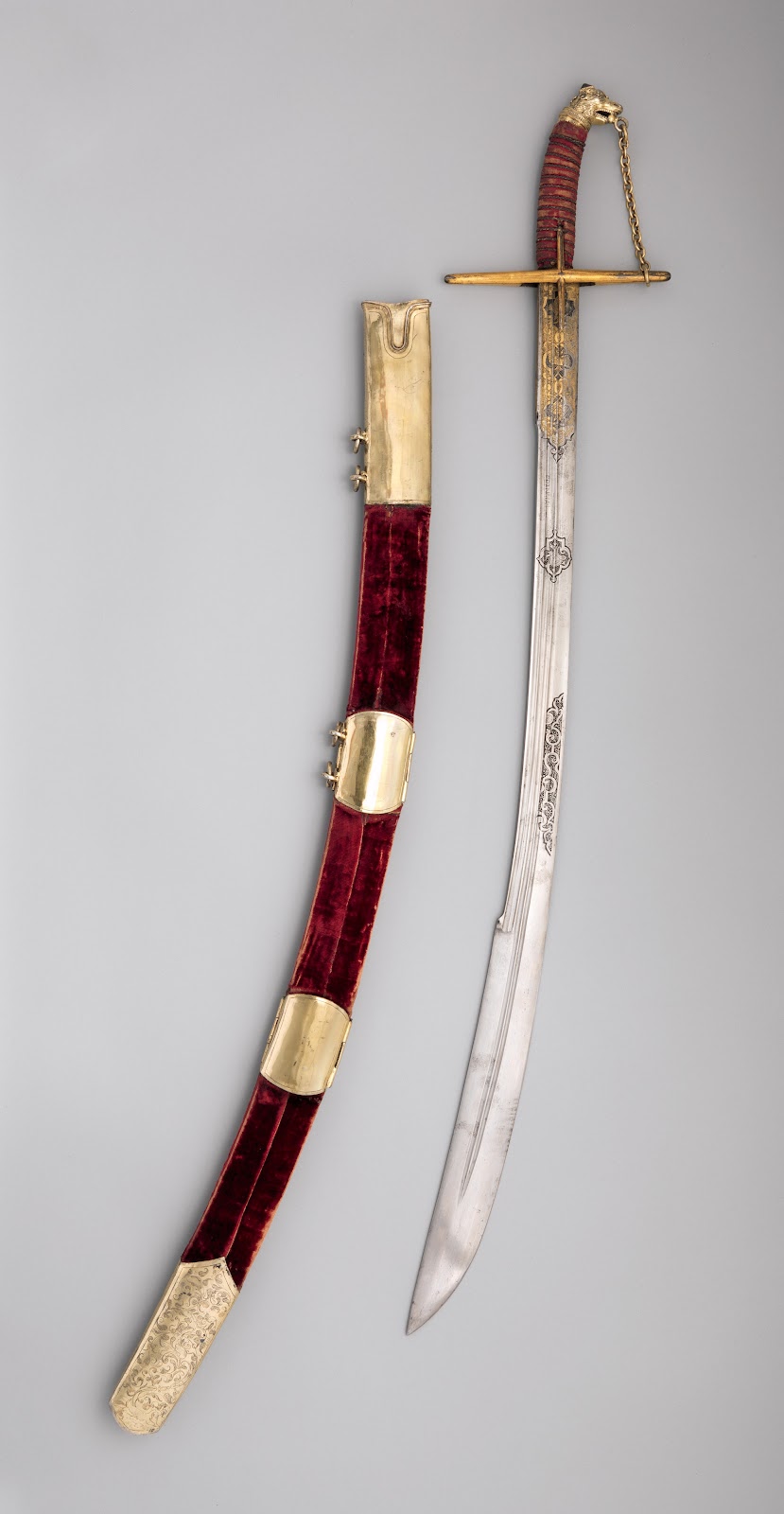
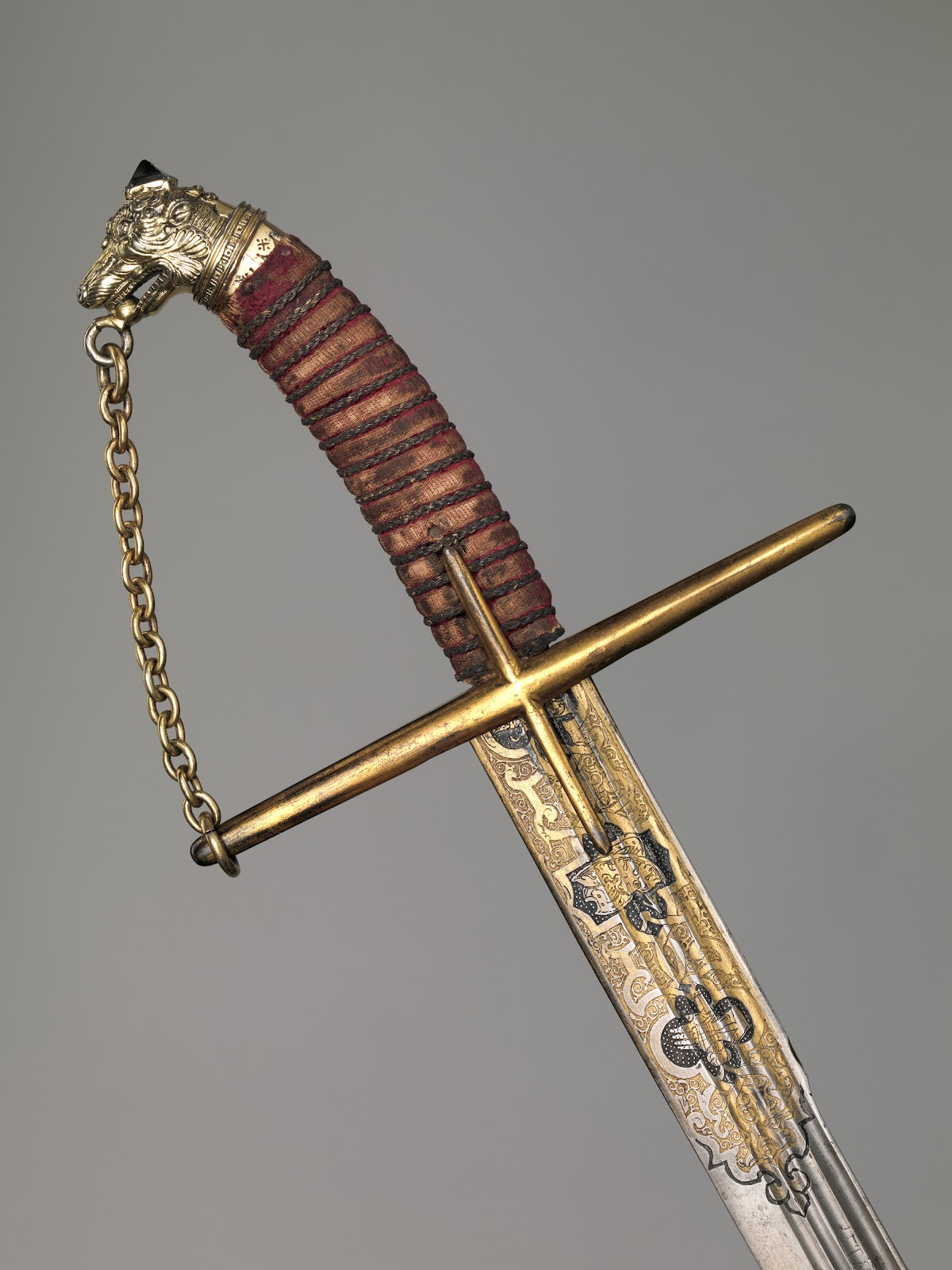
ad rem, great American museum MET has two Old Polish items - sword and saddle - on digital display.
They are both unusual as they belong to the parade type, richly adorned and made with highest skill and mastery by the respective artisans. 

first, the saddle - H. 18 1/2 in. (47 cm); L. 22 1/4 in. (56.5 cm); W. 22 3/4 in. (57.8 cm); Wt. 11 lbs. (5 kg) - I wonder about the dating - AD 1664. It seem very late for this type of saddle. There is a seemingly similar saddle in Sweden, taken as trophy from Polish Commonwealth during the Deluge. 

the horn, very Mexican, has an image of a hunter? or soldier in a Western dress


there may be a coat of arms under the horn plate, inside the horn, of the city of Gdansk


a nice lancer - perhaps a Polish winged hussar with a lance 

                                                                        ***

the sabre /saber with scabbard ('pochwa' in Polish) and carrying belt ('Rapcie' in Polish)- associated with the Saxon court and perhaps with our king Augustus the Strong. Very splendid horseman's weapon. 


Valete