Showing posts with label Gustavus II Adolphus. Show all posts

Wednesday, July 25, 2018

Battle of Walmojza AD 1626 - Polish-Lithuanian army companies

Salvete Omnes,
Wiki Commons has given us access to one unusual XVII century print showing two stages of the winter [January] battle of Walmojza (Wallhof), AD 1626, where Swedish king Gustavus II Adolphus defeated a small Polish-Lithuanian army under starost of Slonim and grand Lithuanian marchall Jan Stanislaw Sapieha, son of Lithuanian grand hetman Lew Sapieha, Lis coat of arms.
Polish-Lithuanian army was divided into two division, starost of Slonim was commanding perhaps a smaller detachment of the Lithuanian army, while the larger one was commanded by the talented hetman Krzysztof Radziwill, Traby coat of arms, who was some 35 km away from the battlefield and in fact was one of the most interesting commanders and tacticians in the Polish-Lithuanian military history.

 Walmojza was the first significant Swedish field victory over the Polish-Lithuanian army, including the winged hussars, during the Polish-Swedish wars for the control of the Baltic provinces and shores.

The map, with all its appearances, looks as it was done shortly after the victory and perhaps represents a piece of Swedish propaganda.
However, even if so  it contains lots of interesting and useful information about the battle, troops involved and even the terrain. or small events taking place during this engagement.
I will attempt to list Polish companies and banners participating in this battle
starting from the top of the first of two prints showing the battle of Walmojza:
right to left of the Polish-Lithuanian army , in parenthesis probable historic names of known commanders :
2 Old kozak-pancerni banners - [commanders' names]
   -Woginski?
  -Zemetowa? [Konstanty Zienowicz]

 2 companies of German 'reitar' cavalry
 -Duce Korfio[Ernest Korff?]

7 banners of winged hussars, under the command of
-Samuel Patz[ Samuel Pac]
-Sanderzewsky?
-Gonsewsky [Aleksander Gosiewski]
-Mlodosky [Mlodski]
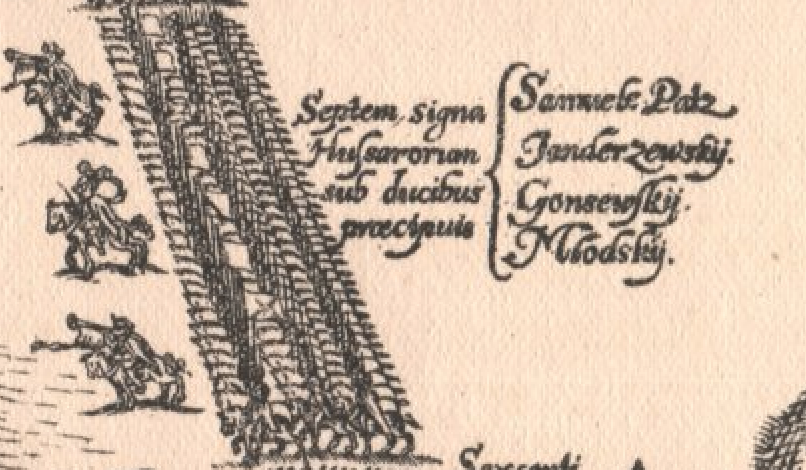
artillery - 5 guns with 6 German musketeer infantry 'units'?* standing behind them

7 winged hussar banners - no commanders listed


3 companies of Hajduk infantry
-Racowsky [ Jan Rakowski]
-Kunsacitz [ Marcin Koszczyc? ]

2 Old kozak-pancerni banners
-Krzyzewsky [ Jan Krzyczewski]
-Poplawsky [ Adam Poplawski /Plawski]

so according to the Swedis.h source for this print Polish-Lithuanian army at Walmojza consisted in total of :
20 banners of cavalry - 14 of winged hussars or heavy cavalry,  4 old kozak/pancerni medium cavalry and 2 reitar (pistoleers)
9 units of infantry - 6 'units' of German musketeers*, and 3 companies of Polish infantry.
5 field artillery pieces
 a quick commentary:
from reading Henryk Wisner's article on the very war -  Wojna Inflancka 1625-1629 (Livonian War 1625-29)[1] pp.48058-we can see that the Polish-Lithuanian army at this theater of operations had nowhere near the 14 banners of winged hussars, be it under the command of starost of Slonim or hetman Radziwill -  so this print is quite a bit too optimistic in the portrayal of the Polish-Lithuanian army and represents either  the wrong intelligence the Swedish army command had about their Polish-Lithuanian enemy or it was a willful attempt to make Swedish victory greater, - of the sort : we did defeat the undefeated Polish winged hussars, u la la ! -  than it was in fact.

valete!

[1]Wisner Henryk, Wojna inflancka 1625-1629 [w:] Studia i Materiały do Historii Wojskowości, tom XVI, cz.1, Warszawa 1970
ps


*Michal Kadrinazi wrote some info about of the Duchy of Lithuania infantry during this period.
ps'
Walmojza battlefield as it appeared  in 2009


Sunday, November 8, 2015

Tczew AD 1627 - Dirschau


Salve,
Kuba Pokojski, którego mam przyjemność znać z czasów rekonstrukcji bitwy pod Kłuszynem AD 2010,  napisał był prace magisterska którą następnie przekształcił w książkę, którą otrzymałem poczta w zeszłym miesiącu, poświęconą bitwie pod Tczewem. Książkę wydał Instytut Wydawniczy Erica,

Książkę mam w czytaniu - tj przeczytałem rozdział I(Opracowania i Źródła) i V (Bitwa pod Tczewem) oraz Bibliografię - tak, tak, rzuciłem się na rzeczy oczywiste, zwłaszcza że nowo-otrzymanych książek  mam sporo.

    Radek Sikora, Ph.D., napisał wstęp który zawiera krótkie studium rywalizacji miedzy królem Szwecji Gustawem Adolfem, Lwem Północy, a hetmanem koronnym Stanisławem Koniecpolskim zwanym 'Nacinaczem'.
Mam nadzieję napisać krótka recenzję po przeczytaniu książki.

Spotkanie z Kuba Pokojskim w Tczewie - część I.

I am reading a book by Kuba Pokojski on the battle of Tczew/Dirschau Ad 1627.
This is the first scholarly work to approach this important battle exclusively.
The book arose from studies and then a Master thesis presented by the author  as a part of the fulfillment of the Master Degree in History requirements.
Thus far I read the chapter one - critical study of the period sources and historical research already published, and the chapter devoted to the battle itself - 115 pages or so on the battle alone.

 The book also has an article-introduction by Radek Sikora, Ph.D., including a synopsis of the martial 'rivalry' between king Gustavus Adolphus and hetman Statnislaw Koniecpolski during this war, including the importance of hussaria in this struggle.

Once I will have finished the whole book I will write a review - :)
                                       ***
Nota bene, 'Journael van der Legatie.. et al' with the engraved drawings by Abraham van Booth via archive library. Images enclosed above come from that book

Thursday, January 9, 2014

Lion of the North and his Horses - Streiff


Salve,
finally I can turn to the history and images of the last horse of King Gustavus II Adolphus.

The Livrustkammaren Museum has the second horse that is known by his name, Streiff, after a Swedish cavalry colonel Johann Streiff von Lauenstein who sold this stallion to king Gustav  for a 1000 riksdalers (Swedish thalers) in 1631. It was a huge sum by Swedish standards, typically cavalry horses were bought at  69-70 thalers.

 According to the surviving documents the horse was bought in Elbląg (then known as 'Elbing' in Royal Prussia and then under the Swedish occupation) between 14-24th of  November 1631AD.

 It was said that Streiff had a pretty head and thus perhaps looked like an Oldenburg  horse ( XVIII century observation on then already century old, lifeless and  stuffed Streiff). This stallion was  definitely a Baroque horse, his conformation consistent with the images of Baroque horses we see in the period's prints, drawings and paintings. He is now of some 146cm in height ( the steed is smaller a bit  and bit longer - in his body - now than when he was alive, simply his almost 400 year old hide has shrunk in height due to gravity while I think the hide was overstretched to provide for his proud stance  when he was mounted for display, while as you can see in the black and white photos his nostrils/muzzle and ears were damaged a bit by the fire the stuffed Streiff  survived at the Museum).

Streiff was a chestnut and his nice brown colour still survives, and as we can see below he was ungelded; from his conformation, a bit 'overstretched ' aspect aside, generally he was quite powerful a charger. His seemingly unimpressive height, by modern standards, is actually fine and quite symptomatic/typical of the war horses through out the centuries of use of riding horses in war until the late XIX century.  Smaller, but more robust, with better conformation and more vitally,  these war mounts were able to withstand the rigors of war, wounds, stress, irregular and often spoiled feed, fatigue and inclement weather etc.


 Returning to Streiff's association with his rider, he probably became the preferred mount for the King, when the grey one died at Ingolstadt, nota bene it can be said with certainty that King had more than these 2 horses.
I am sure that the Swedish historians of Gustavus Adolphus must have came across information on other horses used by the King during his war in the Germanies (name I use since there was not a single Germany then, since Germany came about in 1870 when Prussia won the Prussia-French war), perhaps more names etc. So we know that King Gustav rode  Streiff during his last battle at Lutzen in Novemeber 1632, where the king was killed and Streiff wounded; the Museum information states that the battle charger died from his wounds in route to Sweden in late December 1632 or January 1633. The skin was prepared by a taxidermist in Wolgast in the Spring 1633.


There is also King's saddle and tack that Streiff was saddled with  during their last battle. It is known, from surviving documents etc, that this saddle and harness were the New Year's gift from Queen Maria Eleonora when she visited the king  in German states during the winter of 1629/30.  Streiff and King's last saddle are for ever united in this Royal Museum display we have the photos of.

As per the bridle, we can see a very impressive curb-bit, with long shanks. The bridle, reins and breastplate were made(over the leather base) from the same embroidered velvet (?) as were the saddle and pistol holsters. In sum this complete tack was worthy the King in its splendour, colour and Baroque embroidery.  Perhaps they were made in any of the German states or Flanders, or Holland?

Hail to these war horses and let us remember them and their faithful service to their 'caballero-king' (using  a Cid-esque term).

..
probably in the future I will talk in more detail about King's adventures while at war, as there are some.

Wednesday, January 8, 2014

Lion of the North and his Horses - Unknown Grey from Ingolstadt

Salve,
 King Gustavus Adolphus died at Lutzen, untimely and bravely, perhaps also due to the fact that he had been wounded in his shoulder during his invasion of Kingdom of Poland, and the wound prevented him from wearing any armour. as we already know the injuries he sustained on the fields of Lutzen could have been prevented had he been wearing pistol-proofed cuirassier armour and perhaps he could have ridden to safety away from the Piccolommini cuirassiers.

 But at the moment I will bring your attention to the Spring of 1632AD, so we can move directly to the first of two horses of Gustavus II Adolphus.
King made an attempt to take the Imperial City of  Ingolstadt   after the victorious battle of Rain (River Lech) in April 1632AD. Perhaps he wanted to capture this city since his enemy commander was there, de Tilly. They say that when wounded de Tilly, shot during the battle of Rain, was wasting away and actually dying from gangrene in the besieged city, the King sent his own doctor to attend to the wounded enemy. De Tilly is supposed to have said to the physician: "Your king is truly a noble knight." Chivalry was still alive then :)

The City Museum of  Ingolstadt has a delightful, at least to us afficionados of the history of horsemanship and horses & humans, memento of this siege.
Gustavus II Adolphus was scouting the siege and looking for clues how to attack i better, and got to close to the bastion when a cannon named  'Fig' was fired and the King came within its range.
At this time Gustavus was riding this grey stallion (?)*, his name unknown to me, and the poor war charger was shot and killed from underneath the king in last days of April of 1632. King himself was to get away from this experience with bruises and perhaps some scratches.
The Swedish army withdrew and the carcass of King's horse was  laying abandoned where the horse died, hence left to the crows and vultures.
 *By the way on this portrait the Kings is riding a grey charger, perhaps based on recollections of some of his companions of war and camp.


Yet someone from the city must have remembered the dead horse as the King's charger and this fallen grey was removed from the field into the city. perhaps as fist display of triumph and joy the Ingolstadters must have felt having withstood the siege by the Lion of the North.
 The City council in turn perhaps warmed to the idea of having this trophy and in their happiness they had it preserved, by skinning and stuffing this horse by a taxidermist, thus saving it for posterity, which we should be most grateful for :)

 supposedly another of Gustavus' saddles


Below, a saddle that  supposedly belonged to Axel Oxendstierna

Enjoy

*By the way on this portrait the Kings is riding a grey charger, perhaps based on recollections of some of his companions of war and camp.

Tuesday, January 7, 2014

Lion of the North and his Horses

Salve,
Swedish early modern warrior-king Gustavus II Adolphus is famous for his military exploits, and has been the subject of many books and articles.

I, if had to make a list of likes and dislikes, could name 3 thing that I could like His Majesty king Gustav for  - warrior spirit, his horses and saddles.

His portraits speak for themselves, while his saddles tell a different story of sumptuous arts of Baroque Sweden.

 As per horses, surprise is quite a big one here:  two of his horses are still available for viewing and 'exploring,' their exterior, although not for riding anymore, for the last of them died in late 1632 or early 1633 AD,  but they have been skinned and stuffed for display,and as such taxidermy masterpieces survived in their respective museums.

But about his horses I  will talk in my next posts.

Let us stay with the king himself and his horsemanship and warrior spirit. The king was tall and blond, the champion of the Protestant cause in Europe. He was almost constantly at war, fighting the Muscovites, Polish-Lithuanian Commonwealth, Danes and later the Imperialist (or the Catholic League and  the Holy Roman Empire). Richard Brzezinski in his book on Lutzen writes that because of his upbringing 'he relished war and dreamed of conquest.'

 He was a cavalier to the end - when mortally wounded and dying, with a broken left-arm, many sword thrust into his body and pistol bullets in his chest,while his bodyguards lay fallen around him, and he alone amongst the Imperial cuirassiers when asked who he was, he is said to have answered: 'I was the King of Sweden.' One final pistol shot into his temple thus ended his life and prospect of further conquests and  hence ushered him into the glories of immortal fame - Lion of the North.

In this prints and paintings we see the king mounted on a war charger, most likely of a German breeding, a typical Baroque horse.
A splendid print

A painting of battle of Stralsund 1628

King did not use armour after the wound he received in Poland in 1627 (battle of Tczew/Dirschau), but many of the contemporary paintings show him in some sort of armour covering his trunk or more (from cuirass to a cuirassier 30 Years War armour)
 King, wrongly wearing a half-armour,  victorious at the Battle of Breitenfeld (1631)
 Nota bene here  there are the notorious light horsemen of the Imperial Army - the Croats, riding paint horses :)

In this print he is without the armour, or so it seems, covering himself with a riding coat or Reitrok (German).

His armourless attire - riding boots, elkskin buffcoat coat and enormous ornate lace collar etc. At Lutzen he would wear one with long sleeves, and it was taken by the Imperialist cuirassiers to their commander Piccolomini who sent it, along with his damaged hat, as   trophies to the Holy Roman Emperor. It was kept in Vienna, Austria, until the end of War World I, when Austrians returned the items in a gesture of gratitude to the Swedish Red Cross.


King's armour from his tournaments, at Livrustkammaren museum they have horse trappings and elaborate horse bardings for the tournaments held during his early rein.


One of King's saddles - embroidered with gold thread and with upholstered seat.
side view

rear view
   
More or less a contemporary painting , another one, (although Wikimedia says it is battle of Dirschau, but there are no Polish troops) of the battle of Lutzen, where he was killed by the Imperialists;  below a more recent artwork, XIX century,  in all paintings the king is without the armour. Nota bene at Lutzen there were 3 companies of Polish light horsemen recruited in Polish Kingdom fighting against Gustavus II Adolphus.
Good book to read on the Gustavus II Adolphus' cavalry is the one by Richard Brzeziński from Osprey Publishing.
ps
Images from Wikimedia commons et al