Showing posts with label Vienna 1683. Show all posts

Friday, September 12, 2025

Vienna 1683-2025 - horses

 Salvete Omnes,


today we commemorate the battle of Vienna 1683 -  I have written many posts on the battle, and I am sure will write many more, God willing. 

I would like to commemorate the struggle with the images of horses from the period paintings, mostly from this one - Anonym Entsatz Wien 1683 (painting in Vienna , Austria). 


Many thousands, perhaps a hundred thousand,  of horses participated in this battle. Horses on both sides suffered from lack of adequate feed. Days before the battle the Ottoman side had to take  their horses across the  Danube River to pasture and hay cutting parties roamed further and further from the besieged city and their own camps. During the battle some horses died from wounds but many more, especially of the Polish cavalry and wagon trains, died from malnutrition and near  starvation (the last couple days before the battle they ate tree leaves or nor food at all,  ). After the battle there was very little fodder  in and near Vienna, captured Ottoman camps had stores of fodder but they were wasted by the pillaging victorious soldiers,  while mostly Polish forces captured more than 20,000 animals in the Ottoman camps, including some very fine Turkish and Arabian noble horses.
Imperial bureaucracy was slow to deliver hay and grain to the encamped armies, while the armies  immediate supplies for men and horses. Only when the Polish royal army decamped away from Vienna and entered the country near Pressburg (present Bratislava) they had enough fodder for their horses - but then many Polish soldiers were sick with fever (bloody dysentery) and dying from this plague.
There was more fighting to be had in October against sultan's vizier Kara-Mustafa and his armies. 

Valete

Tuesday, September 12, 2023

Dyakowski' Dyariusz - 3 amigos of Kara Mustafa court

 Salvete Omnes,


and this year we have a rather rounder anniversary of the battle of Vienna 1683. 
Perhaps we should remember the horses - the countless thousands of cavalry mounts and perhaps at least 12 thousands of draft horses pulling 6,000 wagons of the Polish army wagon train. These horses suffered a lot, once they entered the Tatar-ravaged lands of Hapsburg realm, living on twigs and tree leaves, which caused many of them to die before, during and after the battle, until they left the Vienna area in late September 1683.


ad rem, tres amigos of Kara Mustapha  court tale.


Podstoli (deputy pantier) of Latyczow of Podole Mikolaj Dyakowski, a scion of old Polish-Hungarian Podolian family and grandson of Pancerny banner rotameister Siemion and princes Woroniecka, was a pokojowiec (valet) courtier of Jan III Sobieski and of his own coat of arms, . He quite being a courtier to the king in 1684 and became a Vallachian (light)  cavalry banner companion and circa 1688 became a commanding officer or porucznik of one Wallachian banner. H took part in the Moldavian campaigns and during one such expedition in 1691 he took his banner, along the Turkull brothers' two banners, marched away from the royal army. This act of disobedience in fact was the end of this military career under Jan III.

                                                                                                  ***
Under the new Saxon king, Augustus the Strong, he became a podstoli of Latyczow and  circa 1717 wrote his memoirs (a Dyariusz) about his military experiences during Jan III Sobieski. written with a decent dose of self-control and without aggrandizing his own exploits but much dislike and a scorn towards king Jan III. Pan Mikolaj is supposed to have died circa 1726 or shortly after, but in fact the information about his life  post-1712 is  non-existent, but for the note in his Dyariusz.

                                                                                                  ***
Dyariusz was  published at least 10 times between 1823-1883, and the Juliusz Kossak illustrations come from the 1883 edition. Dyakowski's writings inspired Wincenty Pol and Jozef Ignacy Kraszewski. The details about the campaign have been cited in many historical works by Polish historians over the years.  The XX century edition was edited and published by Jozef Dlugosz and Jozef Adam Kosinski  in 1983 - 300 years of the battle -  and is available on Archive.

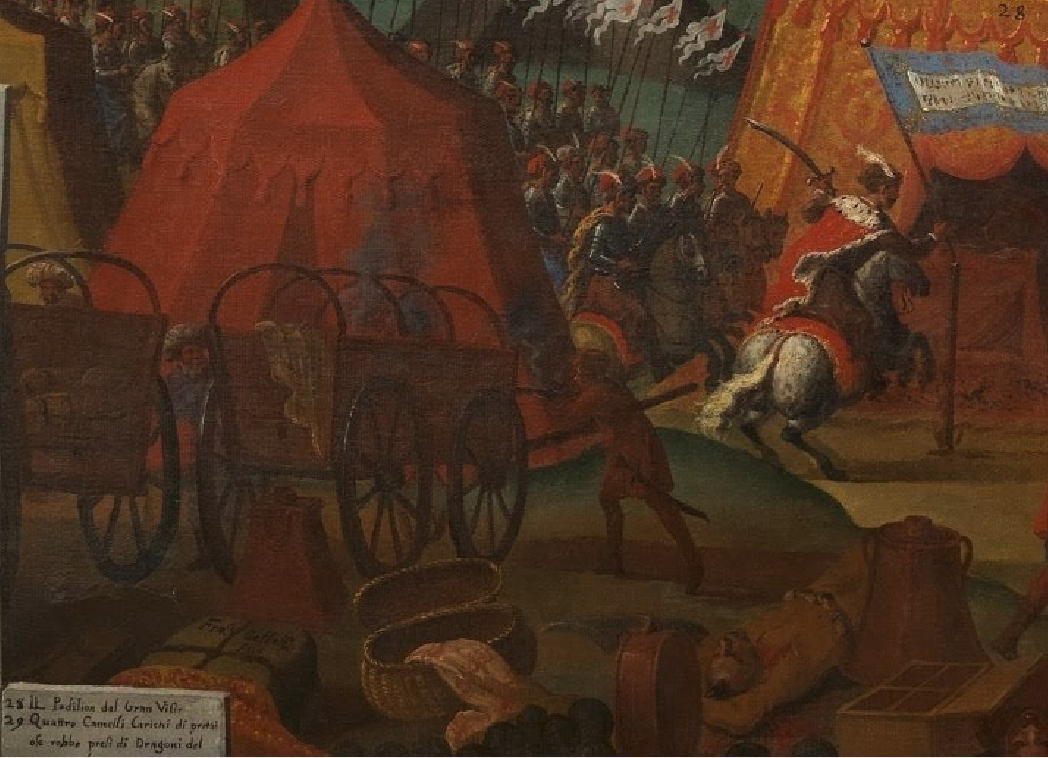
a detail of Turkish camp from a painting by Frans Geffels


So in his Dyariusz pan Mikolaj wrote that on the morning the battle about 9A.M.  the filed guard  brought three young men  to the King. 


So standing before victorious Jan III these three young men declared themselves valets of the Ottoman commander and Grand Vizier Kara Mustafa Pasha. They claimed they had been taken captive in Podole (Podolia) and Wolyn (Volhynia) Lands when very young. One was Pochojski, a Polish nobleman from Wolyn, where he had some land and brothers who would not disclaim his tale. The other two were named Skalka and Podolski, and could not account of any past nor noble connections being very small when kidnapped, so the court thought them to be some townsmen children when taken by the Tatars. 

They all arrived at the king's tent on horseback, each with a  retinue of  several Turkish and Greek servants. also mounted. They had fine Turkish  horses and each of them had huge amounts on money in their coffers - Pochojski 45,000 gold ducats, Skalka 42,000 gold ducats, hile Podolski 39,000 ducats. They claimed that when the battle was lots their lord, Grand Vizier yelled to his servants to grab everything and anything what they could. So they did, and being Christians they decided to return themselves to the Christian side.

They were dressed very richly and splendidly, the three 'amigos' wore beautifully made Ottoman coats of mail armor, with rich golden adornments with rubies precious stones mounted on them - here Dyakowski said that one of this chain-mail armors would end  in the treasury of castellan of Krakow [Adam] Sieniwski (according to the 1983 Dyairusz edition notes) . 

So on the spot the King decided to send them all, along with their millions in gold and jewelry, to Krakow so they could await his return in the safety of king's protection at the old capital.

So when our king Jan III returned to Krakow on Christmas Eve 1683, he asked his courtiers about the whereabouts of those three Grand Vizier valets. He was told that they were partying constantly, had themselves mistresses and were spending their money fast and furious. 

The king called them hultaje - or good-for-nothings and commented that nothing good would come out of that. And - wrote Dyakowski - our king  left them neglected, and they lost everything and eventually became quite  beggars and ended their lives in a misery and want.

So ends the tale of three amigos of Grand Vizier court. 


enjoy
Valete

Monday, September 12, 2022

Vienna 1683-2022

 Salvete Omnes,

today is yet another anniversary of the great battle of Vienna 1683AD
and to commemorate this momentous event a poster was produced by a Polish artist Tadeusz Rybkowski, professor in Lwow technical college, in 1883AD - then the 200th anniversary of the event.


more images - from 1690


and a print of a painting by a Polish painter  Jan Niepomucen Lewicki


another XIX century image


the images come  from this site. Polska Akademia Umiejetnosci- Gabinet Rycin.

Valete


Wednesday, September 12, 2018

Vienna 1683-2018


Salvete Omnes,
yesterday I did some reminiscing about the tragedy of 9-11 and the war that has been following  the attack ever since and that this war may last forever.

    Since the early morning, but 335 years ago, the Polish, Imperial and German states troops or the allied Christian army had been battling their way down to the plain where capital of Hapsburg empire was surrounded and had been besieged by the multiethnic Ottoman army under grand vizier Kara Mustafa.

     Islamic and Christian soldiers fought one another since the early morning, at first the infantries battling one another, but carried by their bravery and good soldiering slowly the Christian soldiers pushed their Muslim adversaries towards the Ottoman camps and thus opened way for the possibility of cavalry to charge.

It was already the afternoon and perhaps the final assault would have taken the next day,  since Jan III Sobieski had envisioned the final assault against the Ottoman lines, with the Polish cavalry leading the way, especially Polish lance-bearing cavalry, i.e. , the winged hussars armed with kopia ( perhaps 4.5-6meters long, hollowed and painted lance with equally swallow tail long pennon ).
Thus King Jan III was waiting for the moment when field was cleared for the lancer banners to probe the terrain and to attempt the charge. Sometime between 1600 and 1700 hours Jan III ordered one of his army winged hussar companies - prince Aleksander Sobieski - commanded by Zbigniew Zbierzchowski to charge the multitudes in front of the king-led right Polish Crown wing of the Christian army, this being the left wing of the Polish forces.

It was clear that Jan III wanted to know if such mounted  charge was feasible.

The 110-120 lancers and horses-strong company of heroes, in two kopia-bristling rows with red and white pennons flying, charged towards the direction of the commander-in-chief of the Ottoman army huge tent looming in the distance with many thousands of sipahi and otehr cavalrymen of the Ottoman main lines; in front of the charging winged hussars went, on his own volition, the court treasurer Andrzej Modrzewski armed and armored as a pancerni cavalryman.
Pan Modrzewski, galloping well in front of the charging banner, reached the Ottoman screening horsemen and soon was engaged by some brave Ottoman horsemen,  in short time he killed one or two with dzida and wounded some but nunc Hercules contra plures and he had been disabled with some well aimed cirit javelin and dzida blows and  died before the charging winged hussars were able to even reach join him in this uneven fight (his body was carried back to the Polish lines with his head intact as the cantering whinged hussars prevented the Ottoman cavalrymen from carrying away Modrzewski's head); having suffered  their first casualty the winged hussar banner went cantering forward and struck the Ottoman lines at a full gallop like a lightning, but was surrounded on its wings and eventually came to a standstill amidst the Ottoman units. Yet  with utmost difficulty they were able to disengage from their  Muslim foe and with some serious losses (12 companions and perhaps 25-30 retainers were killed ) the winged hussar banner was able to return  to the king proving the charge was possible.

During this charge on the left wing of the Polish Crown army, on the right wing of the Crown forces  another charge was made by a tactical cavalry  unit known as szwadron ( Castellan of Krakow Andrzej Potocki winged hussar banner with two pancerni banners- starost of Halicz Stanislaw Potocki and starost of Rzeczyca Jozef Sluszko - on its wings) led the starost of Halicz Stanislaw Potocki, this unit charged  on the right wing of the Polish army, soon seconded by the second szwadron under voivode of Krakow Szczesny Potocki (his own winged hussar banner and his own pancerni banner and another pancerni banner- Boguslaw Potocki's one). The charging cavalry suffered more losses in total than the lonely royal Sobieski banner and proved that the terrain was quite difficult on this wing of the Polish army.
Finally satisfied as to the possibility of all-out cavalry charge the commander-in-chief of the Christian allied armies and king of Polish-Lithuanian Commonwealth ordered all winged hussar and pancerni companies grouped into szwadron tactical units to charge the Muslim lines. The many thousands of riders of the allied cavalry companies followed in tow.
The rest is history...
Hail to the Victors!
Vae Victis!


..


Valete

Friday, August 31, 2018

The End of Dog Days - 335 years ago


Ottoman map of the siege of Vienna 1683
Salvete Omnes,
and here we have the last days of summer vacation before the kids go back to school after the Labor day weekend.
in less than 14 days we will celebrate the 335th anniversary of the battle of Vienna 1683.

I hope that for the 337-40th anniversary Polish film makers will come up with a decent and long memorable  feature film to entertain and at the same time to commemorate this important event in the Central European history. It could be a better monument to king Jan III Sobieski and his troops than the latest sculpture by mr. Dzwigaj.
 The paintings of the XVIII century painter August Querfurt may aptly illustrate the small war that was going on around the besieged Austrian provinces, while the main Ottoman army set up a city of tents and continued besieging the Imperial capital.


back then during the hot dog days of the summer the Tatar and Turkish riders were combing the Austrian countryside for the slaves to capture  and plunder to be had. The Austrians said that more than 50 thousand peoples lsot their lives or were captured during the summer invasion.


Polish army was still marching on towards the Imperial City of Vienna and the Saxon and Bavarian et al., allies of the Hamburgs were marching to join the Imperial army under Charles of Lorraine.
The Viennese defenders were suffering under the duress of the Ottoman guns and constant attacks by the Ottoman soldiers and miners. Summer dog days brought nothing but war, hunger and deprivations to the Austrian capital.
 The winged hussars and pancerni cavalry marching with the rest of the Polish army were still almost two weeks away from the slopes of Kahlenberg.
But the protestant Hungarian subjects of the Imperial Austria were rather supporting the Ottomans in this struggle, and their leader Imre Thokoly conducted his own war against the Imperial troops in upper Hungary.
Also other Ottoman vassals came to the huge camp at the plains of Vienna to show support to this latest Ottoman display of might and military exellence.


 They were all looking forward to see Kara Mustafa and his powerful army at the Austrian capital's gates taking the Imperial city.
...
Valete !

Tuesday, September 12, 2017

Vienna 1683


Jan III apotheosis by de Hooghe
Salvete omnes,
et voila! today we have a very important date for the Polish history aficionados and patriots, for it is September 12, and on this day His Royal Majesty winged hussars charged with their lances couched and won; hence today we celebrate the anniversary of the momentous charge and victorious battle that changed the course of the history.
if you are in Vienna, you could visit  the famous Belvedere where they have magnificent exhibit devoted to His Royal Majesty & our 'Sarmatian' king Jan III at and circa Vienna 1683 (open until All Saints Day or November 1, 2017).

His Royal Majesty, King of Crown of the Kingdom of Poland Jan III according to van der Muelen
This painting of the battle attached below, from the Museum Narodowe in Warsaw,  is most unusual for the high quality painterly quality and panoramic dimensions (55cm X 360cm) - I am afraid I do not have a better resolution image than the one provided by the museum. The researchers see the reality of the king's appearance as perhaps too idealized,  king Jan perhaps being too thin and too robust. 
unknown painter, National Gallery, Warsaw
Also I would like to bring to your attention this painting by Adam Frans van der Meulen who was the popular Louis XIV court painter.I have never seen it in this resolution.

Meulen pinxit, National Gallery, Warsaw
Some details of the wounded horse with a 'jarczak'(Tatar-style saddle) and fallen soldiers, one of them appears to have a maile-coat like the Polish pancerny cavalrymen:

Below interesting Italian print circa the battle time period - Giovanni Giacomo de Rossi etc.

you can also enjoy studying the plan of the Ottoman Turkish camp during the siege of Vienna, a period print. And the battle plan.
Vivat Jan III, vivat husaria, vivat allies, also especially the duke of Lorraine, and ... Pacem aeternam to the Fallen.
Map of the Polish-Lithuanian Commonwealth during King Jan's reign

enjoy
ps
and if you read Polish then do read Radoslaw Sikora's opus magnum about the Crown companies of winged hussars during this battle- Husaria pod Wiedniem 1683 [review].

Sunday, September 3, 2017

Husaria koronna ante Vienna 1683

Salve,
[in Polish]
warszawski badacz wojskowości staropolskiej (Uniwersytet Warszawski) mości Zbigniew Hundert popełnił był artykuł o organizacji husarii koronnej na kampanie wiedeńską AD 1683, opublikowany w pracy zbiorowej pt W hetmańskim trudzie. Praca Pamiątkowa na cześć prof Jana Wimmera (NapoleonV, Oświęcim 2017).
Autor sięgnął do archiwów i niewydanych źródeł rękopiśmiennych, i analizuje je, w swoim stylu i przy znacznej erudycji, zgrabnie a z sukcesem i ku radości zainteresowanego czytelnika, a przy okazji prowadzi głównie polemikę z ustaleniami Radosława Sikory na temat liczebności chorągwi husarskich pod Wiedniem - R. Sikora,Husaria pod Wiedniem 1683, Warszawa 2012.
Miedzy innymi w polemice z R. Sikorą autor wskazuje na błąd tłumaczenia tekstu łacińskiego w tekście pracy R. Sikory (strona 232) - choć przypisuje tenże błąd mości Sikorze a nie tłumaczowi (nota bene autorem tłumaczenia był Radosław Wolniak) - , gdzie przetłumaczono nazwę urzędnika koronnego  ensifer regni (miecznik koronny) jako chorąży koronny, którego nazwa łacińska jest jednak vexillifer regni. Jak widzimy, tłumaczenie precyzyjne jest zawsze kluczowe.
Artykuł można przeczytać na stronie badacza na academia.

      Co nas prowadzi dzisiaj do innego tekstu, albowiem  tenże sam wydawca, NapoleonV, wydał był przełomową anglojęzyczną pracę o husarii polskiej autorstwa Richard'a Brzezińskiego - Polish Winged Hussar 1576-1775 - pod polskim tytułem Husarz Polski 1575-1775.
Ucieszyłem się na wieść, że będzie wydanie tego bogato ilustrowanego dziełka po polsku, i li tylko bardzo ciekawił mnie poziom tłumaczenia, który u NapoleonV jest 'arcyróżny' -
bo np tłumaczenia mości Sławka Skowronka z rosyjskiego są świetne, a przetłumaczony De Brack'a traktat o forpocztach kawalerii lekkiej raczej żałosny!! - co do jakości tłumaczeń, to zdaje się, że forum historycy.org ma sekcję o wydawnictwie i jego pozycjach, w tym o jakości tłumaczeń.

Czytam sobie w dół i górę tę jedną stronę tekstu, która udostępnił NapoleonV, i muszę powiedzieć, że nie jest to adekwatne tłumaczenie książki imć Brzezinskiego, przynajmniej na tej stronie którą czytam.

Wielka szkoda.. bo ta praca, choć wiekowa (od tego czasu nasi historycy poszli mocno do przodu), była przełomową i pierwszą tak dokładną praca o husarii polskiej w języku angielskim (artykuł mości Zygulskiego jr był zbyt krótki żeby można było porównać te dwie prace)
Ergo, szacunek dla tego Osprey'owego dziełka i dla autora mam wielki, choć wiadomo, są tam błędy i 'błędziki', ale nemo propheta en causa sua.

ergo, exempla (oryginalny tekst angielski i tłumaczenie polskie):

'close fire support' to nie jest 'częste wsparcie ogniowe'!
'nags' to nie są 'kucyki' !
"double-mounted behind the hussars'' to nie jest 'na oklep wraz z husarzami'.
'pommel' to nie jest łęk[sic], [ale łęk przedni siodla].
'absorbing some of the enemy fire in process' to nie jest 'absorbujący szyki przeciwnika ogniem prowadzonym'...
I zresztą to cale zdanie o pancernych jest nieodpowiednim tłumaczeniem tego akapitu - załączam oryginalny tekst angielski (choć kompozytowy, bo wydawca polski zmienił był nieco układ książki) można sobie przejrzeć i porównać etc (prawa autorskie @wydawców et autorów).

Także cytat z Montecuccoli'ego jest przekręcony, nie będę tu go całego cytował - i zamiast tłumaczyć to co pisze don Raimondo to tłumacz opisał jego własne 'odczucie' na temat tego co zapisał o szarży chorągwi husarskiej Montecuccoli.
Tego 'kreatywnego' 'tłumaczenia' jest dużo więcej na tej tylko stronie, włos się jeży na głowie na myśl co tam jeszcze wymyślił pan tłumacz z edytorami ( zdaje się, że imć Z. Hundert był także edytorem/konsultantem tutaj, co podał na swej stronie fejsbukowej Michał Kadrinazi) -
A przy okazji, jak się wczytać de novo w tekst oryginalny, to widać teraz jakże niedoskonałym znawcą jazdy konnej, ataku kawaleryjskiego na białą broń zwanego szarża, możliwości koni i wyszkolonych jeźdźców-kopijnikow en general był sam autor mości Brzezinski - tutaj nie ujmując całości dzieła.

Wiadomo, można używać jedne słowa i wyrażenia w tłumaczeniach zamiast innych, ale trzeba jednak oddać najwierniej to co się czyta w oryginale  (coś tam wiem o tłumaczeniu - :) )
szkoda, panie i panowie, szkoda wielka...

- and a little sketch to go with it - :)
 
enjoy...