Showing posts with label Western European cavalry. Show all posts

Saturday, January 7, 2017

Claude Deruet

salve,
2017 - hee ha!
let us start with this particular colorful horse (stallion) and his rider from the past - French painter Claude Deruet painted this noble cavalier astride his fine powerful parade horse. (image from WikiGallery).  Note the collection of the horse and ease of the rider, showing a fine ecuyer.
As in all Baroque horse, this one is not very tall, but has a powerful conformation, with long tail adorned with tassels etc. The mane is brushed and swept on the left side, with some of it visible between the forelegs.
He is ridden with a curb-bit, long stirrups and fine, exquisite Baroque saddle.
we can see the horse shoes clearly.
more paintings by Deruet


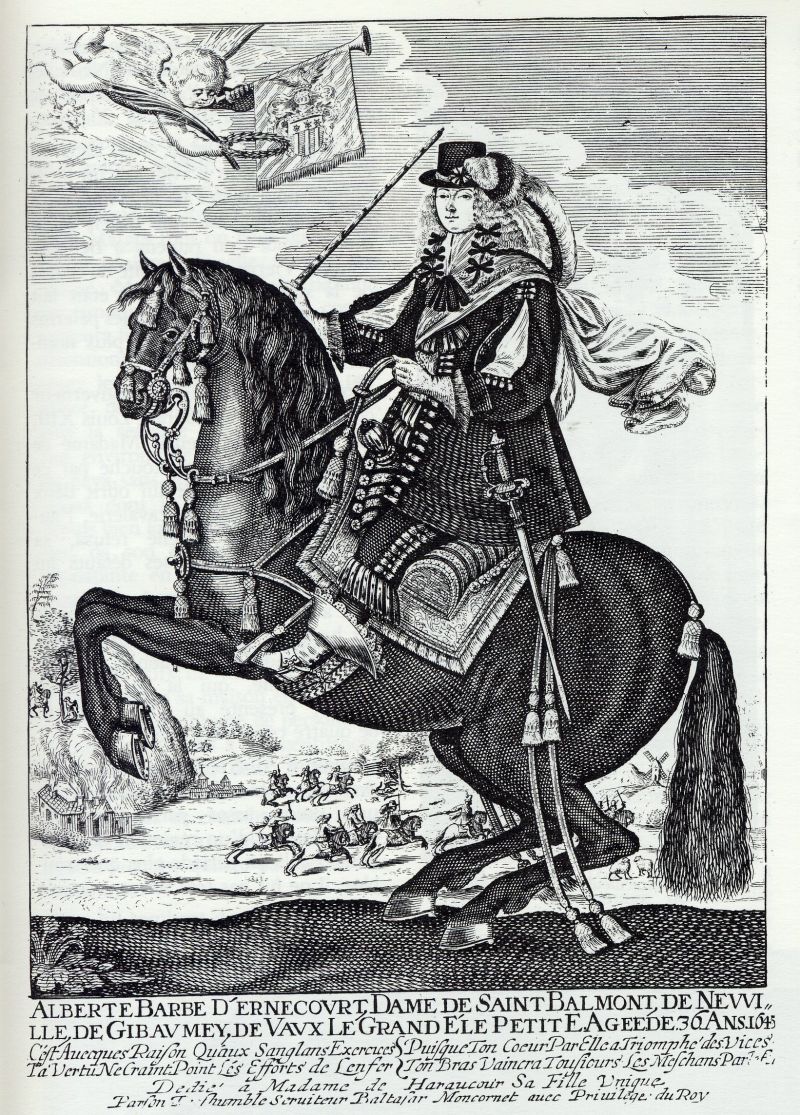
also a very spirited couple (horse and rider) in this print after one of the Deruet's paintings. It shows a famous Lorraine heroine of the 30 Years War - Dame de Saint-Baslemont.

enjoy

Tuesday, October 30, 2012

Abraham de Bruyn's western European lancers

Salve,
 I would like to begin by wishing good luck to my friends and family on the East Coast of the US, as the hurricane Sandy  landed there last night.

Going back to Abraham de Bruyn and his prints, today a set showing armoured lancers of the Western Europe:
..
 Tournament harness

.. another fully armoured lancer


..
 Italian lancer

.


.


.. French lancer

.. Netherlands' (Low Countries) lancer


..German standard bearer

..
Interestingly de Bruyn shows no Spanish heavy lancer but only two bullfighting horsemen  riding à 'la gineta' style and a herreruelo or a pistol-and-arquebus (wheel-lock) armed cavalryman. Also he shows a Belgian armoured commander of cavalry that fought for the Spanish in the war in Flanders.
 a la gineta


Spanish herreruelo


eques Belga


and finally a drummer, as no cavalry could have been without music

..

Monday, April 16, 2012

Hungarian saddle continued - Jean Roemer

Salve,
with archive.org and google books I found more information on the Hungarian saddle, topic already started here. This time is comes from a book by a former Duch cavalryman Jean Roemer (here some recollections on the professor Roemer from the faculty of the City University - New York), who wrote his interesting work (almost mid XIX century) titled:
Cavalry: its History, Management, and Uses in War
 Let us start with a depiction of the cavalryman and his mount versus the saddle:
''....the cavalry soldier places everything needed for himself and horse upon the saddle ; not because the weight thus becomes lighter for the horse, but because distributed on a larger surface, and snugly stowed away, it is easier for him to bear, and leaves his rider a freer use of his arms in combat. The requisites of a good saddle are the greatest lightness combined with the greatest solidity, a perfect fit to the horse's back, a firm and easy seat for the rider, and proper accommodation for the equipments, so as to allow their equal distribution in respect both of bulk and weight. The great fault in military saddles is their excessive weight and bulkiness, which imperfections are not always redeemed by a corresponding solidity. The number of horses rendered useless by sore backs tells fearfully against their construction, while bad riding also is too often owing to the clumsy seat, which in many cases allows the man to stick to his horse, not by means of his saddle, but in spite of it. Now, if the rider cannot keep a steady seat, he will certainly wound his horse, however well the saddle may fit. A bad seat is, therefore, a second cause of that bane of cavalry, sore backs, which, again, are not seldom occasioned by an injudicious method, or, what is worse, a want of method, in packing the effects upon the saddle.''
The light cavalry Hungarian saddle, with a drawing:
 
"The saddle most in use among the light cavalry of Europe, is the Hungarian tree, whose general introduction may be accounted for by the numerous hussar regiments which at one time were gotten up everywhere in Hungarian fashion; and we regret to say that most of its original merit has been lost, owing to the gradual changes successively introduced with a view to improvement. The Austrians and Russians, however, have departed less than any other nation from its earliest form, and the saddle now in use among them, and represented in [drawing above], is thus described by General McClellan: "It is of hard wood, entirely uncovered, and consists of the bars c, the front fork a, the rear fork b, and the saddle seat or strainingstrap d. The ends of the forks e, e, are let into mortises in the bars, and secured by raw-hide thongs passing through mortises p, p. The saddle seat, or straining leather, is a stout strap of leather from 11" to 13" inches long, 4" inches broad at the hind fork, 3" to 4 in the middle, and 2" to 3 at the front fork. It is secured to the front fork by four flat-headed nails, a strip of leather being first laid over the end of the strap, as seen at f." 
 
"As the greatest strain comes upon its junction with the hind fork, it is secured to it differently. At each angle of the strap a stout thong is left when cutting it out; this thong is passed around the neck of the fork, and secured by a nail in rear; five flat-headed nails are then driven through the strap into the fork; under the head of each nail a round piece of leather is placed to prevent the strap from being cut or worn; f shows this arrangement. The strap is attached to the bars by rawhide thongs, as shown in the figure. The forks are strengthened by light iron plates nailed to front of the front fork and rear of the hind fork. The girth is attached to the bars by thongs passing through the holes g. The stirrup leathers pass through the mortises h, and in the notch m, a groove being cut in the under surface of the bar to receive the leather. The holes i, are for the purpose of attaching the straps which secure the holsters; those at k, for attaching the crupper. Near the upper end of each fork is a mortise; that in the front fork to receive the cloak strap that in the rear fork to receive the valise strap. The girth is of leather, 3" inches broad, and fastened by a large buckle on the left side."
 
Allegedly saddles were used without any saddle pad in Hungary by the peasants (as stated by Roemer in the following fragment), and curiously he makes no mention about the Hungarian 'cowboy' or  the 'csikos'* (Roemer was on the Marshall Radetzky staff in the late 1830s/early 1840s, before the Hungarian revolution of 1848, yet perhaps shared his commander's dislike towards the Hungarian patriots, being himself really without a country) - and here we have an image from 1846 that clearly shows that there is a saddle pad under the clearly Hungarian saddle of this puszta csikos:

''In Hungary the peasants use this wooden saddle on the bare backs of their horses, and in the French service they have made experiments to the same effect. As long as the horses kept up their condition, it was found to answer very well, but on long marches and in difficult country, when the horses fell off in flesh, they were invariably wounded by the contact of the wooden edges with the bare ribs.''
I should add that the csikos rode horses often bareback and were famous for the Hungarian post - 5 or more harnessed horses driven with the 'driver/rider' standing on the last pair of horses and driving them all- (Hungarian version of Roman riding) (here is Hungarian or here Roman riding- examples)
 Then he goes to add that,  outside the French army, all use some padding under the saddle tree

''For all these reasons, the Hungarian saddle is still everywhere used with some medium between it and the horse's back, generally a blanket, folded in twelve or sixteen thicknesses, or better, as the Russians have it, placed on a tablecloth of stout felt, four layers thick, which number is increased or diminished according to the condition of the horse. On the march, the seat is usually covered with some article of clothing, and the whole with a shabrack of heavy cloth and a lamb's skin with the wool outside. This saddle recommends itself by its cheapness and lightness, and is also solid enough, provided it be made on correct principles and of good materials; otherwise, as may be easily conceived, the working of the wood and the stretching of the leather parts, especially the thongs, greatly disturb the seat of the rider.''

Here, more info for the Hungarian readers and those who want to see some images from Hungary showing horse tack, including the saddle and bridle, and clothes/costumes.
 ...
 * I plan to do a little entry on the 'csikos' based on the XIX century literary depictions - some quite Romantic - :). and one day on the XVII-XVIII centuries Hungarian hussars ...

Thursday, July 14, 2011

Gaspard de Saunier - l'ecuyer and author of L'Art de la cavalerie


Salve,
I have been perusing the google books search for the XIX century and earlier books and voila! old book on the art of horsemanship is available for reading and download (at least in US & Canada).
The author of this XVIII century 'hornbook' for riders is Monsieur Gaspar de Saunier (1663-1748), one of the many master of equitation that France produced during XVI-XX centuries. He was a soldiers, horse stud manager, master horseman (ecuyer) and a gentleman - having to defend his honor in a duel killing the opponent, emigrant in Netherlands, and horse school master .
His book -  L'Art de la cavalerie was not translated into English, hence he is not as popular as François Robichon de La Guérinière, le petit ecuyer of l'ecole de Tuileries (the 1st or le grand ecuyer of France was prince Charles de Lorraine, comte d’Armagnac), whose fabulous book 'École de cavalerie' was  beautifully illustrated by French court painter Parrocel. Both authors' works became some of the  most important 'ecole de manege' treatises until mid XIX century when another Frenchman's book appeared.
There are some English sites that talk a bit about de Saunier eg voltes quotes of de Saunier  this is very interesting site of Thomas Ritter, a quote from the site ''His seat closely resembles De La Guérinière's. He was familiar with the shoulder-in, the invention of which is usually attributed to De La Guérinière or to his teacher, M. de Vendeuil, who had the same teachers as Gaspard de Saunier'')
a blog by mr Ritter ,
Some engravings from his book(I am not sure who the artist was, but the top image shows that while already in XVIII century the French riding masters did not abandon a lance when training in the manege), and I must add that I myself appreciate them a lot, since I have been training myself and a barn-sour mare for last 4 weeks, from the ground work up to the hackamore and sitrrupless riding, and these images of riders show some hearty and telling suggestions.
1.here we have two images of cavesson (kawecan in Polish) amongst tje samples of various parts of snaffle, curbbit etc


2.here we have curbbits, a bridle with reins and manner of holding them, a whip (in old good steppe fashion) etc

3. various curb bit shanks


4.


5.

6. the last description states - A posture of a cavalier who begins his learning and who is without spurs and stirrups.
Here are some French cavalry images of the period:


ps
I hope to read this book with a strong help from my dictionaries :)

Friday, January 28, 2011

Training horses for war XVI century

Salve,
a quick but very telling image that speaks for itself

training horses for war during the Renaissance, when firearms became part of regular warfare, forcing riders to train their horses  against the equine's natural instincts to run away from fire, smoke, and loud and sudden noise.
ps
 my sketch of late XVI century reiter -with GIMP and Mypaint

Thursday, December 23, 2010

A little sketch with a new software

Salve,
 I've got this new painting program - Sketchbook Pro 2011 (merci Maarcin for pointing it to me  -:) ) and decided to draw this sketch, this is quasi-Swedish/German cavalryman (been reading about these pesky Swedish, Finnish, Latvia and German horsemen-enemies of the Polish horsemen during the Deluge, they were quite great warriors and riders in their own right) .
As I am looking at this 'digital painting' I am thinking that perhaps he will need his horse or a saddle at least at his feet when he is done - :)
1 more day to Christmas or as we call it - Świąt  et Wigilii