Showing posts with label Ottoman Arabia. Show all posts

Wednesday, April 11, 2018

Waclaw Rzewuski - sketches III

Rzewuski pinxit


Salvete Omnes,
Waclaw Rzewuski sketches from Arabia continued, from his manuscripts at the Polish National Library -
Bedouin with a falcon
a scene from Cilicia or Cukurova, a Kurd with his horse on the left, Turks on a hunt

falconry from Lebanon
Black camel  -  the Bedouin family

Valete!
ps
very interesting site about the Manchu archery

Wednesday, April 4, 2018

Waclaw Rzewuski - sketches II


Salvete omnes,
let's keep looking at emir Rzewuski's manuscripts:
 Bedouin family

Arabian horse saddled in a Mameluke manner
Rzewuski pinxit

a favorite horse of 'Mehmed aly Mirza'*
 
Rzewuski pinxit
 A Kurdish horseman and a Turkoman
Rzewuski pinxit

Valete
*original spelling by Waclaw Rzewuski

Tuesday, April 3, 2018

Waclaw Rzewuski - sketches I

Salvete Omnes,
emir Waclaw Rzewuski and his manuscripts - hopefully soon will be published for all to enjoy -
Meantime, some sketches from these manuscripts - 3 volumes, including two self-depictions in two different costumes
emir Taj al-Fahr Abd al-Niszan as a Bedouin - Rzewuski pinxit

emir Taj al-Fahr Abd al-Niszan as a prince of the Mountain Druze - Rzewuski pinxit


small camp -Rzewuski pinxit


Rzewuski pinxit -Bedouins traveling

stallion - Rzewuski pinxit

Rzewuski pinxit - little caravan

Rzewuski pinxit - Hajj - detail of a larger camp scene


Valete!

Thursday, August 15, 2013

Moryson's bits and pieces on travel in XVII century part II


Salve,
today is the great  national holiday for all Poles around the globe - anniversary of the battle of Warsaw 1920

..

Returning to the stories of travel told by our master Fynes Moryson here we have one about traveling in Turkey, note cantering horses, no ambling and trotting etc :

.
Turkey. * [edited some of the spelling a wee little bit] -

In the Turkish Empire [Ottoman Empire] they travel not, as we do, sometimes one man alone, sometimes two, three, or more consorts, at pleasure ; but as thieves there go in troops to spoil, so Merchants for their security, join together till they have some two or three hundred Cammels, loaded with goods, and a convenient number of men to attend them. And this Company is called vulgarly a Carravane. to which passengers join themselves, for their better safety. This Company, to avoid the heat of the Sun, useth to begin their journey in the evening, and to continue the same till two hours after Sun-rise, resting all the day in Tents : And every man carries his own meat, or provides it by the way. ''Malem'' signifies one, that leades Merchants goods ; and ''Muccaro'' signifies him that looks to the beasts, and to the loading of them, and these Men let Cammels, Horses, and Mules, to passengers, for the whole journey, at reasonable rates, and do wait upon the passengers to feed the beasts, and to load them, as also to buy and dress meate for the Men. Myself and my Brother Henry, in our journey from Tripoli in Syria to Haleppo [Aleppo], paid nine Pyastri for two Asses to ride upon, and for their meat [foodstuffs and fodder] and for some tributes (vulgarly Cafars [infidels]) of twenty Meidines or there-abouts, due by the way. And in our journey from Haleppo to Constantinople, we paid to our Muccaro bearing the charge of the beasts meat, seventy and one Pyastri, for a Horse and a Mule to ride upon, and for a Cammel to carry our provisions, of Bisket, Wine, Damaske Prunes, and some such comfortable things : For we pitched our Tents near Villages or Cities, from whence we bought Egges, Hennes [pultry], and Ryce, as wee needed them, and sometimes had opportunity to supply that which we had consumed, of those provisions which we carried with us. One Cammel will bear a passenger, and good store of necessary provisions with him, but the pace thereof is very harde, and shaketh the body of the Ryder, the hinder parts of the Cammel being higher then the fore parts. The Horses either go a foot-pace, or gallop, but are not taught the paces of ambling or trotting : yet in regard that in these journies the passenger goes slowly, following loaded Cammels, their Horses are easy enough to ride upon. The Mules naturally have easy and slow paces, and are most commodious, especially for sick men. 


Besides these Caravans, a passenger may light upon other commodities of taking his journey, namely, when Bashaes or Turkish Governours are recalled from their Governements, and return with their families to Constantinople. For these Magistrates are often changed in Turkey, and so these commodities of passage are frequent. Only the passenger must bee commended to the protection of this Basha or Governour, which upon a small present or gift he will easily undertake, and swear by his head, touching it (as their manner is to swear), that he will bring him safely to his journyes end. And the passenger who together with this caution, hath a Janizare to protect and guide him, shall need to fear no danger, so as he receive this Janizare from an Ambassadour, Consull, or Christian Merchant, who will ask account of the passengers safety from the Janizare at his return. 


They have a third commodious way for journeys, in the company of a Troop of Horse,

vulgarly called ''Cassenda''), which often carries the Turkes Treasure up to Constantinople. And not only the chief of this Troop, upon a small gift, will protect any passenger, but also this course of all others is most commodious for journies, because they ride a good pace, being not troubled with loaded Cammels, and so come speedily unto their journies end.


..
* images from Wikipedia  Orientalist painters page and by Josef Brandt. In my previous post on Ottoman Turks I included various period images, including images of travelers etc, so do explore.

Saturday, December 1, 2012

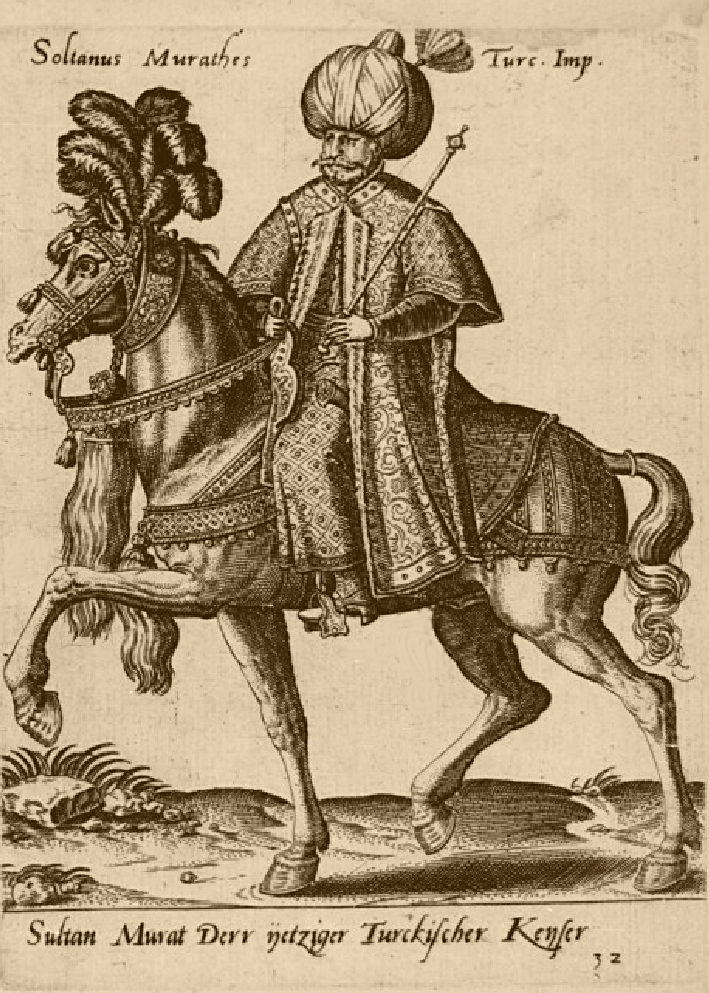
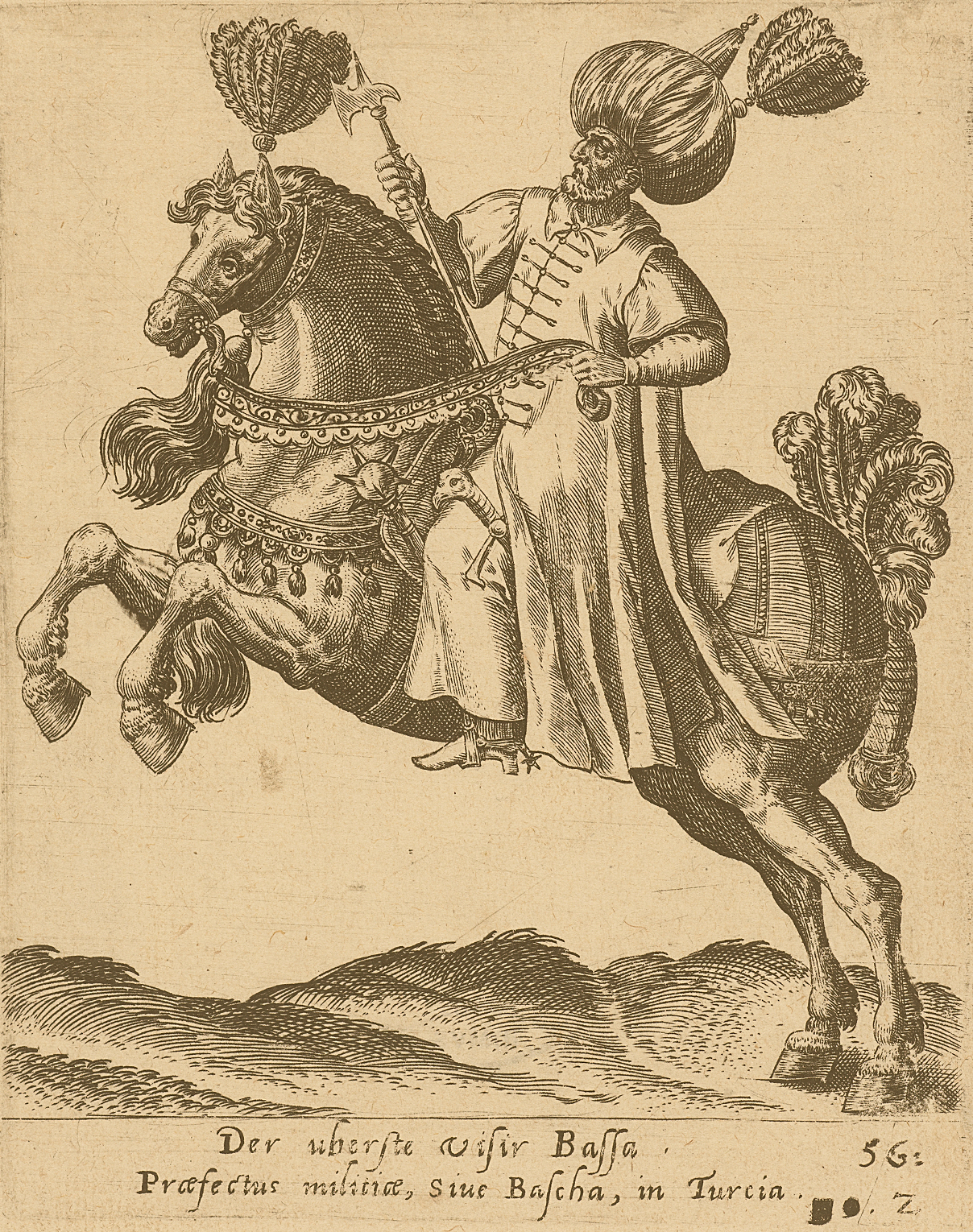
Ottoman horsemen in de Bruyn's album

Salve,
finally we have come to see the Ottoman horsemen in Abrahm de Bruyn's art.

the sultan Murad III

Vizier pasha

Aga

..

..

..sipahi

.. delil

..

..

..

..

..


vassals:
Wallachians

Tatars


and enemies of Ottomans, the Persians:

..

..

finis

Tuesday, March 1, 2011

XVI century pilgrims going to Jerusalem - German woodcut I


Salve,
yesterday I presented this whole woodcut and today, as promissed, some more thoughts on the lance-armed riders of this German woodcut.

From what we can see they are armed with long lances – perhaps 2,5-3,5 meters long, in tradition of Syria, Palestine and Egypt made out of bamboo, adorned with some horse hair or cotton at the lance point.
We do not see if they carry swords (mode of sword arrangement and kind of sword -straight or curved, could have told us more about these riders) , and they do not carry bows and quivers set, in a Bedouin fashion.
The carry round shields, either slung from the shoulder or in hand, similar shields appear in drawings by Carpaccio. They were most likely wicker-silk construction, a metal Iranian Safavid make or perhaps a metal heirlooms of the not-so-distant Mamluk era.

They seem to have two styles of ridding, the closer rider rides with long stirrups and the second with a short stirrups . The both use very long shanked curb-bits (perhaps after the German fashionable imports) on their steeds and single set of reins, but I drew my sketch with a martingale or perhaps a third rein known as a jaquima (hackamore) after a Mamluk horseman in Reception of Venetian ambassadors in Damascus (school of Bellini, 1489-96). Sipahi horses have no tug or horse tail hanging from the bridle, similar to the Mamluk horsemen drawn by Carpaccio.
Both horses are caparisoned and their shabraque is fringed on one side. We see no saddles, but they were most likely the high pommel and cantle saddles of the Mamluk-Turkish make.
Their horses appear to be some sort of Arabian or South-eastern Asian horse (eg in XIV-XVI centuries the Mamluks imported their best horses from India), rather small but spirited demonstrated by the second horse prancing. They are well 'dressed' (via French Dresseur) and proud mounts, ridden with light hand, probably neck-reined. We do not know whether these are stallions/ geldings or mares, but contemporary Turks rode stallions and geldings , while Arab Bedouins rode also mares.

The riders are dressed in more fluid Arab style of clothing – long robe with wide sleeves or galabiyeh/djelaba, loose kameez? shirt underneath, pants, sleepers for footwear, and turbans, perhaps covering their helmets.
Until the next time, my friends..
ps
I used several publications by dr David Nicolle to write this little entry, my 'best friend' when comes to Medieval and Early Modern Islamic warrior dress and appearance

Monday, February 28, 2011

XVI century pilgrims going to Jerusalem - German woodcut


salve,
this time a German woodcut from the second half of XVI century shows a caravan - consisting of a group of Christian pilgrims, riding mules, with an escort made out of 2 Arab Ottoman sipahis and infantry Arab archers along with a mule, camel and donkey train etc.
In my humble opinion this is another very interesting iconographic material related to Ottoman empire, its ethnically diverse warriors and their equestrian traditions, as well as peaceful interactions between the Muslims and Christians, when the latter traveled on a pilgrimage to the Holy Land.
In my next post I will expand a bit on the cavalrymen and their mounts (appearing to be an Arabian horse type) in this woodcut.

Monday, February 21, 2011

Ottoman Turkish Spahis - German woodcut of XVI century


Salve,
Scouting the net and libraries I found this little woodcut done sometimes during the second half of XVI century, showing the Ottoman Spahis aka Sipahi mounted on a caparisoned steed and a priest (imam) on a mule. There are quite a few images of religious men riding mules as they were much more seemly mounts for the clergy, I suppose.

   Our knight is rather dressed for outing on the caravan trail and not expressly for war - notwithstanding his bow and arrows, his noble and ancestral steppe prerogative - and he might be mounted on his parade gelding or stallion (being an owner of an estate he owned a few good gelding and stallions, fillies, colts, mules, donkeys and broodmares), bitted with a long-shanked curb-bit and a tide-down or martingale (but curiously on bridle without a noseband - an error of the printmaker?).

   I daresay this splendid little beauty is a pacing horse and might be  actually doing a Turkish version of a Spanish walk.
...