Showing posts with label konik polski. Show all posts

Saturday, December 10, 2022

Polish peasant horse in Aleksander Kotsis paintings

 Salvete Omnes,


finally a little entry about Aleksander Kotsis (1836-77), citizen of then town of Podgorze (complicated story of Krakow and towns and villages in the vicinity during 1795-1914- nowadays a district of Krakow) who was of mixed Polish and Slovak heritage, his father Jan perhaps of the Slovak ancestry from Lewocza/Levoca in Spis while his mother came from  village of  Ludwinow  , now part of Krakow, and was of a peasant origin.
Kotsis was one the XIX century growing community of Polish masters of brush and paint, pen and ink, and charcoal. This artist grew up, lived and worked mostly in Little Poland, while doing academic and artistic studies at  Krakow Academy of Fine Arts  and at  Vienna's k.k. vereinigten Akademie der bildenden Künste (Imperial and Royal Unified Academy of Fine Arts). 

Luszczykiewicz' gorals or highlanders


While in Krakow  he  studied under two influential  professors   Władysław Łuszczkiewicz & Wojciech Stattler, 


friends of Artur Grottger, including Kotsis and Matejko Ad 1865, Krakow

  Among his fellow students there were many great artists-in-training, like  Jan Matejko and Artur Grottger to name a few.


 He was forced to stop working in 1875 and  died prematurely in 1877.


Kotsis painted lots of country and farm characters, including the gorals aka Highlanders and other Carpathians Mountains  mountaineers.
Became a painter of Polish peasants and their lives in the second half of the XIX century.  And the peasant farmer and highlander used faithful koniks and Hucul horses in their work, draft and in other transposition needs and pleasures, including riding.


in the picture below there is a Gypsy family with a captive bear.


here we have a typical sturdy konik, the workhorse of the Polish peasantry of those past centuries

noble horses in this canvass - horse market

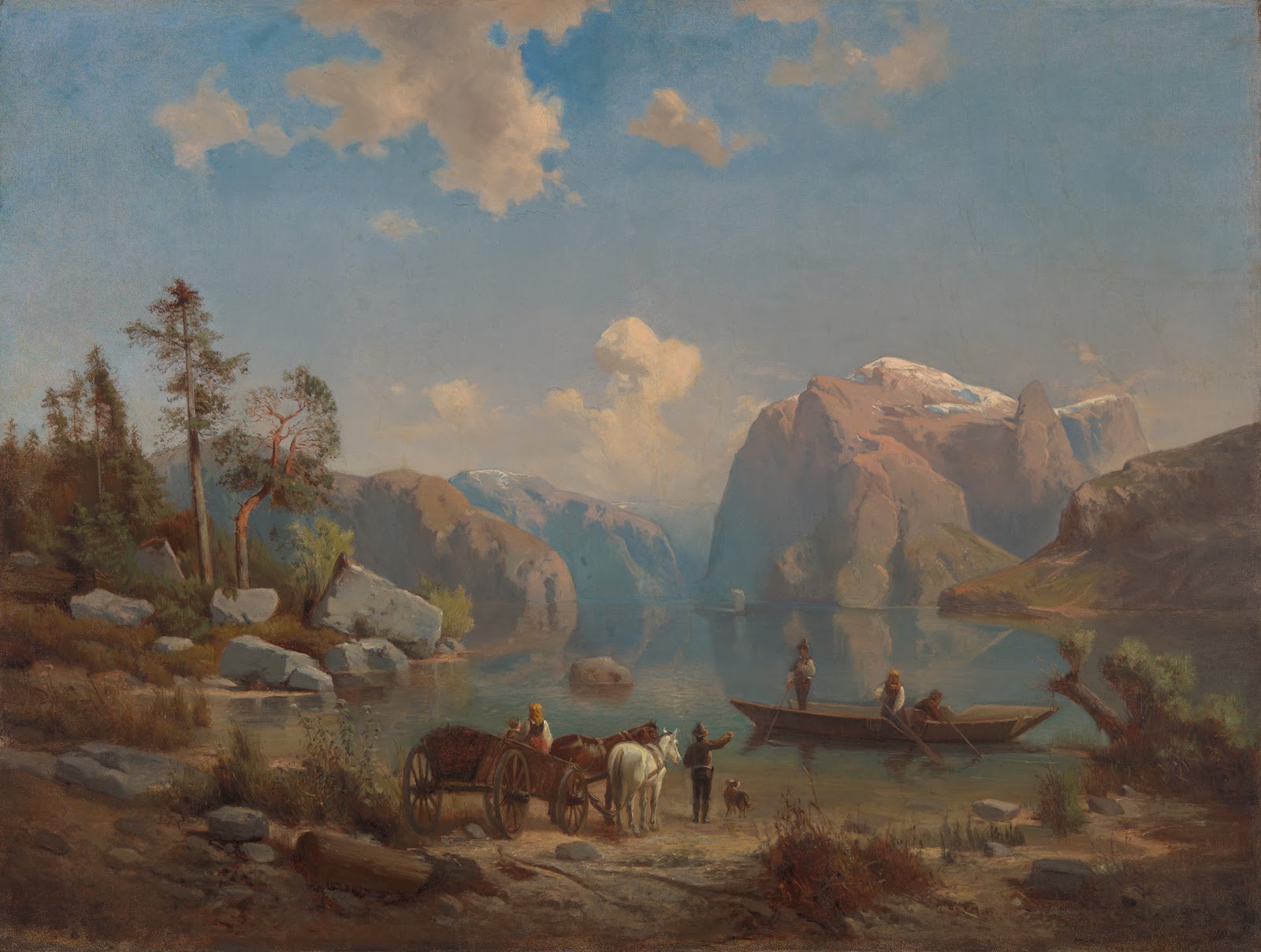
Kotsis traveled across Europe, including the Alps,hence this alpine looking canvas

Cracovian farmer and a Jewish trader


Valete

Sunday, May 1, 2022

Horses at the pasture - Ajdukiewicz

 Salvete Omnes,

Let the peace return to Ukraine - Stop War!

...

 May has begun - it is a lovely time to be living in all that greenery, unless some pollen allergies are clogging your good spirits. Go 'Keto' and forget about the allergies.
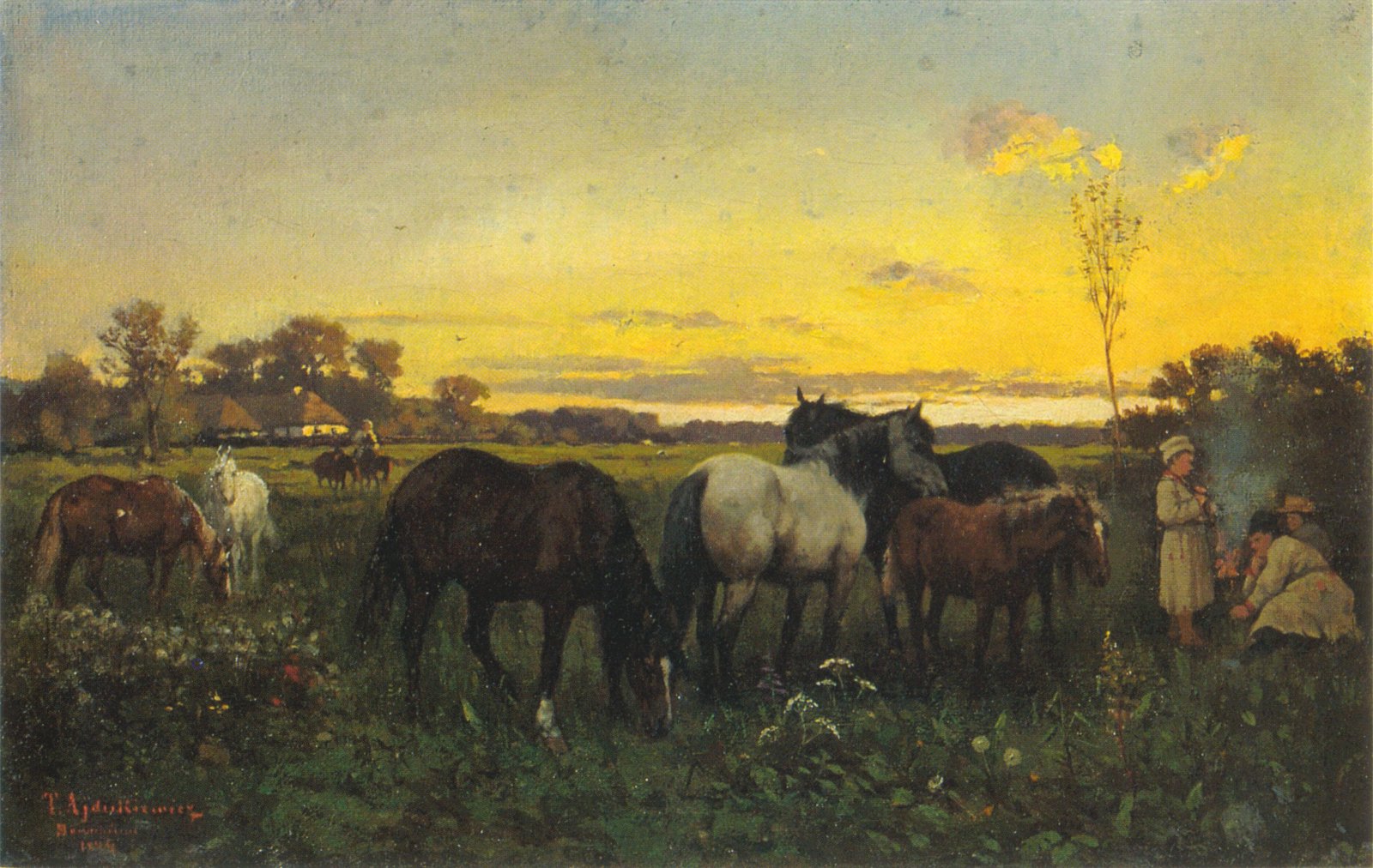
so for a good start of this brand new month - a painting  by Tadeusz Ajdukiewicz, Horses in the Pasture painted in the 1870s, and at the present can be found in the Polish painting collection of Borys Voznytskyi Lviv National Art Gallery at Lviv(Lwow), Ukraine.

Not a disloyal subject of the Hapsburg kaiser Franz Josef's empire,  our maestro  Tadeusz Ajdukiewicz (1852-1916) was born in Wieliczka, where the wondrous salt mines still exist, and in his early years had a wide variety of teachers, from Krakow Academy to Jozef Brandt in his Munich atelier to French Paris masters of the late 1870s. He was very popular as the painter of horses and especially of equestrian portraits. The canvas  in question was painted early in his career when he was still very young. In 1877 he  made a trip, with count Wladyslaw Branicki to the Middle East and also to London, where he painted a portrait of then Prince of Wales.
When World War I erupted in 1914,  rather elderly but patriotic maestro Ajdukiewicz joined the Polish Legions, sub-command within the Austro-Hungarian Imperial army, and during the 1916 campaign his health gave way, he got pneumonia and succumbed to it in one of the Krakow's hospitals. He was buried there and his tombstone is located at the Rakowicki Cemetery. He had a first cousin  named Zygmunt Ajdukiewicz, who was a very successful painter in Vienna prior to World War I.


The painting appears to show a later part of the Spring, or perhaps early Summer. The grazing horses in this painting are of the peasant type, sturdy 'konik polski' type, and they are being watched over by the boys, the time immemorial in the Indoeuropean history of horse husbandry (ten copied by the ancient Turkish herdsmen and repeated in the Americans among the native boys).

Valete

Sunday, February 20, 2022

Estonian Native Horse and genetics

 Salvete Omnes,

while perusing academia.edu subscriptions and searching for the Birka warriors etc I came across Gus Cothran's page on academia. 
I guess I started my adventure with horse genomics by reading prof. Cothran's articles etc.
So in his(and esteemed colleagues)  2019AD article -  Population Genetic Analysis of the Estonian Native Horse Suggests Diverse and Distinct Genetics, Ancient Origin and Contribution from Unique Patrilines- (link) we have a study of the Estonian Native Horse -    University of Oklahoma livestock and breeds page - wiki page, breeders pages. 


The horse averages 147cm at withers and about 430kg in weight (I guess the stallions). Its gene pool includes Mongolian horse and the Yakutian; Scandinavian horses like Gotland Pony, Norvegian Fjord, and Islandic Pony; British Isles horses - Exmoor and Shetland,  Polish Konik and Carpathian Hucul... 


This small horse might have been part of the horses' pool used by the Polish-Lithuanian Commonwealth armies as between 1569-1629 Duchy of Livonia was part of our Polish state. Also, it is reasonable to infer that some Polish stallions left their progeny among the herds of the Estonian horse during that period.  After 1620s the Duchy of Livonia was conquered and annexed by the Swedes who already held the northern part of Estonia. It all ended with Peter the Great of Imperial Russia conquering all of Estonia during the Great Northern War. And Estonian horse became popular in Imperial Russia.. and so on until the present it is the native breed in the independent Estonia. 


Valete

Tuesday, May 26, 2020

Konik Polski, dr Skorkowski - Jezdziec i Hodowca

Salvete Omnes,
[in Polish]
dzisiaj głos słynnego hipologa w temacie konika polskiego z lat 1930, zanim polska hodowle koni zniszczyli Niemcy i Sowieci.

Przypomnijmy dr Edward Skorkowskiego (1899-1985), hipolog i specjalista hodowli koni arabskich, sekretarz Towarzystwa Hodowli Konia Arabskiego w Polsce,
autor wielu publikacji naukowych i hodowlanych,a wiekopomne są 'Tablice Genealogicznych Polskich Koni Arabskich Czystej Krwi (1938, wydanie drugie w 1960 roku), czy wydana w 1927 roku praca 'Kon arabski w Polsce - rys historyczno-biometryczny'. (przypomnijmy, ze po 19121 roku stan polskiej hodowli koni był opłakany, a hodowli konia arabskiego wprost tragiczny, bo 90 % stad zostało zniszczonych działaniami wojennymi i rabunkiem - zniknęły stada w Sławucie, Jezupolu, Taurowie, Zarzeczu czy stado Białocerkiewskie. (więcej na temat u Witold Pruskiego, Dwa Wieki Hodowli Koni Arabskich w Polsce)

 Redaktor  'Polska księga stadna koni arabskich (I tom 1926)',
 'Polska Księga Stadna Konia Arabskiego Czystej Krwi' (I tom w 1932, II tom w 1938 roku) .
Po 1945 roku inspektor stadnin państwowych, autor spisu strat polskiej hodowli konia arabskiego ( ze 143 matek w 1939 ocalało zaledwie 59) w wyniku II wojny światowej, redaktora III tomu Księgi Stadnej etc.

Poniżej fragment przemyśleń gwoli konika polskiego w formie krótkiego artykułu dr Edward Skorkowskiego z czasopisma Jeździec i Hodowca -
ciekawa teoria typow konika według dr Skorkowskiego wystepujaca na terenie Rzeczpospolitej ante 1939 - equus caballus cracoviaensis, equus caballus nordicus i equus caballus sivalensis 


 i skoro o arabskich przewagach dr Skorkowskiego i polskiej hodowli, to  załączone zdjęcie z Jeździec i Hodowca przedstawia wyścigowego ogiera czystej krwi arabskiej o mitologicznym nieledwie imieniu Labirynt (Koheilan I i Ameryka, 1930), zakupionego w 1936 roku do Niemiec, gdzie stanął w stadzie ogierów w Georgenburgu albo Ketrzynie w Prusach.

Valete

Sunday, January 12, 2020

Prof. Tadeusz Vitulani - konik polski

Salvete Omnes,
[in Polish]

chciałbym przypomnieć sylwetkę i dorobek profesora Tadeusza Vetulaniego, twórcy programu hodowli konika polskiego - ze strony prof. Zygmunta Vetulaniego.
Bibliografia dorobku naukowego prof. Tadeusza.
Tamże jest prezentacja źródeł i prac nad tarpanem leśnym.
Na stronie Wielkopolskiej Biblioteki Cyfrowej jest słynny artykuł naukowy prof. Vetulaniego o koniku polskim z okolic Biłgoraja (1925).

Roczniki Nauk Rolniczych i Lesnych tom XIV. - strona tytułowa.


Valete

Wednesday, November 28, 2018

Snow and horses Berezina AD 1812


detail

Salvete Omnes,
my heart is black with sadness today, my beloved German shepherd Inka Negra was euthanized today.
She will sleep forever in the oak forest. C'est la vie.
                                            ***
End of November brings another anniversary in Polish , French, Russian and German military history.
Falat's landscape

On 26th of November  the remains of the Napoleonic Grande Armee (Great or Grand Army), that had entered Russian Empire in the summer 1812, fought their last large ( the entire fight lasted from 26 to 29th of November ) battle of this terribly mismanaged and badly executed campaign.
Encircled by three Russian armies, pursued relentlessly by Russians and inclement weather, starving and frostbitten, with military horses reduced to skeletal steeds collapsing at any given moment and using peasant koniks - now consisting in large part of Polish soldiers, and then the German, Croat, Dutch and French soldiers, plus vast number of camp followers and stragglers - so this struggling army came to the old Polish-Lithuanian Commonwealth Berezyna (Berezina) River crossings on the way to Wilno (Vilnius, Lithuania), had to built bridges, fight their enemies in snow, ice, forests and freezing waters, and just to keep on walking towards Duchy of Warsaw and Empire.
For the Napoleon it was do or die type of an engagement, the emperor being effectively encircled with his fighting-men spread out on the right and left banks and twice the number of civilians and stragglers on the left bank.   For a moment if all came to halt around  the fords on the Berezyna (Berezina) River between Studzianka(Studienka) and Borysow (Borisov), present day Belarus. Actual battle was very bloody and very costly in terms of losses in men, families and materiel, but  soldiers' valiant sacrifice did win Napoleon another chance to fight on in the spring 1813 etc, thus the French Empire was saved and survived the Russia 1812 debacle to fight on until Waterloo stopped all.
On November 29, 1812 Grand Army survivors started marching towards Wilno, but less than 10,000 of them capable to bear arms and fight (and they did fight smaller battles and skirmishes). Several days after Berezyna Napoleon left his army and went straight to Paris, to organize new armies to fight in the Germanies the following spring.
Military details of this battle will become subject of many posts in the future (so  many surviving diaries and memoirs provide so much interesting equestrian information that it would be shameful not to bring them back).
Falat's work
But today I want to post something about the painting, not jsut any painting abut a huge panorama work planned and executed by two Polish masters of brush and paint : Wojciech Kossak and Julian Fałat, with help from several Polish artists - Michał Wywiórski, Antoni Piotrkowski, Kazimierz Pułaski (cousin of Kossak), et Jan Stanisławski.
Falat's winter scene
So these two great brushmasters set on to paint  the grand last act of the Napoleonic retreat from Moscow AD 1812, the battle of Berezina River.
In November 1894 Falat proposed to undertake this project, to be painted in Berlin, where he was residing. The financial backers of this project were Roman Potocki, Antoni Wodzicki and Stanislaw  Homolacs.
Kossak was to paint the figures and Falat the nature(being the foremost painter of landscape, especially the snowed scenery etc, but he painted one bridge with figures too, as seen above). Kossak went to the site in Russian Empire and studied the uniforms and armaments.

The work started on December 1, 1894 and in April 1896 the finished Berezina panorama went on display in Berlin. In September 1898 it went to be displayed in Warsaw, in April 1900 went to Kiev, and in June 1901 to Moscow. After that show it was kept at Kossak's home at Krakow, The panoramic painting was 15 meters high and 120  meters long and without a proper gallery to display it (unlike Raclawice Panorama),  it having been rolled and slowly decaying at Kossak's atelier it was destined to survive in its entirety for long. Addtionally there was the conflict between the two leading painters, and so this great work of art was completely cut into multiple panels and then these smaller paintings were sold off to interested buyers. It had begun already in 1907 when Kossak started to cut it into smaller parts, selling those pieces he painted himself.
There are but photos of some of the larger scenes surviving


Valete!

best books on this engagement
in Polish:
Marian Kukiel, Wojna 1812 Roku, vol. II.
Robert Bielecki, Berezyna 1812.
English:
Alexander Mikaberidze, Battle of the Berezina.
Tuesday, September 22, 2015

New Book on Konik Polski


Salve,
a book has been published on the famous Konik Polski by a Duch researcher Cis van Vuutre (paper here), also an author of a study on the auroch.
From the publisher's page (Semper):


Cis van Vuure
From kaikan to konik
Facts and perceptions surrounding the European wild horse and the Polish „konik”
ISBN 978-83-7507-18506
format B5, s. 446, ilustracje


Cis van Vuure studied forestry at Wageningen University, the Netherlands. In his study he also focused on zoology and nature conservation. A part of his study he spent at the Mammal Research Institute at Białowieża, Poland. There, not only he got interested in historical zoology and the Holocene historical landscape of West and Central Europe, but also in Polish language and history. After his study he was active in e.g. nature conservation, grazing experiments and historical zoology. Developments and perceptions in these fields stimulated him to make a study of several aspects of the extinct aurochs (Bos primigenius), which was published in 2005. During and after this study, the mentioned developments also got him to study another large extinct European mammal, the wild horse, as well as an alleged descendant thereof, the Polish konik. The research into these horses resulted in a PhD thesis.
Konik Polski
''In the late 18th century, scientific interest in the European wild horse began to emerge. During the 19th century, various scientists published about the physical appearance of this animal, its range and habitat. After the discovery of Przewalski’s horses in Central Asia in 1878, this research was stimulated and broadened. Realizing that both the aurochs and the wild horse had become extinct in Europe, the German Heck brothers started to try and breed back these species during the 1920s, to show the people how they looked like. During the 1930s, the Pole Tadeusz Vetulani started to breed back the European wild horse, too. For this, he used certain farm horses. The Polish konik, being the breeding result of Vetulani’s experiment, became well‐known by the paraphrase ‘the most recent descendant of the European wild horse and the one that most resembles it.’ Personal doubts about these allegations, on the part of the author of this book, were the actual reason to start a research into the backgrounds to both the European wild horse and Vetulani’s breeding experiment, and the perceptions surrounding them. To learn about the wild horse, as much original source material as possible was gathered; in this way, several interesting, still unknown and unused sources were found. To learn about Vetulani’s breeding experiment, as much data on this as possible were gathered, to be able to analyse it minutely. The picture of the European wild horse, that now comes up from this research, is more complete than ever before. It turned out to be possible to give a broad outline of the physical appearance of this animal and its habitat. The research into Vetulani’s experiment yielded an analysis that is not only more elaborate than previous ones, but also deviant from the common version told until now. The doubts mentioned above showed up to be well‐founded.''

Contents

1. Introduction
1.1. Subject of the research
1.2. Background to the research
1.2.1. Germany and the Polish‐Lithuanian Union
1.2.2. The Netherlands
1.3. Perceptions of the horse
1.4. Reason for the research
1.5. Research objective
1.6. Research questions
1.7. Research method and sources
1.8. The structure of this book
2. The history of the European wild horse, from the last Ice Age onwards
2.1. Introduction
2.2. The transition from the last Ice Age to the Holocene
2.3. The wild horse in Europe, during the period 8000‐3000 BCE
2.4. The domestication of the wild horse and the spread of the domestic horse
2.5. Horses living in the wild in Europe, during the period 500 BCE‐18th century
2.5.1. Europe, outside East Prussia and the adjacent areas
• Classical antiquity
• The Middle Ages (for the non‐German territories)
• The German territories
2.5.2. East Prussia and the adjacent areas
• EastPrussia
• Lithuania
• Poland, up to the 16th century inclusive
• Poland, during the 17th and the 18th centuries
2.5.3. The origin of the Great Wilderness: political context
2.5.4. The nature of the Great Wilderness
2.5.5. Wild and feral horses: the most important distinguishing features
• Coat Colour
• Mane
• Size
• Ability to be tamed
2.5.6. The assessment of the records of horses living in the wild in Europe
2.5.7. The arguments in favour of the existence of the wild horse in East Prussia and the adjacent areas
• Physical appearance
• Ability to be tamed
• Protective measures
• Collector’sitem
• Abruptend
• An original name: kaikan
• Eating horse meat
2.5.8. Reasons why the wild horse was able to survive in East Prussia and the adjacent areas
2.6. The Eurasian steppes, from the 17th to the 19th century
2.6.1. Records of horses living in the wild on the Eurasian steppes
2.6.2. The assessment of the records of horses living in the wild on the Eurasian steppes
2.7. Jan Zamoyski and the European wild horse
2.7.1. The political situation in the Polish‐Lithuanian Union during the 16th century
2.7.2. The origin and nature of Jan Zamoyski’s zoo
2.7.3. The origin of the wild horses at Jan Zamoyski’s zoo
2.8. Perceptions
2.8.1. From wild to tame
2.8.2. Wildernesses and wild horses
2.8.3. Eating horse meat
2.8.4. The horse in art
2.8.5. The horse as a status symbol
Conclusions
3. The emergence of a myth
3.1. Introduction
3.2. The political developments in the Polish‐Lithuanian Union as a background to Brincken’s work
3.3. Brincken’s description of the Forest of Białowieża and the European wild horse
3.4. Criticism of the claims by Brincken
3.4.1. Contemporary criticism of Brincken
• Miscellaneous items
• Wisent counts
• Plants149 • Animals
3.4.2. Brincken’s reply to the contemporary criticism
3.4.3. Recently formulated criticism of Brincken’s mentions of the wild horse
• Political arguments for criticism
• Textual arguments for criticism
• Social and economic arguments for criticism
• Breeding‐related arguments for criticism
3.4.4. Conclusions regarding Brincken’s mentions of the wild horse
3.4.5. On the appearance of the Forest of Białowieża
3.5. Description of the physical appearance and the habitat of the European wild horse
3.5.1. Coat colour
• On the occurrence of a white coat in the wild horse
3.5.2. Other features
• Mane,tail,beard192
• Shoulder height
• Hooves
3.5.3. Comparison of the physical appearances of the European wild horse and the Polish konik
3.5.4. Habitat
3.6. Perceptions
Conclusions
4. The breeding‐back experiments and the origin of the Polish konik
4.1. Introduction
4.2. The political context of the breeding‐back experiments by Vetulani and the Heck brothers
4.3. The scientific context of the breeding‐back experiments by Vetulani and the Heck brothers
4.4. The breeding‐back experiment by the Heck brothers
4.5. The breeding‐back experiment by Vetulani, up to 1952 inclusive
4.5.1. Introduction
4.5.2. The execution of the breeding‐back experiment
• The period from 1923 to 1927 inclusive
• The period from 1928 to September 1939
• The period from September 1939 to July 1944
• The period from July 1944 to 1952 inclusive
4.5.3. Criticism of Vetulani’s theory and experiments
• Criticism of the theory
• Criticism of the skull measurements
4.6. The konik breeding‐back experiment, after 1952
4.6.1. The transitional period 1952‐1955 268
4.6.2. Konik breeding at Popielno
4.7. DNA research and the placing of the konik
4.8. Perceptions
Conclusions
5. The Polish konik and nature management
5.1. Introduction
5.2. Developments in Dutch nature management, far into the 1970s
5.3. The introduction of the konik into Dutch nature management
5.3.1. The decision process
5.3.2. Evaluation of the choice for the konik
5.4. Developments in Dutch nature management since the introduction of the konik, and the background to them
5.5. On the appearance of the Holocene natural landscape of Western and Central Europe
5.6. Perceptions
5.6.1. The konik and nature management
5.6.2. Rewilding
5.6.3. Icons and nature management
5.6.4. The horse as an icon
5.6.5. Horses and animal protection
5.6.6. Nature management and animal welfare
Conclusions
6. Recap and perspective
6.1. Recap
6.2. Inferences for the future
6.2.1. The konik in nature management
6.2.2. Other possible substitutes for the European wild horse
6.2.3. Developments in DNA research
Captions for pictures
Appendix
Archives consulted
Interviewees
Overview of manuscripts, printed sources and secondary literature
Words of thanks
Index 


Wednesday, April 24, 2013

Daily sketch - Przewalski horse

Salve,
 beautiful Spring has arrived finally - and I am thinking about the big open grasslands of Eurasia, where wild horses have been domesticated by our ancestors, perhaps more than 6000 years ago.  The ancestor of the domesticated horse or tarpan has been extinct since XIX century, but its cousin, the Przewalski horse, is still surviving. I sketched this Przewalski horse head for now.  But I am going to give a try at drawing a tarpan, especially since I have this excellent (but outdated in many parts) book by David P. Willoughby titled ''The Empire of Eqqus,'' where the author drew some fine diagrams of the wild equids that are quite helpful in understanding the anatomy differences etc.
Polski konik aka Polish konik was used to recreated the extinct tarpan (Tadeusz Vetulani et al) and in Poland there is this wild horse preserve at Popielno, where wild koniki roam. From Popielno the offsprings of polskie koniki gave raise to various wild horse herds throughout European nature preserves.
Interesting article on the ecology of the wild horse and aurochs modern substitutes