Showing posts with label Polish horse. Show all posts

Friday, February 27, 2026

Stanislaw Bohusz-Siestrzencewicz - horses and wagons

 Salvete Omnes,


Polish turn of the XIx century painter and graphic artist - Stanislaw  Bohusz-Siestrzencewicz (1869-1927), disciple of Bogdan Willewalde and Jozef Brandt. Artist was very much rooted in Polish culture of Warsaw and Wilno (Vilnus nowadays). Author of many articles  eg Piekno i Sztuka (Wilno 1916) [Beauty and Art]. The world depicted in his paintings was eradicated by the Red Bolsheviks 1917-1921, and later by the Nazis, Soviet Communists and Banderites 1939-45. 

painting of Tatar captivity and slavery - painted by Jozef Brandt and Stanislaw 

.


.


.


.

also author of these wonderful drawings done in quill pen and ink, published in Wilno 1913, (the printing of drawings was done in Warsaw)


.


. enjoy


Valete

Thursday, January 1, 2026

Year of the Horse 2026

 Salvete Omnes,

so the New Year has arrived - my very first post of this brand new year

It will be the Year of the Horse - in Chinese zodiac calendar. So starting February 17, 2026 it will be the Year of the Fire Horse


here I used one of the Polish horses in Polish tack from the Certamen Equestre
The world may gallop a lot this year... 
I hope for the best but get ready for a ride, my friends and fellow Net travelers. 

.


Enjoy

Valete

Friday, September 12, 2025

Vienna 1683-2025 - horses

 Salvete Omnes,


today we commemorate the battle of Vienna 1683 -  I have written many posts on the battle, and I am sure will write many more, God willing. 

I would like to commemorate the struggle with the images of horses from the period paintings, mostly from this one - Anonym Entsatz Wien 1683 (painting in Vienna , Austria). 


Many thousands, perhaps a hundred thousand,  of horses participated in this battle. Horses on both sides suffered from lack of adequate feed. Days before the battle the Ottoman side had to take  their horses across the  Danube River to pasture and hay cutting parties roamed further and further from the besieged city and their own camps. During the battle some horses died from wounds but many more, especially of the Polish cavalry and wagon trains, died from malnutrition and near  starvation (the last couple days before the battle they ate tree leaves or nor food at all,  ). After the battle there was very little fodder  in and near Vienna, captured Ottoman camps had stores of fodder but they were wasted by the pillaging victorious soldiers,  while mostly Polish forces captured more than 20,000 animals in the Ottoman camps, including some very fine Turkish and Arabian noble horses.
Imperial bureaucracy was slow to deliver hay and grain to the encamped armies, while the armies  immediate supplies for men and horses. Only when the Polish royal army decamped away from Vienna and entered the country near Pressburg (present Bratislava) they had enough fodder for their horses - but then many Polish soldiers were sick with fever (bloody dysentery) and dying from this plague.
There was more fighting to be had in October against sultan's vizier Kara-Mustafa and his armies. 

Valete

Monday, April 14, 2025

Juliusz Kossak - lady & grey Arabian

 Salvete Omnes,

a curb-bit bridle


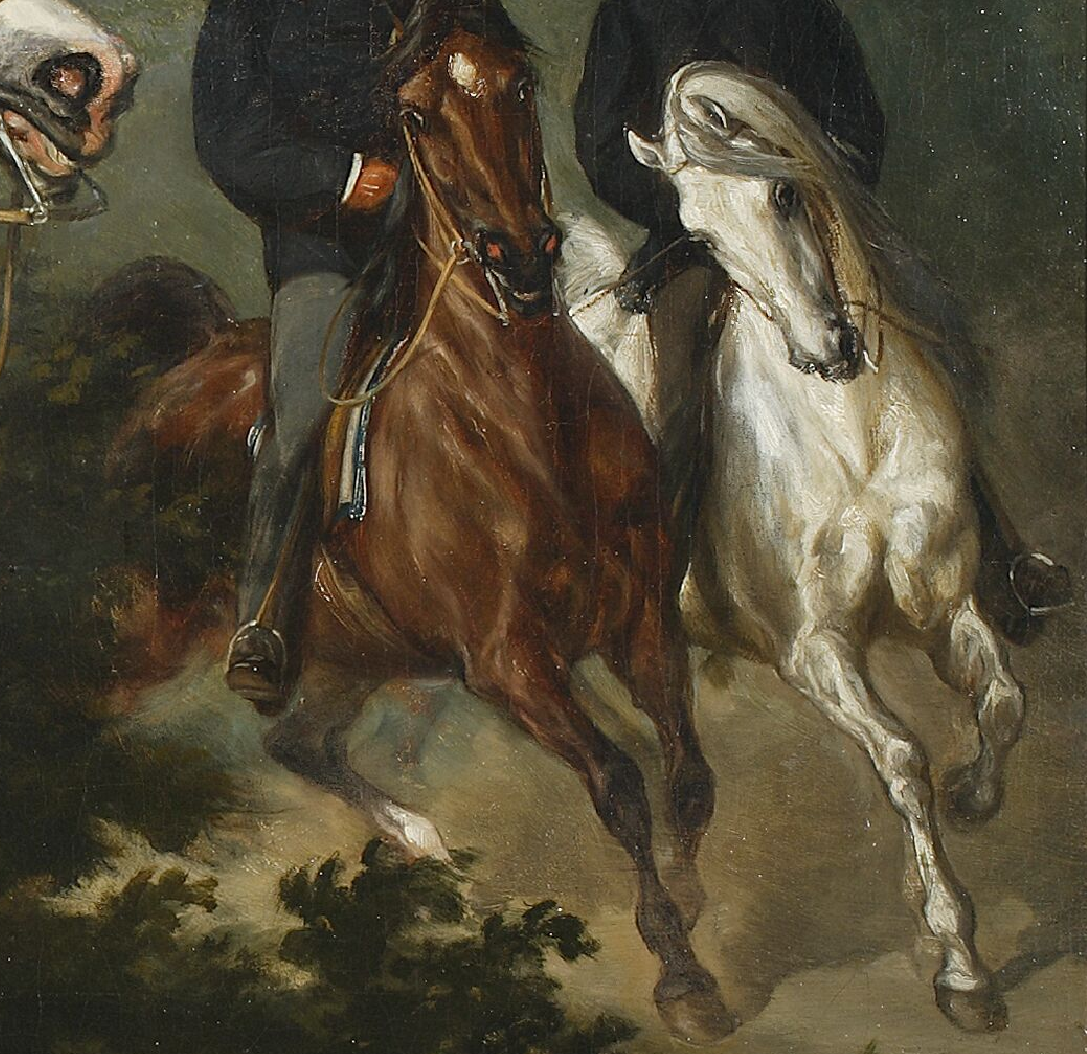
National Museum of Warsaw has a collection of paintings by maestro Juliusz Kossak, some of these have been made accessible to the internet audience via the digitization project.
One of them is a medium size, 87,5cm x 76cm, oil on canvas work titled 'Amazonka (Amazon)'[ in black on grey Arabian horse] - painted in 1868AD.

NMW

The painting depicts a lady riding side-saddle on a beautiful grey Arabian in a park-like environment, perhaps in one of the Potocki family estates.
 The treatment of the Arabian and two other horses in the background shows the mastery of equestrian subjects by the painter. The unusual technique, i.e., oils, since Kossak already had been painting in watercolors, still show his mastery of the medium.  

During the late 1860s Juliusz Kossak, residing in Warsaw (Russian Empire) participated in many exhibits in Krakow, Paris, Munich and Dresden.
This painting was completed around the late summer of 1868, when our artists was exhibiting his new works in Dresden, Saxony.


Nota bene during the following year, 1869, Juliusz Kossak moved his atelier and family from Warsaw to Krakow, Austro-Hungarian Empire. Their Krakow property, a house with a garden, would become their family seat for the next century. 
enjoy

Valete

Tuesday, January 7, 2025

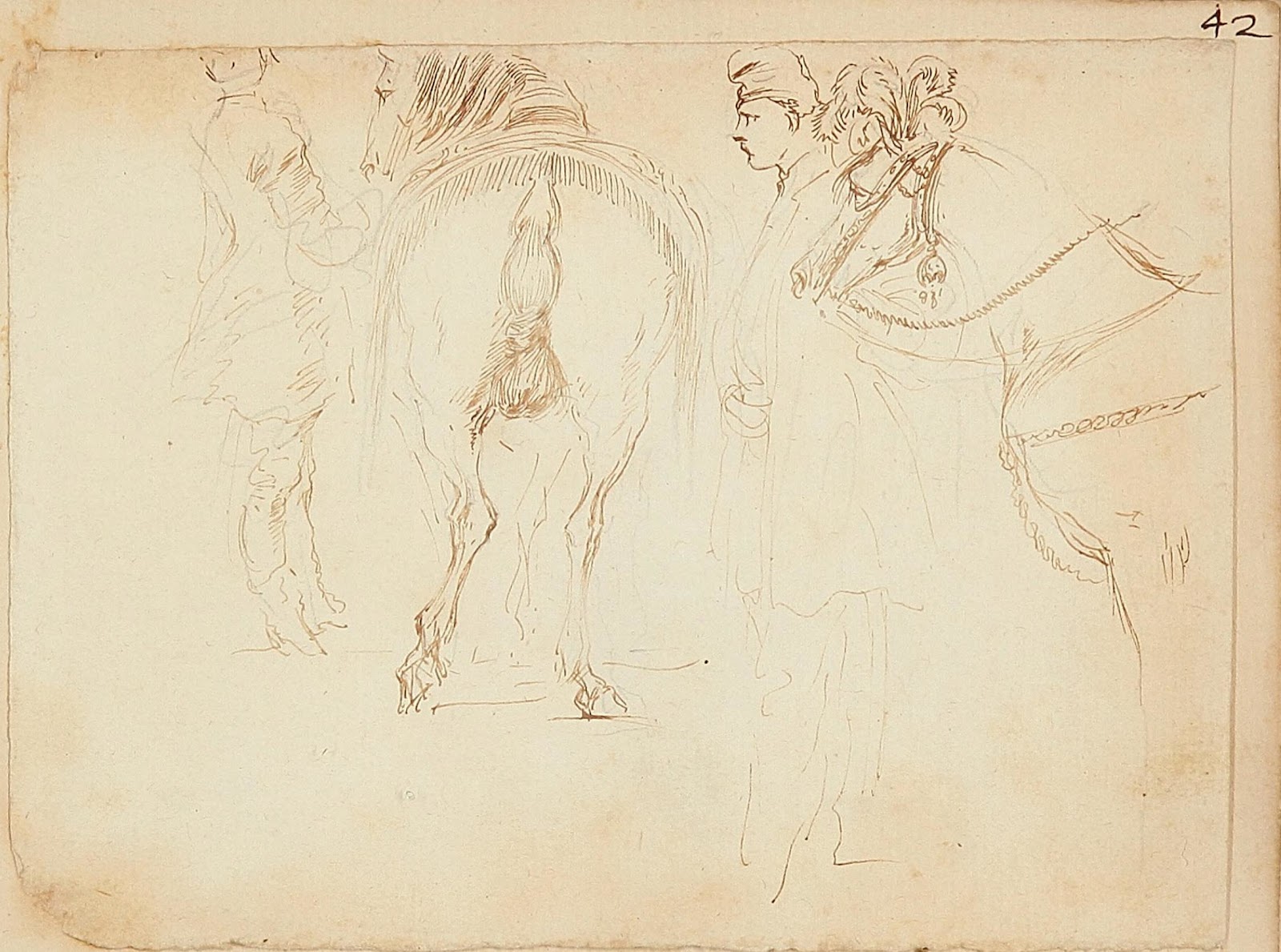
Stefano Della Bella, Disegni e pensieri originali (schizzi a penna) - Polish horse & horsemen

Salvete Omnes,


a quick but full of wonderful sketches in pen and ink by an Italian maestro of the XVII century.

Polish costume - zupan, delia and kolpak


 Stefano Della Bella, Disegni e pensieri originali (schizzi a penna) from Florence, available on Archive .  Sketches were drawn  in Rome during the 1630s, and can be associated with the so called Ossolinski entry into Rome. 

I corralled for you the Polish horse and horsemen, ad a few Ottoman & Safavid Persian portraits drawn by maestro Stefano:


outfitted horse with a jarczak saddle and splendid bridle 


tying of the sash, Polish style, also shaved head with a hair lock, sabretache 


..


enjoy 

Valete