Showing posts with label Chinese horses. Show all posts

Thursday, February 13, 2025

Quian Xuan - late Song and Yuan painter

 Salvete Omnes,

a noble horse archer 

Quian Xuan (1235-1305) - was a painter and calligrapher during the Song and Yuan dynasties of China. He grew up during the conquest of Chinese states by Chingiss Khan and later creation of the Yuan, Mongol, Dynasty.  He is known by his intricate paintings of birds, landscapes, and mixing of the late Song style and ancient Tang one.   


Liao Dynasty period painting of the famous consort


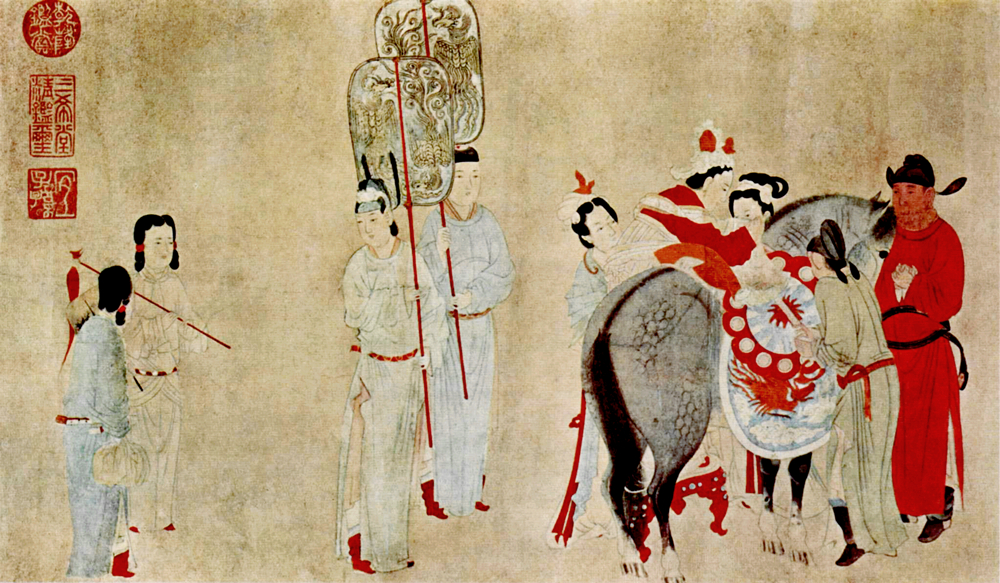
Consort Yang mounting a horse while emperor is watching. - Smithsonian has a page devoted to this artwork.

Tang emperor and his eunuchs retainers


consort being helped to mount the horse . Note the dragon on the saddle's skirt


Yang Guifei was considered one of the Four Beauties of China, and subject of many paintings and artworks in the Chinese and Japanese arts. eg this Wiki Commons page.
During the An Lushan rebellion when imperial forces were all but defeated, the Tang guard soldiers surrounding the emperor forced him to order his favorite consort to commit suicide. She died in July 756 Ad, but went on to live as the object of art and poetry and novels in the Asian history etc. 


Valete

Friday, January 17, 2025

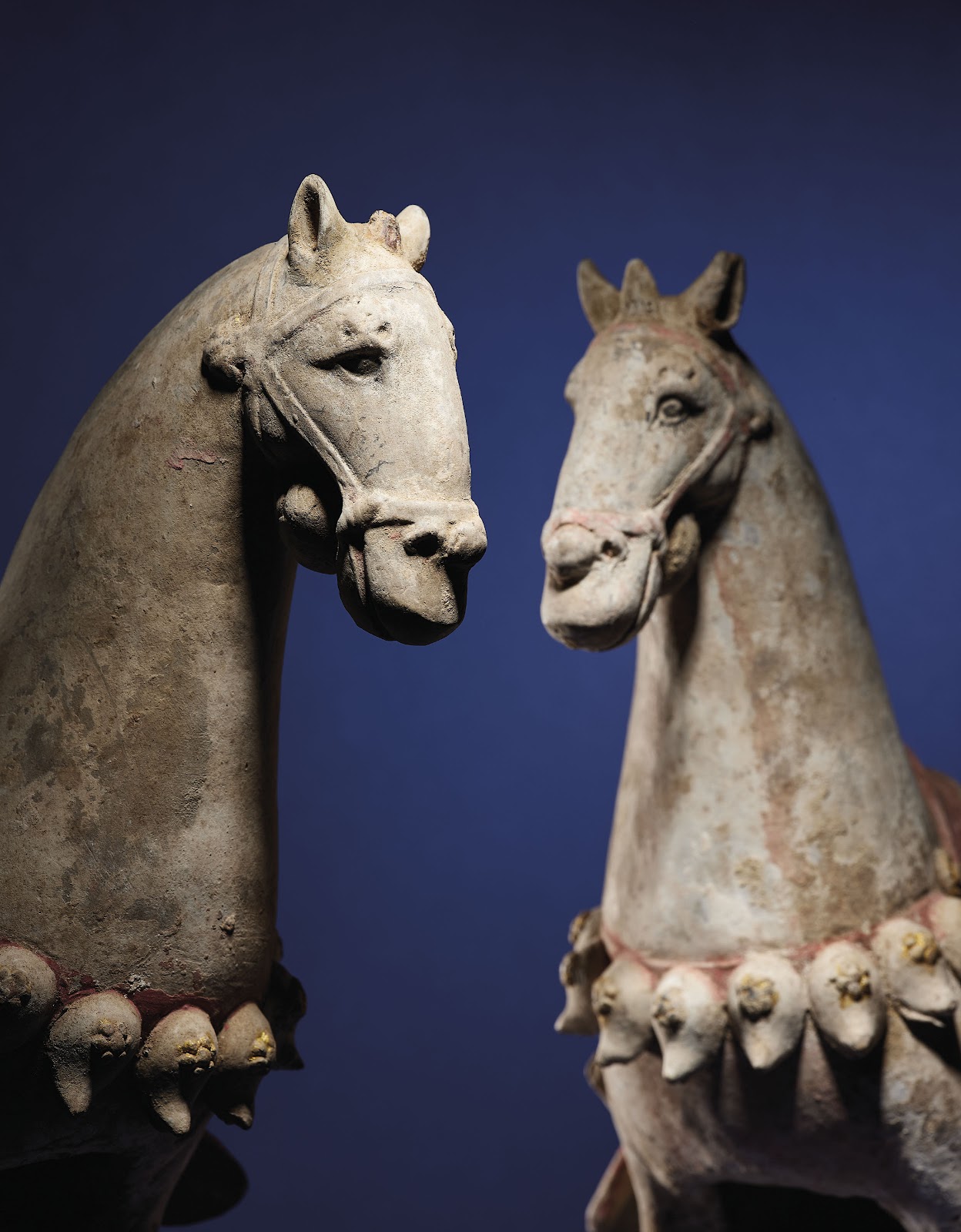
Eastern Wei - caparisoned horses

 Salvete Omnes,


a little visit to early 'Medieval' China - Eastern Wei Empire (AD 534-550) and their warriors and horses.


.

Eastern Wei, albeit short lived, gave us the peculiar sculptures  of fabulously caparisoned and harnessed horses , that where continued during the unifying Sui Dynasty period of the Chinese history, but the Eastern Wei gave way to Northern Qi imperial dynasty (ended in AD 589 by the Sui Empire). 

A Christie's' gallery - larger and full image here


A caparisoned horse with a very clearly sculpted saddle and stirrups -


-from this gallery.


Bonhams auction hourse - a Horse Gallery 


In these sculpted horses we can see many elements of the steppe horse harness elements that will endure for more than a thousand years until the modern age.

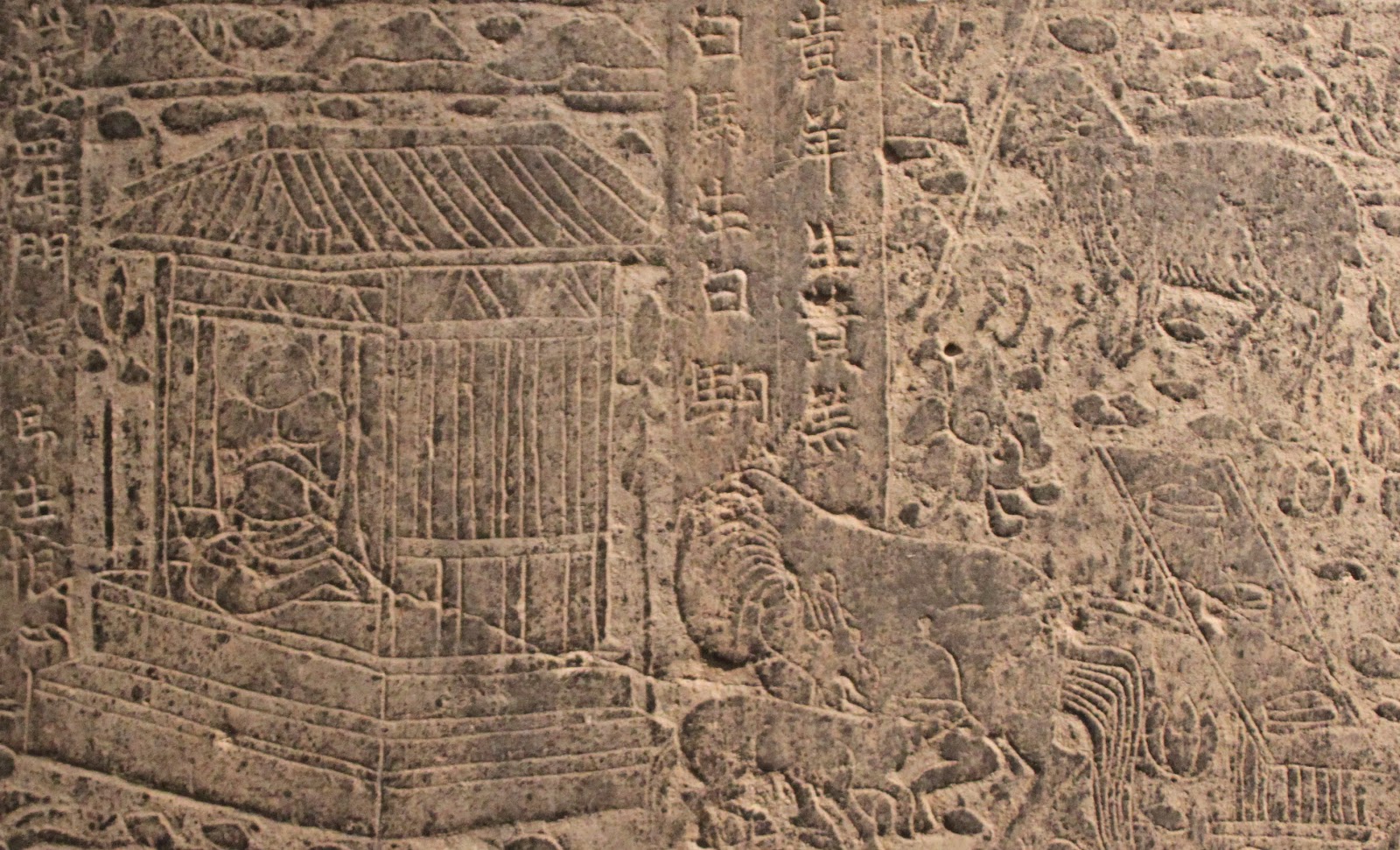
Eastern Wei Stele of 90 Secular Members, 543 AD

a mare with a foal

harnessed horses and carriages

a fine steed in a flying gallop

some personages 


warriors


camel - instrumental in the trade between the Central Asia, Northern Dynasties empires and eastern steppes and Korea.


oxen - 


enjoy

ps 

I will do a post on the Northern Wei and Northern Qi - I hope

Valete

Tuesday, October 4, 2022

Emperor Xuanzong & a dancing horse from Cincinnati

 Salvete Omnes,


beautiful consorts and horses were supposedly the chief preoccupations of emperor Xuanzong

a very short entry -  


there was this fabled empire in China  circa 300 years in duration of the second half of I millennium AD, called Tang  - Golden Peaches of Samarkand is a must read and some other books on the Silk Road etc- and during this illustrious dynasty they had plenty of fine horses, polo, heavy cavalry and horse archery, and dancing horses - all depicted in their flowering arts, including sculpted and painted  horses, including figurines in porcelain and clay. 


And in the SiTech Daily digitally re-published the Heritage Science article about one of those sculpted and dancing horses of the Tang -  on the collaborated effort between the Cincinnati Art Museum and University of Cincinnati on whether this dancing horse had a tassel on its forehead.


The horse comes from the era of emperor Xuanxong of Tang (House of Li) - and thankfully there were works of art created during his reign or about his reign. (Tang military is perhaps  best read about via  Karl Ranitzsch's book from Montvert Pub. titled The Army of Tang China ( 1995).


nota bene, this august emperor had many mishaps during the last decade of his rule and retirement,


 when emperor Suzong became his successor , namely the defeat during the  battle of Talas against the Islamic conquest of Central Asia, and the An Lushan Rebellion and some other calamities, 


enjoy

Valete

Thursday, December 2, 2021

Yuan equestrian art - ceramics

 Salvete Omnes,

snowy and frosty winter out there - I guess it must be the fabled global warming in the Northern Hemisphere. 


ad rem, from the great galleries of wiki commons- Yuan Dynasty equestrian figurines -
as you may have read here I enjoy the long Chinese history, and I read and watch about that history as much as I can.
The Yuans awere particular in many respects, and their art is part of the greater Chinese art heritage, as it was  the fusion of many elements that came to a happy fruition: the steppe patrons and their expectations, steppe artists and Han Chinese artisans, who all together  gave raise to the Yuan Dynasty art.
We should note here that  this foreign Chingizid Borjigin dynasty upon conquering various states and empires across the  land unified the  entire China for the first time since the demise Tang Dynasty.


So, some of these equestrian ceramics are corralled here: 


  camels


camel drummer


horse carriage and escort:


pack horses with folded chairs


and please find this short article on and about the Marco Polo's description of the military affairs of the Yuan Dynasty

Valete

Thursday, July 14, 2016

Zhao Mengfu's horses

Salve,

again thanks to the users of the Wikimedia Commons, we are given  a rare glimpse into the world of Chinese painting some 700 years ago.

First, I am going to add that I do have a favorite dynasty of the Chinese awfully long imperial history - that would be Tang China and her multiethnic empire (at least until the An Lushan rebellion).
Yuan Dynasty is a Chingizid Borjigin Mongol dynasty that had conquered then much partitioned China, unified the country into one imperial state but eventually, after about a 100 years, was forced out of the 'Han' China by the nationalistic Han revolt which in turn  gave raise to the Ming Dynasty etc (I am sure you can read all about this on the Web).
Chinese arts did not stop flowing under the Borjigin Celestial Emperors - eg article on the subject here.  A sample of figurative art under the Mongol rule.
Yuan Dynasty, Yang Guifei Mounting a Horse, by Qian Xuan (1235-1307).

So, this artist Zhao Mengfu came from the highest circles of the Mandarin clans, from the imperial (Song Dynasty) clan of Zhao. He was a prolific artist and awfully skillful calligrapher.


for now we will just enjoy the paintings themselves, but in the fure I may exlpore some interesting info appearing in these works of art.

enjoy