Salvete Omnes,
Some years ago I cited
Vegetius' writing on the Hun horses (you can get there by clicking on labels).
Today, with the series of medieval illuminations from the
Leiden Maccabees X century manuscript that includes book IV of Vetegius military work, followed by the several fragments dedicated especially to the horse soldiers taken from his
De re miltiari treatise - version by
Lieutenant John Clarke his translation published in 1767AD.


From
De re miltiari of Vegetius about the late Roman cavalry - Clarke's version can be read
here.
Vaulting the wooden horse:
The ancients strictly obliged both the veteran soldiers and recruits to a
constant
practice of vaulting. It has indeed reached our times,
although little regard is
paid to it at present. They had wooden horses
for that purpose placed in winter
under cover and in summer in the
field. The young soldiers were taught to vault
on them at first without
arms, afterwards completely armed. And such was their
attention to this
exercise that they were accustomed to mount and dismount
on either side
indifferently, with their drawn swords or lances in their hands.
By
assiduous practice in the leisure of peace, their cavalry was brought to
such
perfection of discipline that they mounted their horses in an
instant even
amidst the confusion of sudden and unexpected alarms.
Legionary Cavalry:
As the divisions of the infantry are called centuries, so those of the
cavalry are called
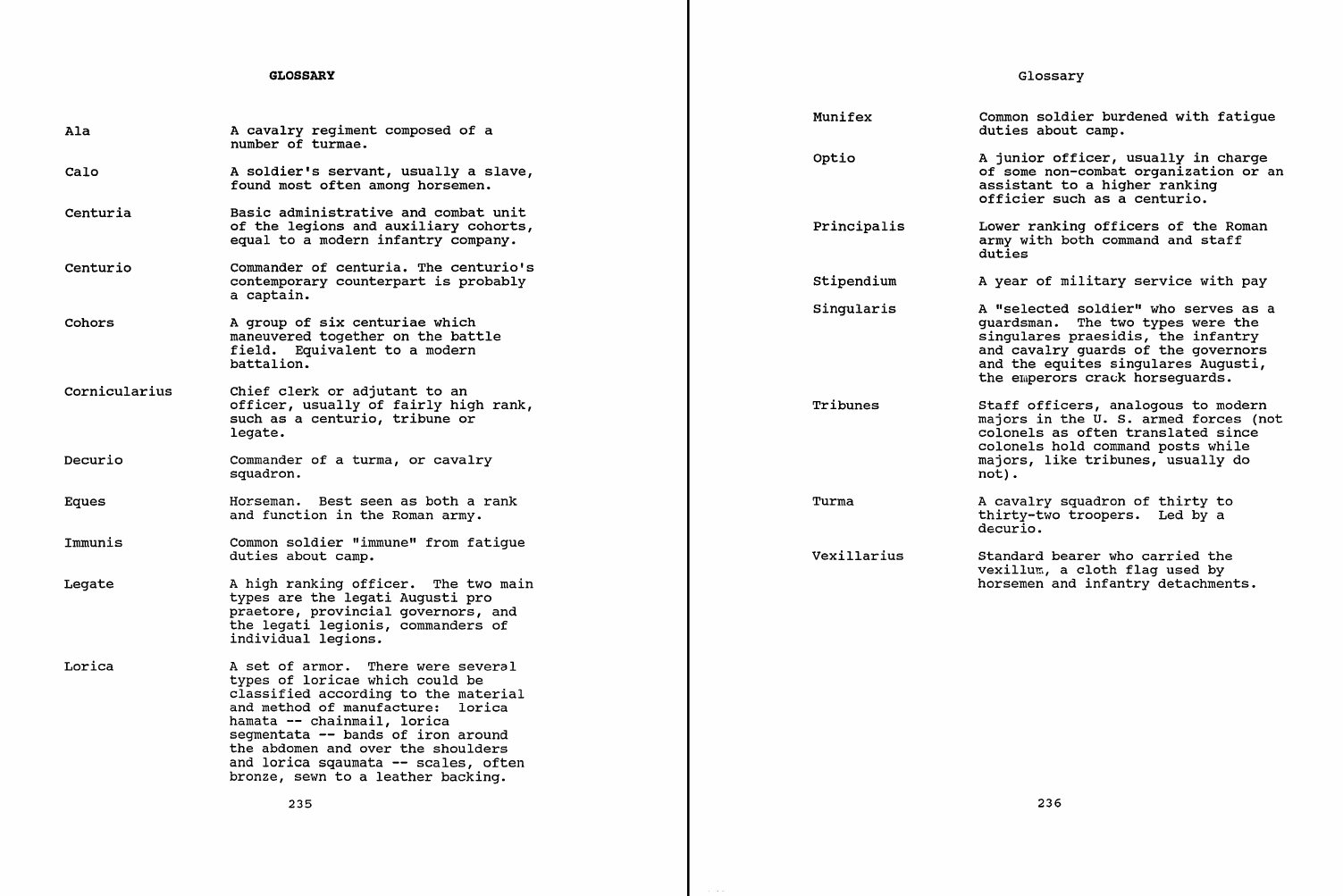
troops. A troop consists of thirty-two men and is
commanded by a Decurion.
Every century has its ensign and every troop
its Standard.
The centurion in the infantry is chosen for his size,
strength and dexterity
in throwing his missile weapons and for his skill
in the use of his sword and shield;
in short for his expertness in all
the exercises. He is to be vigilant, temperate, active
and readier to
execute the orders he receives than to talk; Strict in exercising and
keeping up proper discipline among his soldiers, in obliging them to
appear clean
and well-dressed and to have their arms constantly rubbed
and bright.
In like manner the Decurion is to be preferred to the
command of a troop for
his activity and address in mounting his horse
completely armed; for his skill in
riding and in the use of the lance
and bow; for his attention in forming his men to
all the evolutions of
the cavalry; and for his care in obliging them to keep their
cuirasses,
lances and helmets always bright and in good order. The splendor of the
arms has no inconsiderable effect in striking terror into an enemy.
Can
that man be reckoned a good soldier who through negligence suffers his
arms to
be spoiled by dirt and rust?
In short, it is the duty of the
Decurion to be attentive to whatever concerns the
health or discipline
of the men or horses in his troop.
Disposition of cavalry in the battle array :
The line of infantry being formed, the cavalry are drawn up in the
wings.
The heavy horse, that is, the cuirassiers and troopers armed with
lances,
should join the infantry. The light cavalry, consisting of the
archers and those
who have no cuirasses, should be placed at a greater
distance.
The best and heaviest horse are to cover the flanks of the
foot, and
the light horse are posted as abovementioned to surround and
disorder
the enemy's wings. A general should know what part of his own
cavalry
is most proper to oppose any particular squadrons or troops of
the enemy.
For from some causes not to be accounted for some particular
corps fight
better against others, and those who have defeated superior
enemies are
often overcome by an inferior force.
If your cavalry is not equal to the enemy's it is proper, after the
ancient
custom, to intermingle it with light infantry armed with small
shields and
trained to this kind of service. By observing this method,
even though the
flower of the enemy's cavalry should attack you, they
will never be able
to cope with this mixed disposition. This was the
only resource of the old
generals to supply the defects of their
cavalry, and they intermingled the
men, used to running and armed for
this purpose with light shields,
swords and darts, among the horse,
placing one of them between
two troopers.
...
M. P. Milner's translation - taken from
here - on the cavalry armor:
Armoured cavalry[cataphracti equites] are safe from being wounded on account
of the armour
they wear, but because they are hampered by the weight of their
arms are
easily taken prisoner and often vulnerable to lassos.
They are better in battle against
loose-order infantry
than against cavalry, but posted in front of
legionaries or mixed with legionaries
they often break the enemy line
when it comes to comminus,
that is, hand-to-hand, fighting.
Valete
ps
and I am enjoying miltiry history books and articles written by prof.
Ilkaa Syvanne.