Showing posts with label Raphael Santi. Show all posts

Sunday, April 20, 2025

Easter AD 2025

 Salvete Omnes,

Raphael Santi's Resurrection , currently in Brazil 


it is a beautiful Sunday - Easter Sunday 

happy Easter - wesolego Aleluja, Chrystus zmartwychwstał! Prawdziwie zmartwychwstał  - Χριστὸς ἀνέστη! Ἀληθῶς ἀνέστη

..

and a very interesting 1420s (XV century) northern German painting of Crucifixion, unknown master


. we can observe wide (woven?) cinches,  richly decorated bridles and tack,  dyed-leather large pommel and cattle saddles with skirts, rowel spur, long-leg ridding with heavy stirrups, and their riding attire of  the period. The gray stallion has his forelock gathered and tied up (Eastern or steppe fashion).


enjoy

Valete

Wednesday, December 27, 2023

Pinturicchio's horses from the Duomo di Siena

 Salvete Omnes,


the Old Year is coming to close, we have the last weekend of the Old Year ahead of us, and then perhaps a better year will arrive.

So today let us enjoy some fine frescoes from the  Piccolomini Library of the  Sienna Cathedral - painted by maestro Pinturicchio and his workshop. 

Maestro Pinturicchio, born Bernardino de Betto  in Perugia, Umbria in 1454AD,  was active during the  remainder of  the XV century until his death in 1513AD. 

so maestro Pinturicchio worked in Sienna on the Piccolomini Library frescoes, monumental paintings showing the story of bishop Enea Piccolomini, who would eventually become pope Pious II, (died in 1464AD).  Cardinal  Francesco T. Piccolomini, future pope Pious III, commissioned Pinturicchio and his crew to paint these stories as frescoes. Pinturiccho  executed these paintings  between 1502-1507AD. \

Ad rem, the horses & riders and ... some dogs

Raffaelle Santi aka Raphael drew this plate 
Enea Silvio Piccolomini leaving for the Council of Basel - 
on the roan horse  there is a gilded curb-bit, large riding saddle, breastplate and sumptuous crouper but steel stirrups
Enea on a gray stallion, very sparse saddle skirt, but a large curb-bit bridle

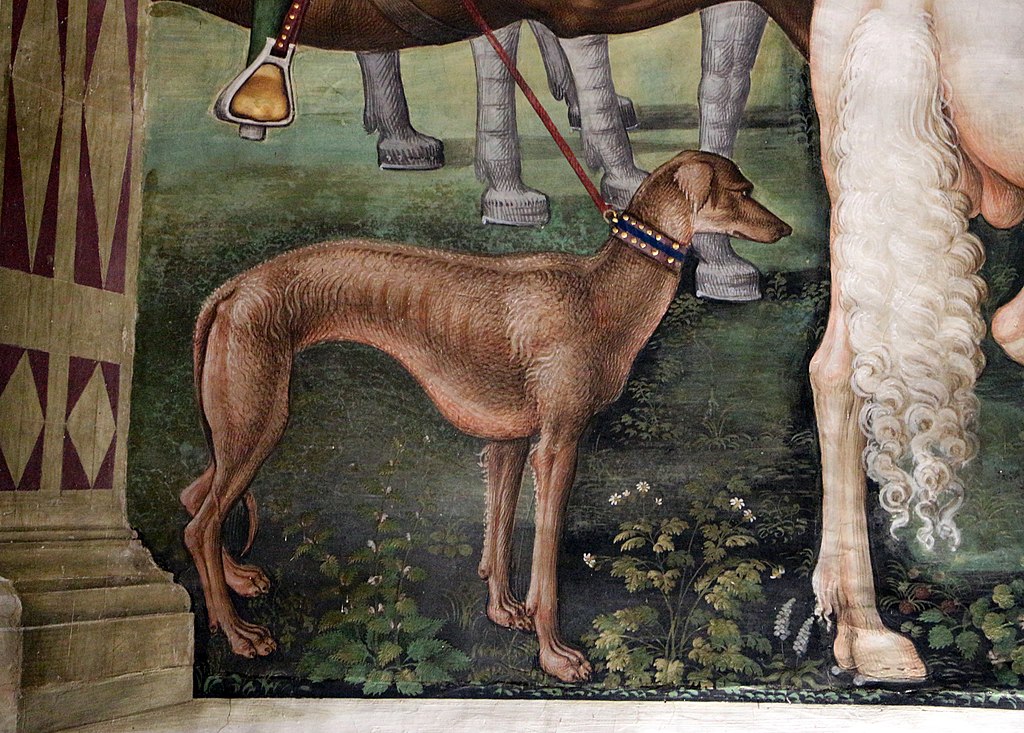
a favorite greyhound? 

horses and mule are all shod

Enea Piccolomini presenting Eleanora/Eleanor of Portugal to the emperor Fredrich/Frederick  III . In this panel there are more horses, another mule, 

a rider accompanied by a piper and an armed assistant 
A black spirited mule with a fine greed bridle, in the background a noble rider with his armed assistant or page?

variety of horse heads and bridles, curb-bits, and a horse trumpeter 


Enea Piccolomini himself as imagined ? by the artists, with a dark grey horse with a high saddle 

beautiful Eleanor of Portugal and her equally beautiful ladies in waiting, two grey horses in the background  

enjoy

Valete


Sunday, April 23, 2017

The feast day of Saint George


Salve,
the feast day of Saint George is today - 23rd of April.
the martyrdom of Saint George - by Martorell
 Medieval miniature - some of the imagery, it is a lovely collection, isn't it?


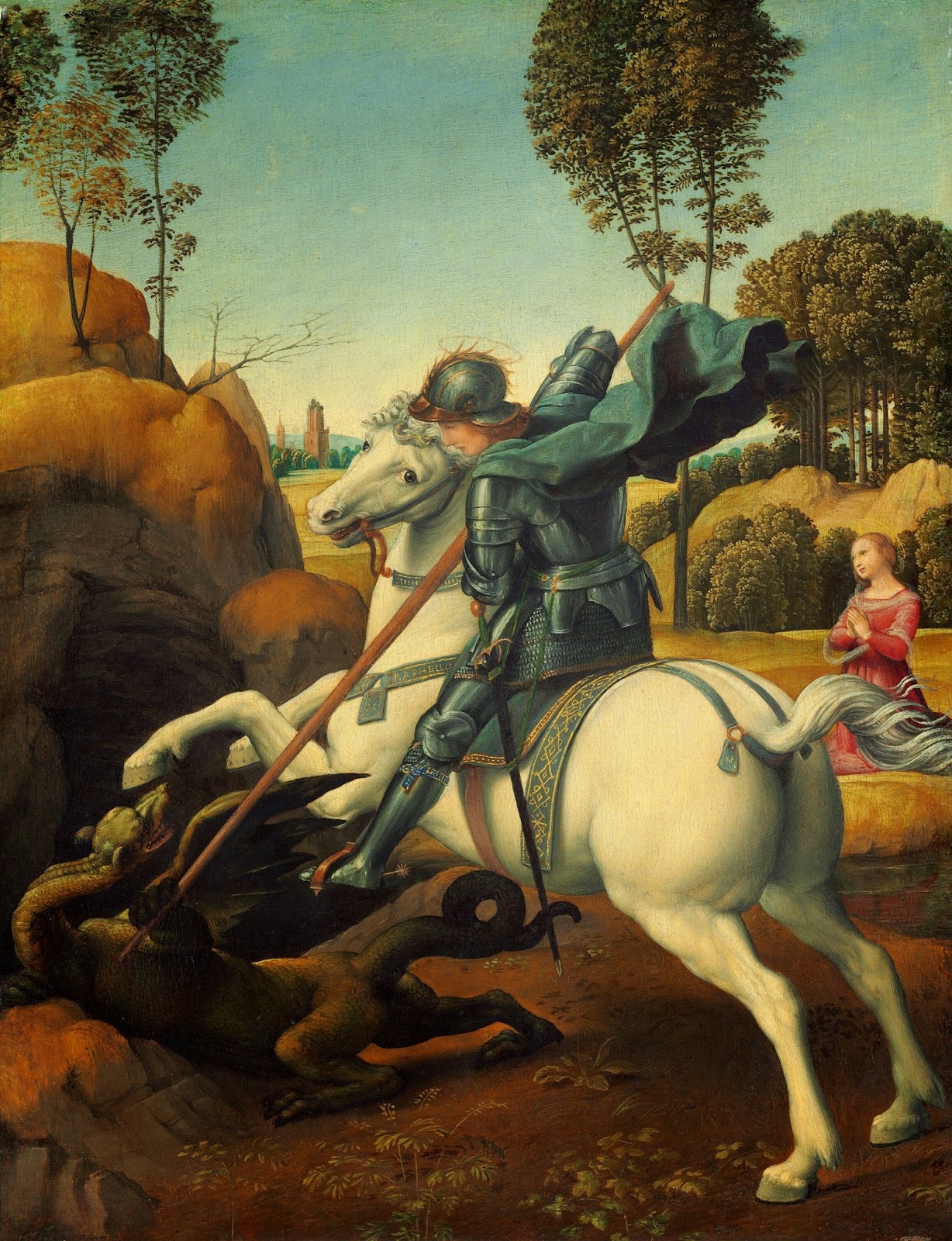
Raphael's Saint George (again showing them, but I like these two paintings)

Albrecht Durer - a great woodcut by the great master

enjoy

Thursday, March 9, 2017

Raffaelle Santi - early modern curb bit

salve,
I admire Italian painting from XIV-XVII centuries, but especially so called high Renaissance painters like Raffaelle Santi.
But before going about his knightly Saint George paintings I would like to draw your attention to this painting (circa 1517) known as lo Spasimo di Sicilia, famous not only for being his masterwork, but because it had survived the shipwreck during the delivery (at least according to Vassari), was sold to Spanish  grandee a century later and had the dubious pleasure to have been looted by the French during the Peninsular War (the French Napoleonic 'collectors,' in the footsteps of the Swedish looters during the Northern Wars, and the Royal French during the wars of Louis XIV, were in fact forerunners of the Soviet and German systematic thievery of art objects during the World War II).

suffering of the Holy Mother during the Passion

 ad rem, the horses depicted in the canvass (well, as you can read, it is now canvass, but  Raffaelle originally painted it on wood and the French 'restorers' transfered it onto canvass in the XIX century, damaging the ground and causing irreparable injury to the masterpiece)

Jewish high priest's dark bay or black horse,  - Oriental bridle (perhaps) but the interesting feature is the very wide nose band with metal adornments. Very long shanks on the curb-bit, and the reins are also adorned with metal pieces, making it rather heavy (perhaps a happy union of protection from sword's slashing to to reins and fine art of beautifying of horse harness)

Roman offcial - Pontius Pilate perhaps - mounted on a neighing gray horse, as suitable for a commander. The bridle is complete, with its leather tanned what appears to be rose or vermilion. There is only one rein set, the curb-bit is long shanked, very late Medieval. The curb-bit chain is not visible, also the attachment of the cheek straps to the shanks is not visible.  The head of this horse is interesting in its conformation, very bull-like. More about this feature some other time.
Valete!

Saturday, December 31, 2016

Lost Objects - Polish Ministry of Culture and National Heritage Inventory - some of winged hussars related items


Salve,
the year ends today and new one will be upon us immediately - :)


This old 2016 ended nicely for the Polish cultural heritage since Polish Republic has just purchased, really cheap - :) , the entire Princes Czartoryski's Collection with their real estate from its owner, prince Adam K. Czartoryski, including this famous Leonardo painting .


we should note that one of the missing items from this collection is the famous Portrait of a Young Man  by Raphael Santi - robbed by the Germans during the War World II. Here an article ( in Polish here) on the very painting and its history and its loss.


Polish Ministry of Culture and National Heritage is rejoicing the mentioned purchase but  we should not forget the tremendous loss inflicted on the Polish culture and heritage by the Soviet and German occupiers during  the War World II and - this is an article(in Polish here) on the Polish heritage losses during the war, however, the losses have been assesed only as to the lands within the post-1945 Polish borders, whereas 50 % of the lands northeast, south and southeast of this present border are excluded. This is the explanation allowed by the Ministry of Culture and National Heritage:
''Estimation of Polish cultural losses in the eastern terrain is impossible, because after the war Poland never had access to museums, galleries, archives and libraries which previously had been Polish. The Soviet side never never carried out an „initial balance" (for obvious reasons). Thus, it is difficult to specify the losses, since we have neither a thorough inventory of our cultural property from 1939, nor information about the state of the situation after 1945. At best it is possible to note one example aiming at such a balance: Polish librarians prepared the guide „Libraries in the eastern lands of the 2nd Republic" (Warsaw 1998) in which they determined that in 1939, in the eastern part of the 2nd Republic, there were 5056 libraries. They were unable to determine their state in 1945.''
I included into this post images of looted artefact's that could be associated with the winged hussars during the XVI-XVIII centuries - military objects and horse tack.


enjoy your New Year's festivities -  :)  -

Szczęśliwego Nowego 2017 Roku -

!Feliz Año Neuvo!

ps
all images are from the Division for Lotted Art