Showing posts with label XVII century bridle. Show all posts

Friday, May 8, 2026

Abraham Teniers' saddles, pistol holsters & cavalry weapons from the guardroom

 Salvete Omnes, 


Flemish master David Teniers the Elder had 4 sons who became painters and masters in their own right. 
David Teniers the Younger achieved the most notoriety, but his younger brother Abraham also was noted for this popular guardroom scenes theme.


In these paintings we can observe numerous pieces of equipment, including fine saddles, armor, weapons, even our Central European  (Polish, Hungarian or Croat) weaponry - sabre and nadziak/war hammer. 


1.


2.
drums and pistol with a young black groom carrying a sword


Valete

Thursday, December 4, 2025

Graff Anton of Oldenburg and his horse Kranich

 Salvete Omnes,


a short a quick XVII century entry.


Graf (count) Anton (Anthony) Gunther of Oldenburg (1583-67)  was one of the longest ruling, 1603-1667, aristocrats of the Imperial lands and cities. 

Kranich was bred Graf's studs circa 1640.

Graff astride his horse Kranich (Crane) - Jacob Sandrart's print circa 1671

Graf Anton, having inherited numerous fine stallions and stables from his predecessor count Johann XVI, also bought stallions for his stables: Neapolitan, Spanish, Danish, Polish, and Turkish. He had his stable masters made these stallions available to the local Oldenburg breeders, who in turn bred their local mares to these fine horses. Thus Graf Anton has been credited as the founder of the Old Oldenburg horse, that became famous carriage horse of the XVIII century, and today is a famous warmblood. 


Mural on the Haus Graf Anton Gunther in Oldeburg


the horse and graff have been subject to reenactment eg (from Wiki Commons)


Valete

Friday, September 12, 2025

Vienna 1683-2025 - horses

 Salvete Omnes,


today we commemorate the battle of Vienna 1683 -  I have written many posts on the battle, and I am sure will write many more, God willing. 

I would like to commemorate the struggle with the images of horses from the period paintings, mostly from this one - Anonym Entsatz Wien 1683 (painting in Vienna , Austria). 


Many thousands, perhaps a hundred thousand,  of horses participated in this battle. Horses on both sides suffered from lack of adequate feed. Days before the battle the Ottoman side had to take  their horses across the  Danube River to pasture and hay cutting parties roamed further and further from the besieged city and their own camps. During the battle some horses died from wounds but many more, especially of the Polish cavalry and wagon trains, died from malnutrition and near  starvation (the last couple days before the battle they ate tree leaves or nor food at all,  ). After the battle there was very little fodder  in and near Vienna, captured Ottoman camps had stores of fodder but they were wasted by the pillaging victorious soldiers,  while mostly Polish forces captured more than 20,000 animals in the Ottoman camps, including some very fine Turkish and Arabian noble horses.
Imperial bureaucracy was slow to deliver hay and grain to the encamped armies, while the armies  immediate supplies for men and horses. Only when the Polish royal army decamped away from Vienna and entered the country near Pressburg (present Bratislava) they had enough fodder for their horses - but then many Polish soldiers were sick with fever (bloody dysentery) and dying from this plague.
There was more fighting to be had in October against sultan's vizier Kara-Mustafa and his armies. 

Valete

Saturday, December 21, 2024

Wouwerman - a scene with a saddled horse and wagon

 Salvete Omnes,

three days to Christmas' Eve - we have to go get the Christmas tree today. 

while perusing Wiki Commons I came across this drawing by Philips Wouwerman - originally this artwork comes from the German state collection.  

.

the saddled horse is interesting - long, strong legged and rather hunter-like, long tail and of a round belly, a picture perfect cavalry horse? 

here I colorized, gently, the saddle and his tack, and the huge 'mantelsack' (?) on the back of the pack horse.
 
nota bene the draft horse pulling this wagon carriage have some serious collars. 
enjoy

Valete

Saturday, September 14, 2024

Vaclav, Wenceslaus, Hollar - equestrian portraits

 Salvete Omnres,


there was this Czech or Bohemian artist Vaclav Hollar, who left Czech Crown(under the Austrian Hapsburg rule) in the 1630s and eventually became a English Crown subject, practicing his art and skills in London, where he passed away in 1677AD.
He created many very interesting prints, including these equestrianp ortraits of the leaders of the era - 30 Years War and English Civil War.


.


.

and  a bit fantastic image of a Chinese personage - governor of Canton .

and in the Americana collection, he did this engraving of an American Virginian  (Algonquian) indigenous warrior  (Powhatan?) - done in 1645D


Valete

Sunday, September 8, 2024

Esaias van de Velde - horse-related drawings etc

 Salvete Omnes,


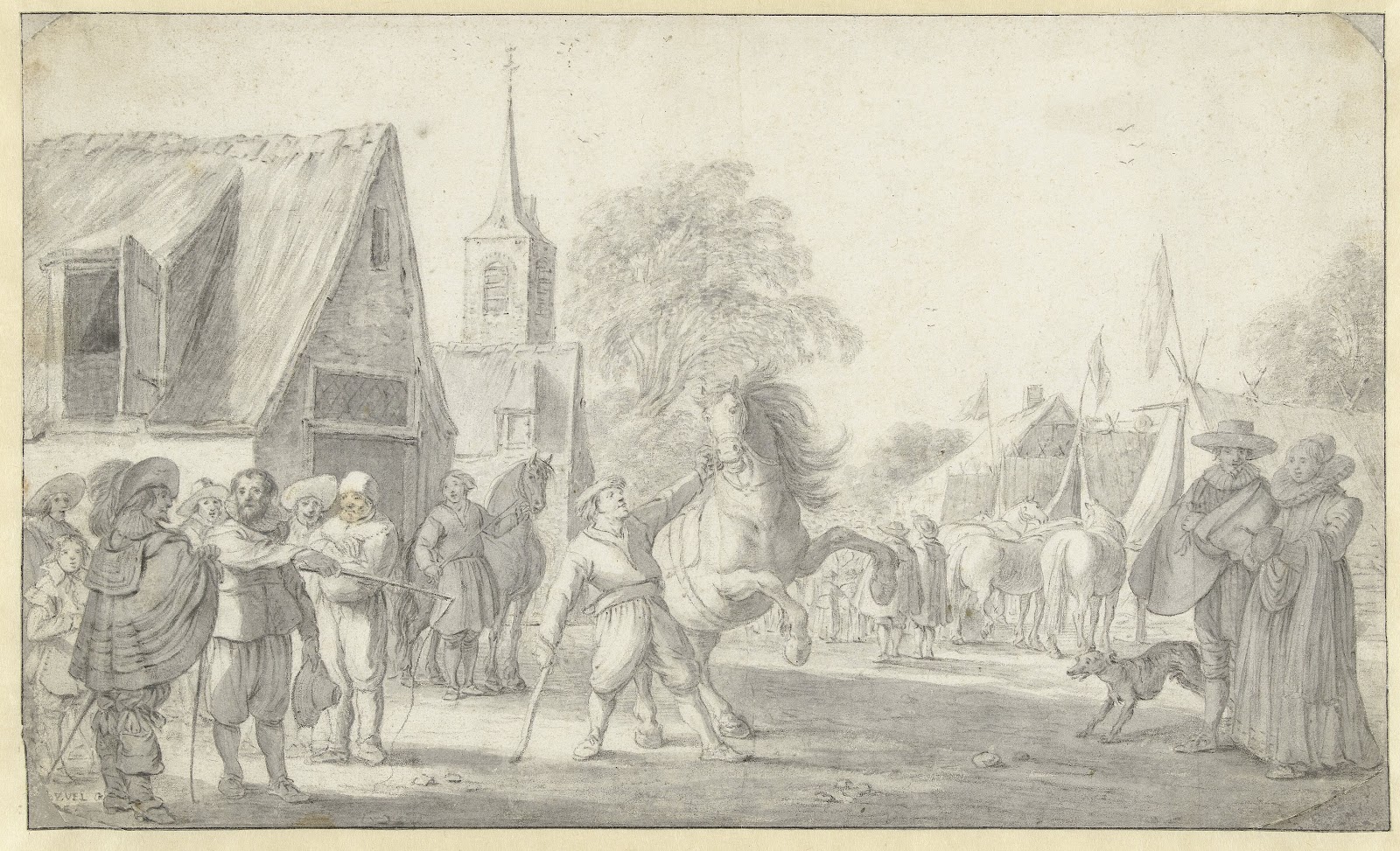
a little jump in time to 1600-20s, horse-related drawings by a Dutch maestro Esaias van de Velde (1587-1630). - early XVII century cavalry, wagons, horse transport etc


.

horse soldiers


.

horse market


Valete