Salvete Omnes,

On November 11, 1673AD Polish-Lithuanian Commonwealth armies under the command of Crown hetman Jan Sobieski, aided by many capable senior commander like Lithuanian grand hetman Michal Pac and junior commanders like Mikolaj Sieniawski, destroyed the Ottoman army, commanded by Hussein Pasha, at Chocim (Khotyn in Ukraine now, by the will of Joseph Stain since 1945). Our king Michal Korybut Wisniowiecki died on Nove.10, 1673.
Polish historian D. Orlowski estimated, in his popular book Chocim 1673 (2007), that there were 27 thousand Crown soldiers, the Grand Duchy of Lithuanian brought close to 7 thousand soldiers. In total some 34 thousand soldiers, 65 cannons and 1 mortar. There are still the armed servants from the noblemen soldiers retinue, and we don't know how many of those participated in the storming of the Ottoman earthworks and camps. We have to take into account the 4-5 thousands of the Moldavian and Vallachian soldiers who came over to the Polish side with their rulers. Their infantrymen must have participated in the storming, capturing and dismantling of the Ottoman earthworks.
Ottoman army under Hussein Pasha, according to the Polish historians, were about 30-31 thousand strong, well provided for with munitions, supplies and fodder for the winter. They had a 25-30 artillery pieces and were in contact with their commands in Moldavia and Kamieneci Podolski, and it is thought that the some Moldavian and Vallachian troops who had stayed with the Ottomans. They could not count on the Tatars, because these Ottoman vassals had been attacked by the Kalmucks from the Don steppes, and Zaporozhian Cossacks from the north and west.
I should add that before the battle there were tournament like duels and fights (harc in Polish) between bravest and most audacious horsemen from both sides. Two Polish notable knights died in these duels on the 9th of November, namely the Sieradz sub-cupbearer Jedrzej Modrzewski and leutenant Florian Maj. Polish-Lithuanian tried to take the earthworks defended by the jannisaries on the 10th but after a number of very bloody engagements Polish attackers had to withdraw from the Ottoman fieldworks. Polish side maintained formations and martial spirit during the night of 10/11th and thus Ottoman side had to stay in armor and with arms.
In the morning of the 11th Polish artillery opened fire - the chroniclers say a quarter hour in duration of artillery fire. At 8 A.M. in a surprise attack the Polish infantry regiments and companies, camp servants and dragoon companies stormed the earthworks. with Jan Sobieski with a sabre in hand walked ahead of his own dragoon regiment, yelling - 'for the love of God, for the [Christian] faith, and churches, for Amor Patria (Love of Homeland), with hope in God attack them courageously.' many great infantry officers and other commander like the Crown artillery commander Marcin Katski, Stefan Stanislaw Czarniecki, Korycki, Zebrowski, Denhoff, Tetwin, Heydepol, Pietrzykowski, etc. The rest is history
We should note that Hussein Pasha, with about 5 thousand spahis cavalry, had made across the Dniester bridge before it collapsed, and found refuge in Kamieniec Podolski, with Halil Pasha. But 8 thousand spahis perished, 6-8 thousand of jannissaries were cut down, many good commanders were killed or died from the wounds. 3000 Ottoman soldiers were taken prisoner.
Both the small fort on the Turkish side of the river and the Chocim castle (Nov 13th) were taken.
Jan Sobieski marched his Crown army into the Turkish lands, Moldavia, and the war went on, and it was not going as good as the victory at Chocim promised. Moldavia was to become the object of Sobieski-Ottoman struggle and warfare for the next 20 odd years. But that is for another post.
The next Spring Jan Sobieski would become Jan III after the free election by the noblemen at Wola, then a village near Warsaw.
 |
| Saint Martin in the foreground, with Jan Sobieski and his army at Chocim in the background. |
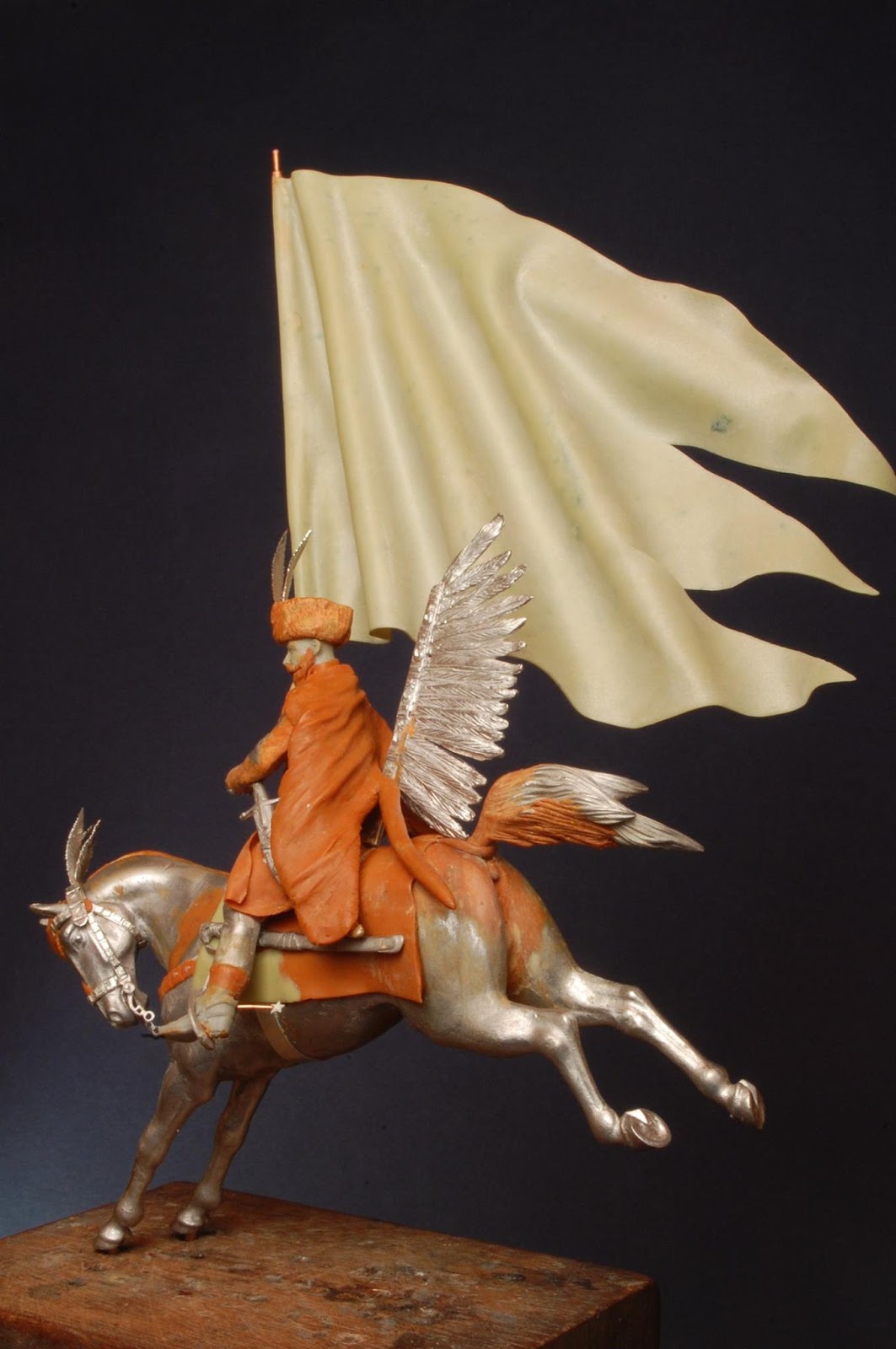
I played a little bit with this Vasa battle-flag and changed the Vasa coat of arms to Janina, Sobieski family coat of arms.

. Jan Huchtenburg painting battle at the National Museum, at Warsaw.


Polish researcher-historian Zbigniew Hundert published an article [in Polish] on the winged hussar companies at Chocim 1673 - available on Academia.
Like I write above, many thousands of men and horses died in this struggle, and when the bridge across the Dniester River, from the Turkish entrenched camp to the Moldavianside where there was a small Turkish fort, collapsed under the weight of men, horses and equipment, many more Ottoman soldiers and servants perished in the icy waters of the mighty river. Many perished from the Polish light cavalry pursuit and also from the wrath of the Moldavian peasantry. After the victory and march either back to Lwow or march into Moldavia, the Polish-Lithuanian camps saw many thousands of horses die from the very cold weather conditions etc.
.
Perhaps some other time I will write about some aspects of this battle - like the booty and captives and animals taken by the victorious side.
Happy 11th to all Polish people around the globe and to all Veterans
Valete