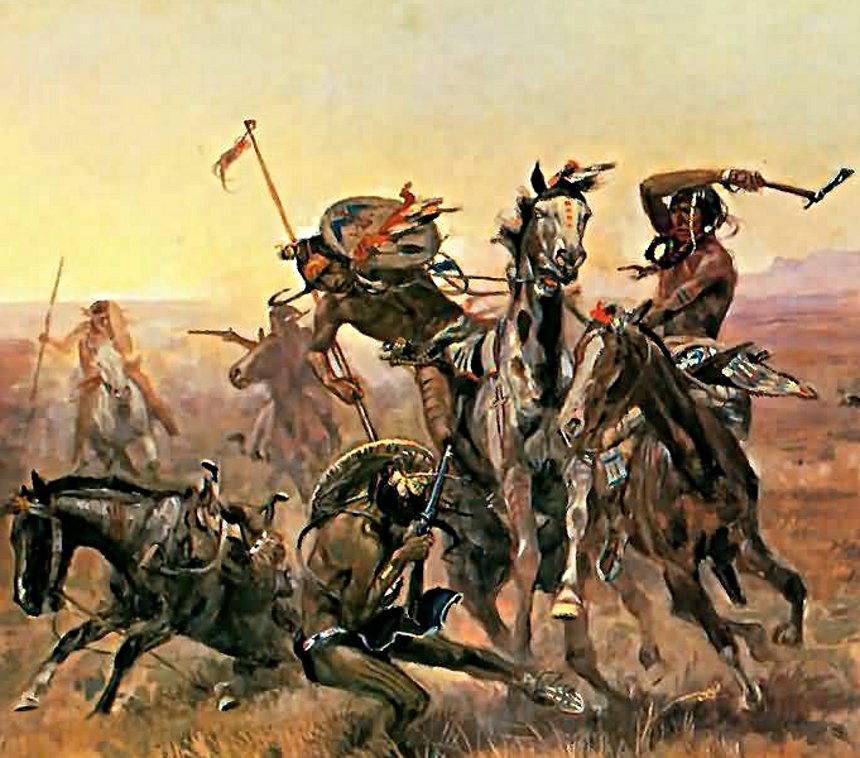
final fragment from Mr. Batty. This time author gives us his observations, views, prejudices, and finally his understanding of the American Indians and their hunting in general.

An Indian,
notwithstanding his warlike propensities and distinguishing
characteristic of cruelty, when in the prime of manhood fully
equipped for the chase, is a picture that cannot fail to call forth
admiration.
Iron-jointed,
supple-sinewed, he mounts his pony, and with bird-like grace and
freedom rides at lightning speed, leaping the saddle from side to
side in a manner almost incredible to relate. When not under
excitement the Indian has a patient, inoffensive look, and one would
scarcely think he was capable of committing the cruelest of deeds.
The Indian is a
perfect hunter, but not a good shot. He is most patient in waiting
for game, and will lie for hours as noiselessly as a cat watching a
mouse. The most intense heat of the sun on the plains does not seem
to affect him, and he will often lie a whole day at a water hole
waiting for game to come to drink.
Indians hunt more or less in the
Summer, but the Great Fall Hunt is the event of the year, and in it
they seem to find the most perfect enjoyment and great excitement. At
this time meat is killed and cured for Winter use. They hunt but
little in Winter, and then chiefly in pleasant weather, going but a
short distance from camp, on foot, as the ponies are too thin to
carry them.
There are laws in
some tribes that forbid an Indian to hunt alone far from camp. If
found hunting on the sly, they are soldiered, that is, have their
clothes cut to pieces on their return to camp.
They prize a good
gun highly, and appreciate the points nearly as well as our own
people. The brass-mounted Winchester carbine is their favorite gun
for hunting or war. We were quite amused in examining the guns of one
Indian camp. Some had the most common of shot guns, cut short like
carbines, many had the pea rifles, and occasionally a double-barreled
gun was seen; there were many old muzzle-loading Springfield muskets
and Spencer carbines, and now and then a Ballard; large bore
muzzle-loaders, however, prevailed. Many of the Dakota (Sioux) and
Assineboine* warriors carry good Government needle-guns. Sharpens*
carbines and brass-mounted Winchester repeating rifles. The stocks of
the guns, and their belts and saddles, are ornamented with brass
nails driven in every conceivable form. The Sioux and Assineboines
are tall and muscular, and look as though they know how to use their
guns; they wear canvas and leather cartridge belts like the whites,
which are generally well filled with fixed ammunition.

An Indian will
barter anything for ammunition, even a valuable robe, or blanket from
his back. When I was crossing Montana, Indians came about and tried
to trade for cartridges ; it was quite amusing to see them
continually show their empty cartridge belts (which had been cleaned
for the occasion) and urge our party to trade. They offered pemmican,
jerked meat, robes, skins, gun cases, moccasins, and tobacco bags
ornamented with porcupine quills and beads, and filled with
Kinnikinic*. I had a heavy belt of the extra long central fire
cartridges with patched balls, which were new to them; pulling out a
ball from a cartridge and handing it to a buck, he examined it
carefully, passed it to his comrades, then returned it with a grunt
of satisfaction and uttered the word ** wash-ta" (good).

Some Indians
foolishly chew their bullets until they are so rough they can
scarcely be forced down a rifle. I told one Indian that it was "bad
medicine," and the bullet would not go straight; he took a
badly marred ball from his pouch, pointed to it and said, " good
medicine, heap kill deer."
They accepted
fire-arms rather doubtfully at first, but now nearly all Indians
possess one of some description.

There were two kinds
of bows used by the aborigines: the short stiff bow for buffalo and
war, and the long bow for small game. The latter is seldom used now
among the Northern
Indians, they preferring the short bow, as it is more easily carried
when riding in the hunt or fight. The Eastern Indians used the long
bow; the Seminoles used one of medium length, between the long and
buffalo bow.

All good Indian bows
are strengthened by sinew, which are stretched lengthwise, and around
them. The sinew from the back of the buffalo is generally used, as it
is long, flat and fibrous, and can be split into any width of band,
or size of thread.
The heavy bows have
broad strips of sinew put on them longitudinally, and are cross wound
over with shaganapa* or rawhide, and fine sinew.
The arrow heads and
feathers are fastened to the shafts with the same material.
There are two styles
of arrow heads, the long for buffalo and the short for general use.
The flint-arrow head has disappeared among all the tribes I have
seen.

Arrows are deeply
notched to receive the heavy rawhide string of the bow, and their
ends spread, to prevent their slipping from the hunter's grasp. The
Indian hunter prizes his bow as much as a rifle, and it is a
difficult matter to buy one, without paying a fabulous price.

The bow is used with
great care and carried in a cover of leather or fur.
Indians often make
bow cases from the skins of their dogs, but some of the great
warriors have covers made of otter skins. A large otter skin with a
perfect tail to protect the bow is invaluable. Skins of albino
animals are also highly prized for quivers and bowcases, and the skin
of the white buffalo — more common than is generally supposed —
is considered " good medicine ;" they think the Walkatonka*
or Great Spirit, favors those who wear them.
Quivers are also
made of leather and fur skins, ornamented with beads, colored
porcupine quills and fringe, and are usually strung from the right
shoulder.
The short bow is a
very effective weapon in close quarters, and with it the average
Indian can discount all breech-loading rifles, except a repeater.
An Indian will bury
several arrows in a buffalo in a few moments; and a dozen or more of
them armed with bows, in ambush, will make lively work for a party of
whites. Whether the Northern Indians have ever used poisoned arrows
or not I am unable to state; I have questioned many about them, also
trappers and interpreters, and have found no clue to their having
been used. Many suppose that the arrows were poisoned with the venom
of the rattlesnake, but the Indians are so superstitious relative to
killing it, that I do not think the belief authentic. They never fire
at one, saying it is "bad medicine," and will spoil their
guns.
The young bucks and
papooses make bows and arrows of every description, and are
continually practising at birds.

[Indian pony] The Indians hunt
more on horseback than any other way, and the endurance of their
ponies is wonderful. Although in constant companionship, the Indian
has not the least feeling
for his pony, and shamefully neglects and abuses him. He is never
stabled, blanketed, curried, or even fed. Saddles are strapped on
mercilessly, and the pony is ridden cruelly ; if his back be torn and
lacerated at night, he is turned into the herd without a thought, and
forced under the same saddle the next day. In Winter they have very
little food, and become almost skeletons, and were it not for the
branches and bark that the squaws cut from the cotton-wood tree they
would die of hunger ; as it is, they are pitiable objects with their
shabby coats and extended hips; but when Spring comes and food is
plenty, their transformation is wonderful, and they are ready to
perform the cruel tasks of their remorseless masters. Although a
slave to the Indian, it is a singular fact, that stabled and fed in
the hands of a white, 'the pony becomes stubborn and even dangerous ;
like many of the human family, prosperity does not agree with him.
[Indian Dogs]

It is generally
supposed that Indians never make use of dogs in hunting, but do their
own driving on foot; there are, however, some tribes that use dogs
success- fully in the chase. The Chippewa Indians surround a favorite
feeding ground of the deer, and one of their number turns the dogs
loose in the centre. Some of them are well trained, and hunt
independently of each other, and several deer are often killed at one
drive. The number engaged in the hunt is regulated according to the
number of runways to be manned. Large parties often split up and hunt
in localities suited to their number. The Chippewas occasionally
still-hunt singly, having trails cut through their hunting grounds as
nearly parallel as possible; there are then no twigs to obstruct the
view, or dead sticks to crack and alarm the game.

A great number of
dogs are seen in every Indian village, though we saw more with the
Crows than with any other tribe. There are no pure blooded dogs,
nearly all being crossed with the wolf.

In the Winter they are
disconsolate, half starved looking creatures, but during the buffalo
season they fare sumptuously and become very fat. These dogs fight
savagely, much to the delight of the young bucks, who never separate
them, but let them fight it out. The Indians make an article of food
of their dogs, and tan their skins for mats. They also use them to
haul sledges and carry light packs

*original spelling