Showing posts with label Alexander the Great. Show all posts

Wednesday, October 1, 2025

Granicus River 334BC - podcast and articles

 Salvete Omnes,

October has begun.. hopefully it will be a better month than September,

 Ad rem,


today I finished listening to dr Goldsworthy addressing the battle of the Granicus River 334BC topic in his Yt podcast.  The great cavalry battle of the war.


In the ancient primary sources this first battle won by Alexander of Macedon  in his Achaemenid Persian wars survived, to some extend, in five major ancient works - Diodorus Siculus, Justin, Plutarch, Qvitus Curtius Rufus and Flavius Arrianus.


E. Badian wrote his article - The Battle of the Granicus: a new look, 1977. 

N.G.L. Hammond went to Turkiye and did in situ study of the Granicus river valley, and  in 1980 his findings he published in an article (Journal of Hellenic Studies) available on JSTOR or on Cambridge Univ. site.. In 1986 A.M. Devine wrote his article, Demythologizing the battle of the Granicus - available on JSTOR. 


K.Harl, Alexander's cavalry battle at the Granicus. (1997) - this is a major study, with good maps. I like 

Kathleen Toohey made he study of Alexander's tactics available on Academia - Chapter 2: The Battle of the Granicus.

D.B. Campbell  wrote his article "Alexander's great cavalry battle: What Really happened at the River Granics" (Ancient Warfare Magazine VI-2) - available on Academia.edu. The article contains illustration by great Spanish illustrator Pablo Outeiral, showing Alexander with his Companion Macedonian horsemen.  There is also a map of the battle. 

Baroque horses of Cornelis Troost


In 2022 Philip Register wrote his senior thesis (Univ of North Carolina at Chapel Hill) - Fresh Evidence: Reevaluating Alexander's Battle at the Granicus (pdf link). 

The military history of Alexander's generalship is treated by Major-general J.F.C Fuller in his work: The Generalship of Alexander the Great (London 1958), pp.147- 154, General Fuller is critical of the Persian satraps' plan and performance in this engagement with the Young Macedonian king and his fine cavalry. 


Waldemar Heckel in The Conquests of Alexander wrote a brief accout of the sources and some critique of the official narrative, as history usually is written as some narrative (pp. 47-51).

Also, Polish historian Krzysztof Nawotka wrote the analysis of the battle in his book Aleksander Wielki (2004) - pages 172-181. Another Polish historian Eddward Dabrowa narrates, based on Diodorus, Plutarch and Arrian, the event of the battle in hs book Gaugamela 331p.n.e.

And another battle of the Granicus -  Charles Le Brun painting and tapestry by Louis Licherie (Academia link to the article about this Baroque artwork).

Chalres Le Brun Baroque horses 


Valete

Tuesday, April 9, 2024

Monday, April 8, 2024

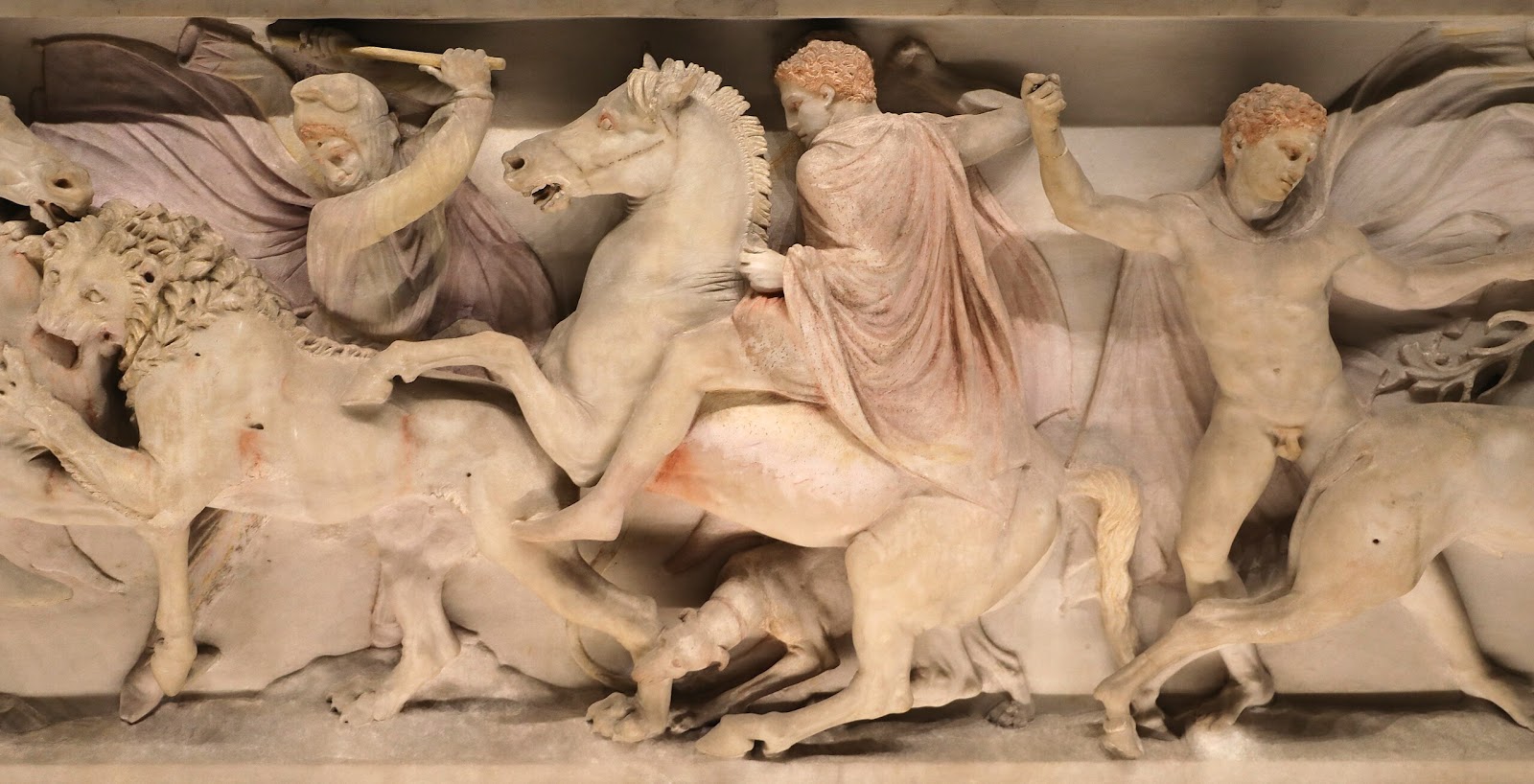
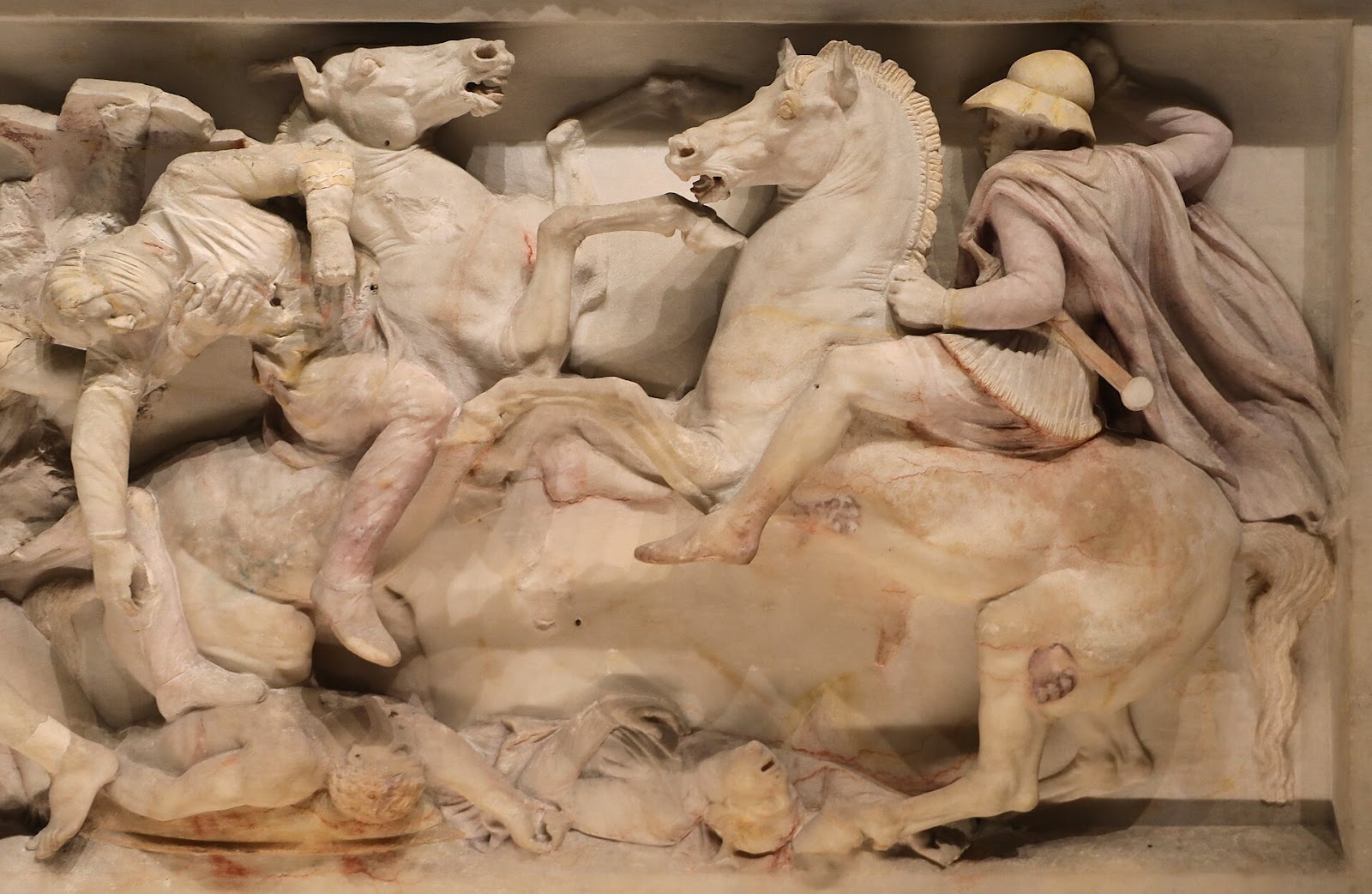
Alexander sarcophagus in the Istanbul Archaeological Museums - short side & the battle of Issus

 Salvete Omnes,


the short sides of the sarcophagus contain two battle scenes - here I will share with you the photos form Wiki Commons of the battle of Issus (eg prof. Nicolas Sekunda's The Persian Army - book published by Osprey Military Publishing)


beautiful sculptures to study, copy and interpret - link to Wiki in my previous post
enjoy

Valete

Alexander sarcophagus in the Istanbul Archaeological Museums

 Slavete Omnes,


the great Istanbul museum has this amazing piece of ancient  Greek funerary art -  The Sarcophagus of Alexander - from Sidon in the ancient and beautiful land of Lebanon. 
this is the first of my post showing this sarcophagus - and thanks to the photographers and museum policies in Turkiye we can enjoy almost every detail of this amazing sculptural work. 


the top of the sarcophagus ..


more to follow 

Enjoy
Valete

Monday, July 18, 2022

Alexander astride Bucephalus - Pella

 Salvete Omnes,


I came across this equestrian monument while perusing Wiki Commons -

This is a sculpture erected in Pella (Greece), the ancient capital of kingdom of Macedon, and was sculpted by Constantinos Baliou Loghos.(says wiki)

This modern sculpture is realistic and symbolic at the same time - Alexander holds a figure of Nike - goddess of Victory - in his extended hand.


 unfortunately the bridle as sculpted is a modern one and does not belong here - more about Alexander and his horse's tack in a separate post .
Still Bucephalus as depicted here is strong, powerful and war-horse like - so I say it is a powerful and moving image of the famous pair.

Valete

Wednesday, October 17, 2018

Ancient bit from Dodona Sanctuary

Salvete Omnes,
a little time jump today, we will time travel to the ancient Epirus where at Dodona since the time immemorial had been a sanctuary and oracle.
Pegasus or  winged horse from Louvre

Excavations brought forward various and amazing objects of art from across the ancient Greek antiquity.
 Among them, on display at the Athens Museum,  there are the fine examples of the ancient metal forging arts from the IV century BC/Ante Christum , a two different bit parts (one from Dodona, and one from an unknown location), shown at the museum as one large bit: with large S psalia and elaborate discs on the 'bit-bar,' shortened ringchain and studded bars between the psalia and discs. The s-shaped psalia or cheekpieces look a bit like the wild boar's tusks and could make the horse head appear quite unusually grotesque. Similar bit is displayed on the Alexander Mosaic.


the way this composite bit is constructed or displayed on a see-through horse's head -
- with its discs sharp, pointy and this large inside the horse's mouth and the metal chain rings joining the two pieces very short and with rings loose inside the mouth (perhaps dangling on the tongue) to create one horse bit,
- then perhaps this display  in this entirety presents a hypothetical piece of horse equipment, and not a real one (my old rendering of the Persian bits now make me think twice about them too). Because how would they  operate this bit without completely ruining a horse's mouth  (as it is 'reconstructed' in the museum).

a horse from Dodona, rider missing - note this  horse with rider from Boston Museum, dated to late VI century BC.
horse from Louvre

Valete!
ps
Alexander Mosaic from Pompei -  the Persian Achaemenid horses with S-shaped bit


***