Showing posts with label XVII c. horses. Show all posts

Monday, April 20, 2026

La Gerusalemme liberata - Tassos epic poem in XVII c art

 Salvete Omnes,


Jerusalem Delivered or in original Italian- La Gerusalemme liberata (1581AD) - an epic poem on the liberation of Jerusalem by the First Crusade (1099AD) by Italian poet Torquato Tasso. The famous poem has been published many, many times and  illustrated by many artists over the centuries since its publication. 

I corralled some illustrations of the poem created in the XVII century - by David Tenniers the Younger, Nicolas Poussin, Paolo Domenico Finoglia.  

. Paintings by Finoglia and David Tenniers the Younger 


...


paintings by Nicolas Poussin 


.


the most acclaimed English translation was accomplished by Edward Fairfax and published in 1600AD. - the 1901 edited version from Archive


Polish poet and translator Piotr Kochanowski, Korwin coat of arms, wrote his version of the poem and this translation was published in 1618, but was not limited to a single edition as it was printed several times during the XVII century. 

1651 edition 

Valete

Thursday, February 5, 2026

More of Sadeler's horse & wagon prints

 Salvete Omnes,


following the previous post on the Sadeler's  Italy-related printmaking, I would like to share some more of the corralled equestrian imagery from the chisels and knives of master Aegidus.


.


.


enjoy

Valete

Friday, September 12, 2025

Vienna 1683-2025 - horses

 Salvete Omnes,


today we commemorate the battle of Vienna 1683 -  I have written many posts on the battle, and I am sure will write many more, God willing. 

I would like to commemorate the struggle with the images of horses from the period paintings, mostly from this one - Anonym Entsatz Wien 1683 (painting in Vienna , Austria). 


Many thousands, perhaps a hundred thousand,  of horses participated in this battle. Horses on both sides suffered from lack of adequate feed. Days before the battle the Ottoman side had to take  their horses across the  Danube River to pasture and hay cutting parties roamed further and further from the besieged city and their own camps. During the battle some horses died from wounds but many more, especially of the Polish cavalry and wagon trains, died from malnutrition and near  starvation (the last couple days before the battle they ate tree leaves or nor food at all,  ). After the battle there was very little fodder  in and near Vienna, captured Ottoman camps had stores of fodder but they were wasted by the pillaging victorious soldiers,  while mostly Polish forces captured more than 20,000 animals in the Ottoman camps, including some very fine Turkish and Arabian noble horses.
Imperial bureaucracy was slow to deliver hay and grain to the encamped armies, while the armies  immediate supplies for men and horses. Only when the Polish royal army decamped away from Vienna and entered the country near Pressburg (present Bratislava) they had enough fodder for their horses - but then many Polish soldiers were sick with fever (bloody dysentery) and dying from this plague.
There was more fighting to be had in October against sultan's vizier Kara-Mustafa and his armies. 

Valete

Tuesday, March 18, 2025

A paint with a royal rider - Valdemar Christian and Potop 1656

 Salvete Omnes,


back in the XVII century, during the infamous Deluge - 1655-60- or the Swedish invasion and mayhem in the Polish-Lithuanian Commonwealth.
And from this period comes another splendid paint horse with a rider who was a son of a king, Valdemar Christian of Schleswig-Holstein.


Our prince in question was a cavalry commander within the Swedish royal army during the 1655 invasion, he commanded a regiment of reiters he had completed enrolling in Bremen,  at that time was a territory taxed and aligned with the Swedish realm.


Polish soldier, poet and chronicler Wespazjan Kochowski wrote that this Swedish mercenary and Danish prince was wounded at the battle of Golab in February 1656 and died in Lublin, around the time when the Polish-Lithuanian forces took the city from the Swedish occupiers in April 1656.

Some interesting elements of this horse tack

very ornate saddle and tack

the beautiful paint is shod with horseshoes

quite short shanks on this curb-bit, while forelock and mane are just flowing 

enjoy

valete

Sunday, September 8, 2024

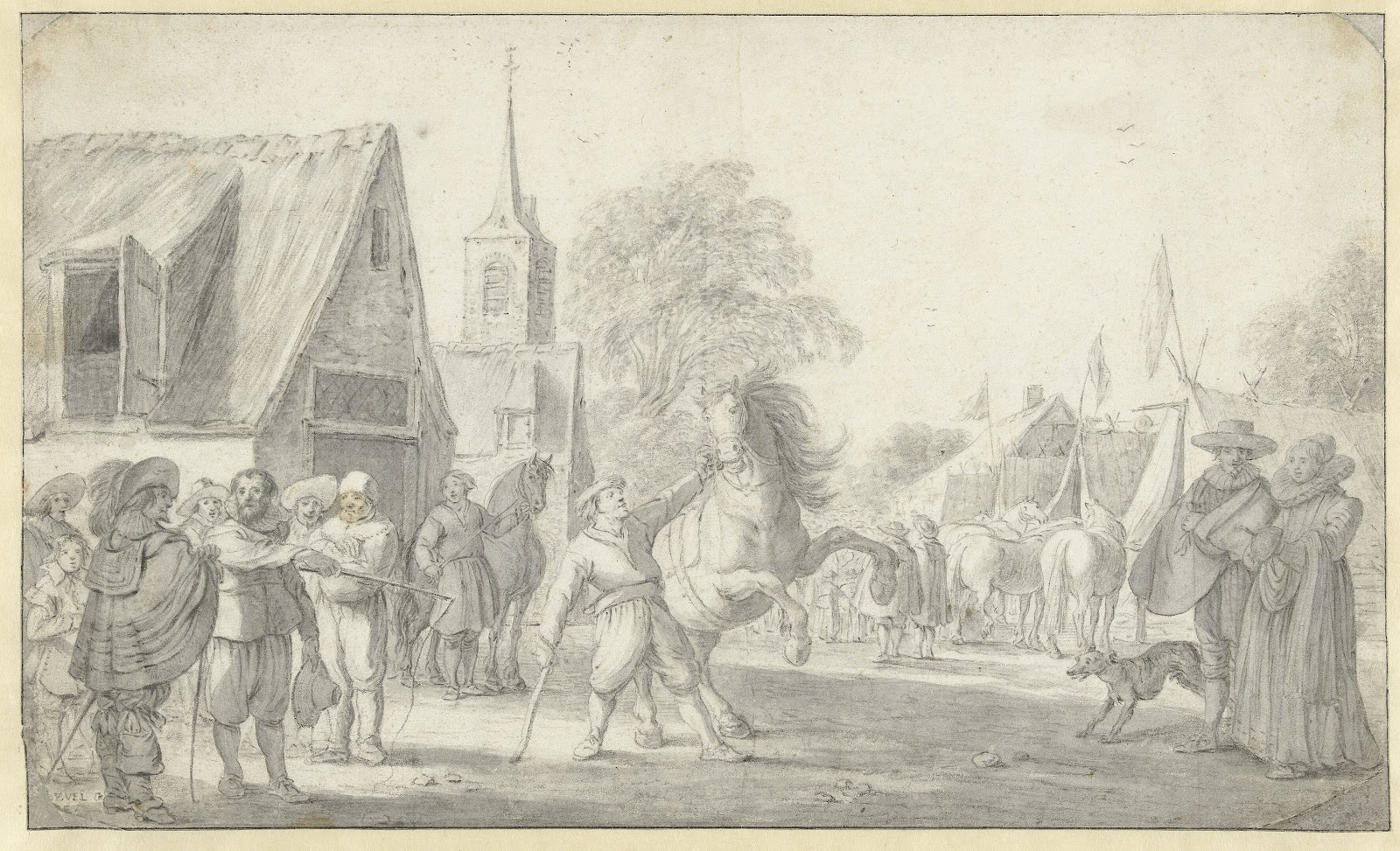
Esaias van de Velde - horse-related drawings etc

 Salvete Omnes,


a little jump in time to 1600-20s, horse-related drawings by a Dutch maestro Esaias van de Velde (1587-1630). - early XVII century cavalry, wagons, horse transport etc


.

horse soldiers


.

horse market


Valete