Showing posts with label Ottoman jannisary infantry. Show all posts

Tuesday, November 11, 2025

Chocim 1673 AD - Jan Sobieski's infantry and cavalry victory

 Salvete Omnes,


On November 11, 1673AD Polish-Lithuanian Commonwealth armies under the command of Crown  hetman Jan Sobieski, aided by many capable senior commander like Lithuanian grand  hetman Michal Pac and junior commanders like Mikolaj Sieniawski, destroyed the Ottoman army, commanded by Hussein Pasha,  at Chocim (Khotyn in Ukraine now, by the will of Joseph Stain since 1945). Our king Michal Korybut Wisniowiecki died on Nove.10, 1673.
Polish historian D. Orlowski estimated, in his popular book Chocim 1673 (2007), that there were 27 thousand Crown soldiers, the Grand Duchy of Lithuanian brought close to 7 thousand soldiers. In total some 34 thousand soldiers, 65 cannons and 1 mortar. There are still the armed servants from the noblemen soldiers retinue, and we don't know how many of those participated in the storming of the Ottoman earthworks and camps. We have to take into account the 4-5 thousands of the Moldavian and Vallachian soldiers who came over to the Polish side with their rulers. Their infantrymen must have participated in the storming, capturing and dismantling of the Ottoman earthworks.

Ottoman army under Hussein Pasha, according to the Polish historians, were about 30-31 thousand strong, well provided for with munitions, supplies and fodder for the winter. They had a 25-30 artillery pieces and were in contact with their commands in Moldavia and  Kamieneci Podolski, and it is thought that the some Moldavian and Vallachian troops who had stayed with the Ottomans. They could not count on the Tatars, because these Ottoman vassals had been attacked by the Kalmucks from the  Don steppes, and Zaporozhian Cossacks from the north and west. 

I should add that before the battle there were tournament like duels and fights (harc in Polish) between bravest and most audacious horsemen from both sides. Two Polish notable knights died in these duels on the 9th of November, namely the Sieradz sub-cupbearer Jedrzej Modrzewski and leutenant Florian Maj. Polish-Lithuanian tried to take the earthworks defended by the jannisaries on the 10th but after a number of  very bloody engagements Polish attackers had to withdraw from the Ottoman fieldworks. Polish side maintained formations and martial spirit during the night of 10/11th  and thus Ottoman side had to stay in armor and with arms. 

In the morning of the 11th Polish artillery opened fire - the chroniclers say a quarter hour in duration of artillery fire. At 8 A.M.  in a surprise attack the  Polish infantry regiments and companies, camp servants and dragoon companies stormed the earthworks. with Jan Sobieski with a sabre in hand walked ahead of   his own dragoon regiment, yelling - 'for the love of God, for the [Christian] faith, and churches, for Amor Patria (Love of Homeland), with hope in God attack them courageously.'  many great infantry officers and other commander like the Crown artillery commander Marcin Katski,  Stefan Stanislaw Czarniecki, Korycki, Zebrowski, Denhoff, Tetwin, Heydepol, Pietrzykowski, etc. The rest is history 
We should note that Hussein Pasha, with about 5 thousand spahis cavalry, had made across the Dniester bridge before it collapsed, and found refuge in Kamieniec Podolski, with Halil Pasha.  But 8 thousand spahis perished, 6-8 thousand of jannissaries were cut down, many good commanders were killed or died from the wounds. 3000 Ottoman soldiers were taken prisoner.  
Both the small fort on the Turkish side of the river and the Chocim castle (Nov 13th) were taken.
Jan Sobieski marched his Crown army into the Turkish lands, Moldavia, and the war went on, and it was not going as good as the victory at Chocim promised. Moldavia was to become the object of Sobieski-Ottoman struggle and warfare for the next 20 odd years. But that is for another post. 

 
 The next Spring Jan Sobieski would become Jan III after the free election by the noblemen at Wola, then a village near Warsaw.

Saint Martin in the foreground, with Jan Sobieski and his army at Chocim in the background. 

 I played a little bit with this Vasa battle-flag and changed the Vasa coat of arms to Janina, Sobieski family coat of arms. 


. Jan Huchtenburg painting battle  at the National Museum, at Warsaw.


.

Jan Pasek, who was not at the battle, observed  in this Memoirs:   'During this[1673] the Turks did no leave the field [of war], but entrenched themselves at Chocim and encamped there. [..] with the Tatars already having gone from them. In inaudio exemplo (unheard of example) our side decided to take the entrenched camp, first they came close to the fieldworks, had the entire camp circumcirca (all around) surrounded. The  infantry climbed the walls' of  Turkish earthworks, and destroyed these walls nemine reclamante (with nobody protesting), since the Turks did not even fired their artillery, yet they had so many artillery pieces [at their disposal]. Our Lord must have blinded the pagans and taken away their hearts[courage]. for they received our men, who were clamoring to get to them, as modeste as if a guest had been arriving and not the foe.

Polish researcher-historian Zbigniew Hundert published an article [in Polish] on the winged hussar companies at Chocim 1673 - available on Academia. 

Like I write above, many thousands of men and horses died in this struggle, and when the bridge across the Dniester River, from the Turkish entrenched camp to the Moldavianside where there was a small Turkish fort, collapsed under the weight of men, horses and equipment, many more Ottoman soldiers and servants perished in the icy waters of the mighty river. Many perished from the Polish light cavalry pursuit and also from the wrath of the Moldavian peasantry. After the victory and march either back to Lwow or march into Moldavia,  the Polish-Lithuanian camps saw many thousands of horses die from the  very cold weather conditions etc. 
. 

Perhaps some other time I will write about some aspects of this battle - like the booty and captives and animals taken by the victorious side.

Happy 11th to all Polish people around the globe and to all Veterans

Valete

Sunday, September 26, 2021

Cecora 1620 - Iskander-Pasha, Tatars and Ottoman army

 Salvete Omnes,

re: Cecora-Chocim battles theme  as the anniversaries are here- 


let us turn our attention to the Ottoman forces that 401 year ago took to the field against the Polish-Lithuanian Crown army that marched into Moldavian territory in September 1620AD. 

Faced with the Commonwealth invasion led by grand hetman Stanislaw Zolkiewski  the Ottoman Empire command   in the region had various types of troops available to them, namely, the imperial troops paid by the state, nobles levy (toprakly) and finally the vassals,allied and tributary troop. The most important allied soldiers were units brought by the Crimean Tatars and steppe Tatars (Nogai, Budjak etc).

The experienced northern  Ottoman commander  beylerbey of Silistria   Iskander (Alexander) Pasha who according to the Turkish sources could have been Hungarian, tall and brave (like Rustam of the ancient fables) shaved his beard in a Bulgarian fashion leaving a big mustache - was to command this rather motley of forces to face the invasion.


Iskander-Pasha was rather quite experienced in warfare against our Polish-Lithuanian armies on this front.

as far as I can gather he might have  been  one of the lower Ottoman and Tatar commanders led by Ibrahim Pasha, Wali of Silistria, that defeated large Polish-Lithuanian army (large component consisted of  winged hussar banners) at Sasowy Rog on July, 19 1612AD; 

Iskander Pasha  is certainly known as the  victorious commander over another Polish-Lithuanian army (that had large contingent of winged hussars) again at Sasowy Rog in Moldavia on August 2, 1616. His command contained Ottoman, Tatar, Moldavian, Wallachian and Transylvanian troops.

In the summer of 1617 he commanded a large (perhaps 40,000 strong) army, but apart form raiding some villages, including burning of Raszkow on the Polish side of Dniester, there was no large action against the Polish side recorded. But by standing on the border, i.e,  Dniester river, and threatening the Polish-Commonwealth with a savage invasion,  this warlike demonstration resulted in a peace treaty of Busza (September 23, 1617), where Polish-Lithuanian Commonwealth agreed to stop interfering into the Moldavian, Wallachian and Transylvanian(Bethlen Gabor ) affairs, stop the Zaporozhian Cossack invasion into the Ottoman lands, and  return Chocim castle, on the Moldavian side of the Dniester Rive, to the Moldavian principality.  The Ottomans were to stop the Tatars from riding into the Commonwealth.  Both sides immediately and consequently always  failed on the prohibition of riding each other by their proxies.

The 1620 found him rather short of large number of Ottoman troops when compared with 1617 and without any support from Bethen Gabor and other vassals, but  the Tatars were present and ready, and he was aided by various Ottoman regional commanders with their very limited troops - 

We know that  had some jannissaries and  sipahi cavalry units, and Ottoman artillery. Probably he had a body guard of chosen troops, including the deliler (deli singular) or guard cavalrymen, and all his Ottoman commanders had such bodyguard troops. Chronicler Naim claimed that Iskander Pasha had only 1000 of his own troops.
Five other sanjaks provide some troops, commanded during the battle by these commanders:  Jusuf Pasha  beylerbey of Rumelia, Circassian  Hussein Pasha, Nikopol Mutasarrif Chyzyr pasha, Vidin Mutasarrif Sarymsak-Terjaki Muhammed Pasha (after the ''Collectanea or the compliation of Ottoman' primary sources translated into Polish by Sekowski, and published in 1824 in Warsaw, Congress Poland)

Crimean Tatar horde units  were led by Galga Soltan Devlet Giray, aided by Neberd Giray and varied in number, more about the numbers below.

Uymak(horde) of  the Nogai Tatars was commanded by their zealous ghazi warrior and enemy of the Christian foe - Kantemir Murza and his brave sons- Urak Mirza, Selman-shah and Ynayet-Shah and Weli-shah.
Finally there were also Wallachian tributary troops

Period Ottoman Turkish sources claimed that iskander Pasha had less than 10,000 soldiers under his command.

Polish contemporary sources saw various numbers - 10-15,000 Tatars and about 2-300 Ottoman Turks plus Wallachian tributaries.
We should also think that there were camp servants - all professional cavalry and troops had servants, all noble cavalry had armed servants and non combatant retinues, and also led thousandth of animals, spare horses, train and pack animals, and animals for food. Also Ottomans often counted all living beings as the part of the army, but it appears that here they just counted the combatants.


Polish historian Majewski in his book 'Cecora,' p 180,  set forth the following numbers for the combined forces commanded by Iskander Pasha:

2000 Ottoman soldiers (imperial?)

2-3000 Nogai Tatars

6-8000 Crimean Tatars. led by 


eg Leszek Podhorodecki saw the Iskander Pasha army as:
4-6,000 Ottoma Turks and Wallachians

5,000 Nogai under Kantemir Murza

6-8,000 Crimean Tatars

...

Valete

Thursday, May 27, 2021

Costumes de la Cour du Grand Seigneur

Salvete Omne,


a quick entry today -  the great French National Library on line aka Gallica contains a digital copy of a manuscript titled  'Costumes de la Cour du Grand Seigneur '[Ottoman Turkish emperor], compiled around 1630AD.


Drawn and painted in gouache, and written in Italian this manuscript is a veritable feast for the eyes, showing the splendor and beauty of the old Ottoman and Crimean Tatar costumes and people. 


Some of the plates below:

Tatar khan


Tatar warrior

Sipahi


Cairo [Ottoman Egyptian cavalryman)


and his servant

master of the stables


Courier 


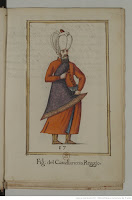
Janissary


Valete

Thursday, January 23, 2020

Claes Ralamb Costume book - horses and tack

Salvete Omnes,
one of the Swedish Kingdom ambassadors to the High Porte in Constantinople ( Istanbul) Claes Ralamb ordered a so called Ottoman costume book painted for his collection while at this post, and he took it with him back to his homeland (along with the famous sultan procession paintings ) - mentioned already on my blog long time ago.
the digital copy of the entire book here.

from that collection we can 'corral' the paintings showing the horse  of the Ottoman empire -


an Ottoman sipahi


 also of interest are these wild cats (leopard etc) pelt-skin clad warriors of the Ottoman sultans etc - some of them are the jannisary, and some are deli warriors.


and finally  a Safavid Persian with a kalkan shield at his belt? covered by his coat - an interesting way to carry the kalkan

Valete

Saturday, December 15, 2012

sketches for Christian Cameron's novel 'Tom Swan'

Salve,
great historical fiction writer Christian Cameron is an author of new series taking place in mid XV century time period, where the main character is an English lad named Tom Swan. I read all three books and had so much fun that I can recomend this series to anyone who wants to time travel to the last battles of Hundred Years War, to the Republic of Venice and to Turk conquered Constantinople in old fashion style - by horseback or by galley :).  The adventure is fast paced but set firmly in the time period, but be forewarned that this is the world of fighting men and swordplay is frequent and very realistic. A review here.

I did some illustrations for these books and now I am  going to share my sketches with you. Hope they will be liked :)

First I copied, using MyPaint, some Bellini drawings:
.
.
.
Sketched some horse tack:


Byzantines (still in Morea):


Ottoman Turk Janissary:


and Western European characters including the main personage of Tom Swan


all sketches were done using MyPaint and worked over with GIMP