Showing posts with label Medieval Poland. Show all posts

Tuesday, July 15, 2025

Grunwald 1410-2025 AD

 Salvete Omnes,

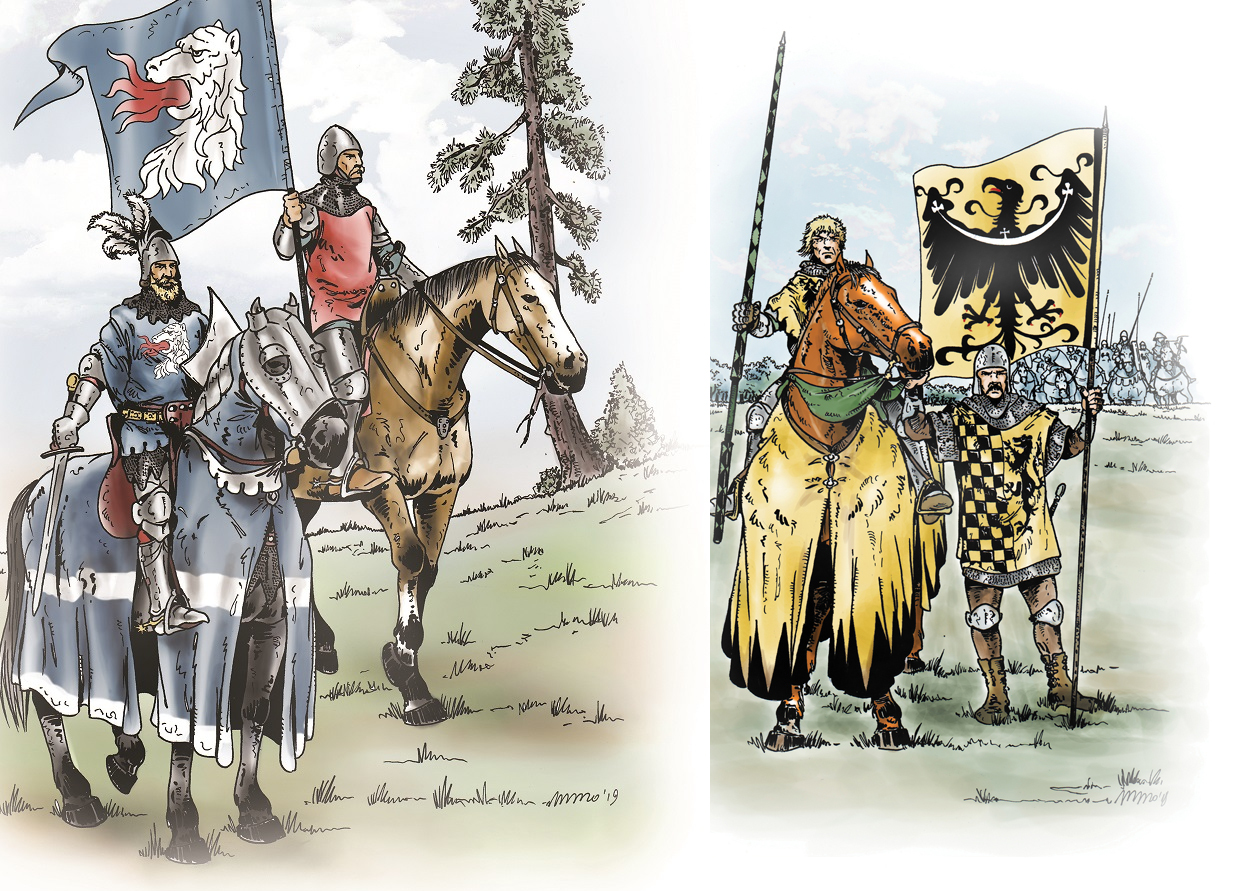
WHP - Banners in the battle of Grunwald

hear! hear !-  today's 615 years since Polish Kingdom and allies' gained their great victory over the Teutonic Order and Western European allies in the fields between Stebark and Grunwald, near Olsztyn in Poland.


A short video on the armament and armor of the knight [in Polish]
Another video on the armor and armament of a lightly armed horseman [in Polish], also the non-battlefield parade dress of the well-to-do nobleman or magnate [in Polish]
The Grand Master Urlich von Jungingen  - Jaroslaw Struczynski of Gniew Castle in this role - reenactment at Grunwald [in Polish] Among others there is a tale about the horse and needful training of horses for reenactment. 

video on the  Teutonic knight - arms and armor[in Polish]

This year reenactment of the famous battle took place past weekend, July 11-13, 2025 - here a short video prepared by Gazeta Olsztynska. Here a view from the bleachers. On Facebook you can faind hundreds of photos of this year's reenactment, eg search this photographer Ann Nowakowska. 

also,

do recall that in 2023 I translated and reedited this book by Mariusz Moroz from Winged Hussar Publishing LLC - it can be had from Amazon or WHP site.


and do not forged Jan Matejko's opus magnum (and many other paintings of this battle), Henryk  Sienkiewicz' fabulous novel, and the fabulous Polish 1960 film -Teutonic Knights.

Pacem Aeternam to all knights, squires and retainers

Valete

Monday, October 2, 2023

The Banners in the Battle of Grunwald 1410

 Salvete Omnes,

copyright of Mariusz Moroz & Winged Hussar Publishing LLC

a quick but happy entry  about a project carried out to fruition:

lastly  I have been involved in the translating, editing and fine tuning of the English language edition of the Polish company - Wydawnictwo Kameleon - publication titled 'Choragwie pod Grunwaldem' (Banners in the Battle of Grunwald) which deals with the famous battle of Grunwald AD 1410. 
The plates for this album had been drawn and painted by Mariusz Moroz , Polish artist, including being a successful tattoo artist. The Polish text, that I helped translate and edited, had been written by a seasoned writer and publisher Robert Zareba. 

copyright of Mariusz Moroz & Winged Hussar Publishing LLC

The book allows for a final one-volume collection of the banners of the opposing sides, and also contains banners captured by the Polish knights at Koronowo and Dabki (two victorious for the Polish side battles of the fall 1410). 

The American publishing company - Winged Hussar Publishing LLC -  produced this  edition of this book - 208 pages. The project has been a challenge on many levels, like the names of historic persons involved,  localities and  historic regions, the chronology and terminology etc, but finally has been completed and it will be available for your pleasure and enjoyment by the end of October 2023. Also in the United Kingdom eg on Amazon UK. 

copyright of Mariusz Moroz & Winged Hussar Publishing LLC


copyright of Mariusz Moroz & Winged Hussar Publishing LLC


enjoy

Valete


Tuesday, August 9, 2016

Saddle from Wielun XV century

Salve,
yesterday I wrote about  visiting the Slav and Viking Festival in Wolin, Polish Republic. I met there Mieczyslaw Mietko Machowicz from Kalisz, Poland, who leatherwork master and historical leathercraft reconstructor and researcher.
In his tent, along with many different examples of his craft and various leather and hides for sale, he had several interesting examples of horsetack and several saddles.

The saddle that brought my utmost attention is this one, from Wieluń in Poland:

reconstructed XV century saddle

 Article about the exhibit in Wielun, including a short information about this saddle, and many photos from this exhibit.

historic excavated saddle from Wielun
a Polish saddle circa 1467, a detail of a painting from the Holy Trinity/Holy Cross chapels at the Wawel cathedral
The historic saddle reconstructed by Mietko was excavated during the archaeological excavation in Wielun, Poland. According to the maker, the saddle has been used while riding, on the Polish 'konik' and with plenty of comfort and safety.
Below find some photos of this historic reconstruction.

saddle tree, horizontal view

saddle, horizontal view

saddle -front arch(pommel), right side

saddle - front arch (pommel), left side

saddle and saddle tree, horizontal view

saddle, 'underside' with rear arch (cantle) visible- with bars covered, and birch bark layers shown, saddle skirts from underneath

saddle, 'underside' with rear arch (cantle) visible- a closeup

so as you can see the saddle appears to have been a riding saddle, not a lancer war saddle, but it could have been used by the crossbowmen and squires too.
and one of my most favorite saints always on horseback - St. Martin in a painting from late XV century Kingdom of Hungary

ps
when I opened the photos I realized that I had not taken any shots of the saddle tree alone, and no shots of front and rear arches (pommel and cantle).

Thursday, April 14, 2016

the 1050th Anniversary


Salve,
 they say that today, on April 14, but 1050 years earlier or in 966AD a Polish ruler Mieszko (Dagome) and his court were baptized and became members of the Christian community. This ceremony occurred perhaps  in one of the strongholds these Piast rulers had built in Wielkopolska (Greater Poland), either in Ostrow Lednicki or Poznan. He was a ''Rex Barbarorum'', and his state quickly arose to prominence on the eastern flank of the Holy Roman Empire, at odds with the fellow Slavic and Christian Bohemian state, and poised to take more lands and tribes in all directions.

As the records are scant we can but speculate about the extend of his state so by the 990AD


Since the very beginnings of Christian Poland are mostly shrouded in myth, legend and hearsay, other than written records have to provide some more detailed info about the early medieval Poland.

Archeology has provided some answers about the Piast state. It appears now from dendro-chronological analyses undertaken in 1990s that the early medieval Polish state begun at the turn of the IX century, while the huge building projects peaked in the 930s through early 940sAD, thus it can be said with certainty that our Piast Poland rose to prominence in 940AD.