Showing posts with label XVII century German lands. Show all posts

Thursday, December 4, 2025

Graff Anton of Oldenburg and his horse Kranich

 Salvete Omnes,


a short a quick XVII century entry.


Graf (count) Anton (Anthony) Gunther of Oldenburg (1583-67)  was one of the longest ruling, 1603-1667, aristocrats of the Imperial lands and cities. 

Kranich was bred Graf's studs circa 1640.

Graff astride his horse Kranich (Crane) - Jacob Sandrart's print circa 1671

Graf Anton, having inherited numerous fine stallions and stables from his predecessor count Johann XVI, also bought stallions for his stables: Neapolitan, Spanish, Danish, Polish, and Turkish. He had his stable masters made these stallions available to the local Oldenburg breeders, who in turn bred their local mares to these fine horses. Thus Graf Anton has been credited as the founder of the Old Oldenburg horse, that became famous carriage horse of the XVIII century, and today is a famous warmblood. 


Mural on the Haus Graf Anton Gunther in Oldeburg


the horse and graff have been subject to reenactment eg (from Wiki Commons)


Valete

Sunday, February 12, 2023

Wilhelm Peter Zimmermann - quintain at the wedding feast

Salvete Omnes,

back to the XVII century 

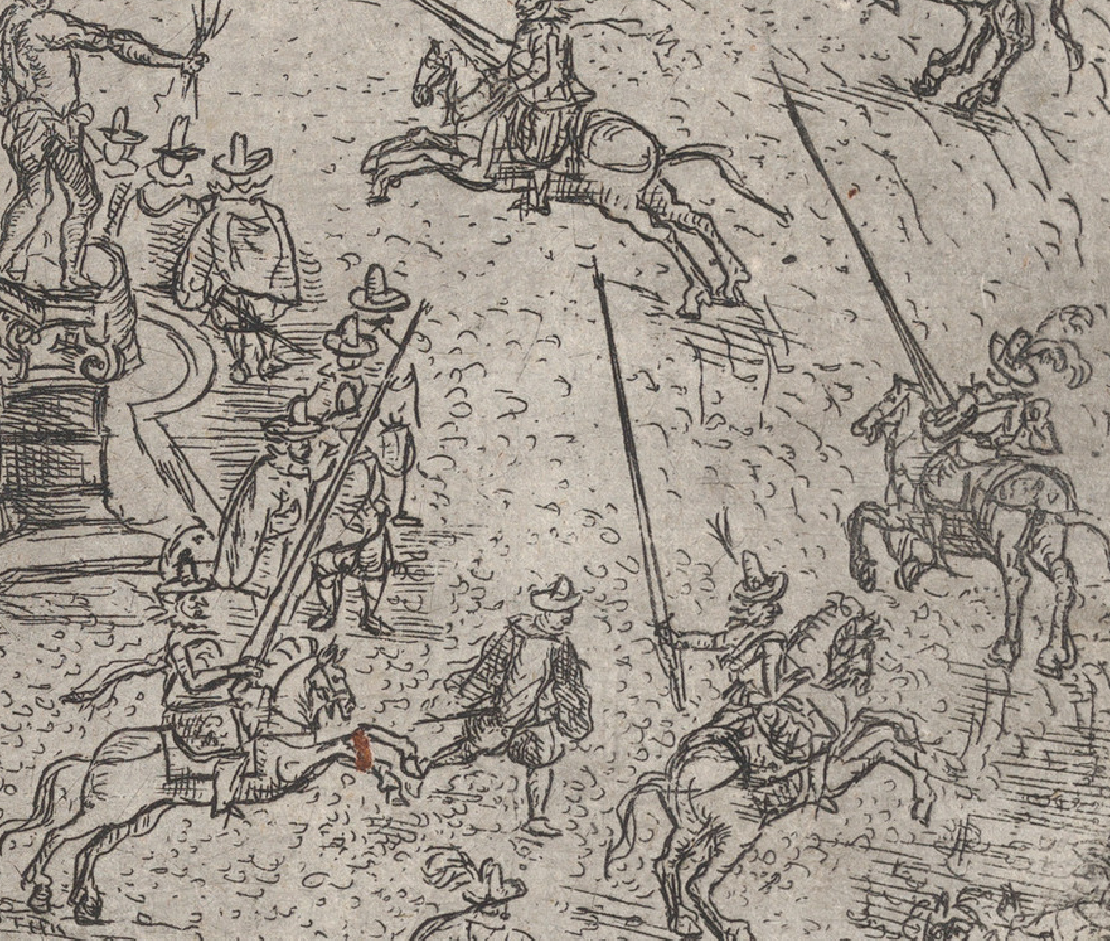
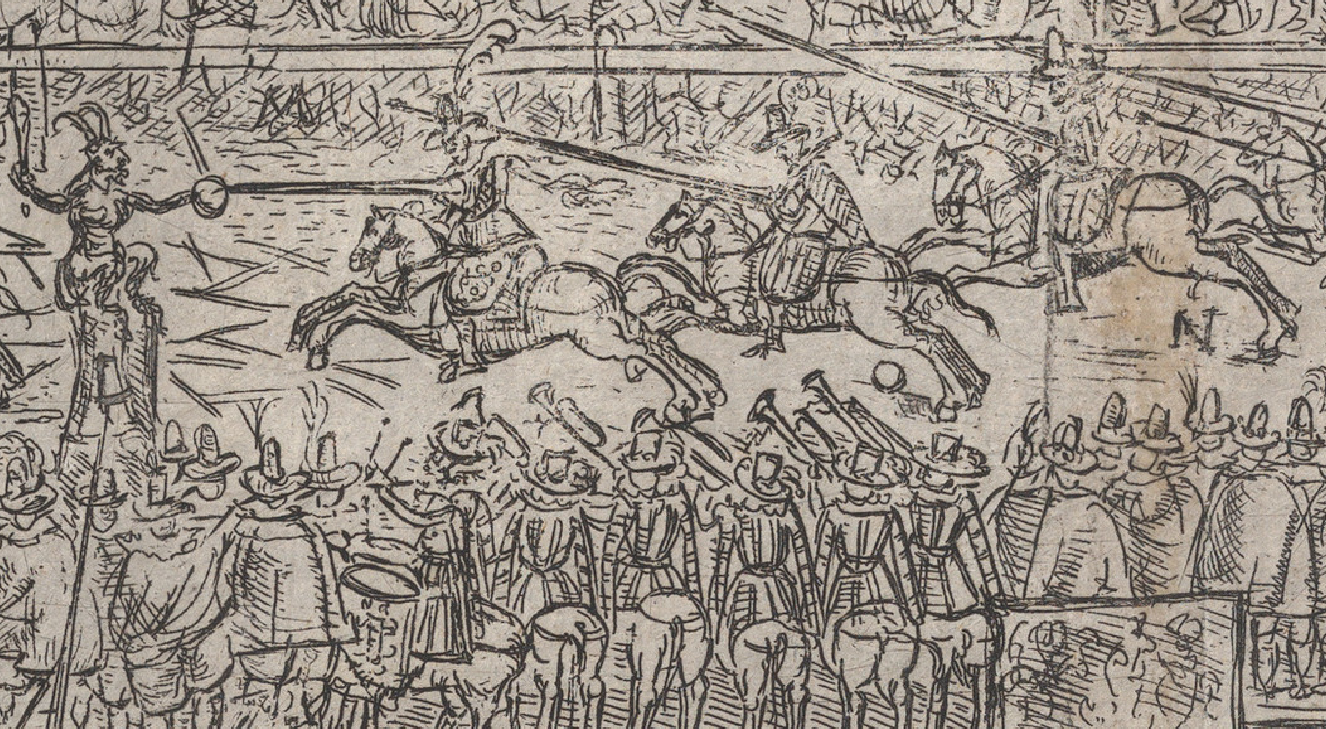
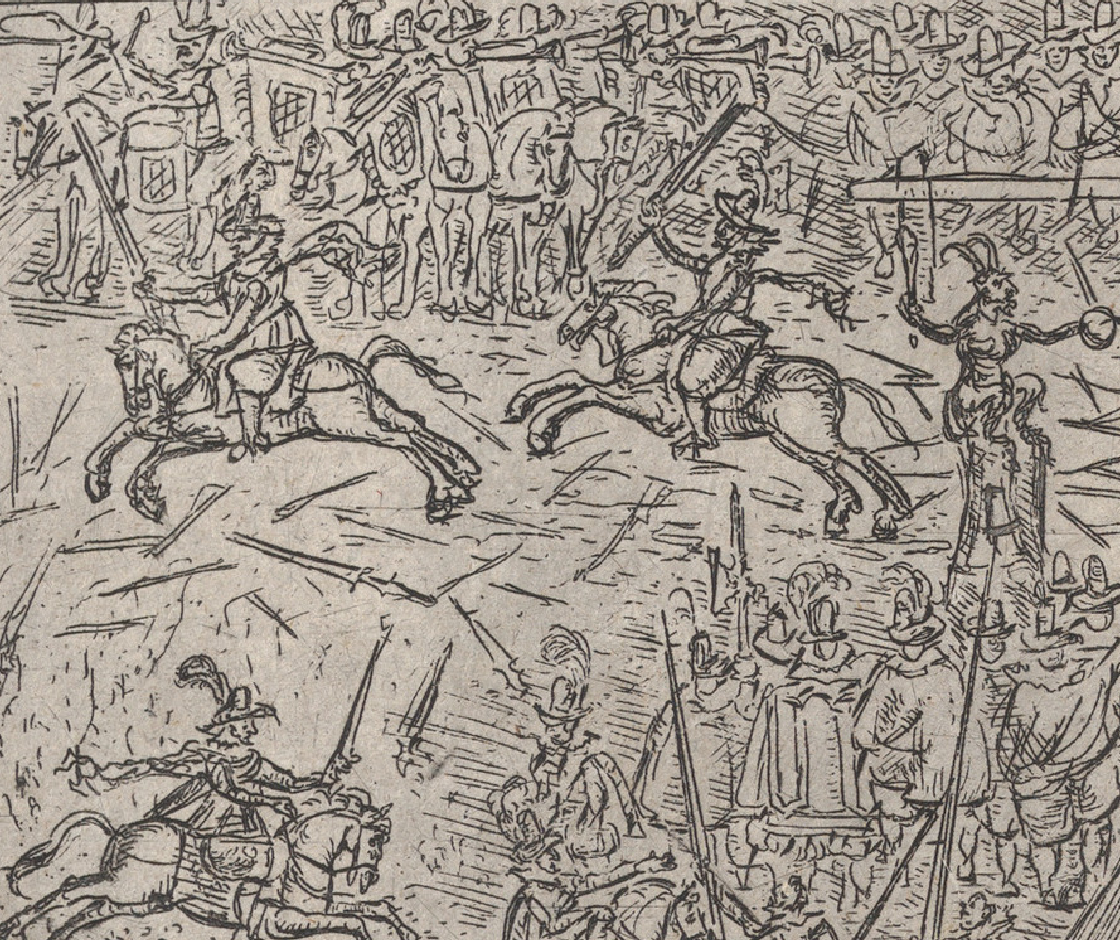
quintain with lances


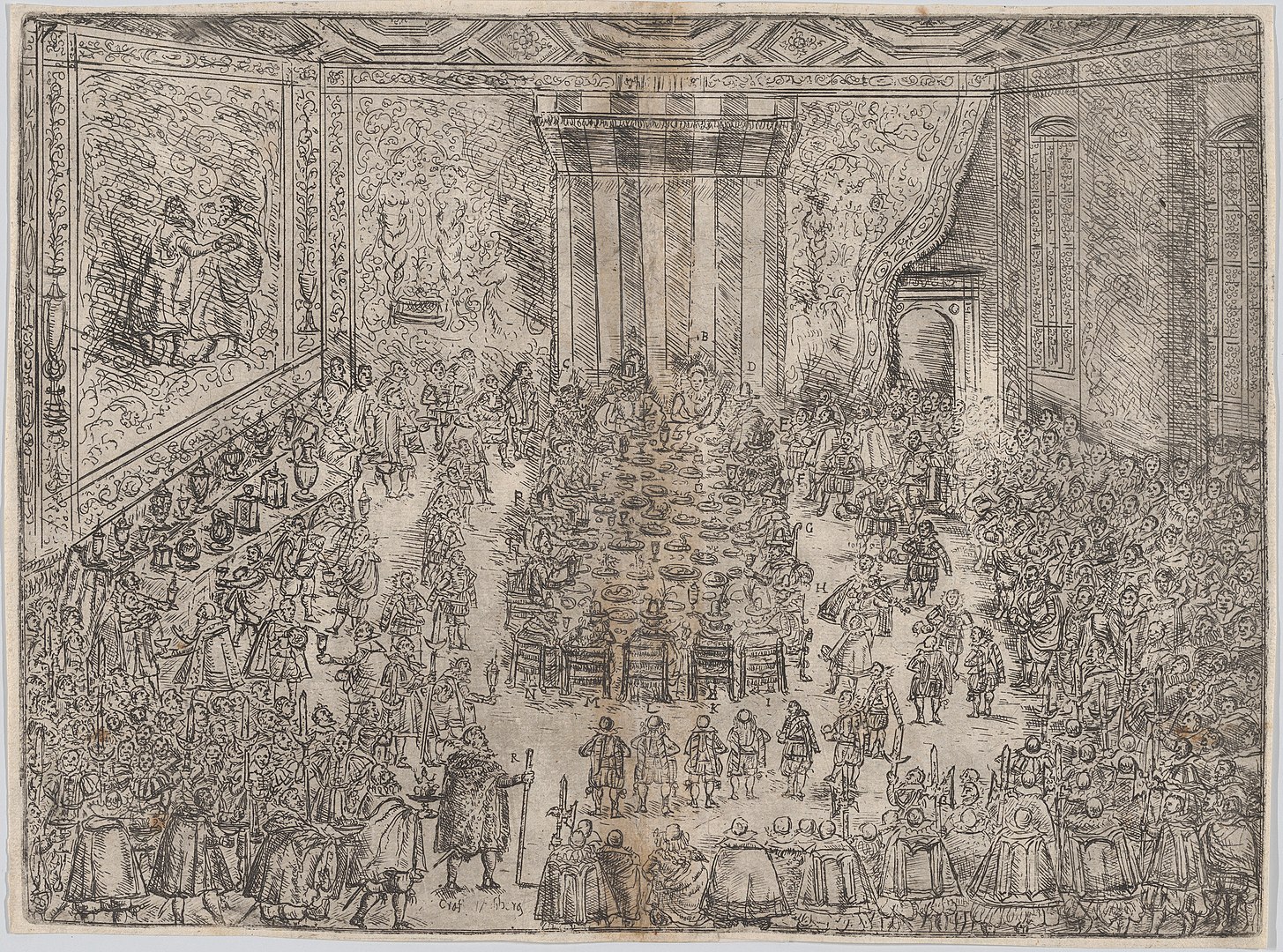
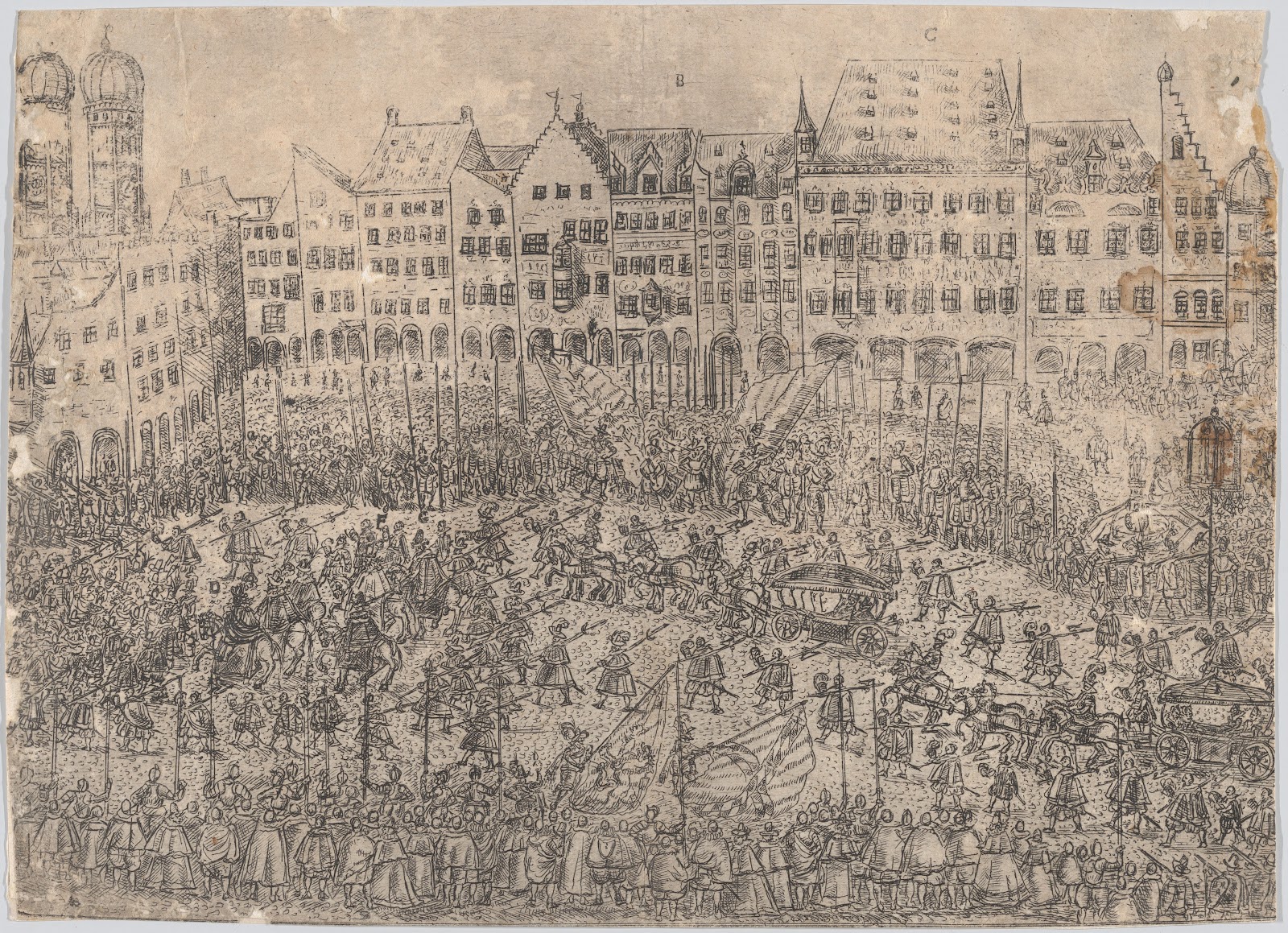
 let us move fast - so, the German printmaker Herr Wilhelm Peter Zimmermann (1589-1630) did execute 11 etchings and based on them a number of  prints celebratory of the noble wedding of the houses of Bavarian Wittelsbach  and Pflaz(Palatinate)-Neuberg Wittelsbach.
From MET description:

This print is one of 11 etched illustrations from a book containing a description of the wedding festivities for 

Wolfgang Wilhelm, Duke of Pfalz-Neuberg, Pfalzgraf (1578–1658 - great portrait with his dog) and Magdalena, Duchess of Bavaria (1587–1628) (beautiful portrait here). 

The marriage took place in Munich on November 12, 1613, and the commemorative book was published by

 Wilehlm Peter Zimmermann in 1614 in Augsburg. 


Plates 4, 7, and 10 are in the collection of The Metropolitan Museum of Art.

Book title: Beschreibung und kurtze Radierte entwerffung der Füsrtlichen Hochzeit So Der Durchleuchtig und

Hochgeborn Fürst und Herr Herr Wolffgang Wilhelm Pfalzgraff bey Rhein/ Hertzog in Bayrn... Mit.. Fürstin Fraw 

Magdalena Pfalzgräfin bey Rhein Hertzogin in Obern und Nidern Bayrn. 

Zu München im sechszehenhunfert und dreyzehenden Jahr den zwölfften Novembris Celebriert und gehalten

 (Wilhelm Peter Zimmermann, Augsburg, 1614)


...
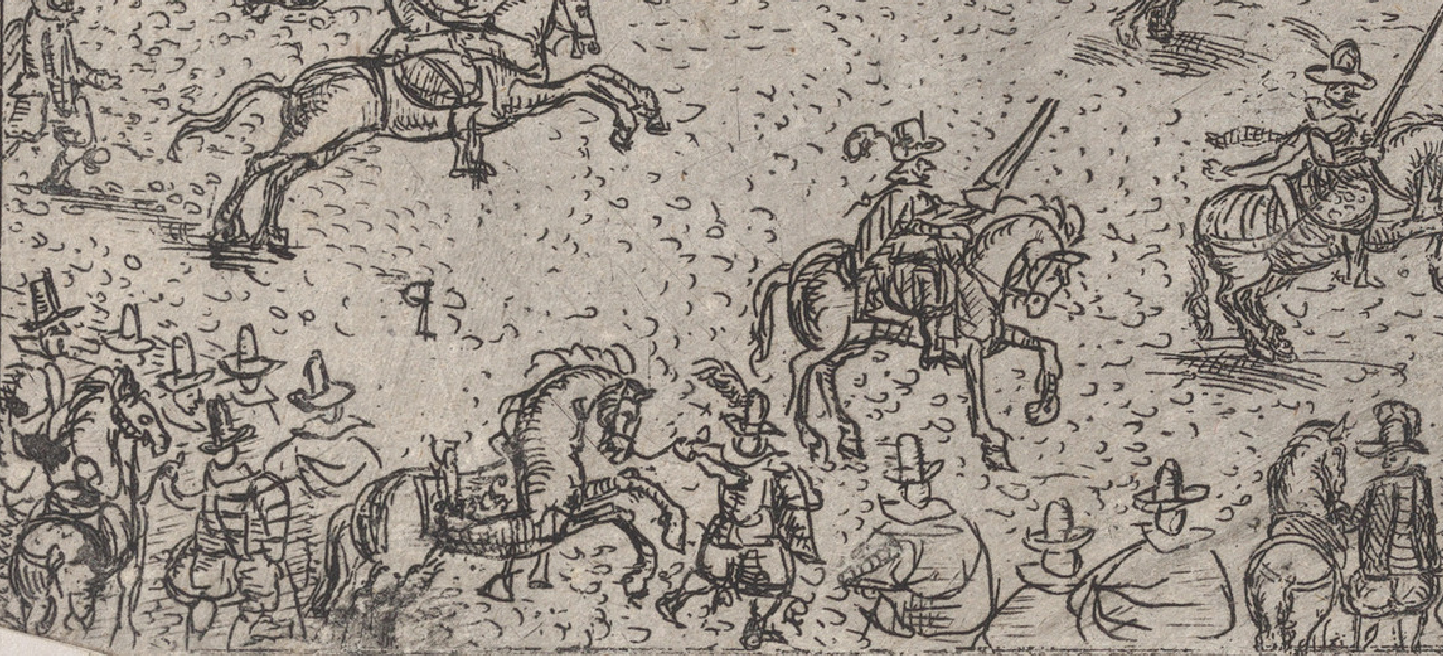
 I will 'dissect' a bit the plate showing lancers on horseback , showing the stages in this quintain


Herr Zimmermann executed plenty of etchings showing Hapsburg-Ottoman wars in Hungary, but these we will save for later.


enjoy

Valete

Wednesday, December 8, 2021

Sketchbook from Baden-Wurttemberg

 Salvete Omnes,


via Szlafrokow Rozmowy group and its members comes yet another interesting visual  collection called a stambuch, a virtual treasure from the European early modern period - Stammbuch Johann Michael Weckherlin - that contains tons of hand drawn and painted coats of arms, portraits and illuminations from German lands drawn between 1500s-1600sAD.


there are many images there, but to share but a few could be a gateway for all to explore the collection:


you can download the entire collection in a pdf form, or study the images via the viewer provided by the Baden-Württemberg Archives. 


Valete

Tuesday, February 19, 2019

Riders and horses - lords of Hallwil

Salvete Omnes,
a quick entry - pointing to an early XVII century source held in the Zurich library. The book was donated there by the Count Walther von Hallwil and his wife.

Lords of Hallwil: armed and armoured, at tournament, going hunting? and just taking a stroll through their countryside
 
.

.

.
 
.

.
 
.
and I would like to point to the way they hold the reins in the last two illustrations:


neck reining?
Valete

Saturday, January 7, 2017

Claude Deruet

salve,
2017 - hee ha!
let us start with this particular colorful horse (stallion) and his rider from the past - French painter Claude Deruet painted this noble cavalier astride his fine powerful parade horse. (image from WikiGallery).  Note the collection of the horse and ease of the rider, showing a fine ecuyer.
As in all Baroque horse, this one is not very tall, but has a powerful conformation, with long tail adorned with tassels etc. The mane is brushed and swept on the left side, with some of it visible between the forelegs.
He is ridden with a curb-bit, long stirrups and fine, exquisite Baroque saddle.
we can see the horse shoes clearly.
more paintings by Deruet


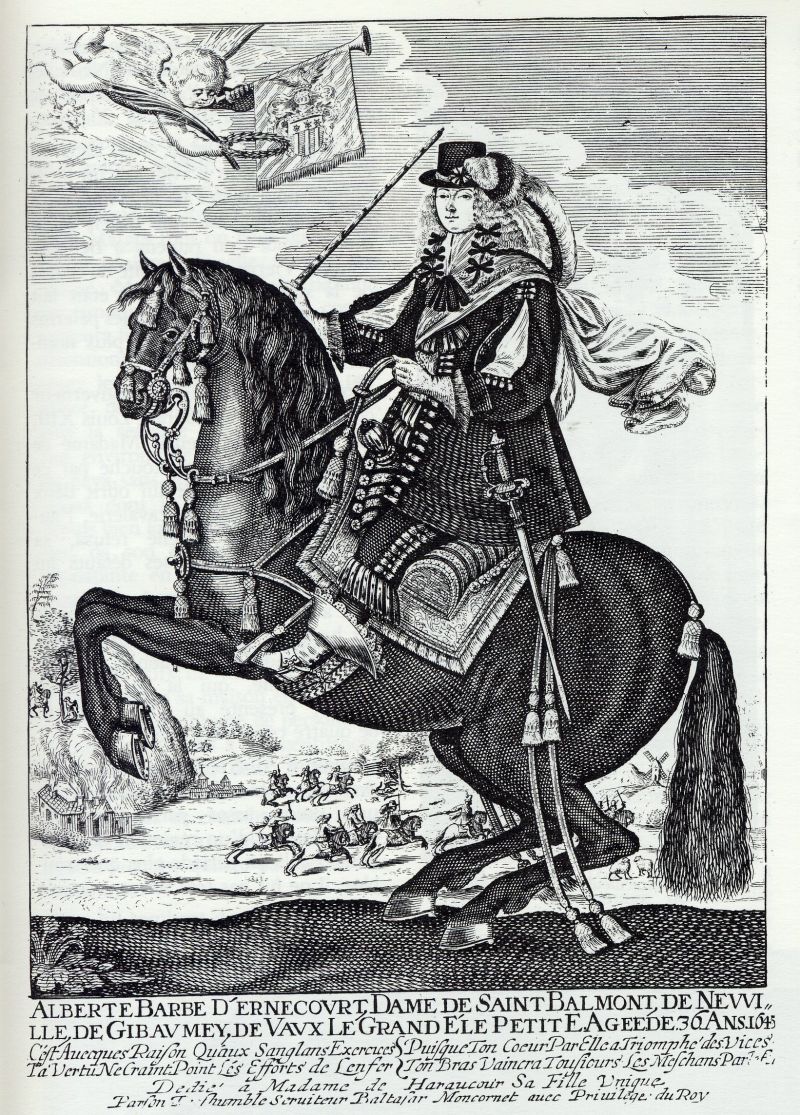
also a very spirited couple (horse and rider) in this print after one of the Deruet's paintings. It shows a famous Lorraine heroine of the 30 Years War - Dame de Saint-Baslemont.

enjoy

Monday, November 21, 2016

Pfaltzgraf on horseback - Baroque engravings

Salve,
today we will do a quick landing in the beginning of the XVII century, in the Holy Roman Empire, precisely in the Rhine valley, where at that time existed various states ruled by elector-princes.
I would like to turn your attention to two such princes count-palatine (comes palatinus) or Pflazgraf of Neuburg at al., and the prince-elector (princeps elector) or Kurfürst of Palatinate and king of Bohemia  - the images of horse and his rider are in the ancient traditions established already by the Greeks and Romans 2000 years earlier, cultivated by the Medieval chivalry and eventually the early modern riding schools and their noble pupils. Sort of a bridge between the ancient tradtion and modern horsemanship

Wolfgang Wilhelm, count-palatine
 Count Wolfgang Wilhelm seems to be riding in the Italian-Spanish style (as seen in the later Crispin de Passe's images or  Velazquez' portrait of Felipe IV) , dressed in the courtly riding attire, sitting at ease well mounted on a spirited but collected Spanish? stallion. The rider is not a warrior, but master of his mount, perhaps in this print he also serves as a fine example of the courtly art of horsemanship.
They, the ruler and his steed, cast  a splendid figure together,  amid the bucolic and prosperous landscape of his realm.
But below
Frederic V, prince-elector of Palatinate, and king of Bohemia
 Duke and king, short-while though, Frederic is a different matter. He is a warrior (cuirassier armor and with his broadsword at hand), military leader and statesman (Prague behind him and the marshal staff in his hand) mounted on a stallion moving in passage or parade trot. The stallion appears to be, from his conformation, a Turkish one, neighing and very spirited, but his tail tied to show it is a warhorse. His mount's tack is perhaps a mixture of the English and Imperial traditions.
His riding is military (the bridle is curb-bit with two-reins, as preferred by the cavalrymen) and full of action and bravado, closer to the ancient Greeks than the Italian-French schools of horsemanship.
Unfortunately for this rider, he rode nowhere, as his Bohemian kingship lasted but a year (he was a duke of Silesia too - Silesia being mostly the Bohemian Crown fiefdom- it thus makes him a bit 'our' that is a Polish lands ruler), and he also lost his ancestral holdings, becoming a fugitive lord depended on the Lion of the North until his untimely death at Mainz in 1632.
enjoy