Showing posts with label Paul Kane. Show all posts

Wednesday, September 4, 2024

Caravan 1839- Friedrich Adolph Wislizenus

 Salvete Omnes,


Archive World Library has a  number of works on or about dr Friedrich Adolph Wislizenus. German-American medical doctor, somewhat a revolutionary, American diplomat and traveler, who in 1839 made a journey along the Rocky Mountain Fur Company caravan to the Rocky Mountains. 


The journey produced a journal or sketches in German, published in 1840 in St. Louis,  that was published in English by the Missouri Historical Society in 1912.


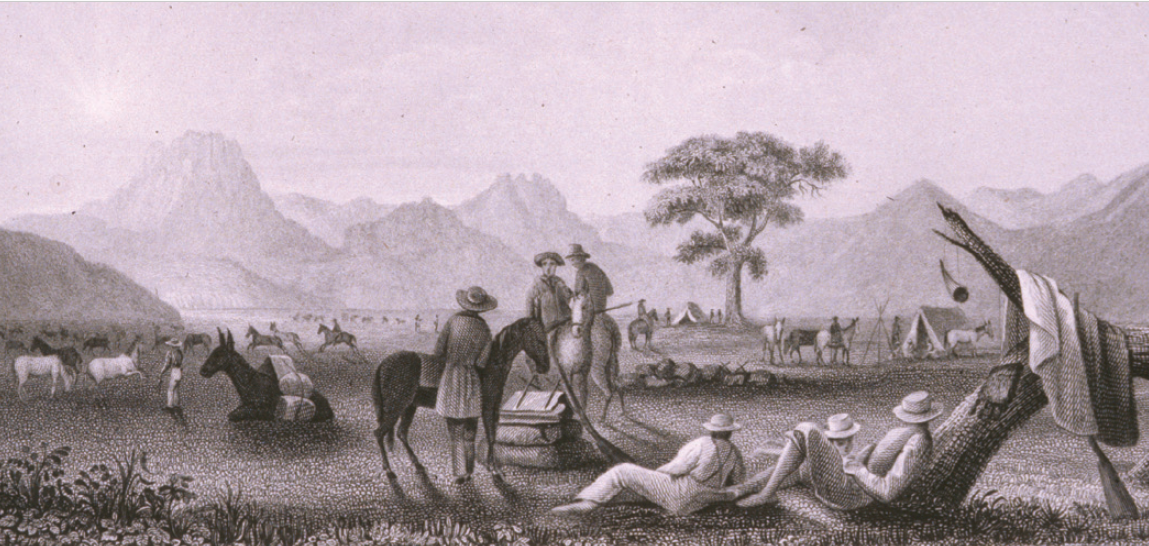
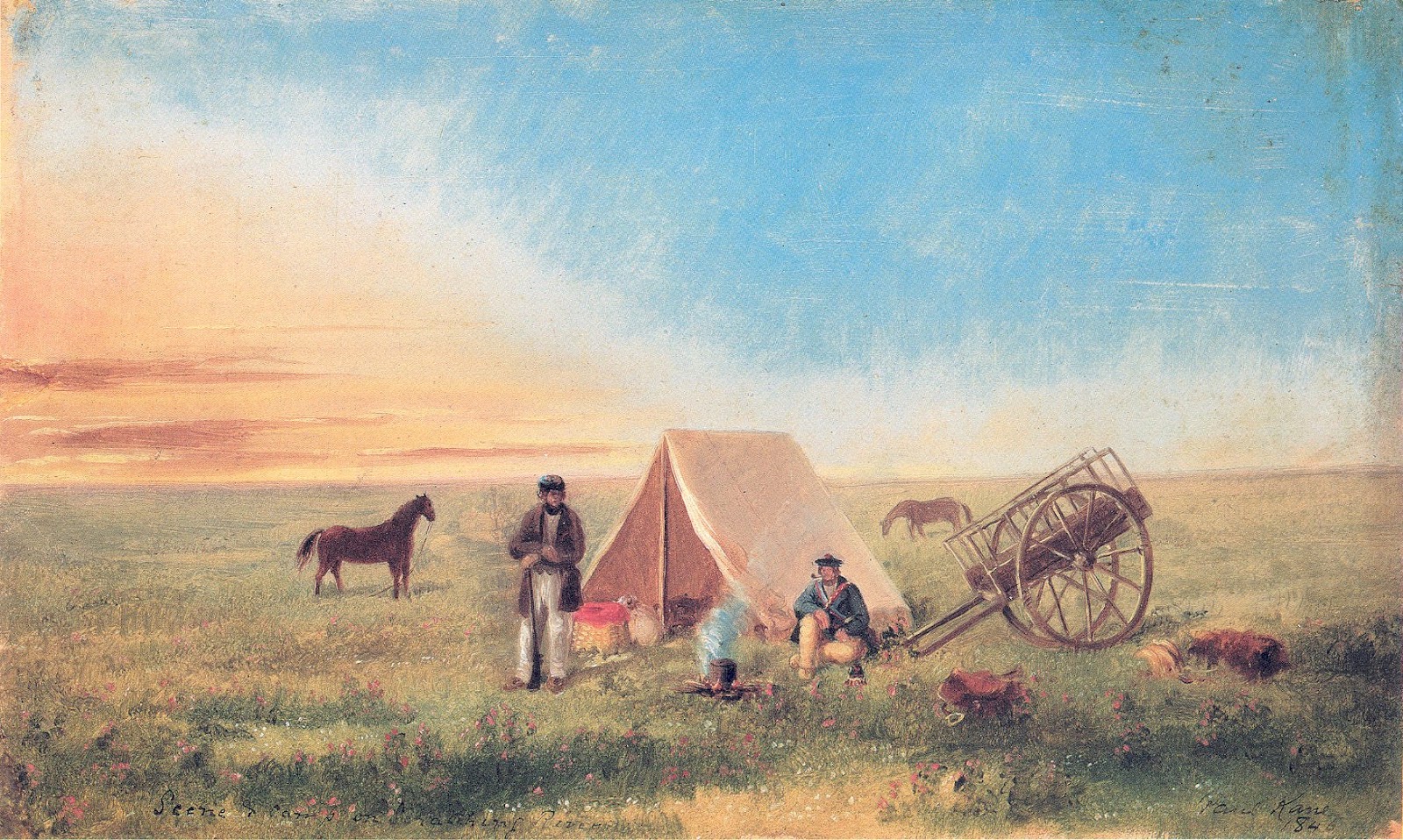
I would like to point your attention to the chapter on the caravan or the daily activities of this outfit going west from Sapling grove, 80 miles from West Port, a border village not far from Chouteau's Landing in Missouri in April 1839. 

The caravan, led by  mountain man Harris,  included 27 persons, including two women, wives to two missionaries, the 3rd missionary was single. They had 4 two-wheeled carts drawn by two mules. 

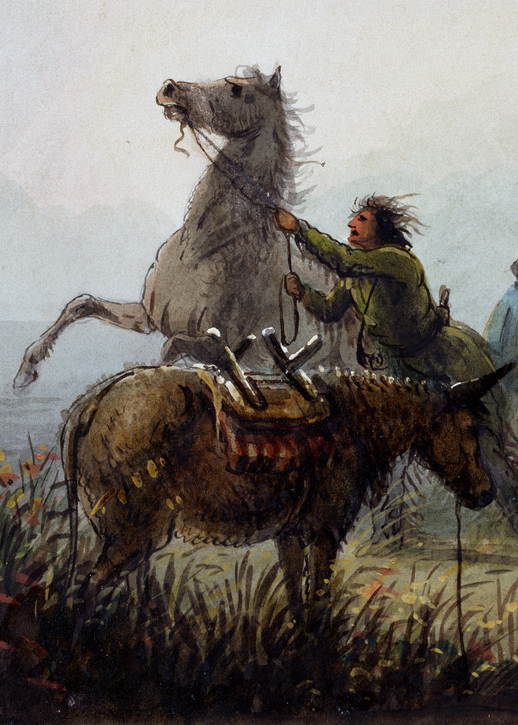
saddlin' the pack saddle on the mule

We learn that first they let the animals graze - to prevent them from straying far they hobbled them (details on page 30), each animal drag a long rope of buffalo leather - a trail-rope.


.

at night the horses and mules were fastened to stakes (pickets)  by their trail-ropes.

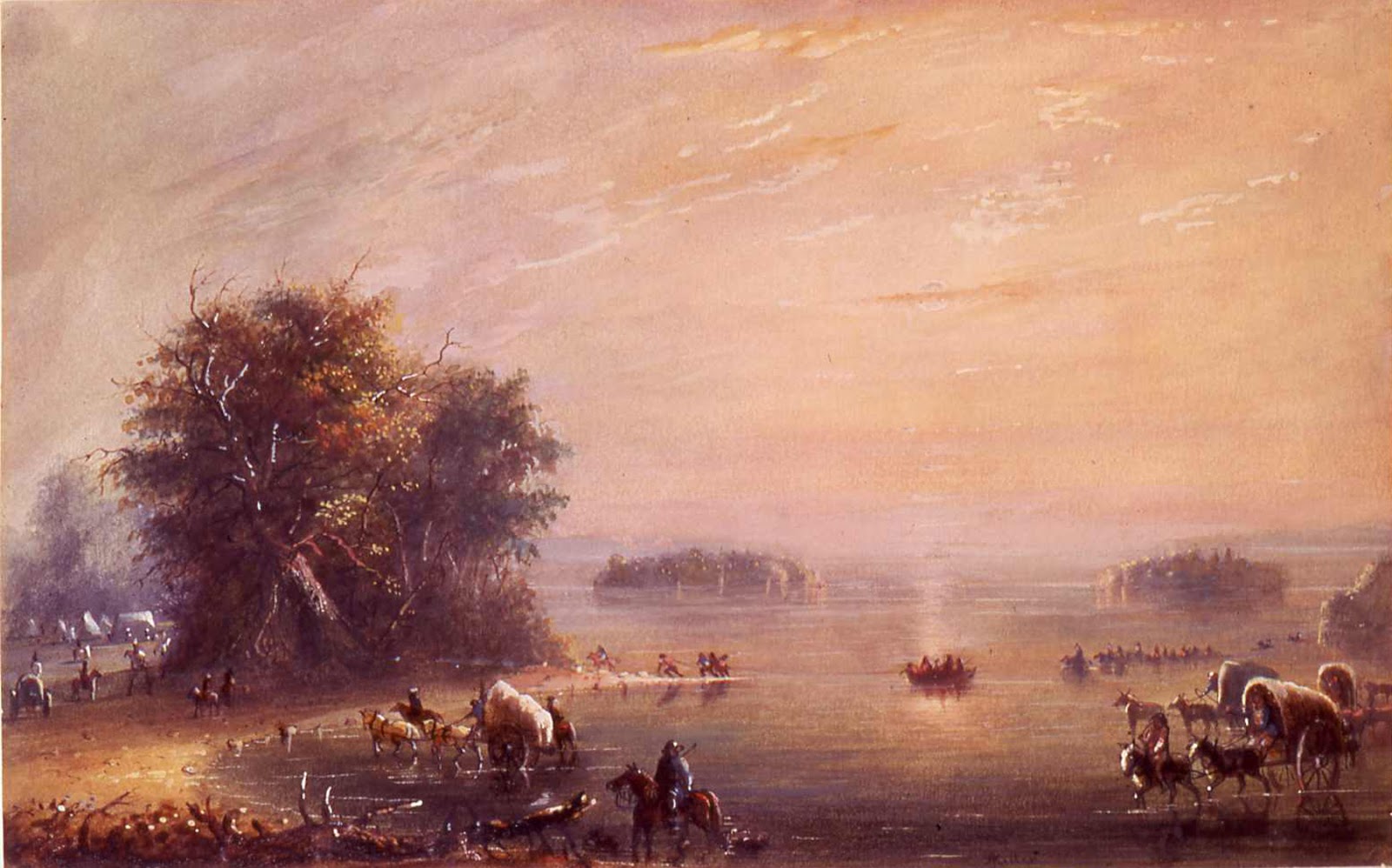
the caravan moved with the leader with his company carts in front, the line behind him with riders and pack animals

this way the caravan covered 20 to 25 miles daily across the western prairies...


.
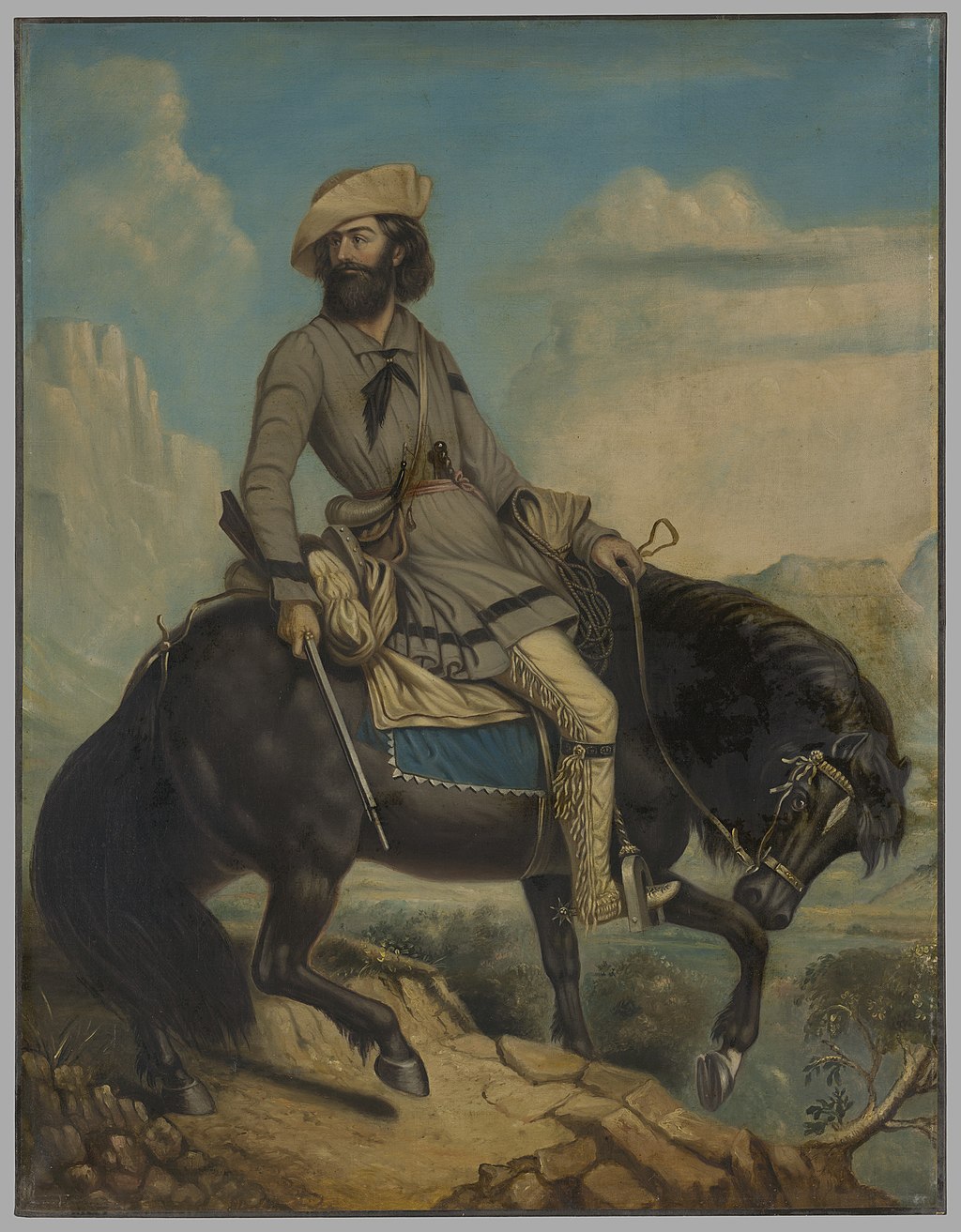


Valete

Wednesday, June 22, 2016

Batty - HOW INDIANS HUNT THE BUFFALO

Salve,
Joseph Batty wrote on How Indians Hunt the Buffalo [on horseback and in 1870s].
Hopefully in the future I will provide more primary accounts describing the bison hunting techniques of the Great Plains tribal peoples:


Were it not for the buffalo, the Indians of the southern plains would be deprived of food, and also of bedding, clothing and teepies which the skins furnish ; even now there is so much hunting by the Whites that the number of buffalo are greatly reduced, and the Indian's comfort, comparatively speaking, is already gone. On the northern plains they remain yet in greater numbers, but their final destruction is inevitable everywhere.

The Great Fall Hunt

" The great Fall hunt " is the Indian's harvest and annual feast. 
Never is he in such good spirits, never does he hunt with such excitement, and never is his insatiable appetite so gratified.
 In September, bands start out well provided with teepies, guns, ammunition and horses. They travel sometimes hundreds of miles before reaching a buffalo country, camping each night when darkness overtakes them. When finally reaching a place where buffalo are known to abound, runners are sent out to sight them. When they return with good news, the Indians, anticipating the hunt, are thrown into great commotion; they strip themselves of all clothing except breech clout, and moccasins, and some deck themselves with feather head-dresses. 

Saddles are removed from ponies and riding pads substituted. 
Young bucks are sent out to choose desirable camping ground near water, and when a place is decided upon, squaws and trappings are sent for. The squaws get up the teepies, erect scaffolds for drying meat, and make all preparations needful to camp comfortably. 
The hunters that have started on their ponies ride until a favorable herd of buffalo is dis- covered, then, as well as diversity of country will admit, they slowly surround them at a distance. It is seemingly understood that they shall all dash forward after a certain length of time, and they come in a fury of speed, yelling inhumanly, and shouting the "whey! whey! whey !" to their horses. 

Each Indian singles a buffalo and follows it in every direction, and the form of the surround is lost. So perfectly trained is the pony, and so skilled in hunting is the Indian, that in every effort to turn or get away, the buffalo is pursued as it were in shadow, and unto death. When the first buffalo falls, the Indian looks forward, and if any scattering ones are seen, a second chase ensues. Old men and young bucks not engaged in the fight stand at specified distances with extra horses, and when those in the chase give out, the rider drives up to those. in reserve and exchanges. 

The hunting is done as near camp as possible, and the squaws are sent for to skin and dress the buffalo that have fallen within reason- able distance. Each of the animals too far away to be reached, are partially skinned by the Indian who has killed them, and they will often tear the liver and heart from a buffalo while warm, and devour it with the relish of wild beasts; the best meat is cut out in flakes, and piled and tied on the ponies. They are cruelly overladen, and the meat hangs so low on each side that it usually drags upon the ground, gathering much dirt, which is never removed, but allowed to dry in ; then, as if the poor pony was not sufficiently loaded, the Indian takes his seat upon the top of the meat and rides to camp, the pony staggering beneath the load. Both pony and rider become saturated with blood, and neither are ever cleaned. If the chase has been a successful one, the remains of partially dressed buffalos are left; but if not, they return, and the carcass is cleaned and meat taken to camp. Sometimes those who have not been successful in the chase will assist others in dressing game. 

At night a great feast commences, in which men, squaws, bucks, children, and even the dogs participate. Singing, dancing and wild games are enjoyed, and the most immoderate eating that man or beast could be guilty of is indulged in. The intestines of the buffalo are considered the choicest parts, and are devoured by the Indians in a most disgusting fashion. They often eat, at this feast, the greater portion of the choicest meat of the first day's hunt, but on the second day and afterwards, meat is prepared for the Winter. 
Day after day the hunt is continued, a chase often being six miles long, until meat enough has been obtained for the Winter, or until intense weather puts an end to the sport.
[...]
The squaws do all the drudgery; they prepare the meat, and hang it on the scaffolds to dry. In damp weather it is often partially smoked by fires being made beneath it when drying. The squaws often skin the buffalo, and always dress and tan the robes. Few skins are used early in the season, except for teepies and lodges.
When the Winter coat of the buffalo is half grown, it is at its best, and the squaws begin to tan robes for trade and their own use. Very strong lariats are woven by the Indians, out of the fine hair from the fore shoulders of buffalo, for which they get fabulous prices.
Some Indians use the army revolver in the hunt, some the carbine or Winchester rifle, while others use the bow. 
A warrior snatches an arrow from his quiver over the shoulder, springs the bow with a magic hand, and in an instant buries the arrow to the feathers in the flesh of the buffalo. 
The arrows are marked in colors near the feathers, so that each can be recognized, and the game claimed by the owner of the one which, by its position, indicates that death was caused. 
 
***

Images are from Wikimedia Commons and are photos of paintings done during the XIX century - Alfred Jacob Miller, George Catlin, John Mix Stanley, Paul Kane & Karl Bodmer.

Monday, June 20, 2016

Batty & bison hunting 2

Salve,
'Mister' Joe Batty back in the saddle, so to speak:

HOW TO HUNT [Buffalo]*
Buffalo are hunted in two ways: 
they are still-hunted on foot with a heavy rifle, 
or
run with horses and shot with the carbine, army revolver, or Winchester repeating rifle. 
                                    ***
It is a much more difficult matter to shoot well when mounted than on foot; rifles should not be cocked until an instant before discharging, and the finger must not rest upon the trigger except at the moment of action. Unless these rules are carefully observed, and the utmost caution taken, sudden movements and irregular motions in riding, will sometimes cause the gun to discharge, and the rider to shoot his own horse. In general shooting, hit the game high in the shoulder. Most of the hunters who shoot for market, stalk the game and fire at long range with the heavy Sharpe's rifle.[article on the 1863 and 1874 models]

The large American horse is a rough rider, and unless thoroughly broken to the sight of buffalo, and perfectly trained to rough ground, is liable to stumble, and throw one over his head at any moment. 

There is but little danger with the Indian pony ; he runs securely and smoothly, and knows how to " lay aside " a buffalo as well as his rider does. The most comfortable way to be mounted is Indian fashion, with double pad resting each side of the pony's spine, as a substitute for a saddle [apishamore]. Moccasins keep the feet from slipping, and enable one to retain his seat with ease. If a saddle is used, the Spanish saddle with the California tree is the easiest ridden and the safest known. With the McClellan saddle, one frequently gets unhorsed; it answers, however, for ordinary riding.
When preparing for the hunt, saddle-bags and blankets are removed from the horses, and saddles are cinched tightly; the hunter then straps a well filled cartridge belt around his waist, seizes his weapon, mounts his pony, and is ready for the run.
clearly an apishamore saddle on the roan horse


It is quite a feat to shoot successfully from a horse's back, when on a dead run, and one should not attempt it unless he has been long accustomed to the saddle.
When making a surround, the herd is usually sighted from a distance, and the hunters approach from the bottoms, or " coolies ;" it takes considerable time, but is generally successful if managed by veteran hunters. Should the herd become alarmed and stampede before the surround is completed, the hunters rush from concealment and endeavor to turn the herd. Then follows an exciting moment; the yelling of the hunters, rapid running and thundering tread of the buffalo, and constant reports of the guns, with horsemen half visible in a cloud of dust, form a strange, wild and exciting scene, that must be seen from a distance to be appreciated. When one is in the excitement of the chase, he can have no idea of general effect ; he singles out his buffalo, and runs it to the death, and should the chase be a short one, he heads another band and obtains a second run. Buffalo usually fall on their knees with
the fore legs doubled under, and often one horn is buried in the ground. After the hunt, the hunters are called together by signal, and proceed to dress the game.
If the skins are saved they are taken off flat, like cattle hides, salted (except in cold weather), then stretched on the ground, driving stakes through holes in the edges ; but if the flesh only is used, the best of it is cut in flakes and the horses are packed with as much as they can carry. When killed for the market, they are quartered with the skins on, and wagons are used for their transportation.

enjoy
*American bison