Showing posts with label German printmakers. Show all posts

Friday, June 19, 2026

Ottomans archery practice in XVI century - Jost Amman

 Slavete Omnes,


From British Museum, under Creative Commons licence, comes this XVI century print by the German printmaker Jost Amman, who frequently drew and printed images of the Ottoman warriors and soldiers.


It comes from this print, lavishly published by Jost Amman, and the British institution has only this etching. The etching shows some episode from the Ottoman wars in Hungarian Kingdom of the 1520-30s. . 

translation from German - via Google translate 

..

Our Polish painter Jozef Brandt was influenced by the images of such equestrian archery feats


Valete

Sunday, March 29, 2026

Heinrich Aldegrever - engravings and drawings

 Salvete Omnes,


A short entry with lots of drawings and prints by Heinrich Aldegrever or Aldegraf (1502-1555, 1558/61) - German printmaker from Duchy of Westphalia (born Padeborn, lived in Soest) - influenced by Albrecht Durer.


.

.


Mars


Marcus Curtius 

.


.

it reminds me of Rawicz coat of arms 

      beautifully rendered Fortuna - 


Audaces Fortuna juvat

and a period curb-bit from the Fortuna print 

enjoy

Valete

Tuesday, March 25, 2025

Rugendas - Stanislaw August on horseback

 Salvete Omnes 

Bavarian artist Johann Lorenz Rugendas (1775-1826) executed a drawing that his workshop converted into a etching and printed- the National Museum at Krakow has the print, and graciously allows for study and enjoyment via their Digital Collections.  


The subject of this print is last elected king of Polish-Lithuanian Commonwealth, Stanislaw  August (Poniatowski), (s)elected in November 1764, with the strong Russian 'bayonet and musket' presence, This last election followed  the short war between the national, conservative Sarmatian faction and the Progressive faction with Russian Imperial army in the vanguard. The war was atrocious on many levels, showing the complete ruination of the Polish Crown army, while the Lithuanian army, under the command of grand hetman Massalski, was told to stand aside, in exchange for large sum of money given to the grand hetman, while Progressive-allied Russian Imperial army marched into the Kingdom. It was during that war when the castle of Neswiez, the seat of Radziwill family then headed by Karol Radziwil 'Panie Kochanku', was plundered of its fabulous art and riches collections for the first time by the Russians (second will be in 1812). Withing the Royal Crown army  only the Tatar Ulan regiments,  that had freshly marched from Saxony and the Seven Years War's fields, showed themselves capable of any military action and order, while very ancient Crown grand Hetman Branicki was beyond any help as a military commander and leader.

In my opinion (and many historians), this ruler was to be one of the worst politicians ever on the Polish throne, being weak, afraid of this former lover empress Catherine the Great of Russia,  and always pursuing pleasures of life while borrowing money for his expensive ideas and projects, especially art collections. 

Ad rem, the mount of the monarch is white or grey - with the usual horse tack of this period, the 1760s. 


behind the monarch there are two attendants in stylized Hungarian attire

.

their horse also is bitted with a  double rein bridle, but the rosette in its forehead perhaps indicated both Polish and Hungarian bridle tradition. 


enjoy

Valete

Saturday, November 23, 2024

Stammbuch Andreas Huber - Cod.Don.899

 Salvete Omnes,


a short entry to this extraordinary Stammbuch of Andreas Huber - a mix of gouaches and woodcuts (of Jost Amman's workshop) from  1584 or the last quarter  of the XVI century. Held at the Württembergische Landesbibliothek Stuttgart (FR of Germany)- follow this  this link


enjoy


ps
caveat -
the war between Russian Federation and the West being fought in Ukraine, with horrendous losses to the people of that poor country,  has just gotten darker and more dangerous - Russians fired a new type of a hypersonic ballistic missile in Ukraine - prof. Ted Postol talks about this development with US Army colonel(retired) Daniel Davis (on his Yt channel) .  Our world is moving closer to a nuclear war? 

Valete

Saturday, November 16, 2024

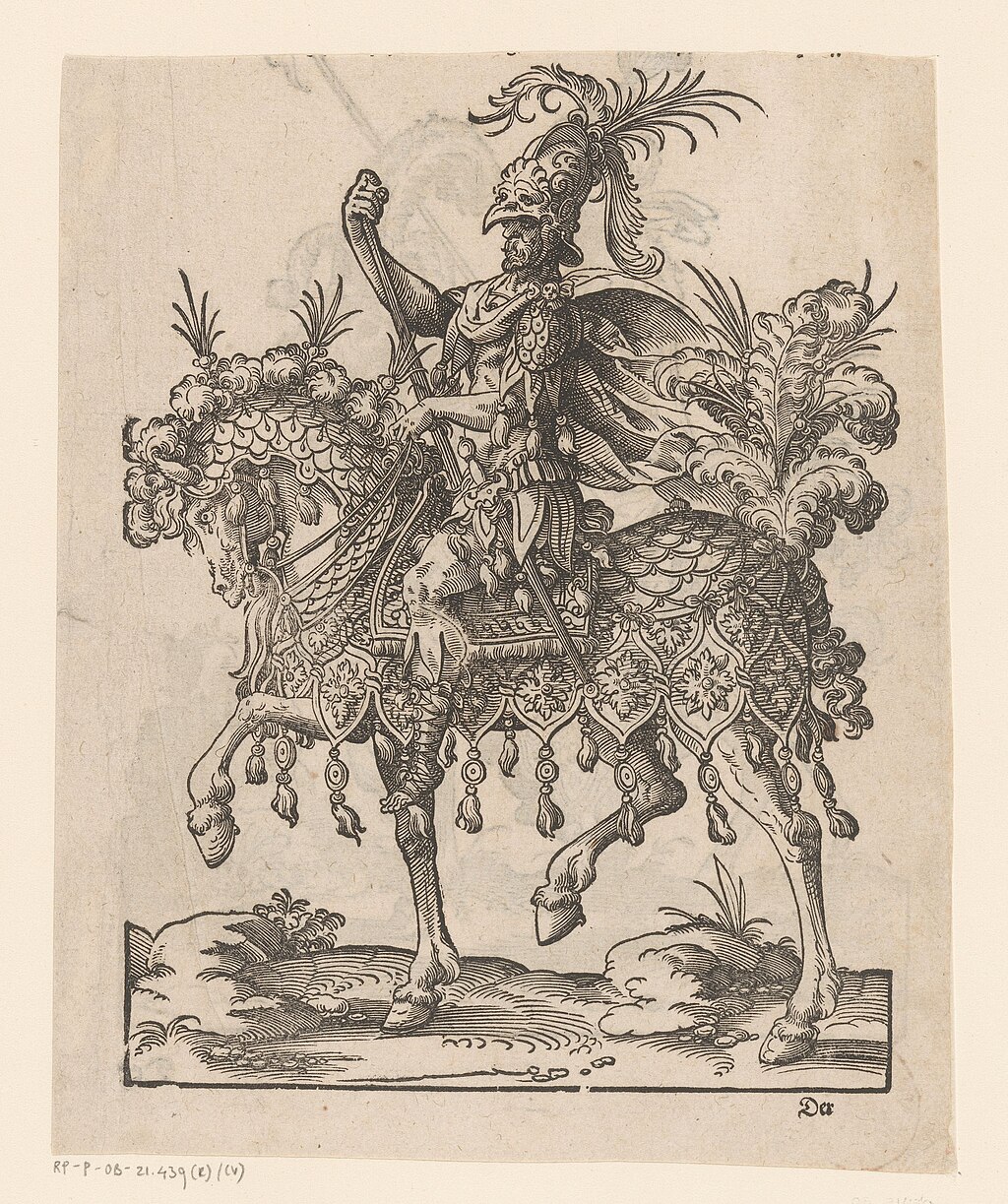
Mythical figures on horseback - Jost Amman

 Salvete Omnes,

this image makes a very interesting idea for a watercolor or drawing


Long time ago I posted some woodcuts from  meister Jost Amman's workshop. They were depicting horse care and everyday grooms and horse handlers & drivers.
Today, different but very interesting woodcuts from Jost Amman - including depictions of Mars, Aurora & Apollo.


Marcus Curtius - legendary Roman hero


and two warriors in 'Persian' costume.


..


Valete

Sunday, December 12, 2021

Roubaud and his teachers 1878-80

 Salvete Omnes,
having started with Franz Roubaud and his equestrian art I have decided to continue with his Munich education  and other topics, as they  interconnect with the Munich Academy, and allow me to bring forward some fine artists who taught and practiced their art in the sunny capital of Bavarian Kingdom in its glory days.


Our Odessa born young Roubaud - born in 1856 to French parents -  decided to travel to Bavaria to enroll in the Munich Art Academy. His teachers there were to be Carl/Karl von Piloty, Otto Seitz and Wilhelm von Diez. He saved money working in the Black Sea bustling seaport and perhaps received some from his parents, albeit Hans-Peter Buhler, author of a book about the Polish artists circle in Munich titled 'Jager, Kosaken und Polnische Reitter' (1993) stated that Franz was very gifted with pens , pencils and brushes from the very age, and starting at 6 y.o. his parents had him taught formal lessons in drawing,  while he also made a trip to Tbilisi on the river Kura, then Russian Georgia. There he first saw the fascinating world of the Caucasus Mountains and multi-ethnic world of the borderland between Asia and Europe.

ad rem, his Munich academy teachers:
von Piloty


Seitz


von Diez


Franz continued his studies at Munich  until money run out , and in spite of the fact that he was one of the most promising students there (Piloty issued a official diploma in 1880, with a note invoking an urgent need for this disciple's financial support, which failed to materialize), so our young artists left for Odessa to make some more money there.

He would be back in Munich at the end of 1881, and this time he joins the Polish artists circle, with Jozef Brandt at its helm. 

Nota bene a very large scan of one of his paintings.

to be continued

Valete