Salvete Omnes,
let us take trip to the XVIII century Europe with an expert-
and so we will return to a Prussian cavalry general
Charles E. de Warnery, whom I quoted in my posts in the past, and these are some of his observations about military horsemen and horses of his days:
" For a soldier to be really a light horseman, he must be able to turn his horse quick
and short, when in full speed, to raise up and catch any thing from the
ground;
he will find himself much firmer in his seat, have greater
command of his horse, and much more
agility in the exercise of his arms, & by being mounted on an
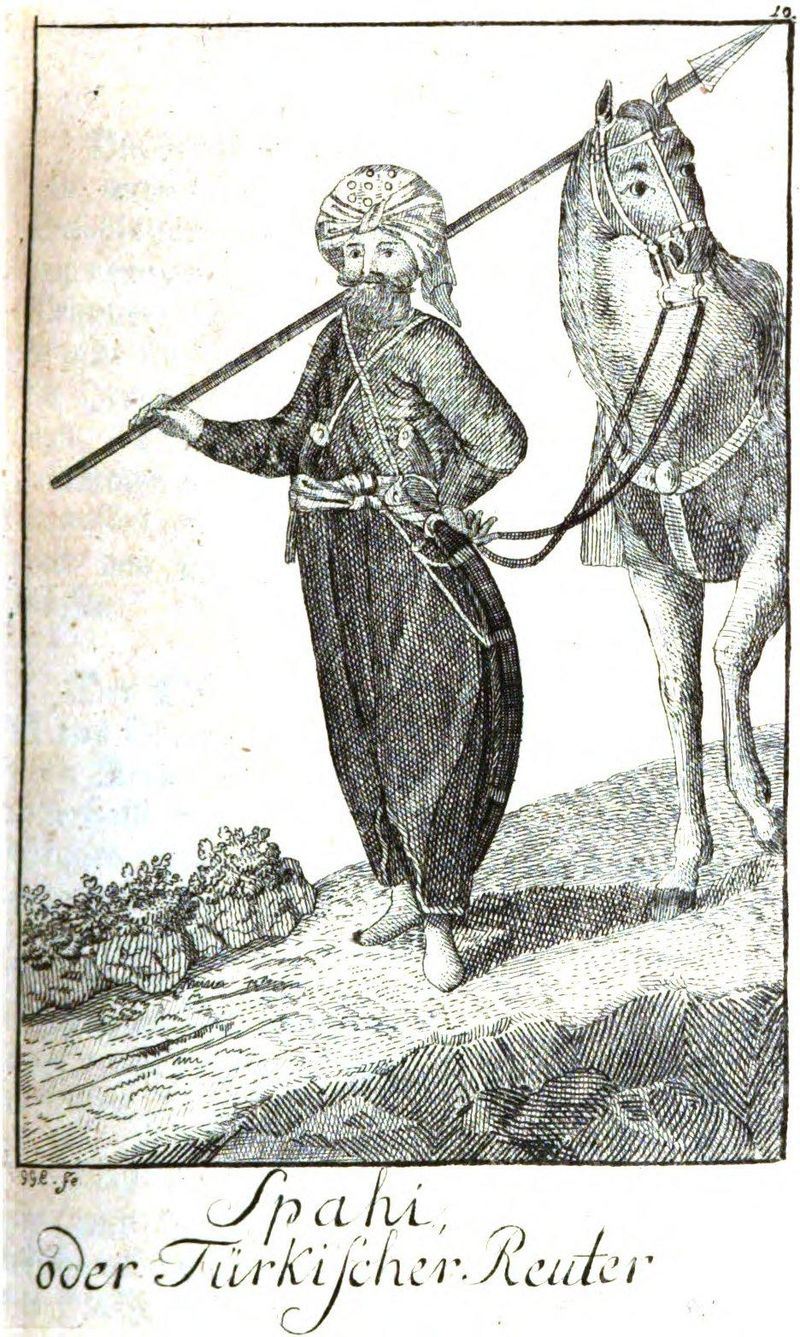
eastern saddle, that is to say, upon a Hungarian, Turkish, or Polish
one; to those who have been accustomed to other saddles, they appear at
first to be inconvenient, but they very soon find themselves perfectly
at ease in them, and ever after, prefer them to all others; they are
very light, cheap, and durable, and do not so often require repairing as
the others do.'
''The service of light horse requiring them
to be as it were always in presence of the enemy, and ready to mount on
horseback in an instant; they ought not to have either breast-belts or
cruppers to their saddles, which will enable them to saddle much quicker
than they can do otherwise: besides, as the saddles above described
have double girths, they are sufficiently firm without them.''
''In every species of cavalry the man ought to be proportioned to the size of his horse, and
the arms with which he is to serve, adapted and proportioned to them
both, and the nature of service to be performed;
thus
''...consequently the
cuirassier should be larger, and his arms heavier than the dragoon, and
those more so than the Light Horse or Hussars; a small man has great difficulty to mount a large horse, particularly
with a cuirasse, they should all however be muscular and robust, but
not heavy; the Prussian Dragoons are too heavy for their horses, and it
is ridiculous to see a large man upon a small horse:
which by being strained with too much weight, is very soon ruined, and
the trooper dismounted; a man who is more than 5 feet 8 inches, ought
not to be received into the cavalry, but will find his proper place in
the infantry.''
When a recruit is enlisted
he is taught to hold himself upright, to march with an easy air, and to
shake off the lounge of the peasant; he is taught the exercise of the
broad-sword, with small basket-hiked sticks; nothing contributes more
towards rendering him active and dexterous; he is exercised on foot,
until he is sufficiently prepared to begin it in the squadron. Whatever
may be said, I hold it very essential, that cavalry soldiers, and
particularly dragoons, should be acquainted with the exercise on foot,
almost as well as the infantry; but always in two ranks, as the
cuirassiers; they may also preserve their bayonets, provided they are
not too weighty: the English and Hanoverians have taken them from their
cavalry. It is however very advantageous that cavalry should be enabled
to defend themselves at all times, and even on foot, if necessity
required it,''
''It will be
found very useful to practice on foot, at least once, any manœuvres
which you would perform with the squadron, before you try them on
horseback, this not only saves the horses, but very much assists the
ready and correct conception and execution of it, particularly should it
be an intricate or complex manœuvre.
When the recruit is sufficiently instructed on foot, he is mounted upon a wooden horse, much
like those made use of in riding-schools for vaulting, but it must have
a neck and head, to fix a bridle to; there should be two of those
horses per troop, the recruits must be instructed by them how to place
the saddle on their horses, to mount and dismount on both sides, with or
without stirrups, how to fold his cloak, to put on his baggage, and a
truss of forrage, to vault into the saddle without aid by the croup,
that he might be enabled to do it on his horse, without
having occasion for a knot instead of a stirrup; he must be exercised
to bend forward and take his hat from the ground; to dismount, to stand
and hold the bridle properly; in a word, every thing but vaulting; to
place himself in every position of the exercise, to draw, handle, and
return his sword; to load and fire his carbine and pistols; and to
exercise and make use of his arms with spirit and address: this is the
manner in which recruits are formed in the service, and is very nearly
the fame that is recommended by Vegecius. These two wooden horses should be placed as in a rencounter, on the
right hand of each other, and those that are upon them mould thrust and
cut with the point and with the edge, with basketbasket-hiked sticks, and they should be taught all the guards, to ward off, and to parry the fame. ''
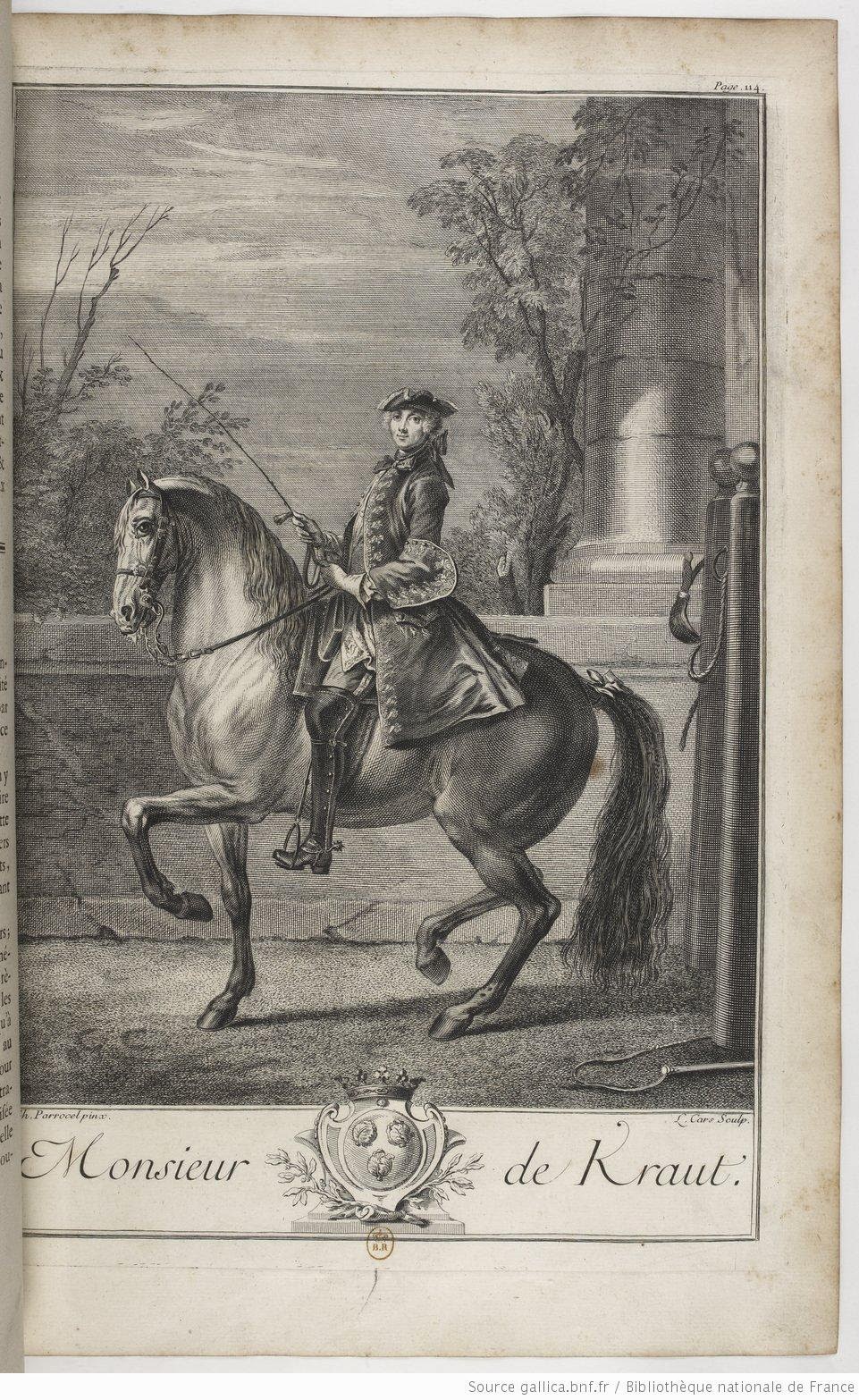
''A soldier should not be taught to ride as it is practised by professed
riding-masters, because the greatest part of the aids given by them must
be with the bridle, which for that purpose must be held short, but
without stiffness, the left shoulder a little forward, extending his
hand in an easy manner to the mane of the horse; a trooper in the ranks can give false aids only with his legs. When he has been properly exercised in this manner, his horse is
given to him, and he is quartered with a non-commissioned officer, or
some old steady trooper, who is to mew him how to take care of his horse, how to saddle and to bridle it, to comb his mane without tearing out the hair, and never to touch the tail but with his hand, to wash it once a week, and after
the new moon to cut the points of the hair; experience has proved this
to be the true means of preserving that fine ornament of a horse. Every thing should now be taught the recruit which might be requisite
on actual service, very near the exercise of the carousel, except the
exercise of the javelin, which would be useless to him. He ought to be
able to turn his horse suddenly upon his haunches, to run at the
the ring with his sword instead of a lance, which very much suples the horse, and forms the trooper to dexterity and firmness in his feat, without however attending to all the minutia required in the riding academies."
''A squadron
ought to be often exercised without saddles, and manœuvre every day at
least half an hour: this is absolutely necessary, to keep the horses in
wind, and to harden them; it is with them as with racers, if they are
not kept in continual training, they are very soon incapable of
performing the service required of them.''
''There are few horses but
which might be made to run; when we had bought those which our Hussars
had taken from the enemy, the greatest number of them were given in the
re-mount; at first those troopers who receieved them where disatisfied
with their want of activity, but after having felt the Prussian spur for
a few weeks, they were as fleet as the others.''
"As soon as the squadron is mounted the troopers are practised to leap ditches, enclosures, poles put across for that purpose, etc. At other times two troopers run together full speed, trying to get before and carry off each other's hats: they are practised to swim their horses across rivers, to manoeuvre in broken and intersected ground, etc.[...] and they must be made to
trot a good deal, by which they will acquire a firm seat on horseback,
and not to fall upon the saddle at each motion of the horse;
they ought to ride with shorter stirrups than in the riding-schools, because they must be able to raise themselves four inches above the
saddle.''
There are targets to be
fired at by the troopers, with their pistols* walking, trotting, and
full gallop, and even in leaping over a bar.
''A head of
felt, stuffed with wool or straw, is fixed to a branch or post, which
the soldier is to touch with the thrust or the cut, both in passing and
repassing, in full gallop. It would very much stimulate the soldiers to
emulation, by attaching some gratification to those who acquit
themselves with the greatest address.''
''They should frequently be made to move briskly forward, and then suddenly halted upon the spot; at the word halt, the
trooper presses upon his stirrups, keeping his body a little backward,
retaining the bridle by bending his wrist a little, but without moving
his arm; by these means he puts his horse upon his haunches.''
''A squadron
should be accustomed to move off its ground at once, and all the
troopers to be in motion at the fame instant, at the word of command,
either at a walk, trot, or gallop; they should even be made to traverse
in line. It will sometimes happen that when they are not perfect in this
exercise, some horses will receive atteintes, or blows with their fore
feet, from the odiers, but the performance of this manœuvre on service,
is too important to prevent their acquiring it under any apprehensions
of this inconvenience. It is absolutely necessary that good cavalry
should be able to traverse, and that they should move the whole line at
the same instant, and not successively, as I have seen it practised by
some which has rather the appearance of counter than traverse marching;
nothing can contribute more towards supleing of horses than the traverse
movement. It is pityful to see a squadron be obliged to break off by
divisions to gain ground obliquely to the right or the left, when by
traversing this is performed in an instant, and gracefully.''
''A squadron
ought often to be exercised in a single rank, and to advance obliquely
to the right and left, upon a variety of alignements and points of view,
and appui, in a rank entire; the faults are more easily discovered, and
the trooper learns to march in line with more exactness: for which
purpose more attention and accuracy is required, an extensive line in
single rank being much more subject to waving than in two or three;
sometimes even the whole regiment should manœuvre in this manner.''
''Since the lance has been
rejected, the sword is, without contradiction, the queen of arms for the
cavalry; and it is upon that alone, that they should depend in action,
until the enemy is dispersed: it is only then that they might be allowed
to make use of their pistols. Opinions are very much divided with
regard to the advantage or superiority of the edge or the point of the
sword for cavalry in action; each have their advocates equally zealous,
who produce such instances as are in favour of that they prefer: but
after much reflection on this important subject, frequent observations
of the advantages and disadvantages of each, and some experience, during
many years actual service in the cavalry, I hope I shall be permitted
to mention my reasons for giving a decided preference to the latter.
''The point of the sword is
more advantagous than the edge, because with it you can reach your enemy
at a greater distance than with the other, the smallest wound with it
renders the wounded incapable of serving during the remainder of the
action at least; it does not require so much force to give a dangerous
wound with a thrust as with a cut, and the effect of the latter. is much
more uncertain, unless it happens to be particularly well placed, which
it is hardly possible to do, unless you have your enemy as it were
under your hand...''
''A squadron
formed in two ranks is very subject to waving, and much easier broken
than one of three, which also must naturally have a greater weight in
the shock, and be much more difficult for an enemy to penetrate, even
should several of the front rank be fallen or disabled: for as it causes
no opening in the line, the horse will not fail to advance even without his rider, feeling himself pressed on each side and behind, as it always happens: for a horse must
be very much wounded to make him fall upon the spot.
_________________________________________
* original spelling
valete!