Showing posts with label Old Poland attire. Show all posts

Sunday, March 25, 2018

Ambasadorowie JKM Wladyslawa IV w Paryzu AD 1645 cz I.

Salvete Omnes
[in Polish] :
cóż za bogactwo kolorów i różnorodność strojow narodowych ambasady polskiej,   to ci dopiero były czasy .
Jeźdźcy, wierzchowce i rzędy a bron paradna poselstwa królewskiego
 .. wjazd [w]spanialy poselstwa polskiego na zaślubiny per procura przez króla polskiego Wladyslawa IV księżniczki mantuanskiej Ludwiki Marii Gonzagi 
Poselstwo [Krzysztof] Opaliński herbu Łodzią Wojewoda Poznański (tu portret) prowadził z ks biskupem warminskim....
 [stępią szli tedy]
 Pan Chłapowski Rotmistrz pieszy, JPana Wojewody Pozn. Opalińskiego, na nim żupan atłasowy żółty, ferezya szkarłatna sobolami podszyła, czapka złotogłowowa sobola, zapona rubinowa przy piórach białych żórawich, buzdygan złocisty. W ręku na drzewie Indyjskiem, przy boku miał szablę turkusami sadzoną, pod lewą nogą koncerz, takąż robotą jako i szabla: koń pod nim cudny, siodło i czaprak haftowany złotem w kwiaty, strzemiona srebrne szerokie: na głowach podpierścień takiż: wodza, z łańcuchów srebrnych bardzo pięknej roboty.

Po tem jechał Pan Pieczowski Rotmistrz pieszy Jmci Xięcia Biskupa Warmińskiego, w żupanie atłasowym szkarłatnym, w ferezyi axamitney zapona z piórami iak i u pierwszego Rotmistrza: na konu też tak dobrym i tak przystojnym iako i pierwszy.

 Pan Choiński Koniuszy i Rotmistrz karabinierów JPana Wojewody, za nim jechał; na którym żupan atłasowy ceglasty, ferezya axamitna zielona, z czapką axamitną tegoż koloru, 6. piór żórawich białych i zaponą kamieniami sadzoną, na koniu cudnym i bogato przybranym siedział, szabla i koncerz  takiż jako i u pierwszych dwóch.

Za nim jechał Pan Trzeciecki starszy pokojowy JP. Wojewody Poznańskiego w żupanie atłasowym fijałkowym, w kontuszu łabinowym tejże maści sobolami podszytym, czekan w ręku bułatowy złocisto oprawny, szabla i koncerz turkusami sadzony, siodło i czaprak, haftowany złotem i srebrem, nagłówek, podpierścień takiż a wodza z łańcuszków złotych.

 Po nim następował Pan GowarszewskiKoniuszy i starszy pokojowy JMci Księcia Biskupa Warmińskiego Leszczvńskiego, w żupanie atłasowym białym, w ferczyi axamitnej karmazynowej, podszytej złotogłowejem mając w ręku kilof1) złocisty, na cudnym i strojnym koniu, jako i insi starsi; za nim 16. pokojowych JMci Księcia Biskupa Warmińskiego, imiona których są te: Pan Karwat, Pawłoski, Stradzewski, Werda, Przeclawski, Stokowski, Ossowski, Wdski, Pilchowicz, Pruskowski, }Vernerski, Zdazowski, wszyscy W żupanach atłasowych popielatych, w ferezyach i czapkach axamitnych zielonych pod piórami białemi żórawiemi, w tenże sposób ustrojeni jako i pierwsi.

Za niemi jechał Pan Byliński Koniuszy JP. Wojewody w żupanie atłasowym karmazynowym, w ferezyi axamitnej siarczystej maści, sobolmi podszytej: ubrany sam i koń tak strojno i bogato jako i drudzy. Przed którvm dwóch Masztalerzów prowadziło konia Tureckiego białego JP. Wojewodzinego, siodło na tym koniu całe było złotem okryte, turkusami suto sadzone, czaprak haftowany złotem, nagłówek, podpierścień, także i wodza z łańcuchów złotych, tenże koń ceny niezwyczajnej ze srebrnemi podkowami, pod kitą, na czele róża rubinowa, koncerz złoty suto rubinami i turkusami tak sadzony, że próżnego miejsca mało co znać było; za nim trzech Siermaczów na koniach, w atlasowej barwie.

Potem Pan Szczodrowski Pułkownik Polski, Rotmistrz natenczas JP. Wojewody, na koniu tureckim białym w bród farbowanym ceny wysokiej, siodło czaprak, haftowany złotem i srebrem, na ktorym miesiączki małe srebrne złociste, ubrany sam w złotogłów Perski, z skrzydłem białem na plecach, czapka złotogłowa sobola, przy której pioro żórawie bardzo piękne, i zapona z kamieńmi, mając z obu stron sobie dwóch pajuków po turecku ubranych, którzy się poślisk trzymali, i siekierki długie na ramionach nieśli.

Potem ze strony Krolestwa [Francji] Jchmosci jechali cześć wielkich Panów i znacznych u nas, mianowicie Gwardya Duca d'Orelans, Prince de Conde i Duca Dangien; druga cześć prowadzila Panow Polakow, korzy godnością i pokrewnoscia bliscy byli Posłom, mianowicie: Pan Aleksander graf z Bnina Opalinski, brat stryjeczny JP. wojewody, - Pan Aleksander Sielski Marszałek JMci xsiecia Biskupa, - Pan Stanisław Kostka Graff z Stemberka, ubroni w bogate szaty, ze zlotemi kwiatami, przyktorych guzy zlote z kamieniami, u czapek kity , na koniach tureckich w siadania od złota, od kamieni, po trzy lancucuchow szczerozlotych na wodzach. - Pan Adryan Słupecki siostrzeniec JMci Xsiecia Biskupa - Pan Luarestus Bełżecki - Pan Franciszek Ciswicki; Pan Stanisaw Proski Komornik Poznański Marszałek JP Wojewody, wszyscy pięknie dosyć i bogato konie osiedli.
cdn
valete!
ps
za Zbiór pamiętników historycznych o dawnej Polszcze z rękopisów, tudzież dzieł et al. Niemcewicza

Monday, February 23, 2015

Variae

Salve,
there is war in Europe - you know, in Ukraine, south-east of Poland, and thus in the spirit of the horrors inflicted on the south-eastern Ukrainians  I decided to share with you this very interesting and horrifying entry titled  'Homage of a war horse'  this being a recollection of daily drudgery and despair  during the last days of the Croatian Army's withdrawal in 1945.

The mutilation inflicted on the poor 'Zelenko' actually reminds me of the accounts of Polish-Bolshevik fighting 1918-21, where one of the Polish soldiers found a horse skinned alive and left alive and tethered to a stake by the withdrawing Reds.
I also intend to write a little bit about the last Kmicic of Old Polish-Lithuanian Commonwealth) or general Stanisław Bułak-Bałachowicz (an archival film of general's troops fighting the Bolsheviks in Estonia), I am awaiting a book on this fantastic cavalryman and true man of Polish Kresy (Borderlands). In an Osprey book on the White Armies during the Bolshevik takeover of Russia (aka Russian Civil War) the author took some liberties with the life of general, and I intend to provide truer accounts of his life etc.

Anglo historians of Alexander the Great tend to diminish or even disregard Quintus Curtius Rufus's 'Historiae Alexandri Magni' preferring instead L. F. Arrianus, for many reasons etc. And on Academia's site there is an article by prof. Marek Olbrycht on the Macedonian Mutiny at Opis and Alexander's Iranian policies, and Curtius Rufus accounts play the basis for the reconstruction of the events therein, perhaps you may find this useful.

Interesting article by prof. Witold Świętosławski - 'The Saddle of the Late steppe Nomads'..

A book by a noted Polish pre-1920s historian Witold Czermak - ''Plany wojny tureckiej Władysława IV'' (''King Wladyslaw IV's plans of war against Ottoman Turkey'' ) - gratis via Wielkopolska Biblioteka Cyfrowa or in a reprinted book form by Napoleon V
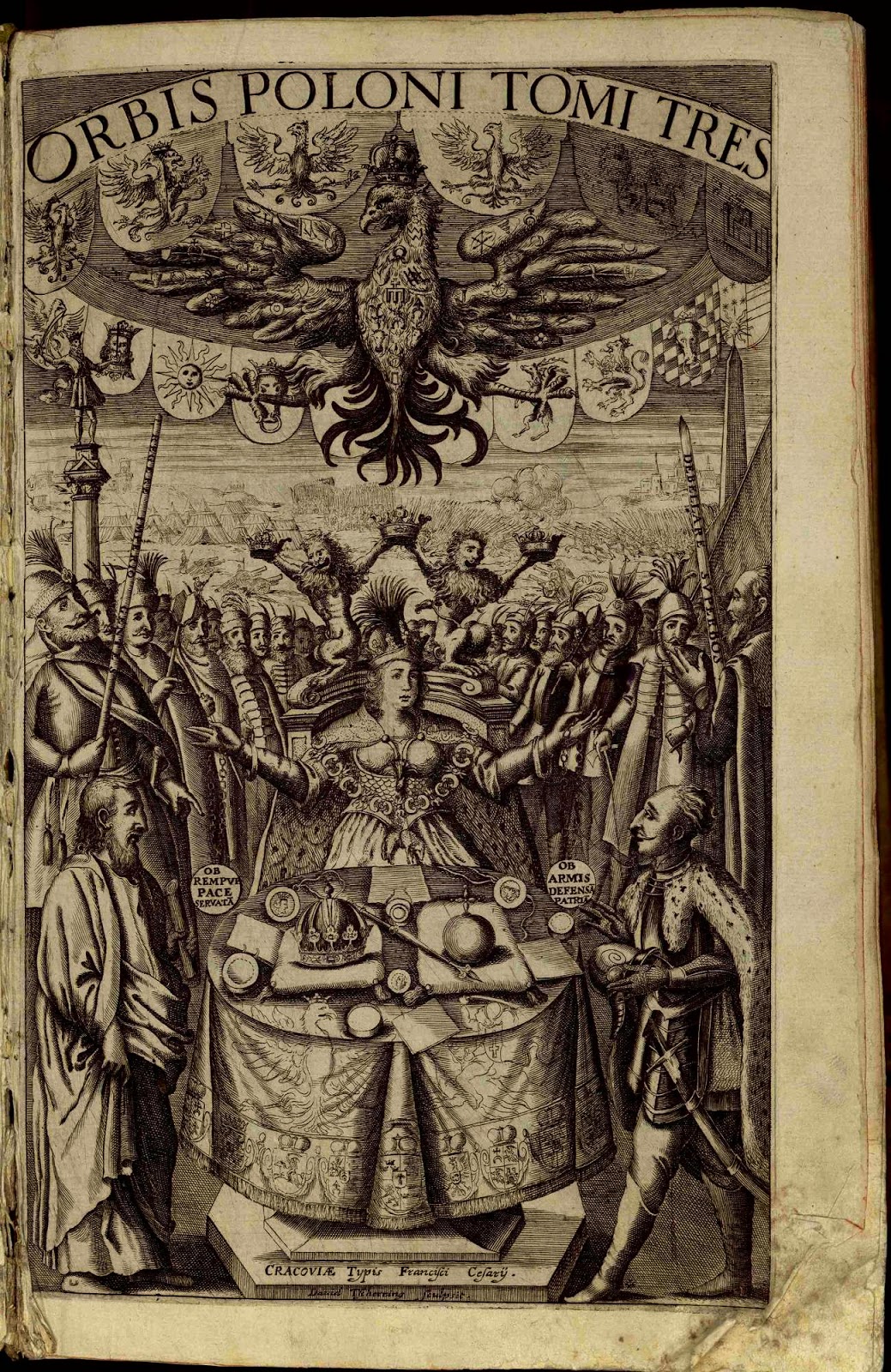
Finally, a page from a three-volume work Orbis Polonus  this being a a compendium of heraldic histories (an armorial)  by a XVII century Polish historian and a Dominican monk Szymon Okolski showing perhaps an winged hussar officer, to the right of  Polonia, and various nobles in their resplendid costumes.


I particularly like the beautiful eagle and the female figure personifying Polonia aka Crown of the Kingdom of Poland.


enjoy
ps
I have to mention something else, especially since I cherish my ancestors and their achievements, especially my grandmother and great grandfather who preserved two Jewish men from Łodź ghetto, so these 2 men emigrated to Israel after the War World II. Also I must recall that my grandma was almost beaten to death by the German policeman near the fence of the Glowno ghetto in 1940, when she was passing a couple of loaves of bread to some Jewish  friends on the other side of this fence. She was saved by the intervention of her childhood German (German Pole) girlfriend, who while running away in a civilain horse-drawn convoy  in turn was massacred, along with some 500 Germans and German Poles, by the Soviet Army tanks  near Głowno in January 1945. Eh, our Central European history is not an easy one, isn't it?
Ad rem, Ida - a feature film made with Polish taxpayers money [sic!] won an Oscar for the Best Foreign Film, and there is a petition on the net to amend a bit the presentation of this  fictional 'flick' with an intro in English explaining that Poland was occupied by the Germans 1939-45 and the Holocaust was perpetrated by the Germans, as the film never even mentions that most important piece of information.
Also, the film takes some horrible liberty with the Soviet and Communist occupation of Poland, and murder of the Polish patriots and soldiers (like rotameister Witold Pilecki) by them and eradication of Polish spirit and character. Thus it seems to me that this feature film promotes anti-Polish stereotypes and falsifies history, especially Polish-Jewish histories, and obviously the history of Nazi and Soviet occupation of Poland. I have seen the film, and I am not impressed, nor i care about Oscars as any example of the highest art award in film industry, the ancients had a saying - De gustibus et coloribus non disputandum est.
Once, long time ago Poland produced a beautiful movie - Noce i Dnie, (Nights and Days) - also nominated to the Oscars, a film infinitely better than this 'flick' but it was about the end of Polish land nobility during the Partitions of Poland, and thus a topic unimportant to Hollywood, perhaps read this book - Hollywod's War with Poland

Sunday, February 22, 2015

Franciszek Smuglewicz - Battle of Chocim AD1673

Salve,
during XVIII century, the last century of Old Poland,  there was a bit of  blossoming of native Polish painters engaged in painting historical pieces, and neoclassical artist  Franciszek Smuglewicz was one of the first of this movement in Old Poland.
Pan Franciszek  started his art studies early, for at first studied at the attelier of his father and his father's friend and fellow artist Szymon Czechowicz, then went to Italy in 1763. In Italy our maestro of brush and paint,  studied in Rome (interested in the ancient Roman art, he was active in recording discovered art of the Nero's   Domus Aureus a and his work was featured in a collection of prints 'Vestigia delle Terme di Tito'), various schools and academies, and spent there about 20 years (some of his art studies were supported by our Russia-selected king Stanisław August Poniatowski), perfecting his talents and artistic craft.
In Old Poland, situated in Warsaw close to the royal court,  maestro Franciszek became a successful painter, including king's favors,and observer, through his art, of the political events taking place there, also painted political figures and historical events, ancient history, portraits, architecture, and worked on many church interiors eg this saint. Amongst his historical works there was an unfinished series of 100 drawings and prints, illustrations that  were to serve as illuminations for the Adam Naruszewicz's History of Polish Nation.
 Having moved to Wilno (Vilnus nowadays) after the Third Partition of Poland, he became the first dean of the new School of Arts at the Vilnus University. He painted and drawn many images of old Vilnus, having thus recorder the ancient appearance of this old princely city.
Sadly he did not live to enjoy the renewal of Polish state, Duchy of Warsaw, under Napoleon, dying in 1807 in Vilnus where he was buried (Cmentarz na Rossie)
The painting in question - Khotyn or Chocim AD 1673, great Polish-Lithuanian victory over the Ottoman Turks -  is perhaps unique in its martial character and national, Polish symbolism and in the fact that this is one of the first works recreating a historical event  painted by a Polish-born artist of this quality when it comes to skill, mastery and abilities of the painter. Also it is noteworthy that Smuglewicz, when a young man before his trip to Rome,  must have seen the last winged hussars wearing armour etc. Being a neoclassical painter he nevertheless shows some Baroque flair, and perhaps studied some of the XVII century paintings showing the very battle, perhaps including the Andrzej Stech's canvas.

This painting follows the tradition already started in the XVII century, when the images showed actual winged hussars, of showing our winged hussars as heavy armoured cavalrymen, with wild cats pelts, gilded armour, rich arms and horse tack,  fabulous horses and flamboyance. Interestingly we see no wings, but there are plenty of feathers on the hussar helmets and  also the wild cat pelts are clearly visible. Defending Turks also look quite Turkish, so to speak, although they seem to be anachronistically wearing their summer costumes, contrary to the actual attire worn during this cold November battle.

He also painted a battle of Warka AD 1656, where Stefan Czarniecki and Jerzy Lubomirski defeated the Swedish forces, cavalry and dragoons, and in this work we see Czarniecki at the head of his armoured cavalry (wined hussars were prominent in this victory) crossing our little Masovian  Pilica river to attack the Swedes.

Franciszek Smuglewicz heroic, winged hussars-horses-sabres, approach to painting of our Polish history was soon emulated and followed, first by Aleksander Orłowski, then January Suchodolski and countless Polish painters off the XIX and early XX century.
Enjoy
ps
great,  2-guitar interpretation of Isaac Albeniz' Asturias (Leyenda) 

Wednesday, February 18, 2015

Painting from the Gołuchów Castle


Salve,
 I have failed to include into my blog this famous and perhaps quite controversial image of the Polish nobility, soldiers and horses, associated with the reign of His Royal Majesty Sigismund III..
According to Zdzislaw Zygulski jr. (''Broń w Dawnej Polsce'' p.295)  - this important iconographic primary source in a form of a panel painting ( Tablica Gołuchowska - 'Goluchów costume tableau' o 'Gołuchowska Board')  contains various types of Polish noble civilian and military attire dated to the beginning of XVII century, however it appears to be of a later date than the famous 'Rolka' painting. It is held at the National Museum at Poznań, but came from the famous collection started by Izabela Działyńska at the Czartoryski's Gołuchow Castle(previously the seat of the Leszczyński clan ). 

Amongst various figures, both male and female nobility)  painted in a somewhat miniaturist manner, we find a figure of a winged hussar armed with nadziak (warhammer) and sabre, with his head covered by a gilded helmet (shishaq/zischagge) adorned with a szkofia (aigrette), armoured with a gilded, four-lames breastplate and mail arm protection, underneath the armour he is wearing a short military żupan, red, tight trousers with buttons on side (not unlike later hussar pants during the Napoleonic and later periods), short yellow leather boots with long, gilded spurs. Zygulski jr writes  that the wild animal pelt on his shoulders is a cheetah skin while Richard Brzezinski, in his 'Polish Winged Hussar, p 48, writes that this pelt only appears to be a leopard one, where it was dyed with spots to make it look like one.


The second cavalryman - a kozak officer - is armed with an Oriental bow(bow in a bow case) and arrows (in a quiver), and sabre, while his torso and arms are protected with a mail(maile) armour, rather short, worn over  a longer than the winged hussar , brocade żupan (with a red lining).  His left arm is covered with additional steel protection known then as zarękawie or vambrace. Fine long yellow leather boots encasing tight, black pants,  and a fur hat or 'kołpak' with long blue textile hat bottom complete his martial attire that is very Polish and very officer like.


Finally we have another soldier there, a typical Polish infantry soldier or a 'haiduk' armed with a sabre, war ax, and a firearm, which according to Mr. Brzezinski is an arquebus (Polish Armies, vol. p 40),  he carries a match wound on his left arm;  although an infantryman he has no 'bandolier' or a belt for carrying the measured charges, but has a powder flask and bullet pouch at his belt, while over the left shoulder he carries  a canvass bag for his firearm.  With his head covered by a black 'magierka' hat (with several small pipes stuck into the brim), he is wearing an early uniform consisting of a white red-lined  żupan (and most likely wooden buttons)  and a short-sleeved, white delia or 'delijka' also with red lining and with passementerie loops and butons, with a belt tied at his waist.  Under his overcoat (delijka) and coat (żupan) he wears  tight red pants while black 'trzewiki' or short boots are on his feet, all of this to complete  an  image of an early European uniformed infantryman, second to the Ottoman Turkish infantry in their uniform appearance  (an article in Polish about Polish infantry prior to 1655AD  by Tomasz Rejf).


Perhaps next time I will discuss a bit the horses and horse tack from this painting.

enjoy
ps
another great piece by Anatoly Telenik - a detail of a larger painting showing Polish Commonwealth winged hussar comarade  - the armour depicted comes in part from the Polish Army Muzeum in Warsaw, and it is called 'anima' type and dated to circa 1620AD.


Tuesday, April 30, 2013

daily sketch

Salve,
A quick sketch from my sketchbook - after Wojciech Kossak -a cavalry commander of Polish-Lithuanian Commonwealth armies.
 ..

 ..
Interesting 'channel' on youtube  - drawing with ballpoint pen - by Allan Barbeau

Wednesday, November 23, 2011

Late XVII century horses and horsemen from Poland

Salve,
I found these prints on the net - they appear to have been made after a painting by old king Jan III Sobieski's painter Altamonte around 1697-8 or so (the original hangs at the Sobieski Palace at Wilanow, Warsaw-Poland). The painting depicted election of the Saxon prince Augustus II der Starke by the nobles of Poland-Lithuanian Commonwealth in 1697 (there were many issues with that election and history proved that this king was not appropriate monarch nor commander-in-chief nor statesman for the Commonwealth).

... a nice image of a winged hussar, with a wing not dissimilar to this winged hussar retainer's wing

... a noble rumak (fine riding stallion or gelding) with its tack, this horse appear to be a dapple grey one and some nobles with bows and quivers and warhammers


... horseman and more men with bows, behind them perhaps a hajduk ( musket and war-ax carrying infantryman of Hungarian style)


...  noble horsemen


... two nobles - perhaps a winged hussar companion and a cavalry chorągiew (company) with musicians in a background

They were going to fight in the incoming Great Northern War (1700-21), the war that destroyed Polish-Lithuanian Commonwealth economy, population and military power.

Wednesday, September 28, 2011

Polish-Lithuanian horseman circa 1634 part I

Salve,
 Michal Kadrinazi gave us, in his commentary to my first post on the subject, this link to Mateusz Stawowy's Gallery where much better quality images of this horseman from Kielce Bishop Zadzik Palace can be found: 


...
Now, as I am looking at him it seems to me that he is wearing a short version of Hungarian ''mente'' (mentyk) with yellow elbow-length sleeves and high collar and żupan underneath it
...


..


And this gentleman, perhaps a rotameister of this Polish infantry from the same painting, seems to be wearing a similar outfit (different colors) to our horseman  plus a rich ferezja overcoat (from Turkish ferezheh)


Again, thanks to Michal-Kadrinazi and Mateusz for the pictures

Friday, July 1, 2011

Glossarium Alte Rerum Polonorum link

Salve,
 just wanted to share a link - king Jan III Sobieski's former residence now a Museum Palace in Wilanow in Warsaw, Poland on its website published a glossy of Old Poland military equipment  in form of painted illustrations done by a Polish artist Bohdan Wroblewski, painted circa 1983, and  line drawings  by other artists, each plate with a side description, albeit in Polish only,   wilanow-palac.pl glossarium
I have the set painted by Wroblewski in 1983 for the anniversary of the Vienna 1683 (prior to Richard Brzezinski's books for Osprey) and the light cavalry and infantry plates of that set are missing in the Museum's glossarium...
Enjoy perusing :)
Wroblewski's light cavalryman:


Wroblewski's Hussar companion:

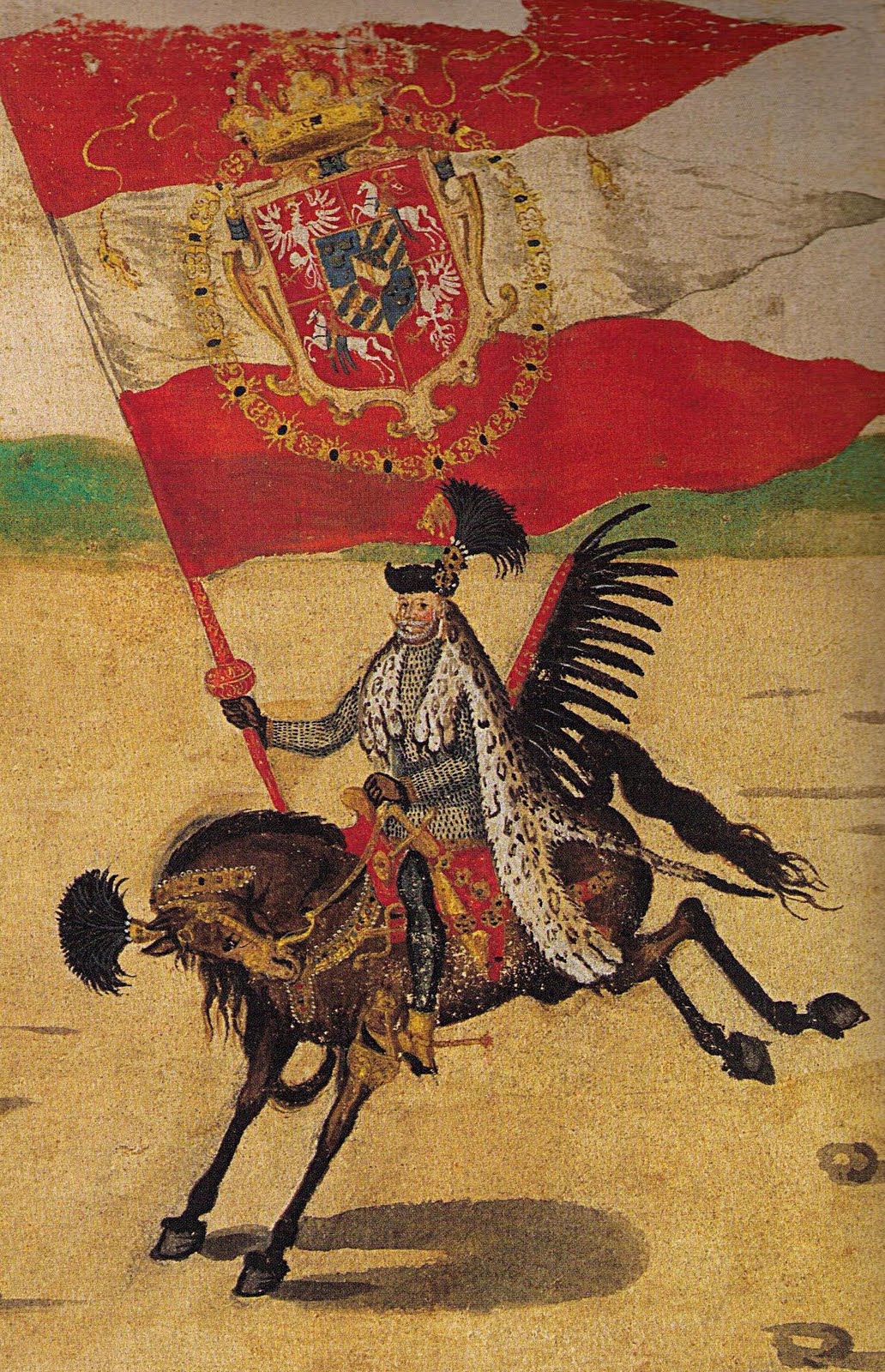
ps. on this day July 1, but A.D. 1569 Polish-Lithuanian Commonwealth was legally started .... here a Great 'Chorąży' of the Polish Crown with the Royal Banner of king Sigismund III Vasa

Friday, June 17, 2011

Old Polish proverb with a horse in a background

Salve,
a friend, Polish-American, asked me to explain the old proverb
Old Polish saying ''słowo się rzekło, kobyłka u płotu'' or ''The word has been said, the mare at the fence/gate''. I decided to follow up with this story you can read bellow and a sketch. As for the saying well, it is thought to have originated during the Polish-Lithuanian Commonwealth, during the second half of XVII century. ...
One fine day during the reign of our good king  John III Sobieski, 1674-96 AD, a poor but well mustachioed nobleman or ''szaraczek''  from Podlasie, for some reason known in English as Podlachia, was riding his thin grey mare to see the king, known amongst the poorer szlachta and lower classes of Masovia and Podlasie as ''Sobek,'' in his hunting castle at Marymont, now a 'barrio' in Warsaw.  He had been traveling already for 3 days and was rather tired.He left his poor home with an idea  that he was going to ask our king for a vacated position of ''wójt'' (vogt) that his deceased brother Melchior once had held.

Our szaraczek named Jakub Zaleski was dressed in his grey homespun ''kontusz'' with 'wyloty' ( a ridding coat - old attire of warriors on the Eurasian steppe) underneath wore a red ''żupan,'' with the sign of his nobility or an old saber at side ( hung from his rather faded cloth belt by old and  narrow leather thongs)  he rode on and thought about his speech to the king. Unlike rich and well-to-do,  he wore black leather boots, ( rich gentry wore yellow and magnates red leather boots), while his fur kolpak (hat) was already long past its finest days. Underneath his hat he had shaved head but for some hair on top - a true Sarmatian hairstyle he sported.
  
Zaleski was all around a typical example of our szlachta, who thought nothing improper about seeing the king in person, for he was of those who elected the king at Wola election and as a Polish nobleman felt himself equal any magnate.


When he was coming ever so closer to the Marymont hunting castle, he saw a man walking towards the castle dressed like himself in nobleman clothes, of rather large but graceful body, but with a noble warrior face, adorned with a fine mustache, wearing similar clothes to himself but of a much better quality, and red boots with golden spurs, at his belt hung  a hunting sword and a Turkish hunting carbine was suspended from his shoulder, the gun was richly gilded in gold and with precious stones inserted. He called out and graciously this man stood waiting for him. 


Zaleski took off his kolpak and asked politely about the king calling the king Sobek instead of Sobieski. King's courtier, described his position  his new friend,  said that the king Sobek was not at the castle.  Then proceeded to inquire about the nature of szaraczek's  visit. Zaleski told him that he was of a rather poor nobility,  but a good man with two sons in kings' cavalry, and that he wanted to get from the king the appointment as wójt after his deceased brother. Asked by the courtier what would have happened if his good king Sobek refused, Zaleski said that the king would have to kiss his own mare's tail (in some versions behind). Smilingly courtier gave Zaleski a ring and told me to show it to the castle guards so they would allow him inside to see the king, but to wait for an hour before proceeding.  So they parted and hungry but much more relaxed Zaleski went  into his provisions, where in his saddle bags he fished out and ate dried  ''kiełbasy'' (sausages) and bread. When time came,  he could see the castle clock on one of  the castle's  towers tolling the hour, so he mounted his mare and rode on to the castle.   

As he was approaching the castle he took a good look at the ring, where in a blood red stone there was engraved a coat or arms in a form of empty shield. He did not know but this was Janina , coat of arms of the Sobieski family. 

Zaleski entered  king's castle and being led inside the castle to the courtyard saw  that 'his' courtier , who stood dressed as he was outside even with his hat on,  was in the mist of many nobles and grandees surrounding him with their heads naked bowing and showing utmost respect.  Zaleski now realized that he had spoken to his king Sobek, that this was his king, John III Sobieski.
King John, who had a great sense of humor and appreciated the brave and daring souls amongst his subjects, asked surprised Zaleski whether he remembered their discussion in the forest and what about his promise to have his king Sobek kiss his horse's behind /tail if his king Sobek refuses to give him the wojt appointment - and Zaleski, already on his knees and showing respect to his sovereign by having touched his king's boots  answered quickly and without confusion that his own mare was waiting at the fence ... Amused king, smiling,  awarded the wojt position to Zaleski..  and the new proverb was born. 


Nothing is know about the fate of his grey mare after his appointment :)

This is the version told by K.W Wojcicki in Biblioteka Warszawska, volume IV, Warszawa 1876, pages 499-504
                                                        ***

Thursday, April 8, 2010

Sketches continued

Salve,
a concept sketch -  a pacholik is parading a war stallion :)

Friday, March 13, 2009


Hello again,
it has been a while since my last post.


While I was reading this entry Wojna litewsko -rosyjska_1558-1570  on wikipedia I found this image above -   two Polish riders with the standard:  White Eagle in the red field. Most likely this is an ensign and his companion and they are part of  some cavalry, perhaps Royal Cavalry Banner,  in their parade clothing, with some very ornate horse tack - red and blue dyed leather .
  They both carry Hungarian style sabres as this nomadic and Central Asian weapon became the weapon of choice for the Polish, Ruthenian and Lithuania nobility and military.
  One can note the multicoloured clothing, the 'red' rider has most likely a ''żupan,'' with a blue collar put down, in the fashion of the second half of XVI century. Also note the spur on the standard bearer's boot.
  Similar fashion and horse tack appear in the German woodcuts of the second half of the 16th century when Polish riders are depicted.
  On the right my own old ink drawing of a winged  hussar officer that is based on the German 1570s woodcut by a very prolific artist based in Nuremberg, Jost Amman.