Showing posts with label Zawisza Czarny. Show all posts

Friday, July 15, 2022

Grunwald 1410-2022

 Salvete Omnes,


the most famous painting in Polish art history - the allegory of this battle by Jan Matejko


Hear, hear, today yet passes another anniversary of the famous, in Polish history, battle of Grunwald.
Glory to the victors and vae to the defeated - pacem aeternam to all.


On the Polish site devoted to the history of arms and armor (Bron i Barwa) there is a free pdf file titled - 'Representation of the armies of the Order of Brothers of the German House of Saint Mary in Jerusalem in the historical miniature soldiers' by K. Czarnecki. 
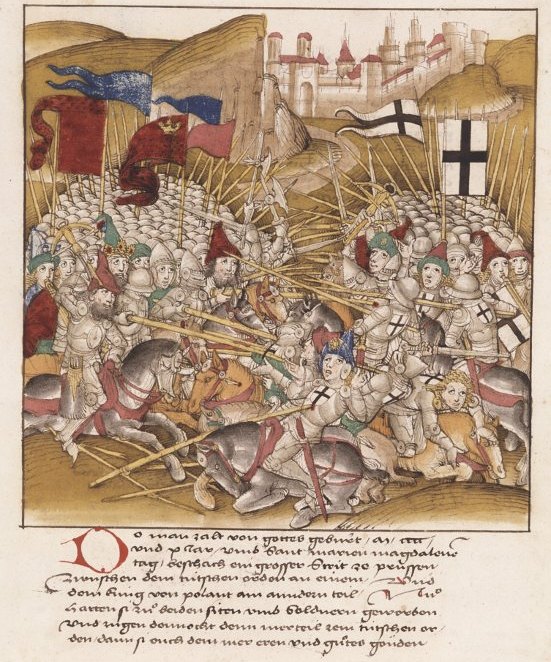


Lodz University's Piotr Nowakowski, on Academia, made available for downloading one of his books(with illustrations by Andrzej Klein)  - Banderia Apud Grunwald - Teutonic Banners at Grunwald (nota bene there is also Banderia Apud Grunwald - Polish & Lithuanian Banners at Grunwald).  Another Nowakowski, Andrzej, is the author of Arms and Armour in the medieval Teutonic Order's state in Prussia , published in Lodz 1994. 


Another scholar Sven Ekdahl wrote Horses and Crossbows: Two Important Warfare Advantages of the Teutonic Order in Prussia - available for reading at DeReMiltiari site.
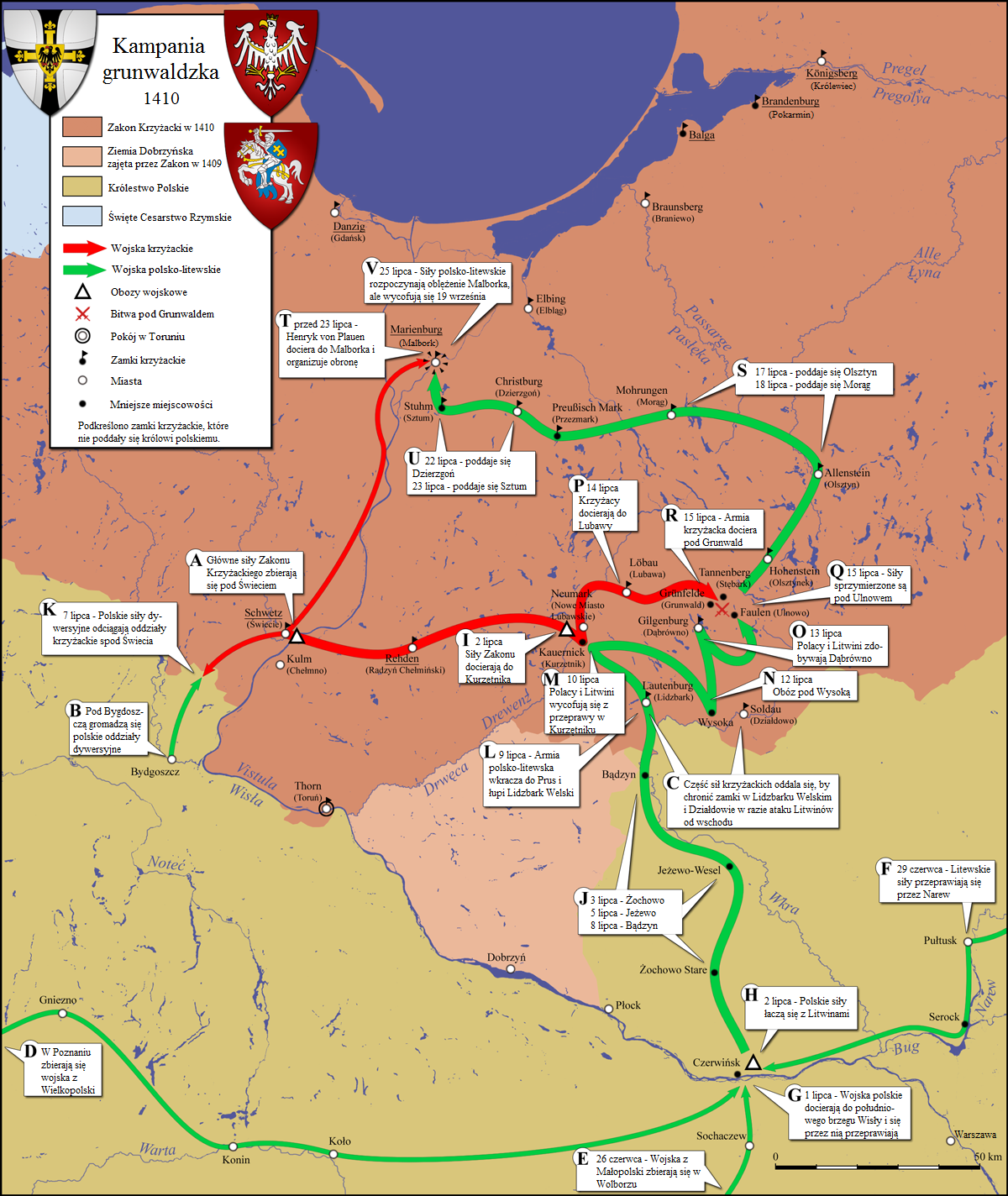


Krzysztof Kwiatkowski wrote -Wojska Zakonu Niemieckiego w Prusach 1230-1525(Armies of The Teutonic Order in Prussia 1230-1525), published in Torun 2016. Probably the most complete study of the military history of the Order to date.
Funny thing is there is no adequate comprehensive modern study of the Polish side of this conflict per arms, armor, horses, tactics, and knightly arts and logistics of the Jagiellon armies of the period..
Lodz University scholar Tadeusz Grabarczyk wrote some articles and two books on the Polish XV century infantry and cavalry - and this article on the Polish army at the Grunwald battle. 
On Academia there is this article, the subject controversial to the modern Lietuva narration of their history and role in the battle - on the Lithuanian retreat/withdrawal/rout at the battle of Grunwald 1410. You can peruse the Academia site in search of more articles and books on the subject of the battle. 


The re-enactment festival is taking place at Grunwald as I am writing this post - many  hundreds or perhaps thousands of reenactors are there until Sunday, July 17, 2022.
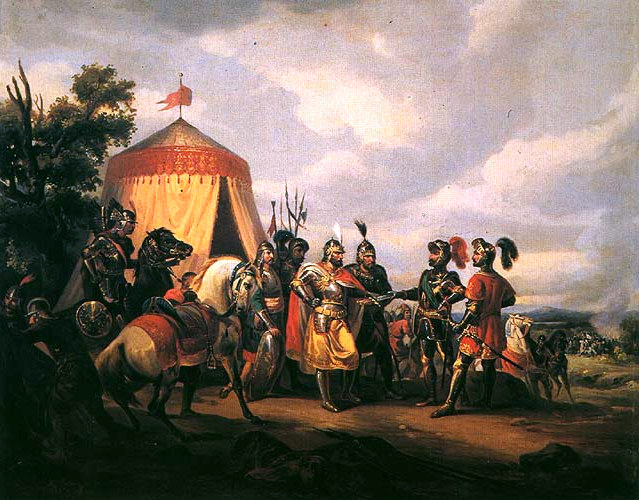
Feliks Sypniewski - before the battle of Grunwald


Valete

Wednesday, August 28, 2013

Knightly Tournament - Royal Castle of Łęczyca

Salve,
 last weekend I had the pleasure of attending the XV Knightly Tournament at the Łęczyca Royal Castle -  Wikipedia has a gallery. I was a spectator and enjoyed it quite a bit, along with my family. Łęczyca is a very ancient and rich in history town in  Central Poland, on the banks of Bzura River.

A reconstruction of a early gród/gord/ - stronghold of X - XI century, from the museum in the Royal Castle.

Some horse related items from the castle museum found nearby by various archaeological excavations, including some from Lutomiersk (the saddle in the drawing).
1.
2.


Tournament took place inside the castle, within its courtyard, a rather limited space for the spectators' but it was fun nevertheless. The banners show Polish coat of arms, Sulima on the right is the coat of arms of Zawisza Czarny of Garbow (today Stary Garbow), the most famous Polish XV century knigh, and actually the most famous Polish knight ever. 


Hussites , their war wagon, and XV century infantry


Knights - the knight in yellow and black reenacts Zawisza Czarny of Garbow


Archers, one archer had the Master bowyer Adam Karpowicz's Turkish bow - a beauty


..

More images of the tournament etc - here 

Wednesday, July 15, 2009

599th Anniversary


This July 15 is the 599 anniversary of the victorious battle of Grunwald .
The Battle of Grunwald (or 1st Battle of Tannenberg) was fought on July 15, 1410 between unified armies of the Kingdom of Poland and the Grand Dutchy of Lithuania, under the command of His Royal Majesty Władysław II Jagiełło (with his trusted councilor bishop Mikolaj Traba having had most likely developed this war's strategy and summer campaign), against the army of the knights of the Teutonic Order and their Western (English, German, French etc) knights-guests, led by the Grand Master of the Order, Ulrich von Jungingen.
This was one of the most important battles of the late Medieval Europe, and the probably one of the largest battles to involve mounted knights fighting one another with lances, tucks, maces, warhammers, axes, swords and daggers.
Notwithstanding the knights there were plenty many of commoners that took part in this herculean struggle, including mercenary infantry from as far away as Italy (Genoa), Tatars, Hungarians, Ruthenians (today's Russians, Belorussians, Ukrainians) , Czechs, and perhaps Slovaks. As usual you may read the depiction of the battle described in many websites on this glorious net, e.g. Wikipedia.
Every year there is a great reenactment of this battle in the same fields where the final mortal struggle took place six centuries ago, I think I will attend the next year 600 anniversary, it should be fun.

Well, I just want to commemorate this anniversary with my 3-penny post, also remembering one of the most fascinating knights ever to have been born in the Polish realms – Sir Zawisza Czarny z Garbowa, of the Sulima Coat of Arms ( a great specialist on the subject of the Polish nobility coats of arms but unfortunately passed away friend Mr. Suligowski would have appreciated this post a lot :) - rest in peace, Panie Suligowski).
Sir Zawisza is very special in our Polish history ans psyche, as to this day he symbolizes the virtues of honor, duty, and courage; and his spirit is still carried in the hearts of Polish scouts (harcerze) and perhaps soldiers of the Polish Armed Forces. His life story does merit at least one Hollywood film, perhaps one day...

So I decided to show two old drawings of a knight with his coat of arms -Sulima. I really never draw knights, and these two are rather old, from the time when his majesty 'read my lips' Bush Sr. was el 'presidente' of the US or slightly little after when the great cigar smoker and truth seeker Billy Clinton assumed the post of the Commander-in-Chief (still pissed at him for having bombed into the stone age the most faithful US ally in the Balkans, Serbia ). Nolens volens I cannot vouch for any arms and armor correctness, this is for a pure enjoyment.
Could not resist to include in this post the most emotionally charged (it is an allegory and not a historical reconstruction) painting of the Polish historical genre of the XIX century – Jan Matejko's Battle of Grunwald. This artwork survived the World War Two, its survival aggravated by the numerous Nazi Germans attempts to locate and annihilate the masterpiece, and now can be admired in the National Museum in Warsaw – if you in Warsaw, Poland, do see it, it is breathtaking.
Funny thing is that pan Jan Matejko was a Czech by origin yet being born in Cracow he became more Polish than the ethnically pure (whatever that may be) Poles, and as history has it Pan Jan has become the most important Polish painter ever, no matter what all his jealous critics say - na pohybel a los criticos.

Until the next time....