Showing posts with label vaquero. Show all posts

Wednesday, November 20, 2024

Paso de la Muerte etc - la charreria

 Salvete Omnes,


a short entry with plenty of different iconography -  the subject being the equestrian symbol of Mexico (United States of Mexico): la charreria.  


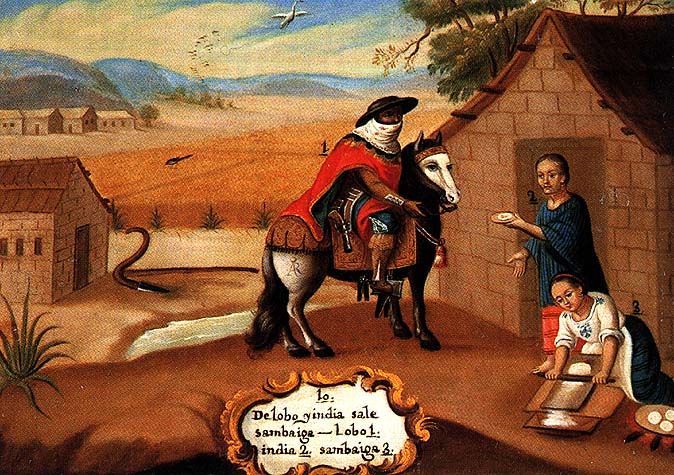
Spanish vaquero riding a la gineta pursuing will, cimarron, bulls


when Spanish horsemen, the conquistadors, brought  their Spanish or Iberian horses, equestrian  traditions and cattle with cattle ranching, the new world's equestrian traditions were born. 


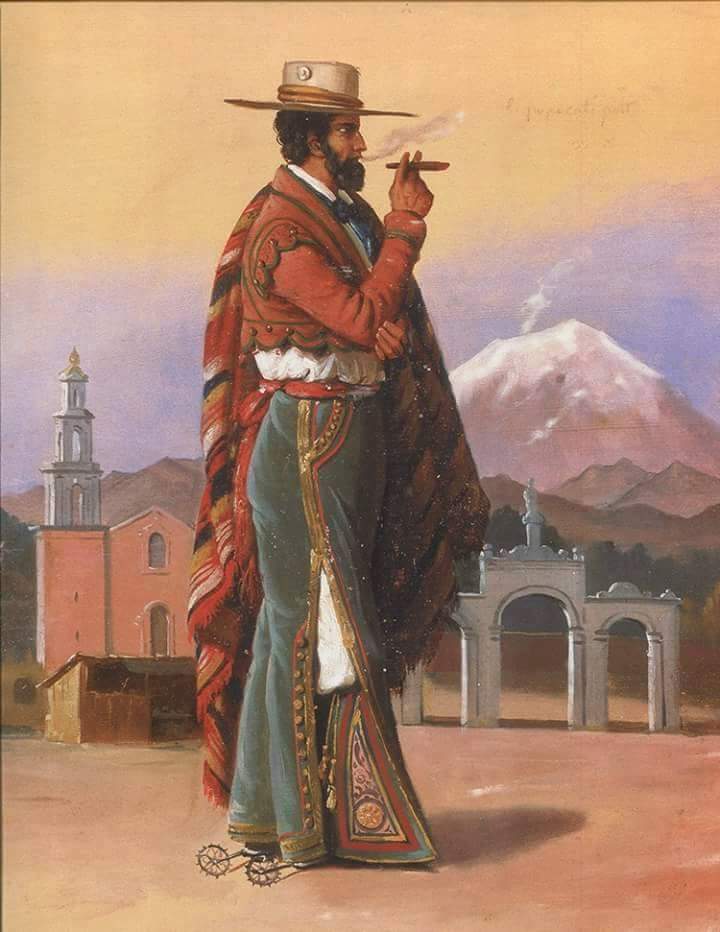
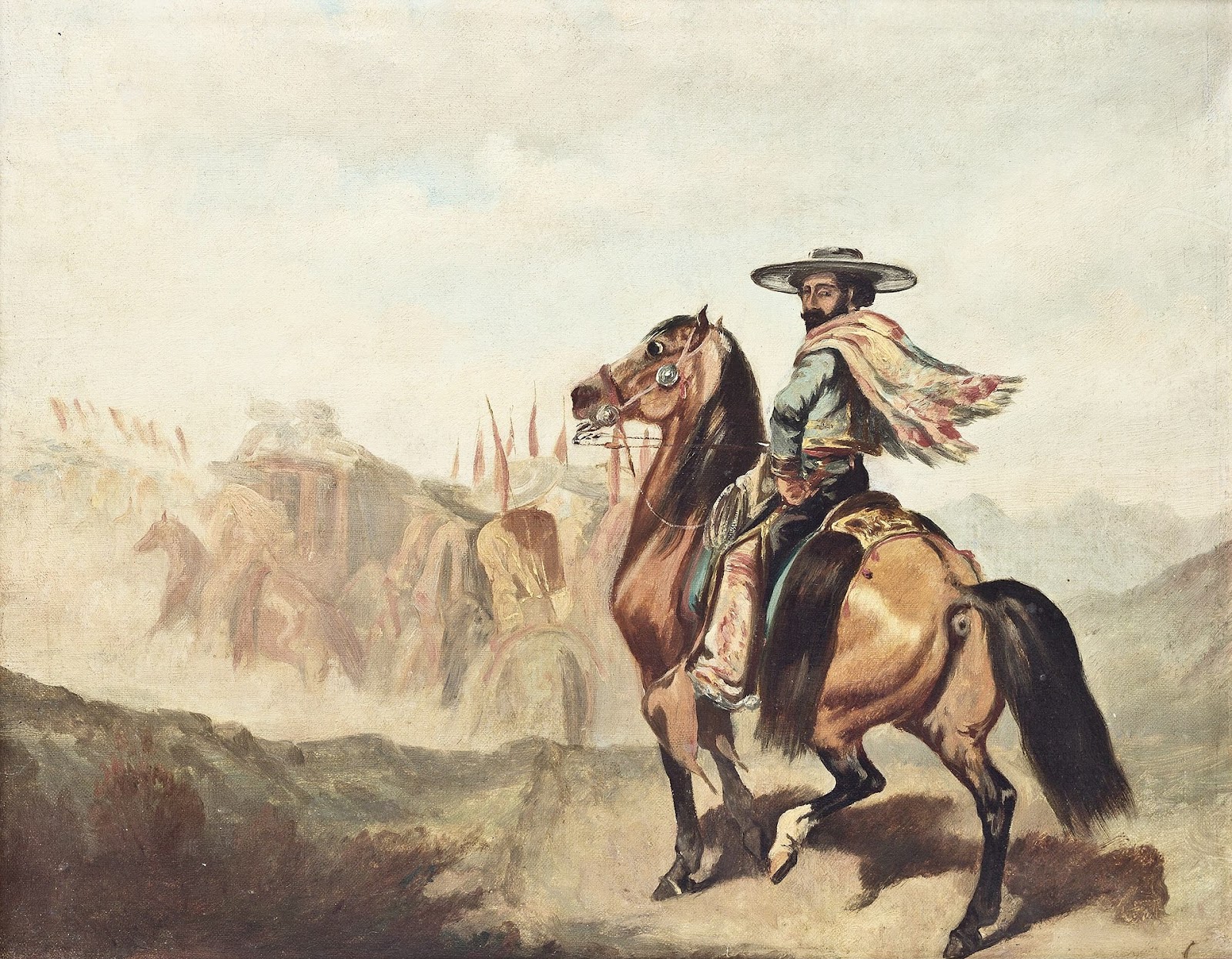
During the centuries of News Spain (or colonial Mexico) these vaqueros or horsemen tending cattle and horses developed their tack &  saddles,  traits and characteristics, that  eventually brought the development of la charreria, el charro (horseman) and la charra (horsewoman) of today's Mexico.

Some iconography - from the XVIII century onwards


.


finally, el paso de la Muerte - or a particularly courageous show of skill, daring and horsemanship when a charro riding in el lienzo charro (arena) 


attempts of jump from his saddled horse onto a back of a unbroken horse and ride around the arena astride  this mount bareback until the new mount stops or he loses his seat and fells to the sand of el lienzo. Dangerous and yet spectacular feat. 


..


the modern Charreria riders use native Mexican horse or the Azteca, or American Quarter Horse


el lazo or the lasso (arkan in Polish)


Valete

Sunday, April 17, 2016

Bronc breakin'

Salve,
time has come to revisit the Old West - I miss it badly, don't you ?
so archive.org gives us access to hundreds of thousands of books, and my favorites are the XIX century books, full of life and stories.

In this instance let us turn to a bronco's breaking (there was little gentling as you will read shortly) as described by an American officer John G. Bourke then serving with the 3rd US Cavalry in the Arizona and New Mexico Territory during the Apache wars. - the book is titled "On the Border with Crook" - and it is freely available for reading or downloading here.

At first, our author introduces Fort Grant to us:

''There would be very little use in attempting to describe Old Fort Grant, Arizona, partly because there was really no fort to describe, and partly because few of my readers would be sufficiently interested in the matter to follow me to the end. It was, as I have already said, recognized from the tide-waters of the Hudson to those of the Columbia as the most thoroughly God forsaken post of all those supposed to be included in the annual Congressional appropriations. Beauty of situation or of construction it had none ; its site was the supposed junction of the sand-bed of the Aravaypa with the sand-bed of the San Pedro, which complacently figured on the topographical charts of the time as creek and river respectively, but generally were dry as a lime-burner's hat excepting during the "rainy season." Let the reader figure to himself a rectangle whose four sides were the row of officers' "quarters,' the adjutant's office, post bakery, and guard house, the commissary and quartermaster's storehouses, and the men's quarters and sutler's store, and the "plan," if there was any "plan," can be at once understood. Back of the quartermaster's and commissary storehouses, some little distance, were the blacksmith's forge, the butcher's “corral,” and the cavalry stables,"

then he move onto the bronco's breaking:
     
[..] while in the rear of the men's quarters, on the banks of the San Pedro, and not far from the traces of the ruins of a prehistoric village or pueblo of stone, was the loose, sandy spot upon which the bucking "bronco" horses were broken to the saddle. Such squealing and struggling and biting and kicking, and rolling in the dust and getting up again, only to introduce some entirely original combination of a hop, skip, and jump, and a double back somersault, never could be seen outside of a herd of California "broncos." The animal was first thrown, blind folded, and then the bridle and saddle were put on, the latter girthed so tightly that the horse's eyes would start from their sockets. Then, armed with a pair of spurs of the diameter of a soup-plate and a mesquite club big enough to fell an ox, the Mexican " vaquero " would get into the saddle, the blinds would be cast off, and the circus begin. 


There would be one moment of sweet doubt as to what the "bronco " was going to do, and now and then there would be aroused expectancy that a really mild- mannered steed had been sent to the post by some mistake of the quartermaster's department. But this doubt never lasted very long ; the genuine " bronco " can always be known from the spurious one by the fact that when he makes up his mind to " buck " he sets out upon his work without delay, and with a vim that means business. If there were many horses arriving in a " bunch/' there would be lots of fun and no little danger and excitement. The men would mount, and amid the encouraging comments of the on-lookers begin the task of subjugation. The bronco, as I have said, or should have said, nearly always looked around and up at his rider with an expression of countenance that was really benignant, and then he would roach his back, get his four feet bunched together, and await developments. These always came in a way productive of the best results ; if the rider foolishly listened to the suggestions of his critics, he would almost always mistake this temporary paroxysm of docility for fear or lack of spirit. And then would come the counsel, inspired by the Evil One himself : “Arrah, thin, shtick yer sphurs int' him, Moriarty.” This was just the kind of advice that best suited the " bronco's " feelings, because no sooner would the rowels strike his flanks than the air would seem to be filled with a mass of mane and tail rapidly revolving, and of hoofs flying out in defiance of all the laws of gravity, while a descendant of the kings of Ireland, describing a parabolic orbit through space, would shoot like a meteor into the sand, and plough it up with his chin and the usual elocutionary effects to be looked for under such circumstances.
Yes, those were happy, happy days - for the " broncos" and the by-standers.''
**
and some more on the pleasures of living quarters at this Army installation:
''There were three kinds of quarters at Old Camp Grant, and he who was reckless enough to make a choice of one passed the rest of his existence while at the post in growling at the better luck of the comrades who had selected either one of the others. There was the adobe house, built originally for the kitchens of the post at the date of its first establishment, some time in 1857 ; there were the "jacal" sheds, built of upright logs, chinked with mud and roofed with smaller branches and more mud; and the tents, long since "condemned" and forgotten by the quartermaster to whom they had originally been invoiced. Each and all of these examples of the Renaissance style of architecture, as it found expression in the valley of the Gila, was provided with a "ramada" in front, which, at a small expenditure of labor in erecting a few additional upright saplings and cross-pieces, and a covering of cotton wood foliage, secured a modicum of shelter from the fierce shafts of a sun which shone not to warm and enlighten, but to enervate and kill.''

more to come from this book in the future
enjoy


Sunday, April 29, 2012

Charles M. Russell and cow-puncher horse


Salve,
I admit I love looking at the paintings and ink drawings by
Charles Marion Russell (own two books on his paintings) but often I have to remind myself that he also was a great sculptor...and a writer, e.g. his fine book "Trails Plowed Under" - with many of his own illustrations - is accessible here

While perusing a book on his sculptures  I saw this sculpture:  "When the best riders quit, when the best riders fail." 
 In this photo there is Charlie with the very sculpture.

The very spirited piece depicts one of the most dangerous evolutions that some unhappy horses could engage in while being 'gentled' no-so-gently into a remuda (working horses' string) by the cow-puncher or cowboy. In this photo below one of the rare historic depictions of a horse throwing himself backward.


   Before I go to the depiction of that sculpture as told by maestro Charlie himself, let me quote his own lines describing what a cow-puncher was, the varieties of cow-punchers and their equipment etc:
"[cow-puncher] ranged from Mexico to the Big Bow River of the north, an' from where the trees get scarce in the east to the old Pacific. He don't need no iron hoss*, but covers his country on one that eats grass an' wears hair. All the tools he needed was saddle, bridle, quirt, hackamore, an' rawhide riatta or seagrass rope; that covered his hoss. 


"The puncher himself was rigged, startin' at the top, with a good hat not one of the floppy kind you see in pictures, with the rim turned up in front. The top-cover he wears holds its shape an' was made to protect his face from the weather; maybe to hold it on, he wore a buckskin string under the chin or back of the head. Round his neck a big silk handkerchief, tied loose, an' in the drag of a trail herd it was drawn over the face to the eyes, hold-up fashion, to protect the nose an' throat from dust. In old times, a leather blab or mask was used the same. Coat, vest, an' shirt suits his own taste. Maybe he'd wear California pants, light buckskin in color, with large brown plaid, sometimes foxed, or what you'd call reinforced with buck or antelope skin. Over these came his chaparejos or leggin's. His feet were covered with good high-heeled boots, finished off with steel spurs of Spanish pattern. His weapon's usually a forty-five Colt's six-gun, which is packed in a belt, swingin' a little below his right hip. Sometimes a Winchester in a scabbard, slung to his saddle under his stirrup-leather, either right or left side, but generally left, stock forward, lock down, as his rope hangs at his saddle-fork on the right.


"By all I can find out from old, gray-headed punchers, the cow business started in California, an' the Spaniards were the first to burn marks on their cattle an' hosses, an' use the rope. Then men from the States drifted west to Texas, pickin' up the brandin' iron an' lass-rope, an' the business spread north, east, an' west, till the spotted long-horns walked in every trail marked out by their brown cousins, the buffalo.

"Texas an' California, bein' the startin' places, made two species of cowpunchers;

those west of the Rockies rangin' north, usin' centerfire or single-cinch saddles, with high fork an' cantle; packed a sixty or sixty-five foot rawhide rope, an' swung a big loop. These cow people were generally strong on pretty, usin' plenty of hoss jewelry, silver-mounted spurs, bits, an' conchas; instead of a quirt, used a romal, or quirt braided to the end of the reins. Their saddles were full stamped, with from twenty-four to twenty-eight-inch eagle-bill tapaderos. Their chaparejos were made of fur or hair, either bear, angora goat, or hair sealskin. These fellows were sure fancy, an' called themselves buccaroos, coming from the Spanish word, vaquero."

"The cowpuncher east of the Rockies originated in Texas and ranged north to the Big Bow. He wasn't so much for pretty; his saddle was low horn, rimfire, or double-cinch; sometimes 'macheer.' Their rope was seldom over forty feet, for being a good deal in a brush country, they were forced to swing a small loop. These men generally tied, instead of taking their dallie-welts, or wrapping their rope around the saddle horn. Their chaparejos were made of heavy bullhide, to protect the leg from brush an' thorns, with hog-snout tapaderos.

"Cowpunchers were mighty particular about their rig, an' in all the camps you'd find a fashion leader. From a cowpuncher's idea, these fellers was sure good to look at, an' I tell you right now, there ain't no prettier sight for my eyes than one of those good-lookin', long-backed cowpunchers, sittin' up on a high-forked, full-stamped California saddle with a live hoss between his legs.

Now to the sculpture, in Charlie's own words (from  Charles M. Russell Sculptor):

"The old-time cow-puncher knew his horse and it was often a battle of wits when he was “breaking" him to ride. This horse is making a fight and is figuring on landing on his riders. This rider being of the best, is thinking too. As he steps off his fighting horse he will be standing besides him when he lands and having a hold on the cheek piece of the hackamore, will help the horse bump his head a little harder when he hits the ground. As the horse comes up the cow-puncher will grasp the horn and will be in the saddle when he gets on his feet again. [...] most horse think twice before they throw themselves a second time."


  +All drawings by Charles Russell - in public domain+
---
*hoss - horse
  ps. 
I have been reading Charlie's biography - quite an interesting read. By the way his illustrated letters have been published too - fascinating material in there :)