Showing posts with label Melchlior Lorck. Show all posts

Wednesday, December 16, 2015

Husaria w Walce - new book by Radoslaw Sikora, Ph.D.


Salve,
Radoslaw Sikora and Erica (Tetraerica Publishing House) recently published a new book on the history, tactics and times of the Winged Hussars, the continuation of the series of the books and articles devoted to the PolishWinged Hussars.
The volume - ''Husaria w walce'' (''Winged Hussars in Combat'') - opens with a very interesting chapter on the opponents of our Polish Winged Hussars known in Polish sources as 'deli junacy' aka Deliler Ottoman Turkish Cavalry of the second half of the XVI century.

 Then we can read  an in-depth study the hussar armour, the next chapter describes the Polish winged hussars fighting against the "reiters"(cuirassiers) , then the following chapter studies the winged hussars' engagements against the musketeers. The subsequent chapter is a study how to break the pikemen when a winged hussar.
Then not a small chapter follows, this is a study about the winged hussars' combats against the Zaporozhian Ukrainian Cossacks.

The final chapter of this volume is devoted to the impact of artillery on the battlefield, and in particular on the winged hussars etc.

There are some period illustrations, mostly showing Turkish Deliler (Melchlior Lorck), Western heavy cavalry and cavalry tactics from the famous work by a Gdansk/Danzig period writer Johann J. von Wallhausen titled 'Kriegkunst zu Pferd.'
The book ends with an extensive bibliography of primary and secondary works cited in this volume.

Summing up this a fine volume and another substantial body of work from the research 'stable' of Pan Radek, Ph.D., 

Enjoy  :)
Ps
 I received this book as a gift from the author, for which I am very grateful .
  
Radoslaw Sikora
Husaria w Walce[Winged Hussars in Combat]
        Language - Polish
Dimensions 160 x 230 mm
Number of Pages: 224
hardcover
ISBN 978-83-64185-90-8
EAN 9788364185908

Friday, November 9, 2012

Turkish horses and their tack in Melchlior Lorck's art III

Salve,
   continuing the cycle of Melchior Lorck and his Turkish horsemen prints, I want to show this next image - a splendid horseman, with a so called Balkan shield adorned with an eagle wing.
   The horse tack here is again both splendid and very practical as in the previous piece. Tail is again either tied or gathered with a metal or fabric, or leather band/thongs, going back to the Ancient Iranians' traditions. Note that our sipahi is armed with a lance adorned with a small  triangular pennon( with small tassel), and apart form a curved, wide sabre he has also a narrow tuck (estock) and a warhamer, both under his left leg.
..

..
As we see below, this sipahi is holding a fine shield, and here we have a MET collection piece from XVI century.
However, I would disagree with the last part of the description on the MET page in the aspect of the costume coping by the Turkish foes - ''Even at a time when Turkish armies were a constant threat to eastern Europe, their costumes and tactics were imitated by their Christian foes.'' We know, from the iconography and written works/sources that at the time of the Turkish conquest XIV century through XVI century already had had their own traditions, including material culture and martial costumes. Conquering Ottomans were actually an amalgam of the peoples of the Balkans and Asia Minor, some joined freely and some under the sword, and these peoples traditions - especially Greek, Slavic, Hungarian and Vallachian - were being adopted by the Ottomans, heirs-by-conquest to the Byzantine Empire. The prints by Lorck and other printmakers of XVI century are part of the period testimony that the interchange between the conquerors and conquered went both ways.

..

..

Great example of the Ottoman Sipahi's shield in this print of a sipahi armed with a lance and dismounted this time. Actually there are several more prints of sipahis or other horsemen armed with lances and protected by shields in the Lorck's collection of Ottoman prints.
..

..
an example of a shishak helmet and a Hungarian-style shield from the MET, similar to the ones displayed in the Lorck's prints

Wednesday, September 26, 2012

Turkish horses and their tack in Melchlior Lorck's art II


Salve,
let us turn to the detailed tack elements on these horses in Lorck's art.
The plate I am going to examine more closely today shows a rider ( perhaps a sipahi oglan of the Kapikulu cavalry) riding a very nicely collected (and his is riding on a very loose rein, a dream of many modern dressage horse riders) horse, with high, if proud neck carriage and low-set tail ( a proof that the stallion is not an Arabian horse or Arabian descent) carrying a lance with a small pennon with tassells (a bit similar to the Sipahi pennon from the Codex Vindobonensis no.8626). The rider is holding  what it looks like a wicker shield called kalkan,, also armed with a bow and arrows, and a sabre. The horse has his tail gathered with what looks like a ring or a metal band, harkening back to the times of the ancient Saka/Scythians, Achaemenid Persians and ancient Turk riders. The horse himself perhaps is an example of the Turkish horse from the Cukurova aka Cilicia Pedias breeding area.


The peculiarities of his horse's tack are quite a few and merit a closer look. Namely, the first strong feature is the entire bridle arrangement- it consists of simple bridle with a nose band and browband and throat latch and a separate and very ornate (gold, silver or tombac) metal strap from which a long and flowing bonçuk (pendulous tugh of horse tail hairs)is hanging. The reins are 3, two for control while riding attached to the curb-bit with some very long shanks, and the third rein  is a halter rein, attached to the pommel of the saddle.
The entire arrangement causes the horse to elevate his head -not unlike the 
The horse bonçuks in Ottoman art from mid-XVI century
The exmaple of the captured Ottoman horse tack showing a halter rein, at Dresden - Saxon kings collection.

   The saddle is secured with a breastplate covered with gold or gilded with gold tombac, and the central metal ornament is  perhaps covered with precious and semi-precious gem-stones (popular was carnelian ) and presumably one or two girth straps, we do not see if there is a crouper, but a large blanket covers horse's back, loins and croup, a feature of the Eurasian horse warrior's tack for millennia. The visible stirrup  is  wide but nor excessively.

   Returning to the halter rein - this device was to have long life in the military and working horse horsemanship in Eurasia and later in the Americas; exemplum: during the Napoleonic period the complete halter-bridle combination was used (my friend zuzu aka Przemek Dunaj has been reconstructing Duchy of Warsaw uniforms, here the uhlans , including their bridles and saddles,I provided little helping with the vocabulary of the bridle parts): two period images of Polish cavalrymen of  in French service/Duchy of Warsaw, first by a German artist Hoffmann Nicolaus ( 1740-1823) showing typical Napoleonic period bridle and method of attaching the halter  (more interesting images - flicker), second a typical bridle-halter of used by the Duchy of Warsaw general.


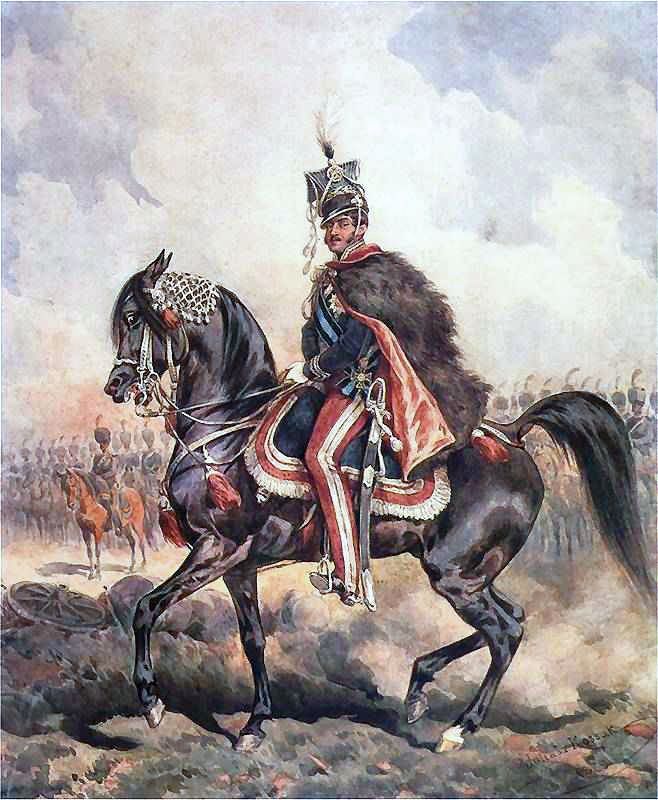
and the image I love the most - Juliusz Kossak's imaginary portrait of our beloved, sans peur et sans reproche prince Poniatowski mounted on his Arabian stallion Szumka ( bred by prince Eustachy E. Sanguszko at his famous horse stud in Sławuta, now in Ukraine )


ps
very interesting blog on art of the Ottoman Hungarian borderlands during the Renaissance


Thursday, September 20, 2012

Turkish horses and their tack in Melchlior Lorck's art I


Salve,

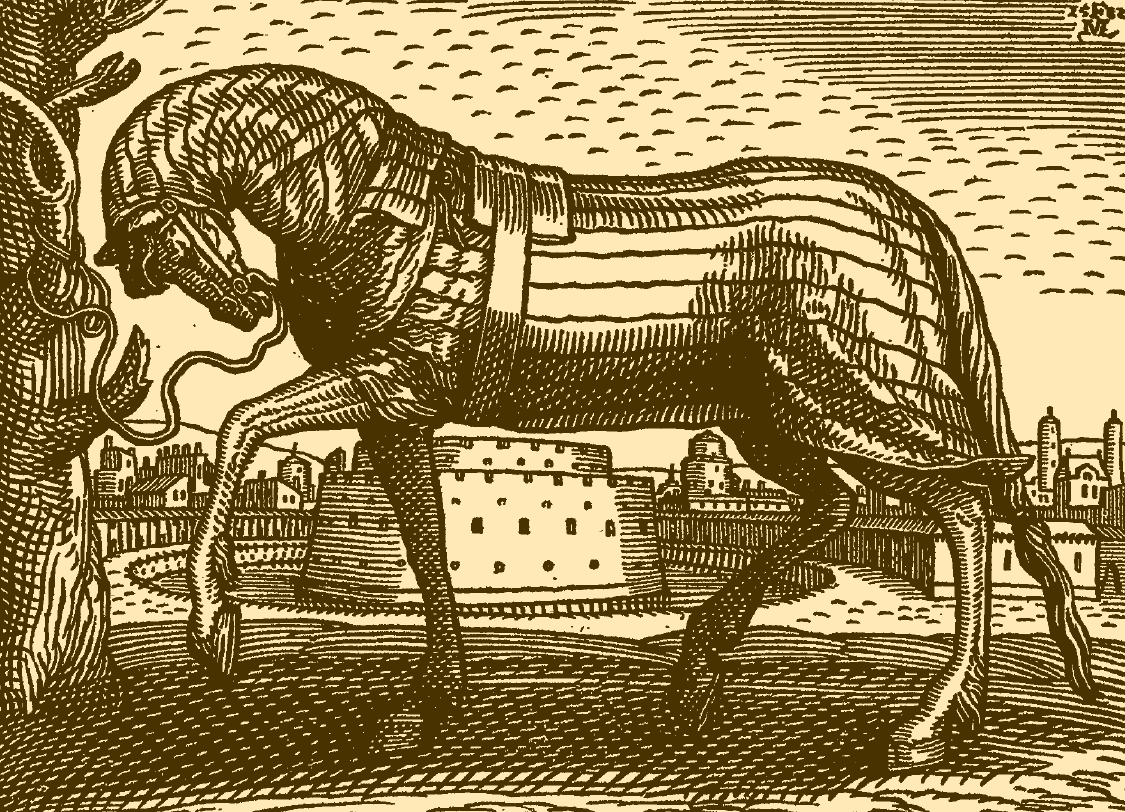
 I have been wanting to share with you some XVI century prints depicting Ottoman forces on horseback.
These prints were drawn and carved into woodcuts by German artist Melchlior Lorck who visited, as a member of the Holy Roman Emperor Embassy under Ogier Ghiselin de Busbecq to Sultan Suleiman the Magnificent, Istanbul in 1555-1559.

Here are the prints - from stallions dressed for war and parade to very ordinary work horses and even a mule, albeit very richly tacked.


 to be continued
ps
the top print shows a very splendidly attired horse and rider, quite similar to the Polish and Hungarian winged hussars. These Ottoman Turkish riders were called Deliler (singular Delil) and by the Christian writers from Poland, Holy Roman Empire, France, or England simply Deli.
...more on Melchlior Lorck and his art here and here