Showing posts with label dun horse. Show all posts

Thursday, May 28, 2026

Dun and grullo Sorraia horses of Iberian Peninsula

 Salvete Omnes,

convex profile 


I am always interested in the rare breeds of horses, and the Portuguese Sorraia horse is one of them

dorsal stripe on a foal

2007 genetics study of the Portuguese and German herds

  Sorraia horses from Portugal (but also bred in the US, Canada and Germany) are usually dun or grullo (Rata in Portuguese) with primitive markings.

.


.


Zebra stripes on the foal's legs


Canada 


Iberian Sorraia phenotype is present in the Black Hills sanctuary in South Dakota,  in Kiger Mustangs of Oregon, and some Pryor Mountian mustangs of Wyoiming etc.


Dr Sponenberg on the American Sorraias - interview

Iberian Origin of the New World horse - DNA study. 

Iberian horses from the Ice Age onward  - 2024 DNA study.

images are from Wiki Commons


Valete

Tuesday, January 9, 2024

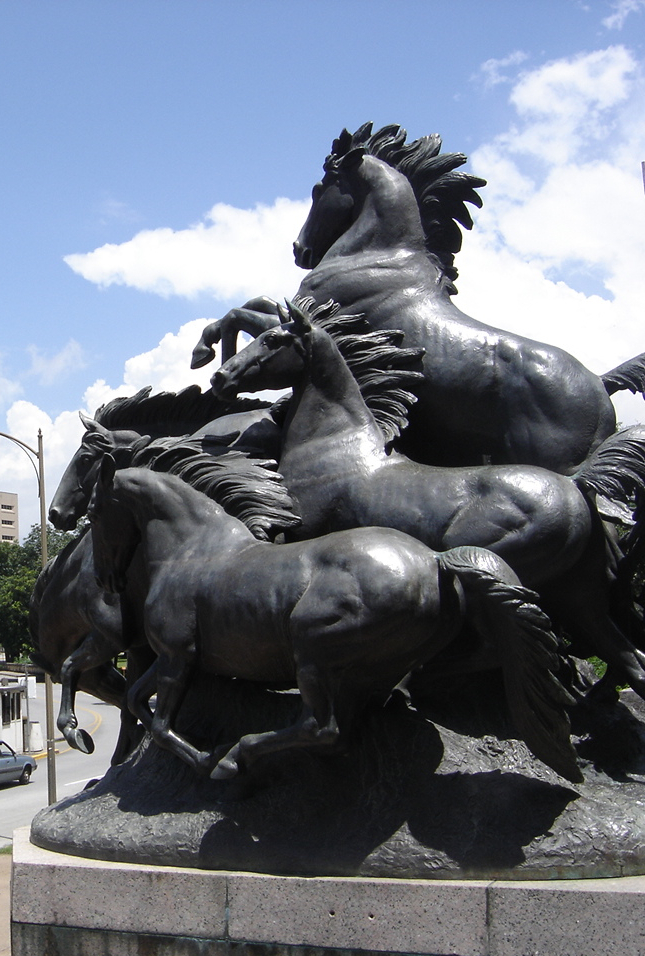
The Seven Mustangs of Rancho Randado

 Salvete Omnes,


a little bit of mustangs lorein this post and some Dobie's storytelling & A. P. Proctor's sculpting - from Texas
Frank Dobie in his book 'The mustangs' wrote the following:

''When A. Phimister Proctor [famous American sculptor] was commissioned in 1939 to make a bronze statue of a group of authentic mustangs - the sculpture called The Seven Mustangs, presented to the people of Texas by Mr. and Mrs. Ralph D. Ogden of Austin, unveiled on the campus of the University of Texas in 1948 -  the only Spanish horses in Texas available for models [...]were owned by Tom T. East in his San Antonio Viejo ranch in the brush border country. He had around 250 head of dun and grullo horses, all line-backed. They were descendants from a dun mustang stallion caught when about ten years old on the Rancho Randado. In 1920 Tom East got a grullo stallion, son of the dun, and began breeding him to a few mare that were puro Espanol. In the course of years he found that no matter what color of a stallion bred to dun mares, ninety per cent of the colts were dun. [...]The Randado used to raise about the best Spanish horses in Texas. It was a horse ranch, established late in the 18th century.[...] It was fitting that A. Phimister  Proctor's mustangs, plunging forever in bronze, should, while representing all Spanish horses, have been modeled upon coyote duns out of the Rancho Randado.''


Book is available for borrowing from the Archive, world library.


enjoy

Valete

Thursday, April 11, 2019

Paulus Potter - oriental horse

Salvete Omnes,
came across, via Wiki Commons, this very interesting painting - not large enough to study the detail - but still very interesting in my opinion, as it may show an Oriental - Polish, Turkish, Hungarian or perhaps a Syrian or Persian/Turkoman - male horse (a stallion or gelding) a beautiful golden bay,  dun or buckskin with a blaze on his intelligent face and four socks on his legs.  Both dun and buckskin (see horse colors article from Practical Horseman) were popular horse colors with our Old Polish horses - also palomino, spotted etc.
Mid-XVII century Dutch liked their horses to have their tail docked, oh, well, that was then (the British continued this practice into the XX century, unfortunately).

It is quite unusual in the Dutch XVII century paintings.

Enjoy this  bit enlarged view.

 
Valete