Showing posts with label New Kingdom Egypt. Show all posts

Friday, July 24, 2026

Ancient Egypt horses, stallion & mares - a 'libre' article

 Salvete Omnes,


from the Journal of Eastern Mediterranean Archaeology and Heritage Studies (2026) comes this article:

On Stallions and Mares: Gendering of War Horses used in Ancient Egypt.  by Uros Matic & Loneke Delpeut.  - so perhaps you may find this approach to horse history of interest 


.


Article is nicely illustrated too. 

enjoy

Valete

Tuesday, December 3, 2024

Ancient Egypt, Ramses II & lasso, rope, lariat.

 Salvete Omnes,


there is a word in the American English for a  long rope with a running noose used to capture cattle or horses that comes from Spanish language.
Namely, it is lasso, which comes from a Spanish noun: el lazo; this lariat, lasso, or rope with a noose (arkan in Polish) used for lassoing animals and people  is a very ancient device, invented many thousands years ago by the Stone Age hunters. 

Now,  we will quickly time travel to the ancient Egypt, where in one of their temples (started by pharaoh Seti I and completed by his son Ramses II)  at Abydos there is so called Corridor of the Bull- 


In ancient Egypt the sinewy lasso had cosmic implication - eg this article explains some aspects of the religious meanings of a lariat.


but this New Kingdom imagery was just a continuing tradition and use from the oldest Egypt dynastic periods - the Old Kingdom.
There is the so called mastaba of Akhmerutnisut (5th Dynasty, 2494-2345BC) where the tomb sponsor is depicted as a hunter wielding a lasso (more details in Ines Torres'  article). While in the mastaba of Raemkai (MET) 'prince' is hunting gazelles with a lasso.

Nota bene, there are tomb imagery showing rope making (plant fibers and leather, eg this one) , while in this article by Emily Teeter you can learn about the rope making, techniques and its terminology in the ancient Egypt. 

Unfortunately the book from Cambridge Univ. Press - The Material World of Ancient Egypt, does not have anything about lasso and its use in the ancient Egypt - the rope chapter is by far so much weaker than any of the articles listed above - nor it mentions the use of rope in warfare,  hunting, war and animal husbandry (but for animal halters and fishing).. 

Valete

Thursday, December 7, 2023

The Earliest Images of Horse and Battle Chariots in Egypt - a Re-Evaluation - a lecture

 Salvete Omnes,


dr Stephen Harvey delivers a lecture - The Earliest Images of Horse and Battle Chariots in Egypt - a Re-Evaluation (on Yt) - delivered at Salmagundi Club in NY, on October 24, 2023.


Dr Harvey participated, along with Mohamed Abd Elsalam, Kathryn Hansen, Robert Hurford, Mike Loades, & Bela Sandor, in the archaeological project of rebuilding of the ancient chariot  (PBS production from 2013). 


The Hyksos are part of the lecture - their apparent role in the appearance and development of horse breeding, horse training and horse chariotry in the ancient Egypt  during the Second Intermediate Period and subsequent early New Kingdom. 


enjoy the lecture

Valete

Tuesday, October 24, 2023

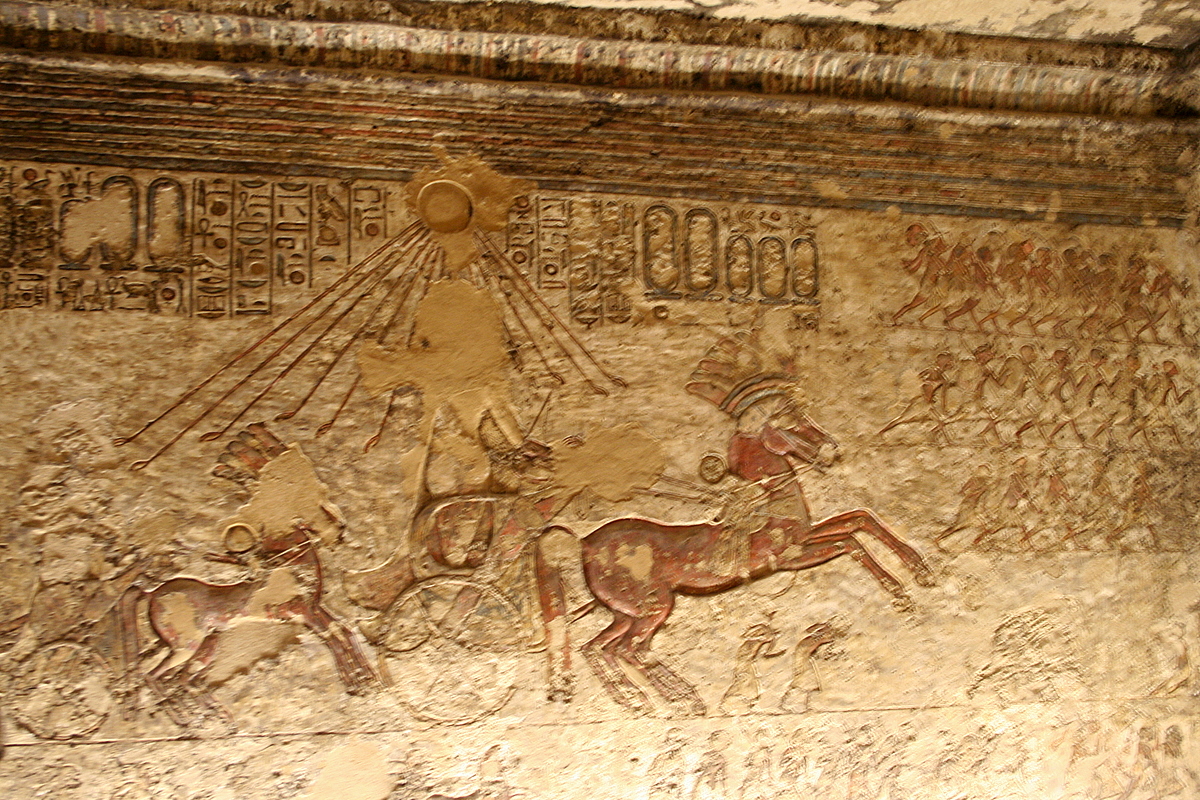
Chariots - Rock Tombs of El Amarna

 Salvete omnes,


a quick lope to ancient Egypt, New Kingdom period, the rule of Amenhotep IV/ Akhenaten(Echnaton), the 10th pharaoh of the XVIII Dynasty. 
On Archive world library there is a collection of archaeological reports from the famous site El Amarna - the short-lived capital of sun-worshiping Akhenaten and his empire.


 Nota bene  German archaeologist Ludwig Borchardt discovered the famous bust of hemet-nesut-aat meretef Nefertiti, the grand or main wife of the pharaoh,  at the ruins of el Amarna, nowadays stored at the State Museum in Berlin .


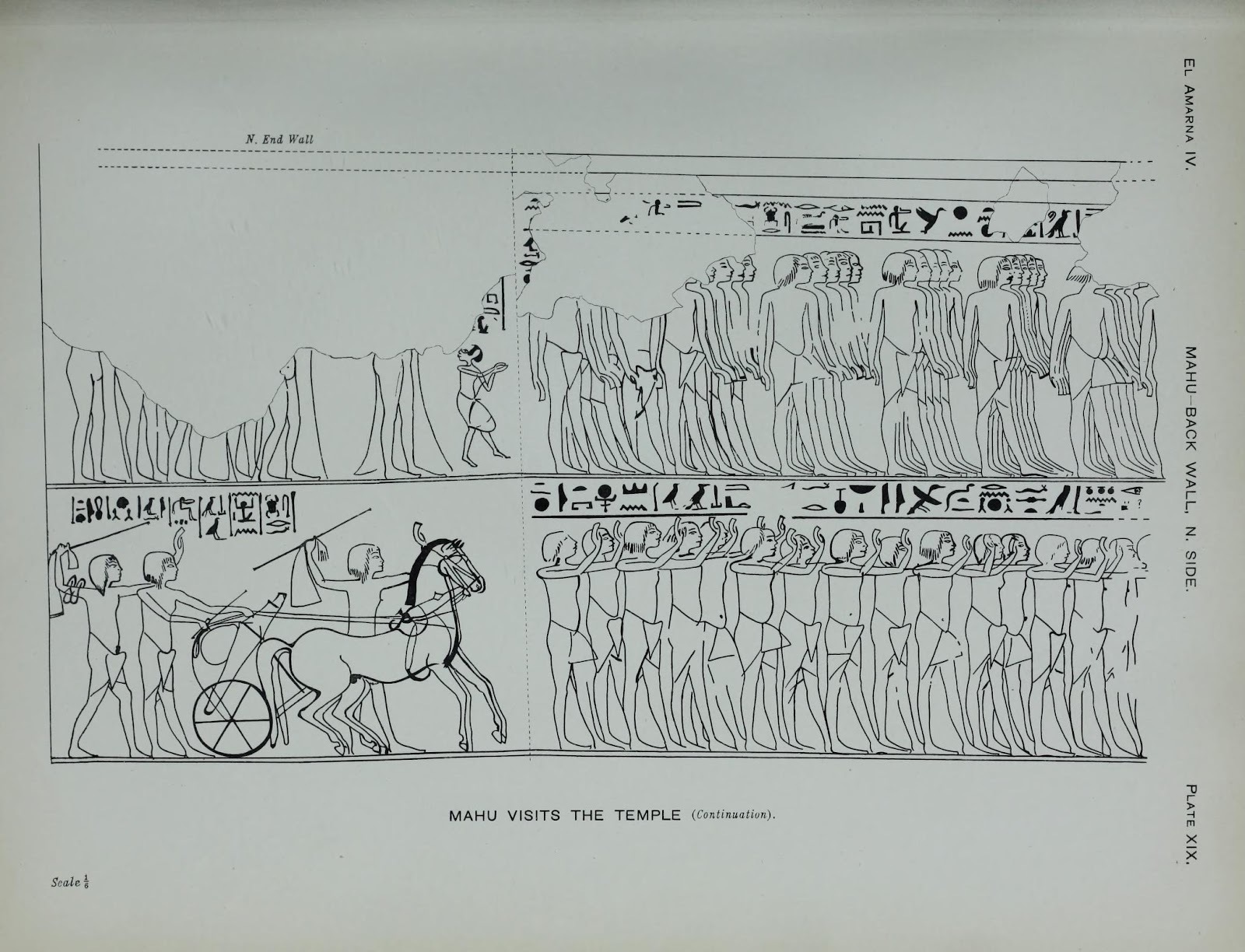
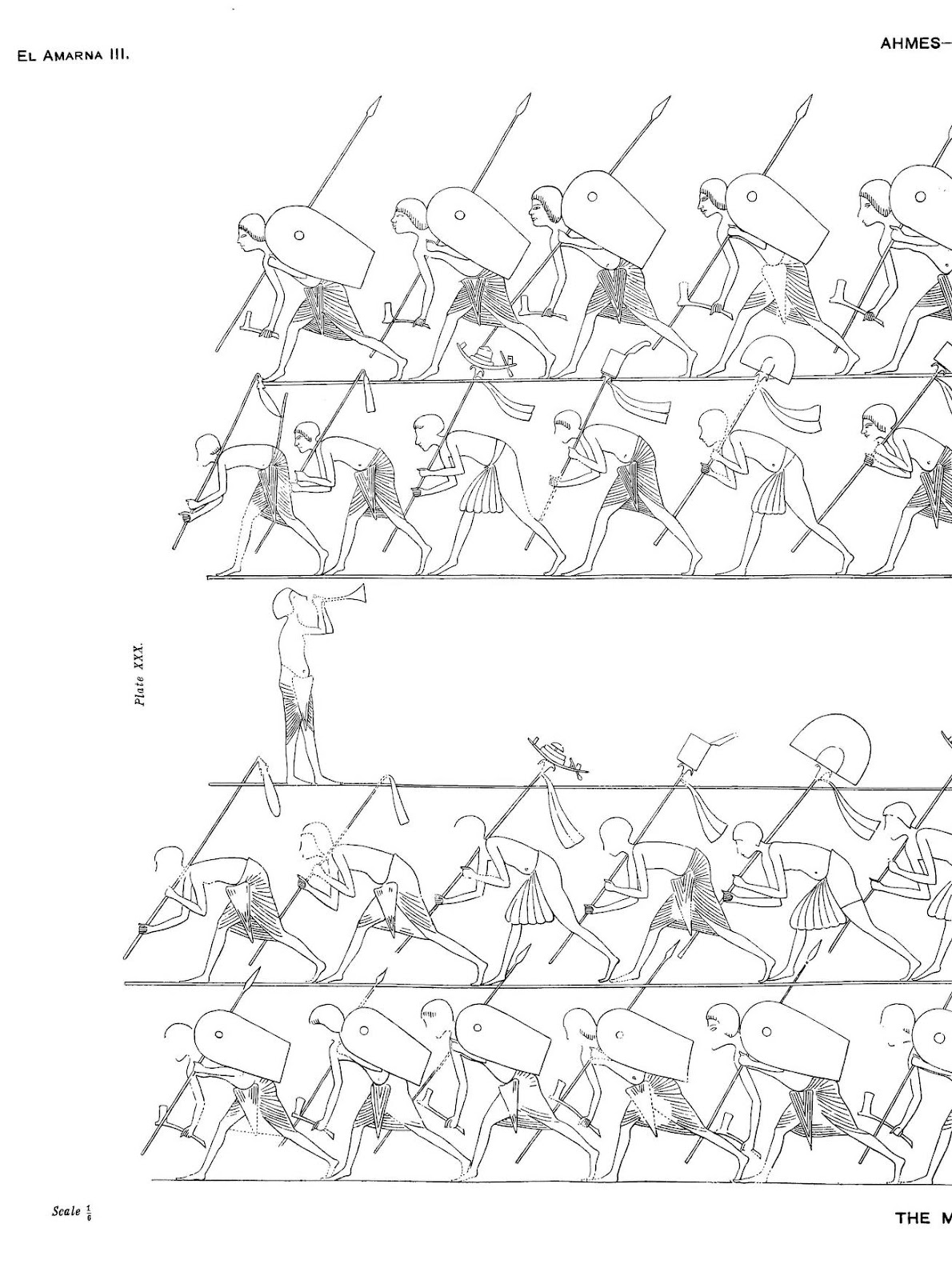
The reports - by a husband and wife team Norman de Garis Daves & Nina M. Davies ( jointly as N. de G. Davies) with Seymour de Ricci - contain hundreds of drawings from the rock tombs at Tell el Amarna.


I decided to pick some drawings up for a chariot display for this blog - these are horses and chariots of the royal couple and their family, of the court officials and administrators. 


among the buried at Tell el Amarna was one captain Mahu, 


the chief of the Medjay - the paramilitary force guarding the pharaoh and his capital


tribute, including horses 


Valete 
Wednesday, June 21, 2023

Cheiron1, vol 3 - 2023

 Salvete Omnes,

 so the Summer 2023- the Summer Solstice takes place today - the dog days will be aplenty.
Let us hope for peace in the world.

training of Achilles

Otherwise, a short entry today 

we have been there already - namely I introduced Cheiron: The International Journal of Equine and Equestrian History in 2021.

Now, they published the new issue - their first of 2023, already a volume 3.  The digital articles are 'libre' for you to download and enjoy -

the articles:  the ancient Egypt's pharaoh and his horse , ancient Persia and horse rations at Persepolis, Roman warhorse in the Funerary reliefs in Panonia, Thoroughbred history through the Royal Mares and finally the observations from the recent  Irish archaeological excavations .

plus  three book reviews etc.

enjoy

plus some sketches of mine to break the mundane - :)

Valete


Thursday, April 15, 2021

The Arrival of the Horse in Ancient Egypt

 Salvete Omnes,


how are you this Spring - cold as hell in these woods of  the northern hemisphere. 

I am always interested in the early horse  history  - so a short entry today with links to articles - 


so, first a British researcher Miriam Bibby made available her article on the arrival of the horse in the ancient Egypt during the Bronze Age. Succinct and short, 6 pages, provides the insight and bibliography - so canter away.


a brief but interesting article on the state of  the Hyksos research by prof. Thomas Schneider. 

and another article, this time  by a Romanian scholar prof. Renata Tatomir - The presence of horse in ancient Egypt and the problem of veracity of the horseshoe magic in the ancient Egyptian folklore and mythology.
enjoy


valete
Wednesday, May 31, 2017

DNA studies of the Ancient Aegyptians

Salvete omnes,
when I was studying at the university I had to read the already very controversial book title Black Athena - it was a required reading and studding its content was like reading the Soviet or Gender Communist works: convoluted, often contrary to reason and fishing for evidence, finally bending it all to the ideological thesis presented by its author.

So finally there is some respite from the racist nonsense of Mr. Berbal and his ilk,  these are newest DNA studies of the material taken from the ancient Egyptians mummies -

 An international team of scientists, led by researchers from the University of Tuebingen and the Max Planck Institute for the Science of Human History in Jena, successfully recovered and analyzed ancient DNA from Egyptian mummies dating from approximately 1400 BCE to 400 CE [New Kingdom to Roman Period], including the first genome-wide nuclear data from three individuals, establishing ancient Egyptian mummies as a reliable source for genetic material to study the ancient past.

and surprise! surprise! -

 The study found that ancient Egyptians were most closely related to ancient populations in the Levant, and were also closely related to Neolithic populations from the Anatolian Peninsula and Europe. "The genetics of the Abusir el-Meleq community did not undergo any major shifts during the 1,300 year timespan we studied, suggesting that the population remained genetically relatively unaffected by foreign conquest and rule," says Wolfgang Haak, group leader at the Max Planck Institute for the Science of Human History in Jena.
figure 3 from this page of the above study
figure 4

figure 5

so they belonged to the Western Asian and European stock...

A succinct study of the New Kingdom Egyptian chariotry - from Matei Tichindelean


Aegyptian chariot from Matei Tichindelean's work
enjoy